

Chocolate Labelling Requirements UK: What Bars, Truffles and Gift Boxes Must Show
A box of chocolates sold prepacked in the UK needs a name, ingredients with allergens emphasised, the net weight, a best-before date, a business name and postal address, and a nutrition table unless an exemption applies. Chocolate then adds its own wording: a cocoa solids percentage on dark and milk chocolate, a milk solids percentage wherever “milk chocolate” appears in the name, and a fixed statement when vegetable fats other than cocoa butter are used.
Truffles and other filled chocolates need fewer of those declarations than bars. A small maker selling direct or through local shops may not need a nutrition table at all.
This guide works through the chocolate labelling rules product by product, then shows where each item goes on a box. It is general information rather than legal advice, and for a specific product your council’s Trading Standards team is the one to ask.
What every prepacked box of chocolates needs
Most of a chocolate label comes from the general food information rules, which Business Companion sets out for prepacked food. They apply to a box of truffles in the same way as to a bar.
| Item | On a box of chocolates | Example |
|---|---|---|
| Name | The legal name, alongside any brand or fancy name | Dark chocolate truffles |
| Ingredients | Headed “Ingredients”, heaviest first, with compound ingredients broken down in brackets | Dark chocolate (cocoa mass, sugar, cocoa butter, emulsifier: soya lecithin), double cream, butter |
| Allergens | Emphasised in the list every time they appear | Soya, cream and butter in bold |
| Net weight | Grams, in the same field of vision as the name | 200 g |
| Best-before date | “Best before” with the day, or “Best before end” with the month and year | Best before 14 Feb 2027 |
| Storage | Only where quality depends on it | Store in a cool, dry place |
| Business name and address | A postal address; email or phone only in addition | Name, street, town, postcode |
| Nutrition table | Per 100 g, unless an exemption applies | Energy, fat, saturates, carbohydrate, sugars, protein, salt |
The ingredients list rules put ingredients in descending order of weight as they went into the mix. Anything that is itself made of several ingredients, such as the chocolate in a truffle, is broken down in brackets after its name.
Allergens must stand out every time they appear, in bold, capitals or a contrasting colour. Business Companion’s allergen guide notes that butter, cream, cheese and milk are understood as milk, so they need the emphasis but no “(milk)” after them. It also suggests a line such as “for allergens, see ingredients in bold”.
Most chocolates carry a best-before date. Where a food is highly perishable from a microbiological point of view and could quickly become a danger to health, Article 24 replaces it with a “use by” date. Check how a fresh cream filling behaves before choosing the date type.
Which chocolate rules apply to which product
The Cocoa and Chocolate Products (England) Regulations 2003 reserve the main chocolate names for products that meet set recipes. Wales, Scotland and Northern Ireland each have their own 2003 regulations with the same declarations and the same vegetable fat statement.
| Product name | Minimum composition (summary) | “Cocoa solids X% minimum” needed? | “Milk solids X% minimum” needed? |
|---|---|---|---|
| Chocolate | 35% total dry cocoa solids, including 18% cocoa butter | Yes | No |
| Milk chocolate | 25% total dry cocoa solids and 14% dry milk solids | Yes | Yes, at least 14% |
| Milk chocolate or family milk chocolate (the higher-milk recipe) | 20% total dry cocoa solids and 20% dry milk solids | Yes | Yes, at least 20% |
| White chocolate | 20% cocoa butter and 14% dry milk solids | No | No |
| Filled chocolate | Chocolate outer part at least 25% of the total weight | No | Only if “milk chocolate” is in the name |
| A chocolate or a praline | Single mouthful, chocolate at least 25% of the total weight | No | Only if “milk chocolate” is in the name |
Two points in that table are easy to get wrong. The UK has two milk chocolate recipes, so 20% cocoa solids can still be sold as milk chocolate here, provided the product meets that recipe’s other minimums, including 20% milk solids. And truffles, pralines and white chocolate need no cocoa solids percentage at all, while a dark or milk chocolate bar does (regulation 6).
The declarations take a fixed form, such as “cocoa solids 54% minimum” or “milk solids 20% minimum”. Because that law already asks for the cocoa figure, Business Companion’s QUID guide exempts cocoa solids in chocolate from a second percentage.
The 25% threshold in Schedule 1 matters for truffles with a thin shell and a deep ganache centre. If the chocolate falls below a quarter of the weight, the product is not a chocolate, a praline or a filled chocolate, so check the name before printing.
Quality descriptions are allowed only above higher minimums. Chocolate needs at least 43% total dry cocoa solids, including 26% cocoa butter. Milk chocolate needs at least 30% cocoa solids and 18% milk solids, including 4.5% milk fat.
A product made with chocolate flavouring rather than chocolate must say so, as in “chocolate flavour coating”. Business Companion’s guide to labelling sweets adds that “choc” may only be used for products that contain chocolate.
The 5% vegetable fat rule and the statement it needs
Chocolate, milk chocolate and white chocolate may contain up to 5% of six named vegetable fats besides cocoa butter (regulation 3). They are illipe, palm oil, sal, shea, kokum gurgi and mango kernel. The 5% is worked out on the finished product after deducting other edible ingredients, and the cocoa minimums still apply.
Any product using those fats must carry the words “contains vegetable fats in addition to cocoa butter”. Regulation 7 also fixes how it appears:
- Visible together with the ingredients list, in one field of vision.
- Clearly separated from that list.
- In bold letters no smaller than the list.
- Near the product name, which may appear elsewhere on the box as well.
In the chocolate itself, other additions have limits too. Ingredients such as nuts or fruit can make up to 40% of the total weight, animal fats other than milk fat are not allowed, and flavourings must not imitate the taste of chocolate or milk fat.
Boxes of assorted chocolates
A box of mixed chocolates can be named “assorted chocolates” or “assorted filled chocolates”, or a similar name. It can also carry one ingredients list covering every chocolate in the box, rather than a list for each flavour (regulation 6).
That single list still has to include every ingredient and emphasise every allergen in the box. If any chocolate in the assortment contains the permitted vegetable fats, the box should carry the statement as well.
Names and pictures create a further requirement. Naming an ingredient, as in “raspberry truffles”, or picturing one, such as hazelnuts on the lid, triggers a percentage for it, known as QUID. Business Companion treats pictures as emphasis. An ingredient used in small amounts only for flavour is exempt.
A “may contain” line is not a legal requirement. Business Companion advises one only after a risk assessment shows a real risk of cross-contamination. It should name the allergen, as in “may contain hazelnuts”, and never sit beside a matching “free from” claim.
The nutrition table, and who can leave it off
Prepacked chocolates need a nutrition table per 100 g: energy in kJ and kcal, then fat, saturates, carbohydrate, sugars, protein and salt. The nutrition declaration guide lists two exemptions that matter to chocolatiers.
- Small packs: no table is needed if no surface of the pack reaches 25 cm². A 4 cm cube favour box has faces of 16 cm², so it qualifies.
- Small makers: food, including handmade food, supplied directly by a manufacturer of small quantities to consumers or to local shops. Business Companion reads this as a micro business with fewer than 10 employees and a turnover or balance sheet under 2 million euros (about £1.75 million).
“Local” means shops in your own county, a neighbouring county, or counties whose border lies within 30 miles (50 km) of yours, whichever area is greater. Selling online straight to consumers still counts as direct supply, but selling online to other retailers does not.
Every part of the exemption has to apply, so growing past those limits, or taking on a stockist outside the area, means adding the table. Any nutrition or health claim, such as “low sugar”, brings it back too. If you do need a table, Business Companion points to the CoFID dataset of average values, or to a test house, nutritionist or dietitian.
Some US guides that appear in UK searches describe state “cottage food” disclaimers, net weights in US units and an optional nutrition panel. The Trading Standards guides behind this page make no exception for food made at home. The FSA’s food business registration guidance covers businesses trading from home, and asks them to register with their council at least 28 days before trading.
Where and how you sell changes the label
| How the chocolates are sold | What the label needs | Source |
|---|---|---|
| Boxed in advance and sold through a shop, a stockist or from other premises (prepacked) | Everything above, including the nutrition table unless exempt | Business Companion general and sweets guides |
| Boxed in your own shop, or at a market stall you run, before customers choose (prepacked for direct sale) | The name and a full ingredients list with allergens emphasised, on a label attached | Business Companion sweets guide |
| Sold loose, or boxed while the customer waits, such as pick and mix | The name and any allergens, as “Contains: milk”, on a label or a ticket the customer can see | Business Companion sweets guide |
| Sold online | The full prepacked information on the website before purchase (the date can be left off) and on the box | Business Companion general guide |
The chocolate regulations’ own names and declarations apply to the products they cover however they are sold, not only when prepacked. A filled chocolate needs no cocoa figure in any setting, but a dark or milk chocolate bar sold from a counter still needs its cocoa solids wording.
Net weight and text sizes on the box
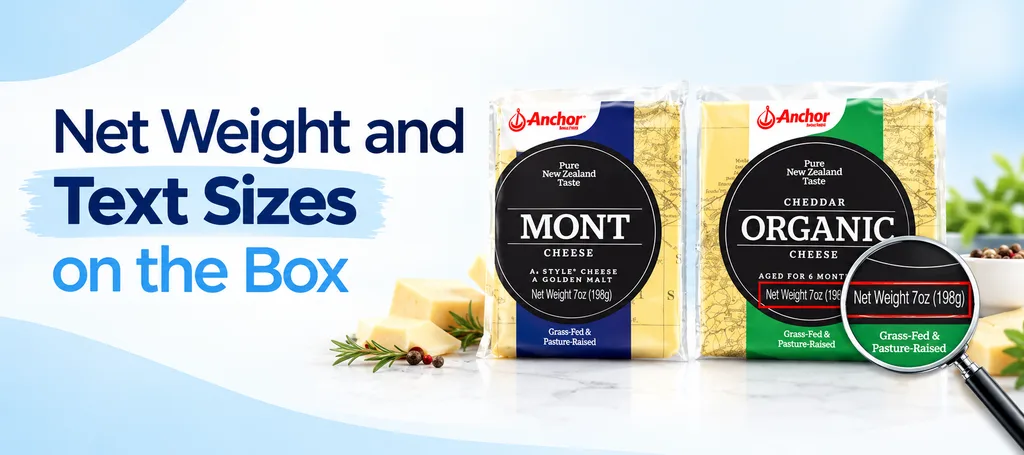
In Great Britain, a box of cocoa or chocolate products must show its net weight unless it holds less than 50 g (article 8 of the 1988 Miscellaneous Foods Order). The weight figures then have a minimum height under Schedule 1 of the 1987 quantity marking rules. Boxes over 50 g and up to 200 g need 3 mm figures, boxes over 200 g and up to 1 kg need 4 mm, and anything heavier needs 6 mm.
The name and the weight belong in the same field of vision, so both can be read with the box held one way. The rest of the mandatory text must reach a 1.2 mm x-height under Article 13, or 0.9 mm on a box whose largest face is under 80 cm².
A 10 x 7 x 3 cm box has a largest face of 70 cm², so its text can drop to 0.9 mm. A 12 x 12 cm box has a 144 cm² face and needs the full 1.2 mm.
Designing the box so the label works
Everything mandatory has to be readable from outside the closed box. The general prepacked guide rules out information that can only be seen once the product is opened, so an ingredients card inside the lid or a list printed on the insert does not count. A label on the base works, as long as it can be read without opening and carries the name next to the weight.
A printed sleeve that covers the information panel has to carry that information itself, so plan the panel before choosing sleeve packaging for a range. A window over the chocolates shows the product, but it does not replace the panel. An assortment’s single ingredients list can run to many lines, so size its panel at the 1.2 mm x-height before the artwork is fixed.
Unwrapped chocolates sit directly on the insert or the board. Food-contact material suitability is confirmed for the specific material before production. Our empty chocolate boxes with inserts give each piece its own cavity. Inserts are cut to the product’s own dimensions, so movement inside the box is controlled.
For Christmas ranges, Christmas truffle boxes and rigid chocolate boxes can be printed with a panel set aside for the label text. The artwork layout can reserve clear panels for the information the product is required to display. All Custom Packaging can help organise the available print space, but the brand or its regulatory adviser remains responsible for confirming the accuracy and completeness of the required product information.
Common mistakes
- “Milk chocolate” in a product name with no “milk solids X% minimum”.
- A truffle shell so thin that the chocolate falls under 25% of the weight, while the box still says “chocolates”.
- The vegetable fat statement in small print on the base, away from the ingredients list.
- Hazelnuts pictured on the lid with no hazelnut percentage.
- “May contain nuts” as a blanket line without a risk assessment.
- Ingredients printed on the insert or on a card inside the box.
- “Choc” on a product that only has chocolate flavouring.
- No nutrition table on chocolates sold to shops outside the local area.
Frequently asked questions
What must be on a chocolate label in the UK?
For prepacked chocolates: the name, an ingredients list with allergens emphasised, the net weight, a best-before date, the business name and postal address, and a nutrition table unless exempt. Dark and milk chocolate bars also need “cocoa solids X% minimum”, and anything named “milk chocolate” needs its milk solids figure.
Do handmade chocolates need a nutrition label?
Not if you are a micro business supplying consumers directly or shops locally, and you make no nutrition or health claim. Business Companion defines that as fewer than 10 employees, a turnover or balance sheet under 2 million euros, and shops within your county, a neighbouring county or 30 miles of its border.
What is the 5% vegetable fat rule in chocolate?
Chocolate, milk chocolate and white chocolate may contain up to 5% of six named vegetable fats besides cocoa butter, without lowering the cocoa minimums. When they are used, the label must say “contains vegetable fats in addition to cocoa butter” in bold, within view of the ingredients list.
Can milk chocolate with 20% cocoa solids be called milk chocolate in the UK?
Yes, if it meets the higher-milk recipe, including at least 20% milk solids. That recipe may be sold as “milk chocolate” or “family milk chocolate”, alongside the standard recipe of 25% cocoa solids and 14% milk solids.
Do truffles need a cocoa solids percentage?
No. The declaration applies to chocolate and milk chocolate themselves, not to filled chocolates, pralines or white chocolate. If “milk chocolate” appears in a truffle’s name, though, the milk solids figure is still needed.
Can I call a product chocolate if it only has chocolate flavouring?
Only as “chocolate flavour”, for example a “chocolate flavour coating”. The short form “choc” is kept for products that contain chocolate.
Do I need to register to sell chocolates from home?
If you are selling as a business, yes. The FSA’s registration guidance covers kitchens at home, and you register with your local council at least 28 days before you start trading. In Scotland, the FSA points to Food Standards Scotland and the council.