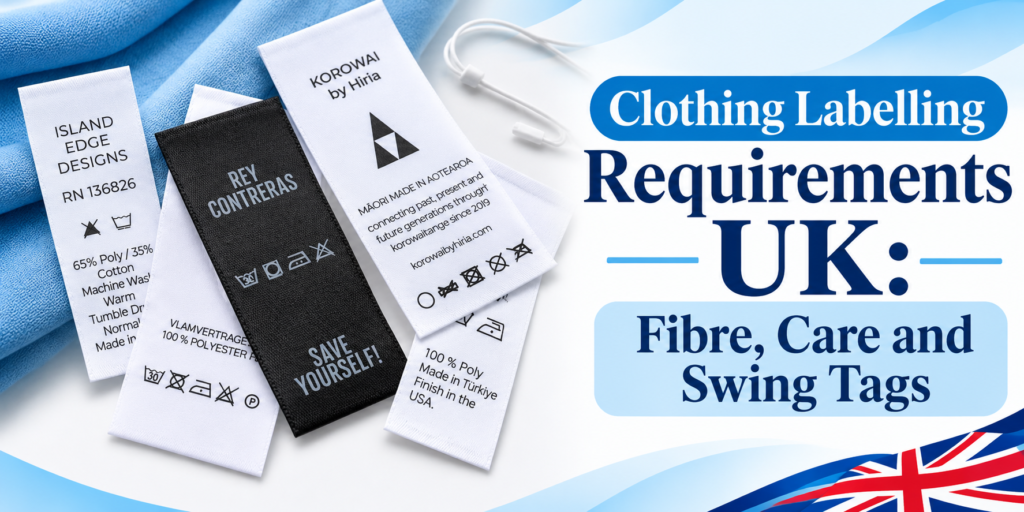
Clothing Labelling Requirements UK: Fibre, Care and Swing Tags
The label UK textile law requires on clothing is its fibre composition: each fibre named from the approved list, with its percentage by weight, in English. Care instructions, a size and a country of origin are not required by the textile rules, although anything you do print has to be accurate.
Two other duties catch small brands. A brand that puts its own name or label on clothes is treated as the producer, and must normally show its name, an address and a product reference on the garment or its packaging. Nightwear has its own fire-safety rules and wording, and online the fibre content has to be visible before anyone buys.
This guide sets out the clothing labelling requirements for Great Britain, from the composition line to swing tags, relabelled blanks, nightwear and listings. The Business Companion guidance it draws on covers England, Scotland and Wales, and your council’s Trading Standards service can advise on a particular garment.
What a clothing label must show
| Item | Required? | Detail |
|---|---|---|
| Fibre composition | Yes, on every textile product made available for sale | Approved fibre names with percentages by weight, in descending order, in English |
| Animal parts | Yes, where the garment has leather, fur, bone or similar non-textile animal parts | The phrase “Contains non-textile parts of animal origin” |
| Producer’s name, address and product reference | Yes for the producer, unless that is not reasonable | On the garment or its packaging |
| Fire-safety wording | Yes for adults’ nightwear, children’s pyjamas, babies’ garments and terry bath robes | “KEEP AWAY FROM FIRE” or “LOW FLAMMABILITY TO BS 5722”, depending on the garment |
| Care instructions | Not required by the textile rules | Accurate if given; the GINETEX symbols need a licence |
| Size | Not required by the textile rules | Accurate if given |
| Country of origin | Not required by the textile rules | Must not mislead |
Responsibility sits with the manufacturer, or with the importer for clothes made abroad, according to Business Companion’s guide to labelling textiles. The label goes on the item, must be in English, and must be durable, easily legible, visible and accessible.
Writing the fibre content
Article 5 of the textile regulation allows only the fibre names listed in Annex I, such as cotton, wool, polyester, elastane and viscose. Bamboo is not on that list. Regenerated cellulose made from bamboo pulp takes the name of the process that made it, such as viscose or lyocell, so “bamboo” cannot appear in the composition line itself.
Article 9 then asks for every fibre with its percentage by weight, largest first, as in “95% cotton, 5% elastane”. Where they cannot easily be stated at the time of manufacture, a fibre making up 5% or less, or several making up 15% or less between them, can be grouped as “other fibres” with their total percentage.
The words “100%”, “pure” and “all” are reserved for garments made of one fibre (Article 7). Up to 2% of extraneous fibre is allowed where it is technically unavoidable and not added as a matter of routine. A 95/5 cotton and elastane T-shirt is not “100% cotton”.
A garment with parts of different fibre content, such as a coat and its lining, shows the content of each part. Under Article 11, a part that is not a main lining and makes up under 30% of the total weight can be left off. Trimmings, buttons, badges and labels are not counted at all, and neither are the extra elastic yarns in a sock’s cuff.
Leather patches, fur trims or horn buttons bring in a fixed phrase under Article 12: “Contains non-textile parts of animal origin”. Business Companion adds that labelling real fur as faux is an offence.
The composition must be printed in one uniform size, style and font. A trade mark can sit immediately before or after it, but any other information goes elsewhere on the label (Article 16).
Sewn-in label, swing tag or packaging?
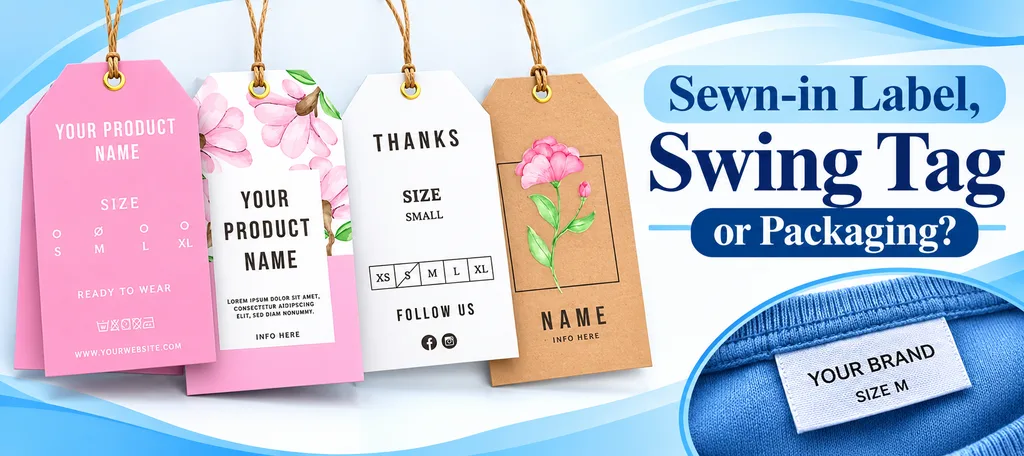
Article 14 asks for labelling that is durable, easily legible, visible and accessible and, for a label, securely attached. It does not say the label has to be sewn in.
A swing tag can carry the fibre content at the point of sale if it stays legible and securely attached. A sewn-in label survives wear and washing, though, so it is the safer home for the composition, with the tag repeating it alongside the brand, price and barcode. Our custom swing tags and luxury swing tags are printed to your artwork.
Business Companion allows the label on the packaging for multipacks. The regulation lists the products that can share one inclusive label in Annex VI, among them belts, handkerchiefs, children’s ties and bibs. Separately, two items with the same fibre content that normally form a single unit can carry one label between them.
Care labels, sizes and country of origin
The textile rules ask for fibre content, not care instructions, sizes or an origin. Whatever you add must still be true. Business Companion points to the Digital Markets, Competition and Consumers Act 2024, which bans misleading descriptions, and to the Consumer Rights Act 2015, under which goods must match their description.
Care symbols carry a catch. The UK Fashion and Textile Association says the GINETEX care symbols are protected trade marks that need a valid licence, and it issues those licences in the UK as GINETEX’s representative. Written care instructions avoid the question.
A “Made in” line is optional, but a false one, or a flag that suggests the wrong country, can be a misleading description.
Putting your own label on blank garments
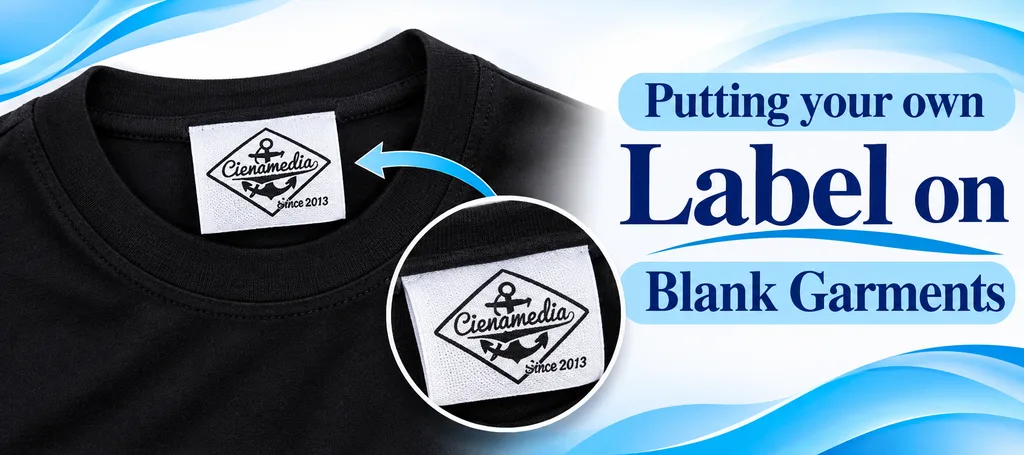
Many small brands buy blank T-shirts or hoodies and add their own neck label. Article 15 treats a seller as the manufacturer once it sells a product under its own name or trade mark, attaches the label itself or changes what the label says. From then on, the brand answers for the fibre label being present and accurate.
If you cut out the blank’s label, your own label has to carry the fibre composition. If you only print onto the blank and leave its label in place, keep that label intact.
Product safety law adds a second duty. Under the General Product Safety Regulations 2005, anyone presenting themselves as the manufacturer by putting their name or trade mark on a product is the producer. Unless it is not reasonable, the producer shows its name and address and a product reference or batch on the product or its packaging.
For clothes made outside Great Britain, Article 15 puts the label duty on the person placing them on the market here. Business Companion’s guide for producers counts importers and own-branders as producers too.
Nightwear and fire-safety labels
Business Companion’s nightwear guide sets out the Nightwear (Safety) Regulations 1985. Nightwear for children under 13 must meet the flammability performance of BS 5722 after washing. The exceptions are garments for babies up to three months old with a chest of 53 cm or less, pyjamas, and cotton terry-towelling bath robes.
Those exceptions, and nightwear outside the children’s rule, including adults’, must tell the buyer where they stand:
- Does not meet BS 5722: “KEEP AWAY FROM FIRE” printed in red.
- Meets BS 5722: “KEEP AWAY FROM FIRE” in red, “LOW FLAMMABILITY TO BS 5722” in black, or both.
- Treated with flame retardant: also “DO NOT WASH AT MORE THAN 50 °C. CHECK SUITABILITY OF WASHING AGENT”.
The wording goes on a durable label at the inside neck or next to the size label, or on the size label itself. Business Companion also recommends the BS EN 14878 flammability standard for children’s pyjamas, terry robes and babies’ garments, to meet the general safety duty.
Selling online
Article 16 requires the fibre composition to be clearly visible to the customer before purchase, including purchases made online. Business Companion applies the same rule to any advert, catalogue or listing that lets someone order from the description alone.
Nightwear adverts have their own marks. An item that does not meet BS 5722 shows “KEEP AWAY FROM FIRE” in a red-sided equilateral triangle next to the advert, and one that does shows a green triangle containing “LOW FLAM”.
Who and what the rules leave out
Article 2 takes two kinds of work out of the textile regulation altogether. One is customised garments made up by self-employed tailors. The other is work contracted out to people at home, or to independent firms, using materials supplied without ownership changing hands. The offence in the 2012 Regulations does not apply to either.
Annex V lists products that need no fibre label, including toys, animal clothing, labels and badges, travel goods and watch straps. Footwear has separate composition rules, and its textile parts are on the Annex V list. Second-hand clothes must comply too, although Business Companion accepts that handmade pre-war pieces rarely carry the same detail.
Boxes, mailers and swing tags
The producer’s name, address and product reference can sit on the packaging, so a printed box, mailer or swing tag can carry them for every garment. The fibre composition belongs on the garment itself, unless it is a multipack or one of the inclusive-labelling products.
Our apparel boxes and T shirt packaging can be printed with that panel.
For post, apparel shipping bags come in polythene or polypropylene, with zip or self-seal closures available depending on the specification.
For Christmas, apparel gift boxes give a finished presentation, and our guide to an unboxing experience on a small budget covers the rest of the parcel.
The artwork layout can reserve clear panels for the information the product is required to display. All Custom Packaging can help organise the available print space, but the brand or its regulatory adviser remains responsible for confirming the accuracy and completeness of the required product information.
Common mistakes
- “Bamboo” in the composition line instead of viscose or lyocell.
- “100% cotton” on a cotton and elastane blend.
- The lining’s fibre content left off a coat or jacket.
- A leather patch with no “Contains non-textile parts of animal origin”.
- The blank’s label cut out and no fibre content put back.
- No producer name, address or product reference on the garment or its packaging.
- A listing with photos and sizes but no fibre content.
- Children’s pyjamas without the fire-safety wording.
- GINETEX care symbols copied without a licence.
Frequently asked questions
Is it illegal to sell clothes without care labels?
No. The textile rules require fibre content, not care instructions. If you do give care instructions, they must be accurate, and the GINETEX symbols need a licence.
What is required on a clothing label in the UK?
The fibre composition, using the approved fibre names with percentages, in English. Garments with non-textile animal parts add a fixed phrase, nightwear adds fire-safety wording, and the producer’s name, address and product reference go on the garment or its packaging.
Is it legal to put your own label on clothing?
Yes, but the brand then counts as the manufacturer under Article 15 and as the producer under product safety law. That means accurate fibre content on the garment, and your name, address and a product reference on it or its packaging.
Can the fibre content go on a swing tag?
The regulation asks for a durable, legible label that is securely attached, and it does not insist on a sewn-in label. A sewn-in label is the safer choice, because a tag can be removed or lost.
Can I call my fabric bamboo?
Not in the composition line. Only the fibre names in Annex I may be used there, and bamboo-derived cellulose is named by its process, usually viscose or lyocell.
Do handmade clothes need labels?
Yes, when they are made for sale in the usual way. The exception is a customised garment made up by a self-employed tailor, which the textile regulation does not cover.