
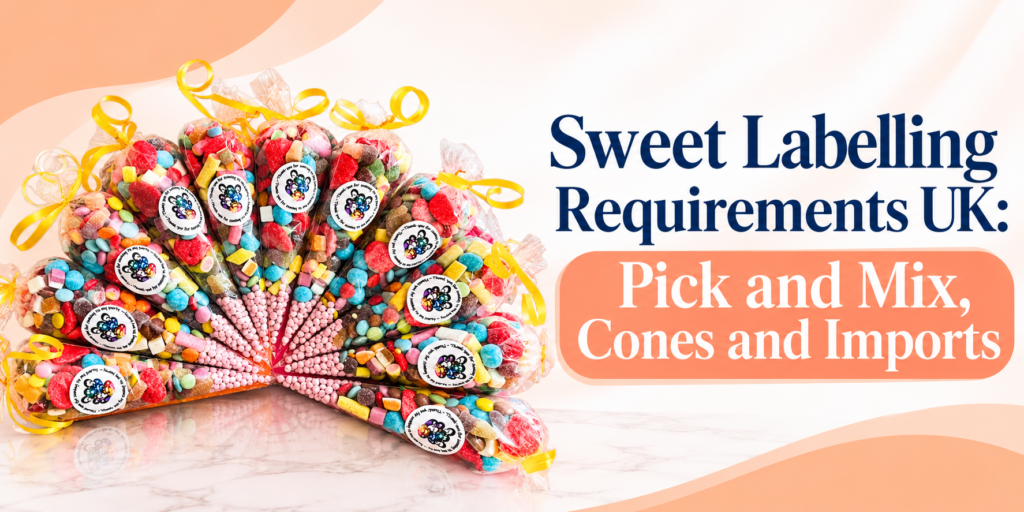
Sweet Labelling Requirements UK: Pick and Mix, Cones and Imports
Loose pick and mix needs two things where customers choose: the name of each sweet and a list of its allergens, on a ticket, a shelf-edge label or the jar. Cones, cups and boxes filled in your shop before customers choose them, and sold there, are prepacked for direct sale, and each needs a label with its name and every ingredient, allergens emphasised.
Sweets packed to be sold anywhere else, such as through another shop, need the full prepacked label, and the business whose name they are sold under is responsible for it. Imported American sweets need labels in English that name a responsible business based in the UK, Channel Islands or Isle of Man. Some additives used in the US are not allowed in sweets sold here at all.
This guide sets out the sweet labelling requirements route by route, from the jar and the cone to the favour box and the hamper. It then covers the warnings sweets often need and the rules for imports. It draws on the Trading Standards guidance for England and Wales, so treat it as a starting point and check a specific product with the Trading Standards service at your council.
Which label applies to your sweets
Business Companion’s guide to labelling sweets splits the rules by how sweets are packed and sold, and its allergen and PPDS guides cover the online cases. Put together, the routes look like this.
| How the sweets are sold | What must be given | Where it goes |
|---|---|---|
| Loose pick and mix, or bagged after the customer chooses | The name of each sweet and a “Contains:” list of its allergens | A ticket, shelf-edge label or notice at the jar, a label on the bag, or staff, with a notice telling customers to ask |
| Picked online and packed after the order | The same name and allergen information | On the website before purchase, and again with the delivery |
| Cones, cups and boxes filled in advance and sold from the same shop, or your own stall or van | The name and a full ingredients list, allergens emphasised | A label attached to each pack |
| Those same packs sold online and sent from the shop that filled them | No printed name and ingredients label, but allergen information | On the website before purchase, and again with the delivery |
| Sweets packed at one site and sold from another, or sold to other shops | The full prepacked label | On the pack |
| Makers’ or importers’ packs sold unopened | The label the pack came with, which must already comply | On the pack, readable without opening it |
The split turns on who packed the sweets, where, and when. Once sweets come out of the maker’s packaging, you are the one packing them, and the information for that pack is yours to get right.
Naming the sweets
Every route needs a name that says what the sweets are. Business Companion’s example is “Wiggly Worms”, a fancy name with no legal standing, which needs a description such as “Fruit flavour jelly sweets” beside it. Customary names that shoppers understand, such as humbugs or black jacks, can stand on their own.
The words “flavour” and “flavoured” mean different things. A strawberry flavoured sweet contains strawberry, while a strawberry flavour sweet only tastes of it. A cone of mixed sweets needs a name for the mix as a whole, such as “Mixed jelly and fizzy sweets”, ahead of the ingredients of each sweet in it.
Allergens on loose pick and mix
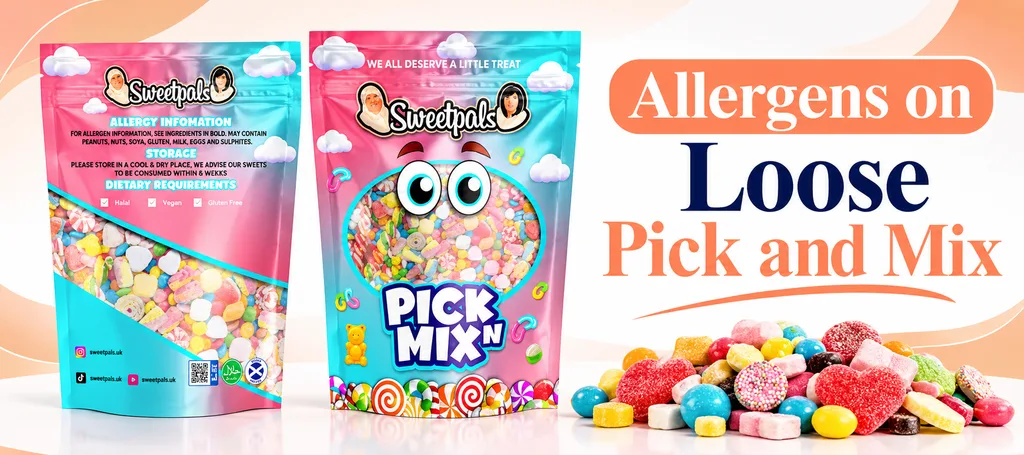
GOV.UK’s guidance on loose foods counts pick and mix as loose food, including individually wrapped sweets. For loose sweets, the allergens go in a “Contains:” statement using the names in the law. Business Companion’s allergen guide gives “Contains: Wheat” as correct and “Contains: Gluten” as wrong.
The statement can sit on a notice by the jar, a shelf-edge label or a label on the bag. Staff can give the information verbally instead, as long as a notice tells customers to ask. Jar markings printed by the manufacturer count if they can be read easily from the customer’s side of the counter.
Your supplier has to give you the information, but showing it to customers is your duty. Keep each line’s specification with its jar, and change the ticket whenever the line changes.
“May contain” wording is for a risk you cannot remove, such as customers swapping scoops between open tubs. Business Companion recommends basing it on a risk assessment and naming the allergen, as in “May contain peanuts”. It must never sit alongside a free-from claim for the same allergen, and it never replaces the “Contains:” information.
Cones, cups and boxes filled before sale
Packs filled before customers choose them count as prepacked for direct sale when they are sold where they were filled, or from a stall or van the business runs. Each one needs an attached label giving the food’s name and every ingredient. Every mention of an allergen is emphasised, using bold type, capitals or a contrasting colour.
In a mixed cone, each sweet is a compound ingredient. Annex VII of the food information regulation allows it to be listed under its own name, in order of its weight in the mix, followed by its own ingredients. Business Companion’s allergen guide requires compound ingredients on PPDS labels to be broken down into their components.
That makes a fixed recipe for each design the practical answer, so the label stays true from one batch to the next. Swapping one sweet for another means a new label. Business Companion also calls it best practice to say how allergens are shown, with a short note beside the list.
If the same cones are sold online and sent from the shop that filled them, Business Companion’s PPDS guide lifts the printed-label requirement for distance sales. Allergen information is still due before the purchase and again at delivery, and Business Companion prefers it in writing, such as an allergen sheet or stickers in the parcel.
Sweets packed to sell anywhere else
Sweets packed in one place and sold from another, or sold to another shop to resell, are prepacked. Business Companion’s guide to prepacked food lists what they need, including the name, the ingredients with allergens emphasised, the net quantity, a date mark, the business’s name and postal address, a nutrition declaration, and any warnings that apply.
Article 8 of the regulation makes the business the sweets are sold under responsible for that information. Once you repack under your own name, that business is yours.
A mix needs its own nutrition declaration unless an exemption in Annex V of the food information regulation applies. Two of them can fit sweets: packs whose largest surface is under 25 cm², and small quantities supplied direct by the maker to consumers or local shops. Article 31 lets the values be calculated from the known values of the ingredients, so a fixed recipe and each sweet’s figures from the supplier give you the numbers.
Warnings sweets often need
Several statements are tied to ingredients that turn up in sweets.
- Colours. Six colours carry a warning: E102 (tartrazine), E104 (quinoline yellow), E110 (sunset yellow), E122 (carmoisine), E124 (ponceau 4R) and E129 (allura red). A sweet containing any of them must name the colour or its E number, followed by “may have an adverse effect on activity and attention in children”. The list is in Annex V of the additives regulation, and Business Companion’s colours guide says the warning is compulsory on prepacked food.
- Sweeteners. “With sweetener(s)” goes with the name, or “with sugar(s) and sweetener(s)” when both are used, and aspartame adds a statement about phenylalanine (Annex III).
- Polyols. A sweet with more than 10% added polyols needs “excessive consumption may produce laxative effects”.
- Liquorice. Confectionery with 100 mg/kg or more of glycyrrhizinic acid needs “contains liquorice” straight after the ingredients list, unless liquorice already appears in that list or the name. At 4 g/kg or more, the statement adds that people with hypertension should avoid excessive consumption.
- Gluten-free. The claim allows no more than 20 mg of gluten per kg, and “no gluten-containing ingredients” is not a permitted alternative.
Best-before dates and lot marks
Annex X exempts confectionery made almost entirely of flavoured or coloured sugars, such as boiled sweets and lollipops, from date marking, along with chewing gum. GOV.UK’s food information guidance says these still need a lot number.
Chocolate and fudge fall outside that description and need a best-before date, while borderline lines such as jelly sweets are worth checking with Trading Standards. Where a pack has a best-before date showing the day and the month, that date can serve as its lot mark.
Imported and American sweets
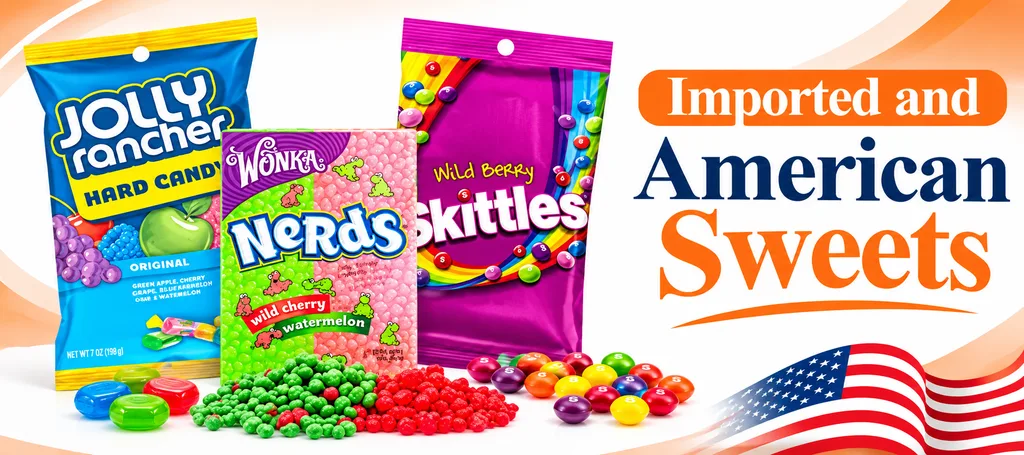
Business Companion says imported sweets need the same labelling as sweets made in Great Britain, and must meet the same composition rules. The mandatory information must be in English. Under Article 8, if the brand owner is not established in the UK, Channel Islands or Isle of Man, the importer is the responsible business.
Article 8(3) also bars a business from supplying food it knows or presumes does not comply. Where an importer supplies UK labels loose, they go on before the pack is displayed, and a pack whose label has come off should not be sold until it is replaced.
The colours guide warns that some imported foods contain additives not authorised in the UK. Its examples include brominated vegetable oil, mineral oil and erythrosine, E127, which appears on US packs as Red 3 and is allowed in cocktail cherries but not in sweets.
The same guide translates US colour names: Yellow 5 is E102, Yellow 6 is E110 and Red 40 is E129. A US sweet listing any of them needs the colour warning on its UK label when it is sold prepacked here.
Repacking imported sweets into pick and mix moves the job to you, just as with UK lines. That means the name and allergens at the jar, or the full ingredients list on a cone filled in advance.
Cones, favour boxes and hampers
A cone filled in advance carries its label on the outside, where it can be read without untying the ribbon. Personalised sweet cone stickers can carry the name and the ingredients list if the sticker is sized for the text. Lower-case letters must be at least 1.2 mm tall, or 0.9 mm on a pack whose largest surface is under 80 cm².
Wedding and party favours filled in advance follow the same route rules. A sweet favour box sold from your own premises needs the PPDS label on each box, and one packed at another site needs the full prepacked label.
A hamper of makers’ packs, sealed and sold as one item, must let the buyer read each pack’s mandatory information without opening it. Clear wrap or a window does that; otherwise the outside carries the information. Empty sweet hamper boxes can take a label on the outside, and sweet boxes with a window let the labels inside show through.
For Christmas ranges, Christmas candy boxes can be printed with the panel a label needs, and our guide to gift box sizes helps size a box around its contents. Inserts are cut to the product’s own dimensions, so movement inside the box is controlled.
Unwrapped sweets can sit straight against the board. Food-contact material suitability is confirmed for the specific material before production. The artwork layout can reserve clear panels for the information the product is required to display. All Custom Packaging can help organise the available print space, but the brand or its regulatory adviser remains responsible for confirming the accuracy and completeness of the required product information.
Common mistakes
- A fancy name with no description of what the sweets are.
- “Gluten” in a “Contains:” list instead of the cereal, such as “Wheat”.
- A cone filled in advance with only a “Contains:” sticker instead of a full ingredients list.
- One ingredients list for a mix that has changed since the label was printed.
- “May contain” with no risk assessment behind it, or next to a free-from claim.
- A US pack on the shelf without its UK label.
- Red 40 or Yellow 5 in the ingredients and no colour warning on the UK label.
- A sealed hamper that hides the labels of the packs inside.
Frequently asked questions
Do pick and mix sweets need ingredients labels?
Not when they are sold loose or bagged after the customer chooses. Each sweet then needs its name and a “Contains:” list of allergens where customers choose. Cones or bags filled in advance are different, and those need a full ingredients list.
Can I sell sweets from home in the UK?
Yes, once the business is registered with your council as a food business. The FSA’s registration guidance covers home kitchens and online-only sellers. In England, Wales and Northern Ireland, register a minimum of 28 days ahead of your first sale.
Do sweet cones need allergen labels?
A cone filled before the customer buys it and sold from your own premises needs a label with the name and full ingredients, allergens emphasised. A cone filled while the customer waits needs only the name and allergens, shown where the customer chooses.
Do I need to relabel American sweets?
Each pack needs UK labelling before it is sold: in English, naming a responsible business based in the UK, Channel Islands or Isle of Man, with any colour warnings. Where the importer supplies those labels, the shop applies them before the packs go on display.
Do boiled sweets need a best-before date?
No. Confectionery made almost entirely of flavoured or coloured sugars is exempt from date marking, as is chewing gum, but each pack still needs a lot number.
What does prepacked for direct sale mean for a sweet shop?
Sweets your business packs before customers choose them and sells from the same premises, or from its own stall or van. Those packs need a label with the name and a full ingredients list, allergens emphasised.