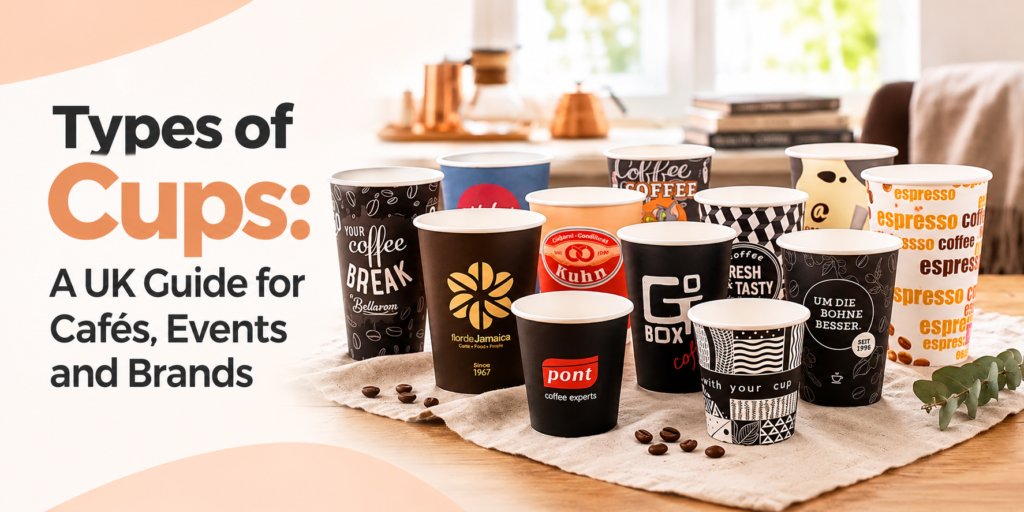
Types of Cups: A UK Guide for Cafés, Events and Brands
Quick answer: The main types of cups for UK businesses are paper cups (single wall, double wall and ripple wall) for hot drinks, clear plastic cups for cold drinks, and reusable cups made of ceramic, glass, steel or durable plastic. Polystyrene foam cups can no longer be supplied in England for ready-to-drink food and drink. Choose by temperature, size and how the drink is served, then match the lid by rim diameter, not by ounces.
The main types of cups at a glance
| Type | Typical use | Notes |
|---|---|---|
| Single wall paper cup | Cold drinks, or hot drinks with a sleeve | One layer of board; lightest and simplest |
| Double wall paper cup | Hot takeaway drinks | A second paper layer adds insulation, so no sleeve is usually needed |
| Ripple wall paper cup | Hot drinks where grip and insulation matter | A ridged outer layer traps air and gives grip |
| Clear plastic cup (PET) | Iced coffee, smoothies, juices | Shows the drink; for cold use |
| Polypropylene (PP) cup | Some hot and cold uses, some food | Depends on the grade |
| Polystyrene foam cup | Formerly hot drinks | Banned in England for ready-to-consume food and drink |
| Reusable cup | Dine-in, refill schemes, merchandise | Ceramic, glass, steel or durable plastic |
Paper cups: single, double or ripple wall
Paper cups are the usual choice for takeaway hot drinks. The difference is the wall:
- Single wall is one layer of paperboard. It suits cold drinks, and hot drinks served with a sleeve or for drinking straight away.
- Double wall adds a second outer layer with a small air gap. It holds heat better and is comfortable to hold, so many cafés use it for hot takeaway drinks without a sleeve.
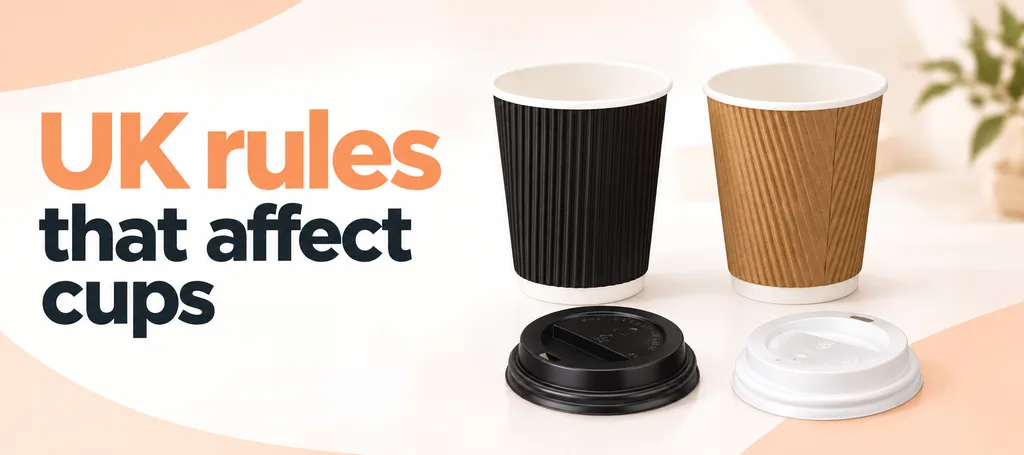
- Ripple wall adds a ridged outer layer. The ridges trap air and give a firm grip, and the texture is part of the look.
If you use single wall cups for hot drinks, add a cup sleeve or switch to double or ripple wall.
What is the lining inside a paper cup?
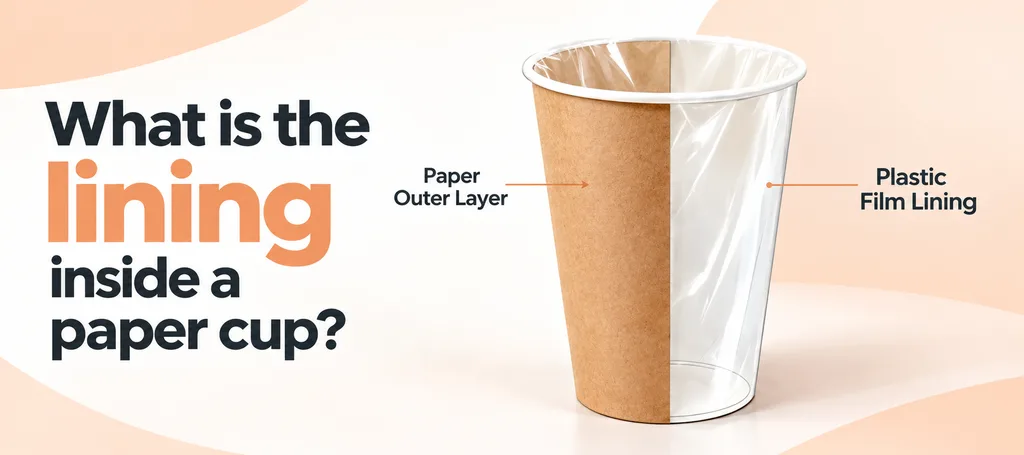
A paper cup needs a thin barrier on the inside so the drink does not soak into the board. Common linings are:
- PE (polyethylene), the traditional plastic lining
- PLA, a plant-based plastic often sold as compostable
- Aqueous (water-based) coatings, an alternative to a separate plastic film; the exact formulation varies by supplier
- PP, used in some cups
Be careful with claims. A PLA lining is still a plastic, and compostable claims usually depend on certification and on industrial composting being available. A paper cup with any lining is a mixed material, so what happens to it at end of life depends on the lining and on the collection it goes into. An unlaminated paperboard construction may be easier to process through suitable paper-recycling streams than a heavily laminated alternative. Final recyclability depends on the full material and finishing specification and the facilities available locally.
Cups by use
| Use | Usual cup | What to check |
|---|---|---|
| Espresso, tasters, samples | Small paper cups, 50 to 150 ml | Steady base; a lid if carried |
| Hot takeaway drinks | Double or ripple wall paper cups | Lid fit; sip lid for hot drinks |
| Iced coffee, smoothies, juice | Clear PET cups | Dome or flat lid; straw hole |
| Soups and hot food | Food cups or bowls with lids | Lid seal; whether reheating is needed |
| Events and festivals | Paper cups or reusable cup schemes | Volume, waste plan, branding |
| Dine-in | Reusable ceramic or glass | Washing capacity |
For tasters and samples, see our 50 ml paper cups. For food that is reheated, cups made for microwaving exist, but only where the specification supports it, so check before you rely on it.
Cup sizes: ounces, millilitres and the fill line
Cups in the UK are usually sold in ounces, but ounces can mislead.
- UK and US fluid ounces differ. A UK fluid ounce is about 28.4 ml and a US fluid ounce about 29.6 ml, so an “8 oz” cup can be listed as roughly 227 ml or 237 ml depending on the supplier.
- Brim-full is not the same as the fill line. The stated capacity is often measured to the brim, while a drink is served below it, with room for milk, foam and the lid.
| Nominal size | UK fl oz, about | US fl oz, about |
|---|---|---|
| 4 oz | 114 ml | 118 ml |
| 8 oz | 227 ml | 237 ml |
| 12 oz | 341 ml | 355 ml |
| 16 oz | 455 ml | 473 ml |
Ask for the capacity in millilitres, and whether it is brim-full, before you set drink sizes or prices.
Lids, sleeves and carriers
Lids fit by rim diameter, not ounces. Two cups sold as the same ounce size can have different rim diameters, and a lid made for one may leak or pop off the other. Buy cups and lids as a matched set, and re-check the fit whenever you change cup supplier or size.
Sleeves add grip and heat protection to single wall cups, and give extra space for branding.
Carriers hold two or four cups for orders taken away together. See our takeaway coffee cup carrier.
UK rules that affect cups
Polystyrene cups in England. Under regulations made in 2023, government guidance on single-use plastics bans says businesses in England must not supply food and drink containers made of expanded or extruded polystyrene for food or drink that is ready to consume, and that includes cups. Scotland and Wales have their own rules.
Takeaway cups under EPR. For larger businesses obligated under extended producer responsibility for packaging, government guidance lists takeaway cups among packaging that commonly ends up in public bins and must be reported. How a lined paper cup is classed depends on its make-up. Under the same guidance, a component counts as fibre-based composite where paper or board is combined with plastic layers that cannot be separated by hand and the plastic is more than 5% of the material by mass; at 5% or less, it is classed as paper or card. The class matters because fees differ by material: the 2025 base fees were £461 per tonne for fibre-based composite and £196 per tonne for paper and card. From 2026, PackUK is modulating household disposal fees by recyclability, so check the current rates before costing a cup specification. Whether EPR applies to you, and how fees work, is covered in our guide to EPR packaging fees.
Which type of cup should you choose?
| Business | Usually the best fit |
|---|---|
| Coffee shop, mostly takeaway | Double or ripple wall paper cups with matched lids |
| Café with dine-in | Reusable cups in, paper cups for takeaway |
| Juice or smoothie bar | Clear PET cups with dome lids |
| Events and festivals | Paper cups, or a reusable cup scheme where you can wash and return |
| Sampling and tasting | Small paper cups |
| Soup and hot food to go | Food cups with sealed lids |
Custom paper cups from us
We make custom paper cups in single wall, double wall and ripple wall constructions, in custom sizes, with lids available. Linings are chosen per specification, from PE, PLA, aqueous or PP. Hot and cold drink suitability depends on the specification you choose.
Popular options include kraft ripple paper cups and paper coffee cups with lids, printed with your branding.
- Orders start from 100 units.
- Design support is free.
- A digital 3D mock-up is free.
Cup questions
What are the main types of disposable cups?
Paper cups (single, double and ripple wall), clear plastic cups for cold drinks, and polypropylene cups for some uses. Cups made from expanded or extruded polystyrene (foam) can no longer be supplied in England for ready-to-consume food and drink.
How do single wall and double wall cups differ?
A double wall cup has a second outer layer with an air gap, so it holds heat better and is more comfortable to hold. Single wall cups usually need a sleeve for hot drinks.
Are polystyrene cups banned in the UK?
In England, single-use food and drink containers made from expanded or extruded polystyrene, including cups, cannot be supplied for ready-to-consume food or drink. Scotland and Wales have their own rules.
How many ml is an 8 oz cup?
About 227 ml in UK fluid ounces or about 237 ml in US fluid ounces. Ask your supplier for the capacity in millilitres and whether it is measured to the brim.
Do all 12 oz lids fit all 12 oz cups?
No. Lids fit by rim diameter, which varies between suppliers. Buy cups and lids as a matched set.
Are paper cups compostable?
It depends on the lining and the facilities. A PLA lining is often sold as compostable, but usually needs industrial composting. Check certification and local collection before making any claim.
Choosing cups for your café or brand? Tell us the drinks, sizes and quantity, and we will suggest a cup and lid.