
How Many Units Fit in a Box? A UK Guide to Case Packs and Multi-Pack Quantities
To work out how many units fit in a box, divide the box’s inside length, width and height by your product’s length, width and height, then round down. But that number is a ceiling, not a target. Real case packs are usually 10 to 20% lower once you allow for labels, wrapping and safe handling. Multi-packs are commonly sold in 6, 12 or 24 because those numbers divide evenly for shelves, trays and pallets, not because of any legal rule.
If you sell candles, Custom soap Boxes bars, cosmetics or small food items, this question comes up the moment you move from single sales to wholesale or gift sets. Get the case pack wrong and you either waste box space and pay for shipping air, or you cram units in and pay for breakages instead. This guide walks through the maths in plain terms, explains the standard multi-pack sizes, and gives worked examples across the categories we pack for most often.
How to work out how many units fit in a box
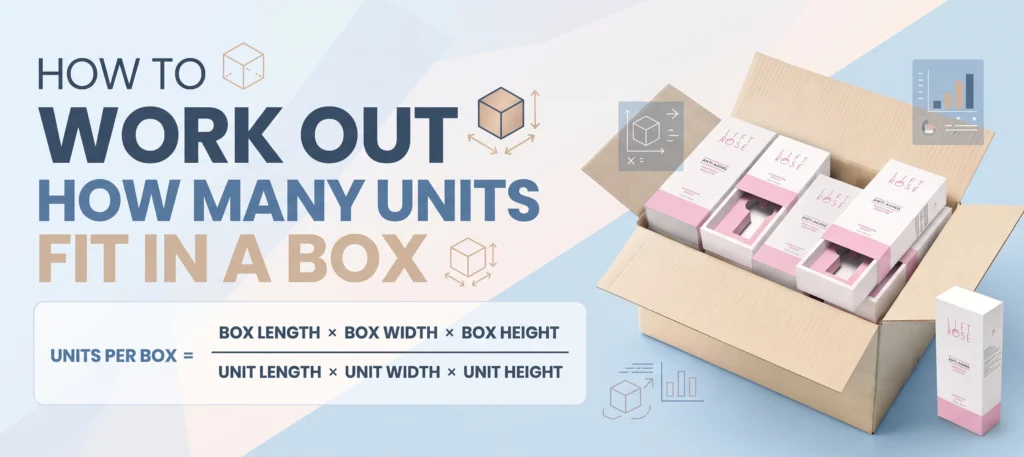
Start with two sets of numbers: the box’s inside measurements and your product’s outside measurements. Always use millimetres or centimetres. Mixing units is the single most common cause of a wrong answer.
Use the box’s internal dimensions, not the external ones. A box described as “200 x 150 x 100mm” almost always means the outside size. The cardboard itself takes up a few millimetres on every wall, so the inside is always a little smaller. If you’re stacking smaller boxes inside a larger shipping carton, the rule flips: use the external dimensions of the smaller boxes and the internal dimensions of the outer carton.
The basic formula:
Units along the length = box internal length ÷ product length (round down) Units along the width = box internal width ÷ product width (round down) Units stacked in height = box internal height ÷ product height (round down)
Multiply the three results together to get a maximum theoretical count.
Worked mini example: a box with an internal space of 300 x 200 x 150mm, holding a candle jar that measures 70 x 70 x 90mm.
- Length: 300 ÷ 70 = 4.28, rounds down to 4
- Width: 200 ÷ 70 = 2.85, rounds down to 2
- Height: 150 ÷ 90 = 1.66, rounds down to 1
- Maximum count: 4 x 2 x 1 = 8 candles
Why the real number is usually lower. That maths gives you the physical ceiling, assuming every unit is a perfect rectangle with zero gap between them. In practice, labels overlap the true edge, wrapping adds a few millimetres, and jars are rarely perfectly square at the base. Most experienced packers plan for 10 to 20% fewer units than the raw calculation to leave room for movement and packing material. The most common mistake we see from new candle and soap brands planning their first wholesale case pack is measuring the box against the product’s packaging photo rather than the product with its label and any protective wrap already on. Measure the item exactly as it will sit in the box.
Round or irregular shapes (bath bombs, cosmetic pump bottles with a wider base) don’t tessellate as cleanly as boxes, so treat the calculation as a starting estimate and confirm with a physical test pack before committing to a print run of case boxes.
Why multi-packs come in 6, 12 or 24
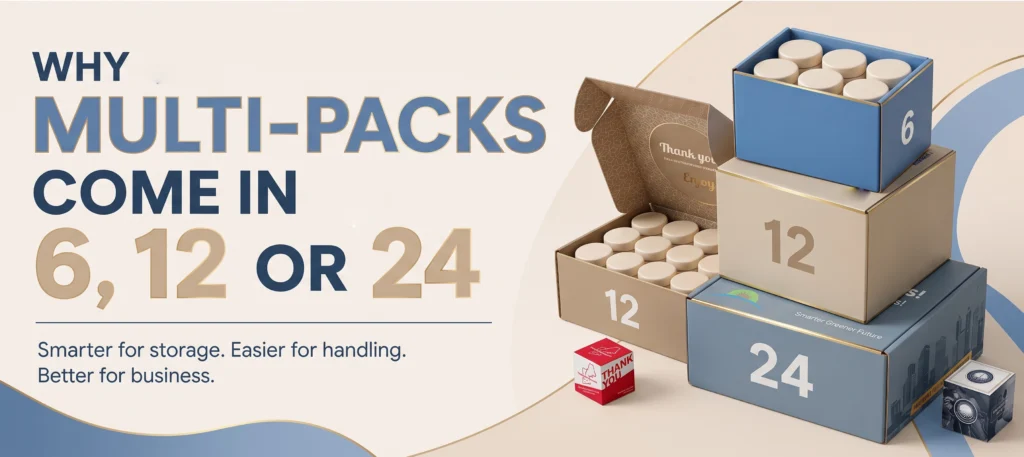
There’s no legal or scientific rule that says a multi-pack has to hold 6, 12 or 24 units. These numbers became standard because they’re highly divisible: 6, 12 and 24 all split evenly into halves, thirds, quarters and (for 12 and 24) sixths. That makes them easy to arrange in even rows on a shelf, in a shipping tray or on a pallet layer, with no odd unit left over.
The convention also has roots in drinks packaging. A six-pack of bottles or cans became a retail standard, and four six-packs stacked together make 24, a common outer case size. That same logic carried across into candles, soap, cosmetic packaging and gift sets, because retailers and wholesale buyers got used to ordering and shelving in those quantities.
For a small UK brand, the practical takeaway is simpler than the history: pick a case pack size that matches how your buyer actually sells the product. A gift shop restocking one shelf slot at a time might want 6. A larger retailer or a subscription box service might want 12 or 24 to reduce how often they reorder. There’s nothing wrong with an unconventional number like 8 or 10 if that’s what genuinely fits your box and your customer’s shelf, but sticking to a round, divisible number usually makes quoting, invoicing and stock counts easier for everyone.
Tight packing versus void fill: the protection trade-off
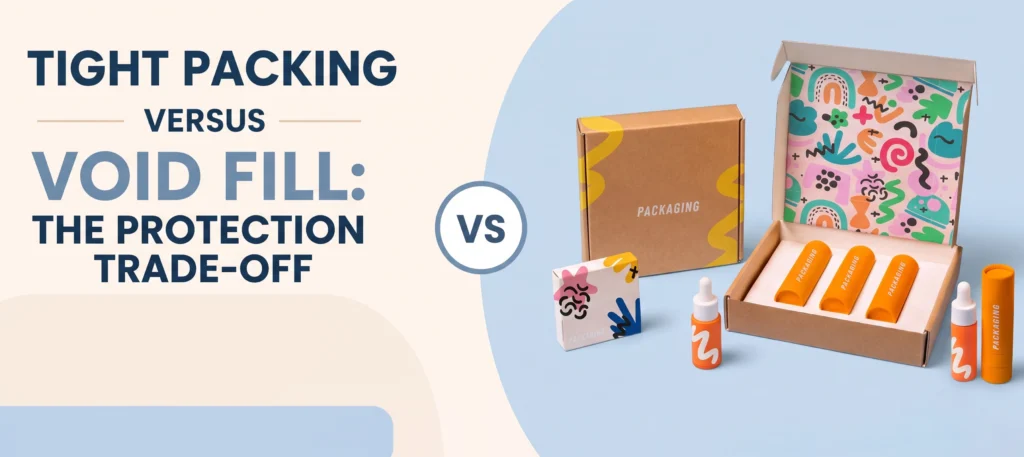
Every case pack decision is really a trade-off between two things: how many units you can fit, and how well those units survive transit. Pack too tightly and you save on box costs but risk scuffing, cracking or crushing. Pack too loosely and the units can shift and collide in transit, which causes the same damage a different way.
| Approach | Units per box | Protection level | Typical risk | Best suited to |
|---|---|---|---|---|
| Tight pack (snug fit, minimal gap) | Higher | Lower, relies on the product’s own strength | Scuffing between units, pressure marks, label damage | Sturdy items: soap bars in shrink wrap, boxed cosmetics, tins |
| Structured dividers or inserts | Medium | High, each unit has its own compartment | Low if the insert is sized correctly | Glass candle jars, cosmetic bottles, anything fragile or breakable |
| Loose fill with void fill material | Lower | High if enough fill is used, low if under filled | Units shifting and colliding if fill settles in transit | Irregular shapes, mixed product gift sets, fragile one-off items |
There’s no single right answer. A soap brand shipping bar soap in a shrink wrap can usually pack tightly because the product itself is fairly forgiving. A custom candle boxes brand shipping glass jars needs either a divided insert or generous void fill, because glass on glass contact is how breakages happen. The honest starting point is to test a full case with the packing method you’re considering, then send it on a real courier journey (or at least drop test it) before you commit to a large print run of boxes.
Worked examples: how many units fit in common box sizes
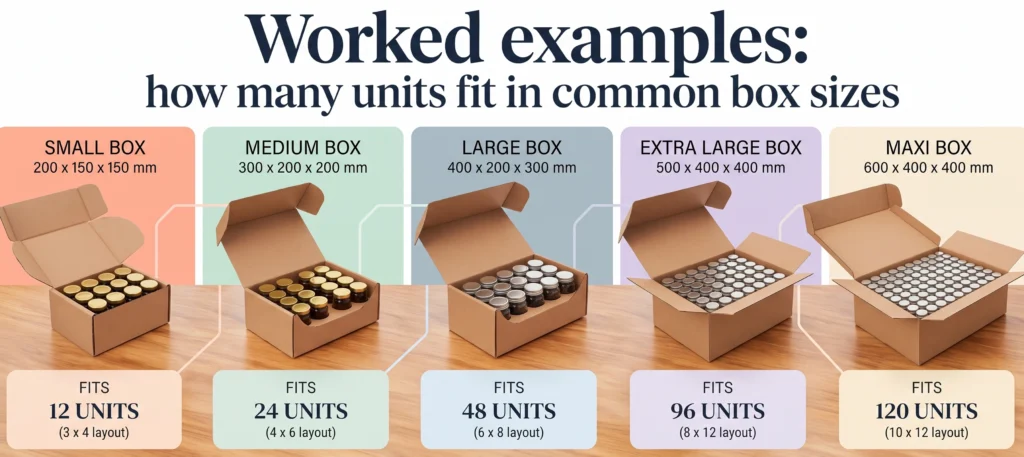
These are starting estimates based on the maths above, allowing roughly 15% off the theoretical maximum for label overlap, wrapping and safe handling. Always confirm with a physical test pack, because label position, wrap thickness and jar shape all shift the real number.
| Product category | Typical unit size (approx) | Box internal size | Estimated units per box | Notes |
|---|---|---|---|---|
| Candles (standard glass jar) | 70 x 70 x 90mm | 300 x 200 x 150mm | 6 to 7 | Use dividers if jars are unwrapped glass |
| Soap bars (boxed or wrapped) | 90 x 60 x 30mm | 250 x 190 x 100mm | 10 to 12 | Tight pack usually safe if individually wrapped |
| Cosmetic jars (30 to 50ml) | 55 x 55 x 60mm | 250 x 190 x 100mm | 10 to 12 | Check lid security before tight packing |
| Small food items (individually wrapped, e.g. fudge or biscuits) | 50 x 50 x 20mm | 250 x 190 x 100mm | 20 to 24 | Confirm food contact suitability of any packaging material before use |
This table is the calculation shortcut, not a guarantee. Treat it as a sense check before you order case boxes at volume, and always run your own numbers against your exact product dimensions.
How case pack size affects your shipping cost
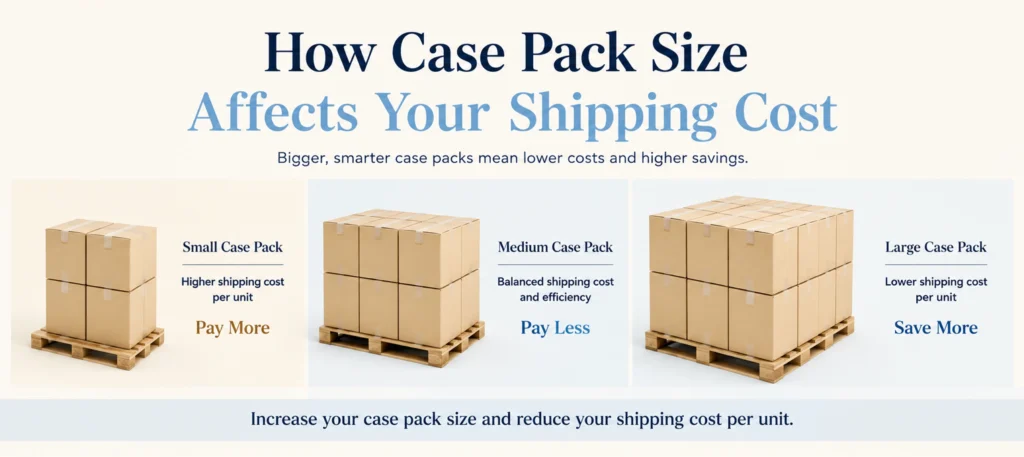
Box size doesn’t only decide how many units you can fit. It also decides what you pay to send that box, because most couriers charge on whichever is greater: the actual weight, or the volumetric (also called dimensional, or “DIM”) weight.
How volumetric weight is worked out: multiply the parcel’s length, width and height in centimetres, then divide by the courier’s volumetric divisor. Couriers including DHL, FedEx and UPS commonly use a divisor of 5000 for shipments measured in centimetres, so the sum is:
(Length cm x Width cm x Height cm) ÷ 5000 = volumetric weight in kg
If that figure is higher than the parcel’s actual weight, you’re charged on the volumetric figure instead. A lightweight but bulky box of candles can easily cost more to ship than a smaller, denser box of soap bars that weighs the same.
Royal Mail works differently. Rather than a volumetric formula, it uses fixed size and weight bands (Small Parcel, Medium Parcel and so on), and every dimension has to fit inside the band, or the whole parcel moves up to the next price. As of the most recent published rates, Royal Mail’s Small Parcel band allows up to 450 x 350 x 160mm and 2kg, and Medium Parcel allows up to 61 x 46 x 46cm and 20kg. Going even slightly over on one dimension pushes the whole parcel into the next, more expensive, band.
The practical link back to case packing: a slightly smaller, better filled box often costs noticeably less to ship than a larger box with the same number of units and a lot of empty space. When you’re deciding between a 6 pack and a 12 pack of the same product, work out the box size each one needs and check both against your courier’s size bands before you decide which to offer.
A simple checklist before you lock your case pack size
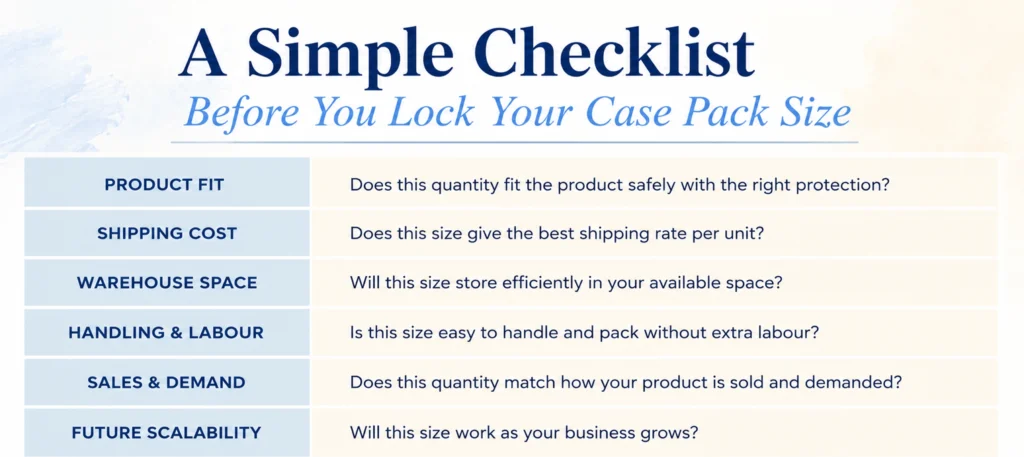
- Measure the product exactly as it will sit in the box, including any label, sleeve or wrap
- Use internal box dimensions for the calculation, external dimensions only when nesting boxes inside boxes
- Subtract roughly 10 to 20% from the raw maths result to allow for real world packing
- Choose a round, divisible number (6, 12, 24) unless your product genuinely needs an unconventional count
- Decide your protection method (tight pack, dividers or void fill) based on how fragile the product actually is
- Check the finished box against your courier’s size and weight bands before committing to print
- Always run a physical test pack before ordering case boxes at volume
Frequently asked questions
Getting your case pack size right from the start
Working out case pack sizing gets easier once you’ve done it for one product, because the same measuring approach carries across your range. If you’re at the stage of ordering custom Food boxes for a wholesale run or a retail multi-pack, All Custom Packaging offers free design support to help confirm a box size that fits your case pack cleanly, and orders start from 100 units, so you can order a specific case pack size without committing to a huge print run.