
Collapsible vs Fixed Rigid Boxes: Which Is Better for UK Brands?
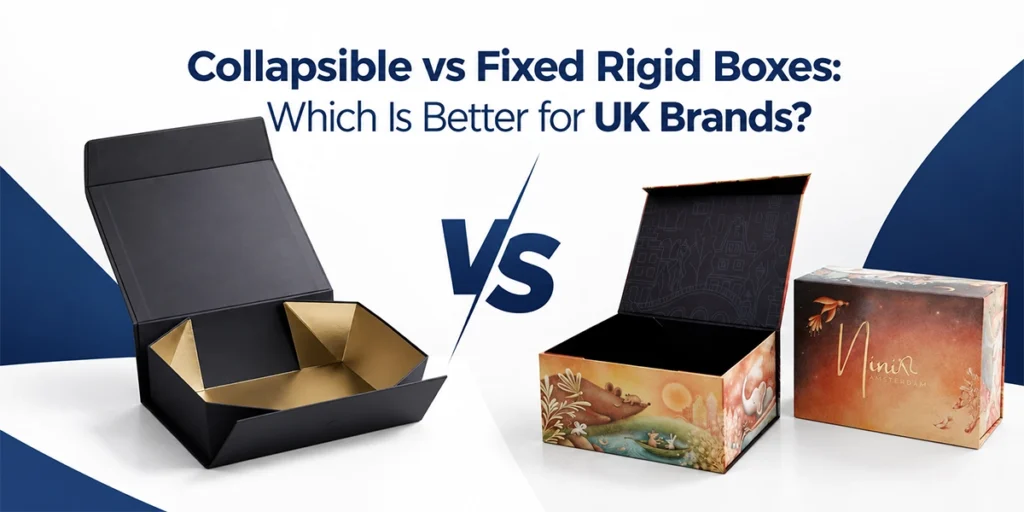
Quick answer: Collapsible rigid boxes arrive flat and are built before packing; fixed rigid boxes arrive made up and ready to use. Once built, both can deliver a rigid, premium presentation, although the corners and fold lines can differ. Choose collapsible when storage space is tight, you order in larger quantities, or you want boxes customers can fold away. Choose fixed when your product is heavy, when packing speed matters more than space, or when the style you want (a lift-off lid or a drawer, for example) is normally made fixed. The real difference is where the cost lands: fixed boxes cost you space, collapsible boxes cost you an assembly step.
How each one is built and supplied
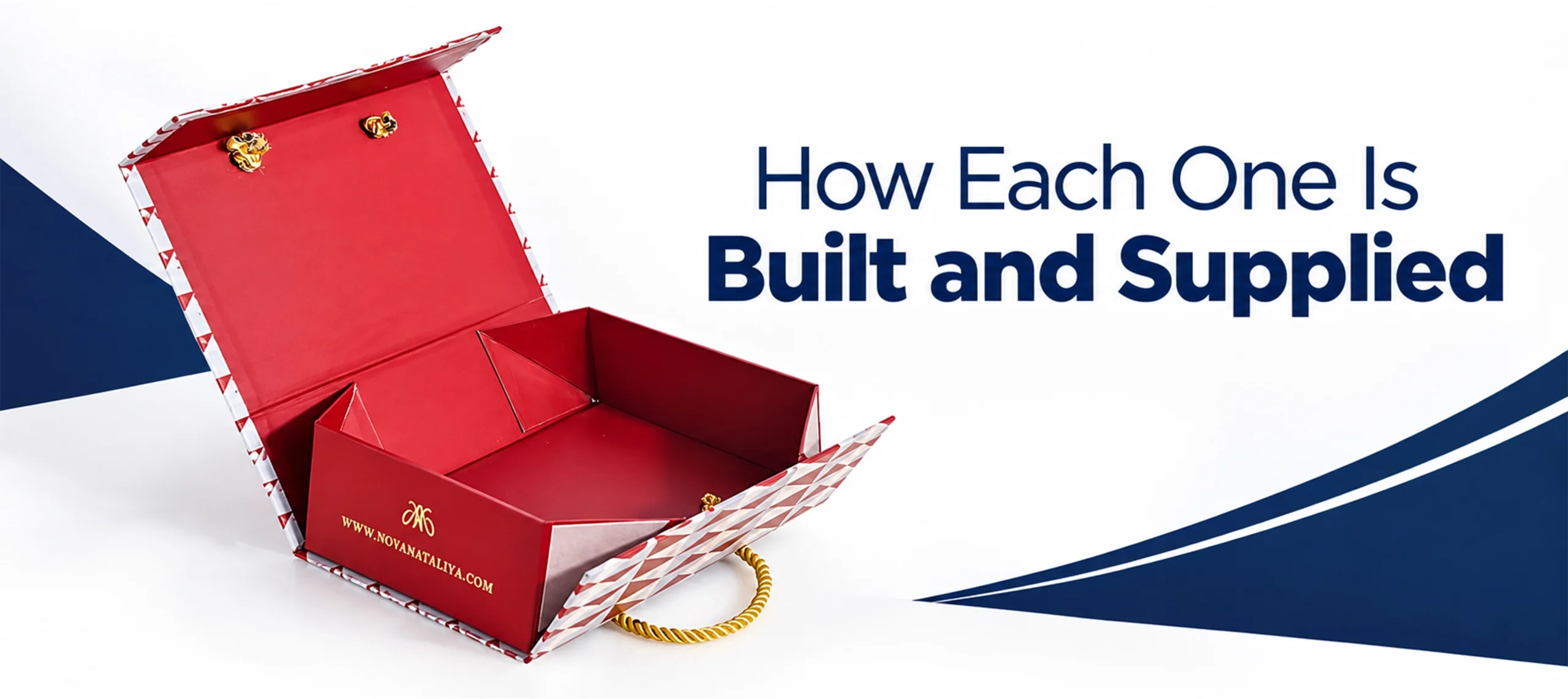
A fixed rigid box is made from thick board wrapped in printed paper, and it is supplied fully assembled. It cannot be flattened. It goes straight from the carton to the packing bench.
A collapsible rigid box uses the same kind of board and wrap, but the walls are hinged so the box lies flat. Before packing, someone lifts the walls and locks them in place. Depending on the design, the walls are held by small magnets, often neodymium magnets hidden under the wrap, or by pre-applied adhesive strips that bond when the box is first built.
That second difference matters more than it sounds:
- Magnet-held walls can usually be folded flat and rebuilt, by you or by your customer.
- Adhesive-locked walls are built once. After that the box behaves like a fixed box.
Ask which method a quote is based on. If you are still deciding whether you need a rigid box at all, start with what a rigid box is and how it compares with folding cartons.
The trade-off at a glance
| Collapsible rigid | Fixed rigid | |
|---|---|---|
| Arrives | Flat | Made up |
| Storage space | Small until built | Full box volume from day one |
| Packing step | Build first, then pack | Pack straight away |
| Presentation once built | Rigid and premium; check corners and folds | Rigid and premium |
| Corners | Hinged; a fold line can sometimes show | Fixed, with no folds |
| Heavy products | Check the locked strength with a sample | The safer default |
| Customer reuse | Can fold away if magnet-held | Kept as a box |
| Typical styles | Magnetic flap | Lid and base, drawer, magnetic flap |
Storage: work it out with the folded size
Storage is the main reason brands choose collapsible, and you can check the saving before ordering. You need two numbers from the supplier: the made-up outer size and the folded size.
An example with assumed sizes, to show the method:
| Fixed | Collapsible (folded) | |
|---|---|---|
| Size per box | 250 x 200 x 80 mm | 260 x 210 x 15 mm (assumed) |
| Volume per box | 4.0 litres | about 0.8 litres |
| 500 boxes | about 2.0 cubic metres | about 0.4 cubic metres |
In this example the folded boxes take about a fifth of the space. Your real figure depends on the board thickness and how the box folds, so use the supplier’s folded dimensions, not this example. Add the outer shipping cartons in both cases.
Then put a value on that space. If boxes sit in a spare room, it may be the difference between fitting a season’s stock or not. If they sit with a fulfilment warehouse that charges for pallet or shelf space, the saving shows up every month.
Delivery: where the saving really lands
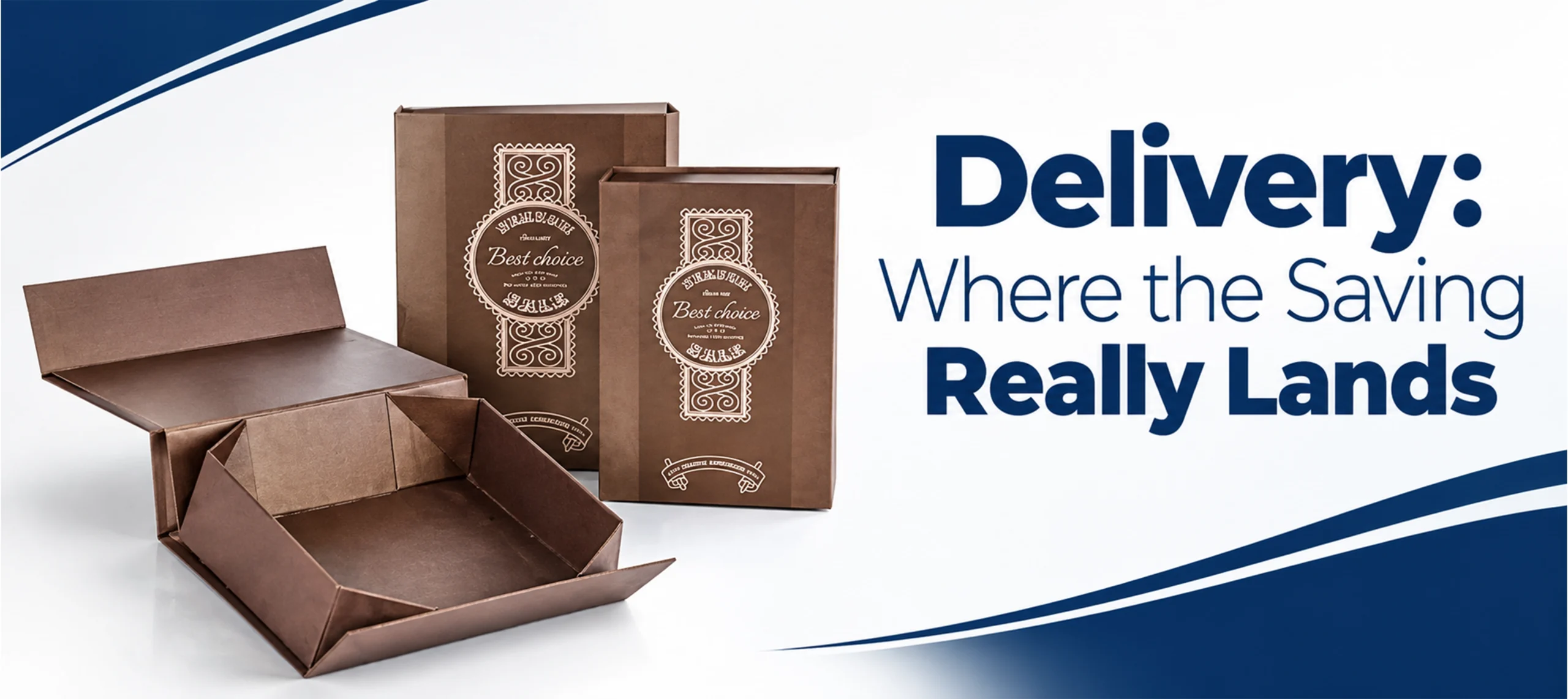
Much of the comparison online is written for importers paying freight by volume, where flat boxes cut shipping costs sharply. In the UK the picture can be different. With us, UK delivery is free, so the bulk of fixed boxes does not add to your delivery bill from us. The saving from collapsible then comes from storage, from moving stock between sites, and from how many boxes you can keep on hand.
Outbound postage is a separate question. A collapsible box is built before the product goes in, so if the two designs have the same made-up external dimensions and packed weight, choosing collapsible rather than fixed does not by itself reduce outbound postage.
The assembly step
A collapsible box has to be built before it can be packed. Building one by hand is quick, but the time adds up across an order, and it falls on the busiest days. Plan for it:
- When: build a batch ahead of packing, or build each box at the bench.
- Who: the same person who packs, or a separate pre-build step.
- Peak: in the busiest weeks, building boxes competes with packing time.
- Check: every wall must be fully locked. A half-closed magnet or a wall that is not seated leaves a soft corner.
If a fulfilment partner packs your orders, ask whether building a collapsible box is included in the pick-and-pack fee or charged as an extra assembly or kitting step. A storage saving can be partly offset by per-order assembly labour.
If your packing runs at speed, or you cannot spare the time in peak season, fixed boxes remove the step entirely.
Strength and heavy products
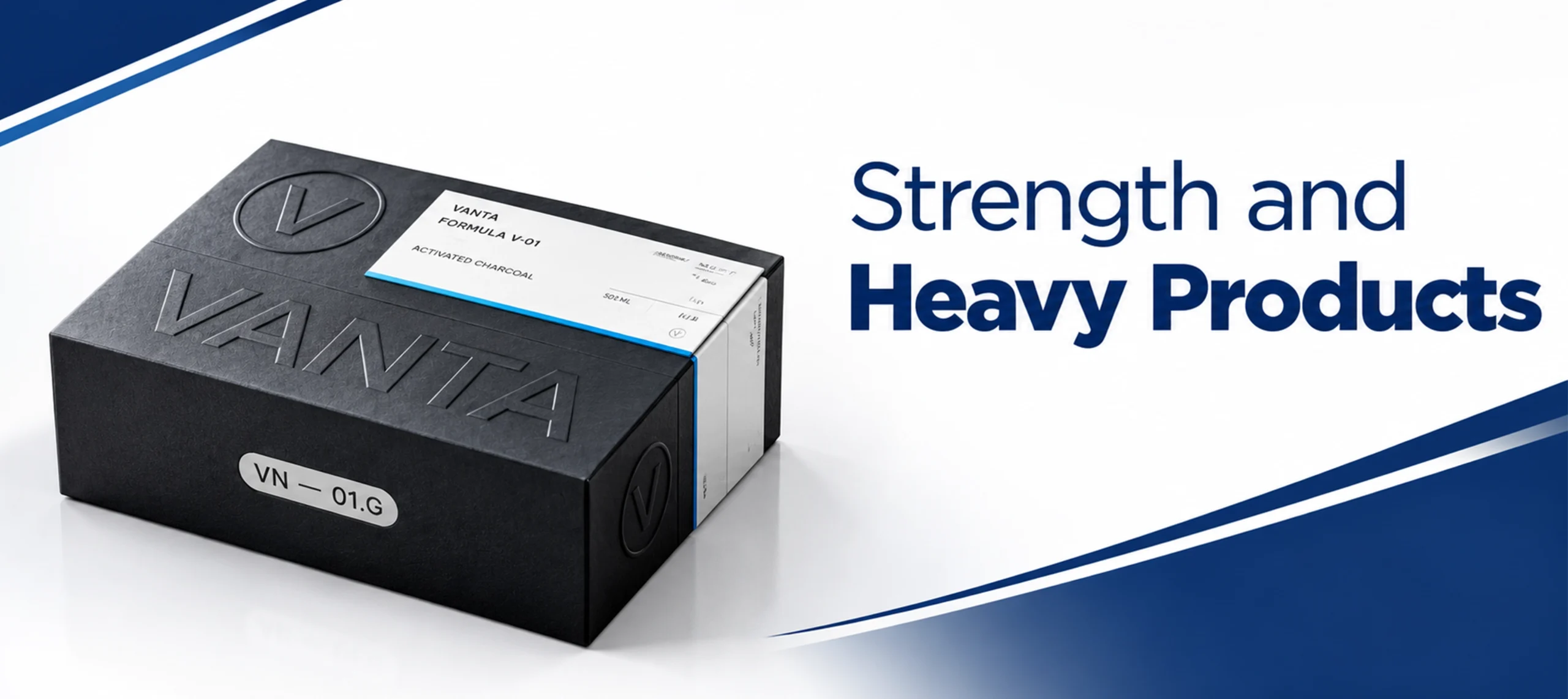
Once built and locked, a collapsible rigid box takes the same rigid form as a fixed one. The difference is at the corners: a fixed box has permanent corners, while a collapsible box relies on its hinges and the lock holding.
A collapsible build may suit many light and medium products, such as clothing, cosmetics, stationery and accessories, subject to the product weight, insert design and handling conditions. For heavy products, glass or boxes that will be stacked under weight, fixed rigid is the safer default. Either way, the build should be specified around what the product weighs and how roughly the box will be handled on its way to the customer.
Inserts and fit
Inserts behave differently in each build:
- A fixed box can have its insert fitted before it reaches you.
- With a collapsible box, the insert usually goes in after the box is built, which adds a step. Some designs build the insert into the base.
Die-cut inserts cut to your product’s dimensions keep the product in place in either build. Check the fit in a built sample, not only on the drawing, because a collapsible wall that sits slightly inward changes the space inside.
Reuse and end of life
A magnet-held collapsible box has an advantage after purchase. Customers can fold it flat and keep it, which suits gift boxes and products stored between uses. A fixed box is kept as a box or not at all.
At end of life, magnets are the complication. Metal parts usually need to come out before the board can go for paper recycling, so check local guidance. An unlaminated paperboard construction may be easier to process through suitable paper-recycling streams than a heavily laminated alternative. Final recyclability depends on the full material and finishing specification and the facilities available locally.
Decision table
| Your situation | Usually the better choice |
|---|---|
| Storage space is tight, or stock sits with a fulfilment warehouse | Collapsible |
| Large orders you draw down over months | Collapsible |
| Heavy, fragile or stacked products | Fixed |
| High-volume packing or peak-season pressure | Fixed |
| Customers keep and store the box | Collapsible, magnet-held |
| Lift-off lid or drawer style | Fixed |
| Small first order, quick use | Fixed |
Test a sample before you commit
Ask for a sample of the build you are considering, then:
- build it several times and fold it again, if it is magnet-held
- pack your heaviest product and press the corners
- time how long it takes to build and pack
- look at the fold lines and corners in good light
Every order is approved before bulk production. Approval may be based on a digital 3D mock-up, a video of the physical sample, or a physical production sample, depending on the order. A physical sample is paid for, and its cost and timing are confirmed when you get a quote.
Collapsible and fixed rigid boxes with us
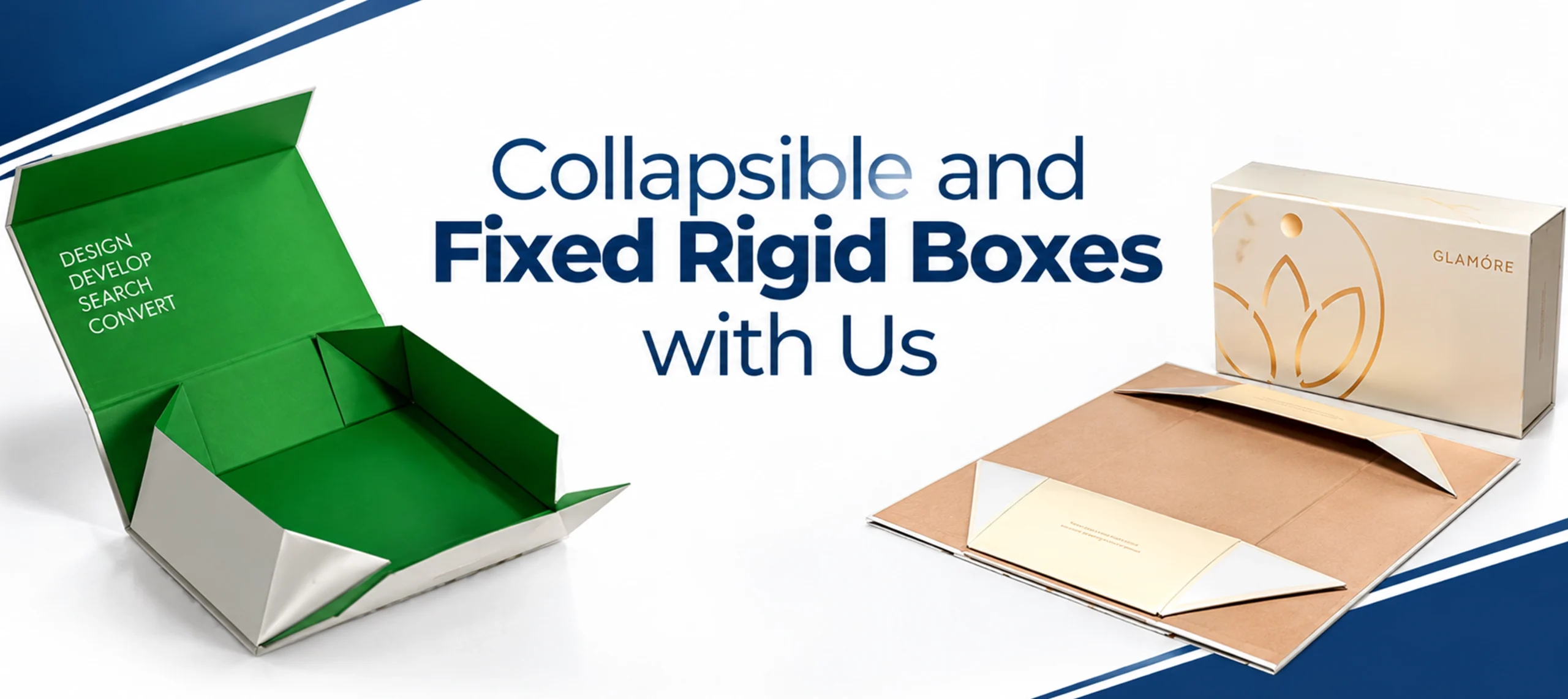
We make both. Our rigid boxes are supplied made up, and magnetic closure rigid boxes are also available.
For the fold-flat option, our custom collapsible rigid boxes give the same rigid look once built and stay flat until you need them. Tell us the product, its weight, how many boxes you will store at once and how you pack, and we will recommend a build.
- Orders start from 100 units.
- Design support is free.
- A digital 3D mock-up is free.
For how the boxes themselves are made, see how rigid boxes are made.
Collapsible rigid box questions
Is a collapsible rigid box as strong as a fixed one?
Once built and locked, it takes the same rigid form. Fixed corners are permanent, so for heavy or stacked products a fixed box is the safer default.
Do collapsible rigid boxes save money?
They save space. Whether that saves money depends on what your storage costs and how you pay for delivery. They also add an assembly step, which costs time, or a fee if a fulfilment partner charges for it.
Can a collapsible rigid box be folded flat again?
If the walls are held by magnets, usually yes. If they are locked with adhesive on first assembly, no. Ask which build a quote uses.
Does a collapsible box change my postage?
Not by itself. It is built before packing, so if both designs have the same made-up external dimensions and packed weight, the outbound postage is the same.
Can customers tell the difference?
Usually not from the outside once built. Look closely at the corners and fold lines on a sample to judge for your product.
Which is better for gift boxes?
Collapsible, magnet-held boxes suit gifts that customers keep and store. Fixed boxes suit heavier gift sets and lift-off lid styles.
Not sure which build suits your product? Send us the product size and weight, how many boxes you need to store, and how you pack, and we will recommend one.