
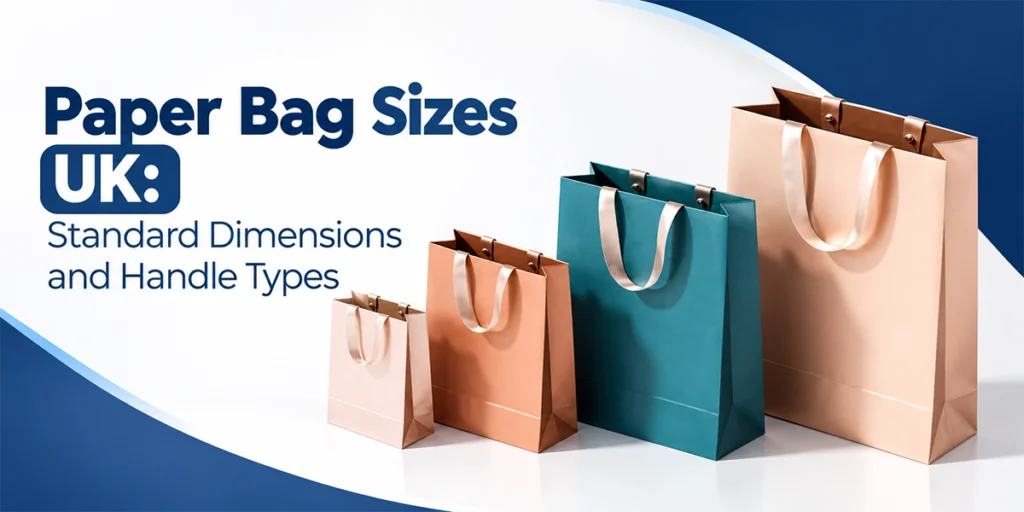
Paper Bag Sizes UK: Standard Dimensions and Handle Types
Quick answer: UK paper bags are quoted as width x gusset (depth) x height in millimetres. Common retail sizes run from a small boutique bag around 190 x 80 x 210 mm, through a medium 240 x 110 x 310 mm, up to a large carrier around 320 x 140 x 420 mm. Handle-free bakery bags and single-bottle wine bags sit outside that range. The size you need depends on what goes in, and the handle depends on how it will be carried.
If you have searched for paper bag sizes UK and found a wall of numbers with no explanation, this guide fixes that. Below are the real dimensions in mm, what the middle number actually means, how the bag is built, the handle options, and a plain table matching a size to the thing you are selling.
How to read a paper bag size
Three numbers, in this order: width, then gusset, then height. Width is the front panel across the top. The gusset is the depth, the pleated side panel that lets the bag open out and stand up. Height is top to bottom, not counting the handle.
Here is the trap the size charts never warn you about. Suppliers do not all list those three numbers in the same order. One site quotes a bag as 190 x 80 x 210 (width x gusset x height); another lists the identical bag as 190 x 210 x 80 (width x height x gusset). Same bag, two different-looking sizes. Before you order, confirm which figure is the gusset, because a 80 mm gusset and a 210 mm gusset are very different bags. When in doubt, the gusset is almost always the smallest of the three.
One more habit worth borrowing: add a little room. A bag sized exactly to your product is hard to fill and looks strained at the top. Roughly 10 percent of extra height and gusset gives tissue paper and fingers somewhere to go.
Standard UK paper bag sizes in mm
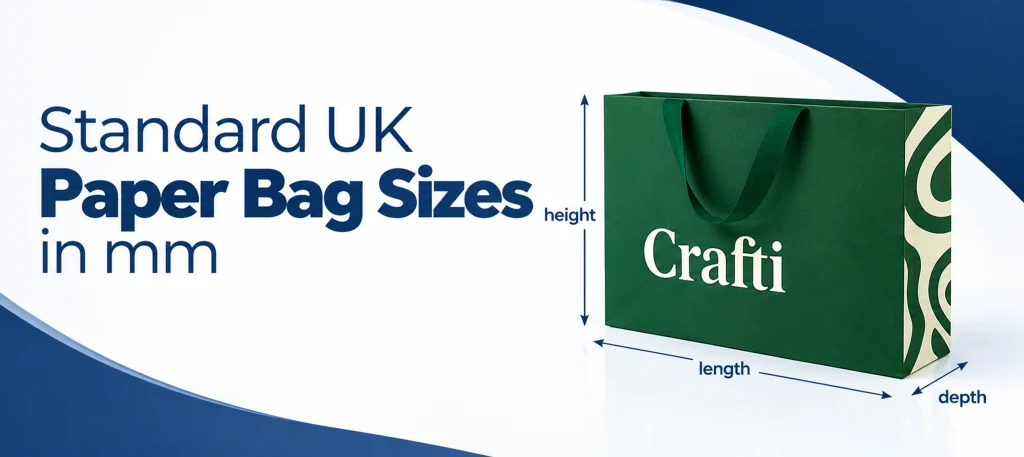
The figures below are typical UK trade sizes, cross-checked across UK suppliers and normalised to width x gusset x height in millimetres. They are a starting point for choosing, not a fixed catalogue, since a custom bag can be built to your own dimensions.
Twisted handle carrier bags
| Size | Dimensions (W x G x H) | Typical use |
|---|---|---|
| Small | 190 x 80 x 210 mm | Jewellery, cosmetics, confectionery, small gifts |
| Medium | 240 x 110 x 310 mm | Boutique standard, books, candles, a folded top |
| Large | 320 x 140 x 420 mm | Folded garments, homeware, a boxed bottle |
Flat tape handle carrier bags
| Size | Dimensions (W x G x H) | Typical use |
|---|---|---|
| Small | 218 x 120 x 270 mm | Takeaway, deli, retail counter |
| Medium | 254 x 140 x 295 mm | Larger takeaway, mixed retail |
| Large | 305 x 127 x 406 mm | Bulky or taller items |
Handle-free and single-purpose bags
| Size | Dimensions (W x G x H) | Typical use |
|---|---|---|
| Small | 150 x 65 x 305 mm | Bakery, pastries, sandwiches |
| Medium | 175 x 115 x 345 mm | Greengrocer, market stall, pharmacy |
| Large | 215 x 90 x 385 mm | Larger loaves, mixed produce |
| Extra large | 260 x 130 x 405 mm | Multiple items over the counter |
| Wine bottle | 110 x 85 x 360 mm | One standard 750 ml bottle, upright |
SOS, flat and satchel construction: what the shapes mean
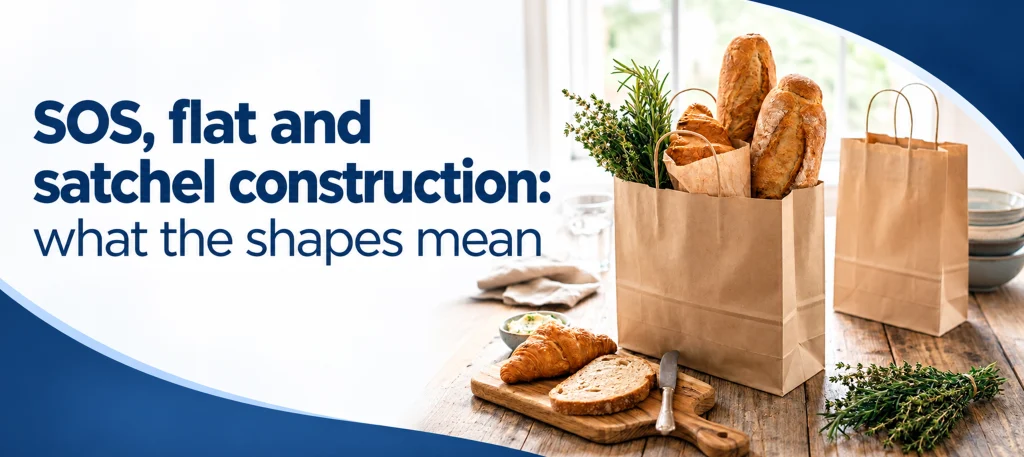
Most people meet the letters “SOS” on a bakery bag and never learn what they stand for. SOS means self-opening satchel (sometimes written self-opening sack). It describes how the bag is built, not how big it is.
An SOS bag has a flat, glued block bottom and pleated side gussets. Because of that base, it springs open with a flick and stands square on the counter, so you can fill it one-handed while the other hand holds the next item. The flat bottom gives it a box-like volume, which is why it suits bakeries, delis and takeaways. Twisted and flat tape handle carrier bags are usually built on the same block-bottom principle, just with a handle added and a heavier paper.
A flat or satchel-style paper bag has no gusset, or only a narrow one. It lies flat, takes up almost no shelf space, and suits flat items like prints, cards, garments folded once, or a single book. It will not stand up on its own and holds less than its height suggests.
Knowing the construction matters more than the outside dimensions. Two bags can share a height and hold very different amounts, because the gusset is where the volume lives.
Paper bag handle types
There are three handle styles plus the handle-free option, and each sends a different signal at the point of sale.
- Twisted paper handle. A rope-like handle made from tightly twisted kraft paper, glued inside the top. It is the strongest of the paper handles and reads as premium, which is why boutiques and gift shops favour it. Best on medium to heavy carrier bags.
- Flat tape handle. A flat ribbon of paper that sits flush against the bag. It is neat, quick to grab across a counter, and the usual choice on SOS takeaway and food bags. Slightly less load-bearing than a twisted handle at the same paper weight.
- Die-cut (punch-out) handle. No separate handle at all: an aperture is cut straight into the top of the bag, sometimes with a reinforcing patch. It keeps the bag flat-packable and economical, and looks clean on gift and retail bags. Not for heavy loads.
- Handle-free (SOS). The open-top bakery and deli bag. No handle because it is filled and carried over a short distance, or dropped into a larger carrier.
Match the handle to the weight and the journey. A twisted handle earns its place on a bag someone carries down the high street; a die-cut handle is plenty for a light gift picked up at a till.
GSM ranges and what each weight suits
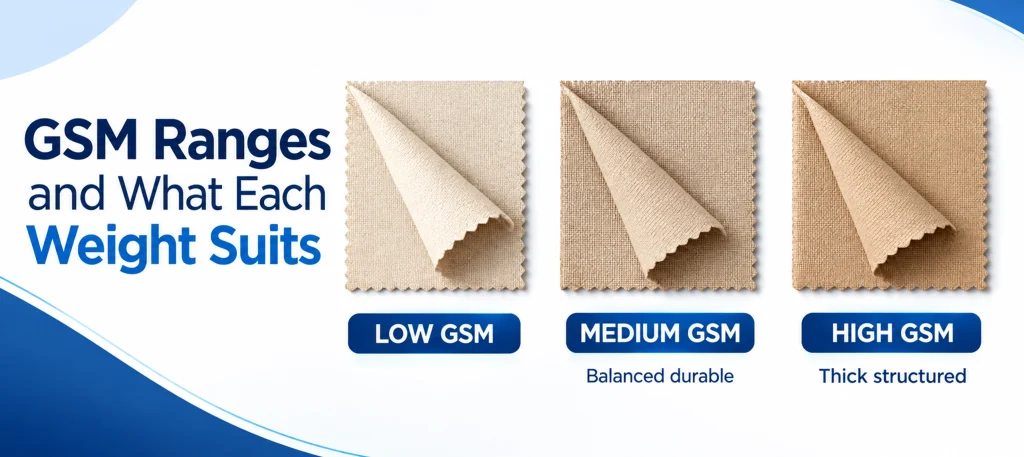
GSM is grams per square metre, the standard way to describe paper weight. Higher GSM means thicker, stiffer, stronger paper. As a general industry guide, paper carrier bags tend to fall in these bands:
- Around 80 gsm: lighter kraft, medium-duty bags and everyday takeaway.
- Around 90 to 110 gsm: the workhorse range for tape and twisted handle carrier bags that need to hold real weight.
- 120 gsm and up: premium boutique bags, often laminated, for a rigid, structured feel.
Treat those as orientation, not a rule. The right weight is chosen around the product’s weight and how the bag will be carried. A light candle in a small bag and a pair of boots in a large one call for different paper, even at the same footprint. Kraft has a brown base that mutes printed colour, especially pale tones, which is worth knowing before you design artwork for a natural bag.
On disposal: an unlaminated kraft paper bag may be easier to process through suitable paper-recycling streams than a laminated or heavily coated alternative, though final recyclability depends on the full material and finishing specification and the facilities available locally.
Which paper bag size fits what
A quick map from a common item to a sensible starting size. Add the 10 percent breathing room mentioned earlier before you commit.
| What you are packing | Sensible starting size (W x G x H) | Handle |
|---|---|---|
| Jewellery, small cosmetics | 190 x 80 x 210 mm | Twisted or die-cut |
| A candle or a small hamper item | 240 x 110 x 310 mm | Twisted |
| A folded t-shirt or knitwear | 320 x 140 x 420 mm | Twisted |
| A shoebox | 320 x 140 x 420 mm | Twisted or flat tape |
| A single wine bottle | 110 x 85 x 360 mm | Handle-free bottle bag |
| Pastries, sandwiches | 150 x 65 x 305 mm | Handle-free SOS |
| Takeaway containers | 218 x 120 x 270 mm | Flat tape |
If your product is an awkward shape, or you are packing several items together, the gusset is the number to grow first. Depth buys volume without making the bag look oversized on the shelf.
A note for buyers reading US guides
Many paper bag guides online are written for the US market. They size bags in inches and often label grocery bags by a number or a pound rating, such as a “#8” or an “8 lb” bag, a system tied to old flour-sack capacities. That numbering does not map cleanly to UK ordering. In the UK, work in millimetres and in width x gusset x height, and ignore the pound and hash numbers unless you are buying from a US supplier.
Ordering custom paper bags
Standard sizes are a fine place to start, but they rarely fit a specific product perfectly, and the gap is where a bag looks either strained or half empty. If you would like paper bags built around your own product, in your size and with the handle that suits how customers will carry them, our team can help. We can also reserve clean panels in the artwork for the wording your product needs to display.
Design support is free, so you can see the bag laid out to the dieline before anything is produced. Orders start from 100 units. If you want to talk sizes, our Paper Bags range is a good place to see the styles, from twist handle paper carrier bags to bakery paper bags and small paper carrier bags with handles.
Frequently asked questions
What are the standard paper bag sizes in the UK?
Retail carrier bags cluster around three sizes, all quoted as width x gusset x height. Small is roughly 190 x 80 x 210 mm, medium about 240 x 110 x 310 mm, and large near 320 x 140 x 420 mm. Bakery, deli and single-bottle wine bags sit outside that range in their own dedicated sizes.
What does SOS mean on a paper bag?
SOS stands for self-opening satchel. It refers to a bag with a flat glued block bottom and pleated side gussets that springs open and stands up on its own, so it can be filled one-handed. It describes the construction, not the size, and it is the classic bakery and takeaway shape.
Which paper bag handle is the strongest?
At the same paper weight, a twisted paper handle carries the most, because the twisting reinforces the kraft and it is glued into the top of the bag. A flat tape handle is neat and quick to grab but slightly less load-bearing, and a die-cut punch-out handle suits lighter items only.
What GSM should a paper bag be?
As a general guide, everyday bags use around 80 gsm, carrier bags that hold real weight use roughly 90 to 110 gsm, and premium laminated boutique bags run 120 gsm and up. The correct weight is chosen around your product’s weight and how the bag is carried, rather than a single fixed number.
How do I measure a paper bag for my product?
Measure your product’s width, depth and height, add about 10 percent to the height and the gusset so the bag is easy to fill, and match those to a size quoted as width x gusset x height. If the product is bulky or you are packing several items, increase the gusset first, since depth is where the volume sits.