
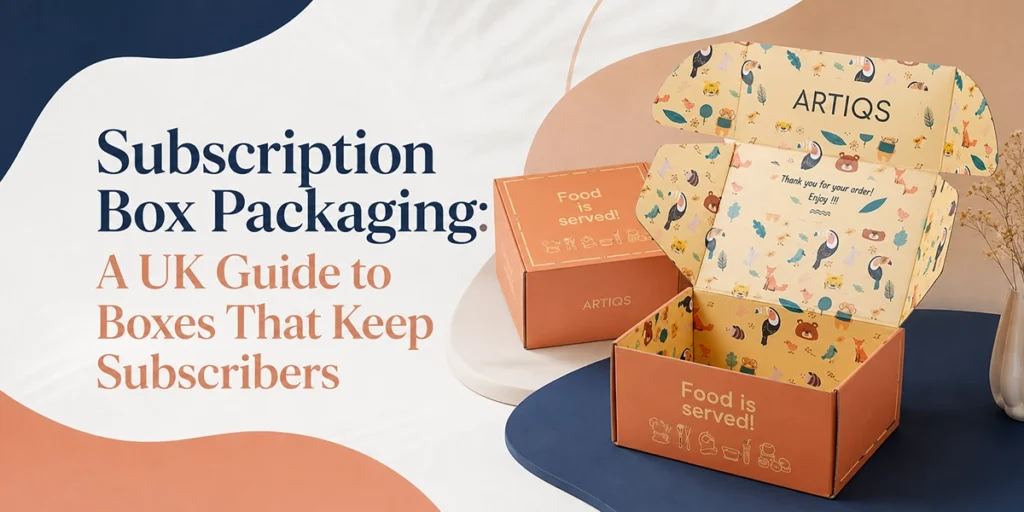
Subscription Box Packaging: A UK Guide to Boxes That Keep Subscribers
Quick answer: For most UK subscription boxes, a corrugated mailer box is the right choice. Keep it within Royal Mail’s large letter limit (35.3 x 25 x 2.5 cm, up to 750g) and you’ll pay from £1.55 to £3.75 per delivery instead of £4.39 or more for a small parcel. Print the inside, add one insert, and test your first design with a 100-unit run before committing to thousands.
Around 29% of Brits now subscribe to a box delivery service, according to Whistl’s 2025 subscription research. That’s a crowded doormat. Your box lands next to someone else’s every month, and the subscriber decides within seconds whether this still feels worth £25.
Packaging is the only part of your product a subscriber touches twelve times a year. Get the size wrong and postage quietly eats your margin. Get the experience wrong and churn does the same, just slower. This guide covers both: the maths and the design.
We supply packaging to UK subscription brands from our London base, so the examples below come from real orders. Prices vary by size, material and quantity, and the worked figures are illustrative rather than quotes.
Why is the mailer box the workhorse of subscription packaging?
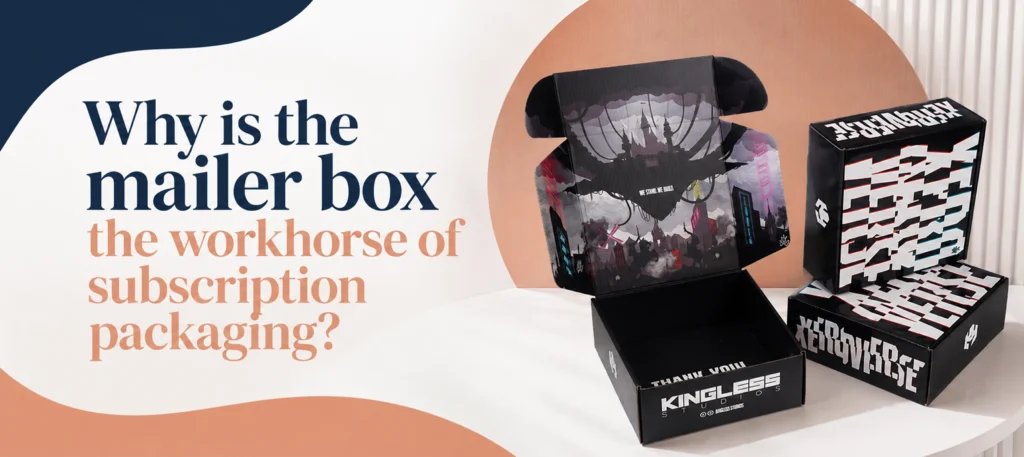
A corrugated mailer box does three jobs at once: it survives the post, opens like a gift, and prints well inside and out. That’s why beauty, snack, book and wellness subscriptions almost all ship in one. No tape, no scissors, no bubble wrap apology.
The style most suppliers recommend is a roll end tuck front mailer. In plain words: one piece of corrugated board that folds into a box with a built-in lid and locking flaps. The lid opens flat, so the first thing your subscriber sees is your interior print, not a wall of brown tape.
Compare the alternatives. A plain shipping box protects well but unboxes like a warehouse delivery. A rigid gift box looks premium but costs several times more and rarely survives twelve postal journeys at an acceptable price. A poly mailer is cheap but offers no structure and no unboxing moment. The mailer box sits in the sweet spot, which is why it’s the default for subscription work.
One caveat here: if your product is genuinely flat, like prints, socks or tea sachets, a slim mailer built for the letterbox beats everything else on cost. That’s the next section.
Letterbox or courier: the size decision that sets your margins
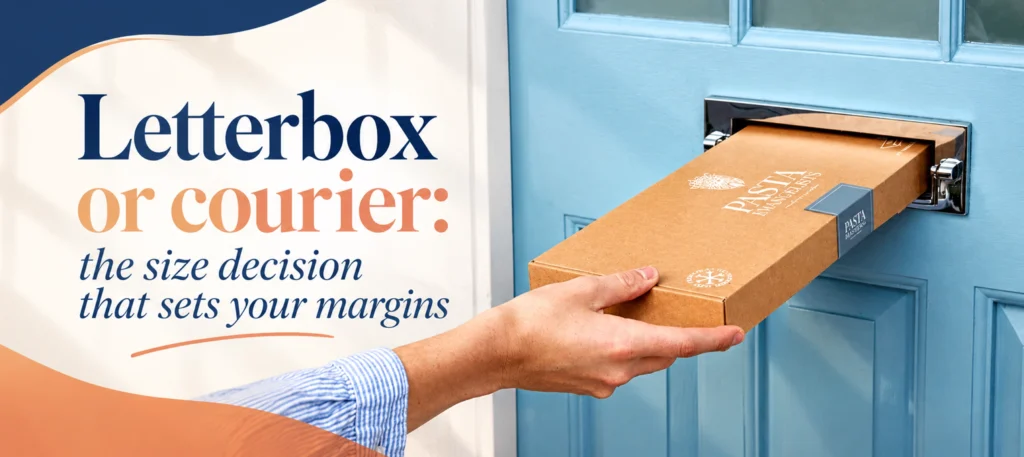
Royal Mail prices by format, not just weight. An item counts as a large letter up to 35.3 x 25 x 2.5 cm and 750g. Go over any one of those limits and it becomes a small parcel (up to 45 x 35 x 16 cm, 2kg), which costs more on every single delivery. The limits are published on Royal Mail’s size guide at royalmail.com.
Here’s what that means in stamp prices from 7 April 2026:
| Format | Max size | Weight band | 2nd Class | 1st Class |
|---|---|---|---|---|
| Large letter | 35.3 x 25 x 2.5 cm | up to 100g | £1.55 | £2.20 |
| Large letter | 35.3 x 25 x 2.5 cm | up to 250g | £2.20 | £2.70 |
| Large letter | 35.3 x 25 x 2.5 cm | up to 500g | £2.85 | £3.40 |
| Large letter | 35.3 x 25 x 2.5 cm | up to 750g | £3.75 | £4.45 |
| Small parcel | 45 x 35 x 16 cm | up to 1kg | £4.39 | £4.99 |
| Small parcel | 45 x 35 x 16 cm | 1 to 2kg | £5.95 | £6.85 |
Source: Royal Mail prices effective 7 April 2026 (royalmail.com/prices2026). Business account rates differ, usually downwards, but the format gap stays.
Two things jump out. First, a 500g letterbox box posts for £2.85 while the same weight as a small parcel costs £4.39. That’s £1.54 saved on every delivery, forever. Second, the 2.5 cm thickness limit is brutal. A box that measures 2.7 cm packed pays parcel rates. We’ve seen brands lose the letterbox rate to a generous handful of shredded paper.
So which format should you pick? Ask three questions:
- Does the product physically fit under 2.5 cm? Measure the packed box, not the product. Board thickness counts. An E-flute mailer wall is roughly 1.5 mm, so budget about 3 mm of your height for the box itself.
- Will it stay under 750g packed? Weigh product, box, insert and tissue together.
- Does letterbox delivery suit the customer? No missed-delivery cards, no porch theft, no waiting in. For subscriptions this is a retention feature in its own right, not just a cost saving.
If the answer to the first two is no, don’t force it. A crushed product costs more than the postage difference. Move to a compact parcel-format mailer and make the unboxing earn the extra postage.
What does packaging really cost per subscriber? The monthly maths
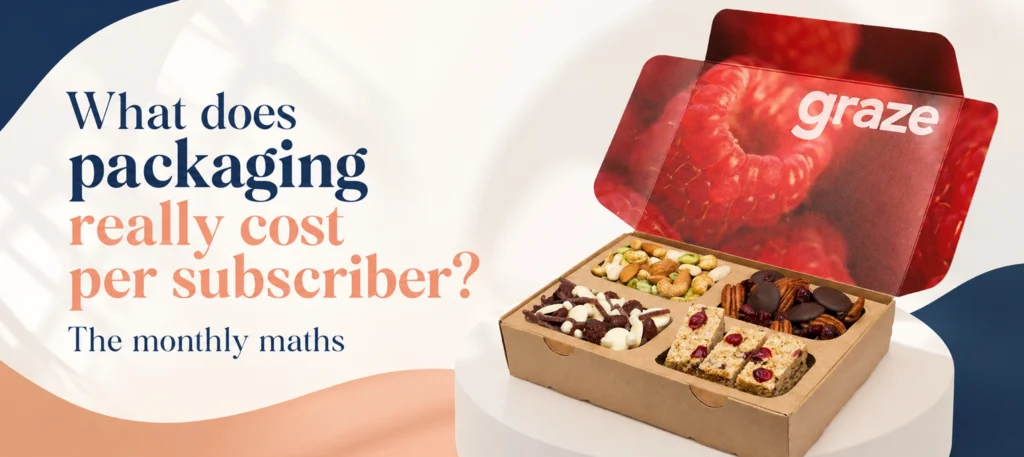
Subscription packaging is a recurring cost, so small unit differences compound hard. A £1.89 saving per delivery is worth £11,340 a year to a 500-subscriber box. Here’s a worked example, and every figure in it is illustrative. Real prices depend on size, board grade, print and quantity.
Say you run a £24.99-a-month box with 500 subscribers, and you’re choosing between two designs:
- Letterbox route: a 33 x 23 x 2.5 cm printed E-flute mailer at around £1.10 a unit, posted 2nd Class as a 500g large letter at £2.85. Total £3.95 per delivery.
- Courier route: a 30 x 22 x 10 cm printed mailer at around £1.45 a unit, posted 2nd Class as a small parcel at £4.39. Total £5.84 per delivery.
The difference is £1.89 per box. Across 500 subscribers and twelve months, that’s £11,340 a year. Same product, same subscriber, different box height.
Now the churn side, because cheap isn’t the whole story. At 8% monthly churn, your average subscriber stays about 12.5 months. If a better interior, a printed insert and decent tissue add £0.35 a box but help nudge churn to 7%, the average stay stretches to about 14.3 months. That’s roughly £45 more revenue per subscriber against about £5 more packaging spend over their lifetime.
Worth knowing: nobody can promise packaging alone will move churn by a point. Product quality and value perception do the heavy lifting. But packaging is the cheapest lever you control every single month, and the maths only needs a small nudge to pay for itself.
Will your box survive the twelfth trip?
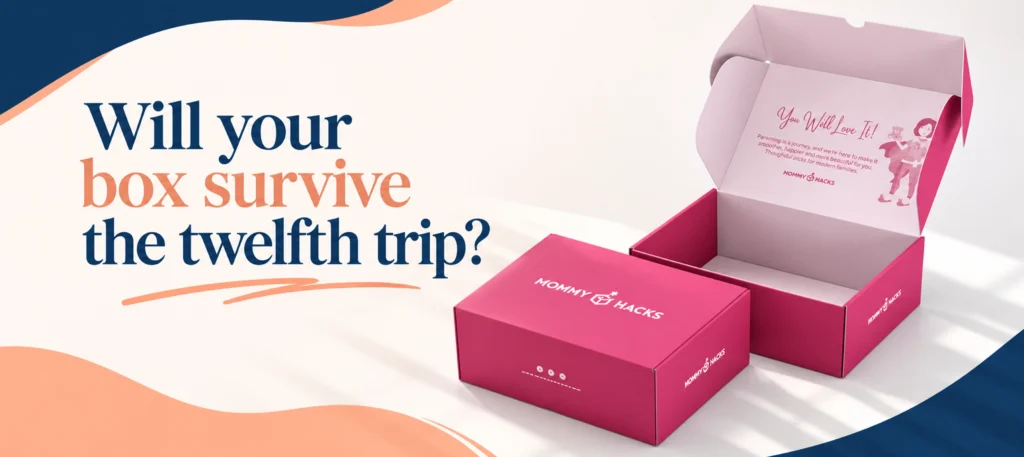
Durability matters more for subscriptions than for one-off e-commerce, because a subscriber who receives one crushed box starts wondering about next month. Corrugated board is the answer, and the grade matters.
For letterbox formats, E-flute corrugated is the standard: thin enough to protect the 2.5 cm budget, stiff enough to shrug off a letterbox shove. For parcel formats carrying jars, bottles or anything over about 1kg, step up to B-flute single wall. Flute, if the jargon’s new, is the wavy layer between the flat sheets that gives corrugated board its strength.
Three supplier-side observations from subscription orders we’ve produced:
- Self-locking beats tape. Tuck-flap mailers hold shut without tape, so there’s nothing to tear badly or look scruffy on arrival.
- Print inside the lid survives; stickers on the outside suffer. Outer surfaces get scuffed in the post. Put the beauty inside.
- Snug beats padded. A box sized to the contents needs little or no void fill, weighs less, and posts cheaper. Over-spec wastes money twice: on board and on postage.
How do you design the interior for retention?
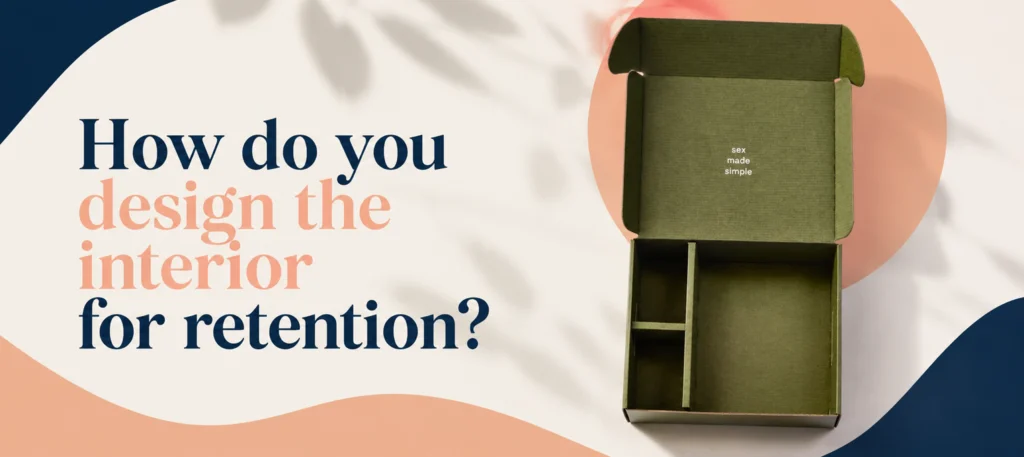
Open flat, look up: the inside lid is the largest printed surface your subscriber sees, and most brands leave it brown. Interior print costs little extra on a custom mailer because the sheet is printed before it’s cut and folded. Use it.
What actually earns the next renewal:
- Inside-lid print. A pattern, a message, or this month’s theme. It’s the first thing seen on every open.
- An insert card. A card that lists what’s in the box and why. It frames value, and perceived value is what subscribers weigh at cancellation time. Our guide to product packaging design covers the design principles.
- Tissue paper and a sticker seal. The two-second ritual of breaking a sticker and folding back tissue is most of what people mean by “unboxing”. Printed stickers and labels cost pennies each at volume.
- Kitting order. Kitting is just the packing sequence. Hero item on top, consumables underneath. The first thing seen should be the thing they’d photograph.
None of this requires a bigger budget so much as a deliberate one. A plain outer with a considered interior beats a glossy outer hiding a jumble.
Seasonal variation without a full redesign
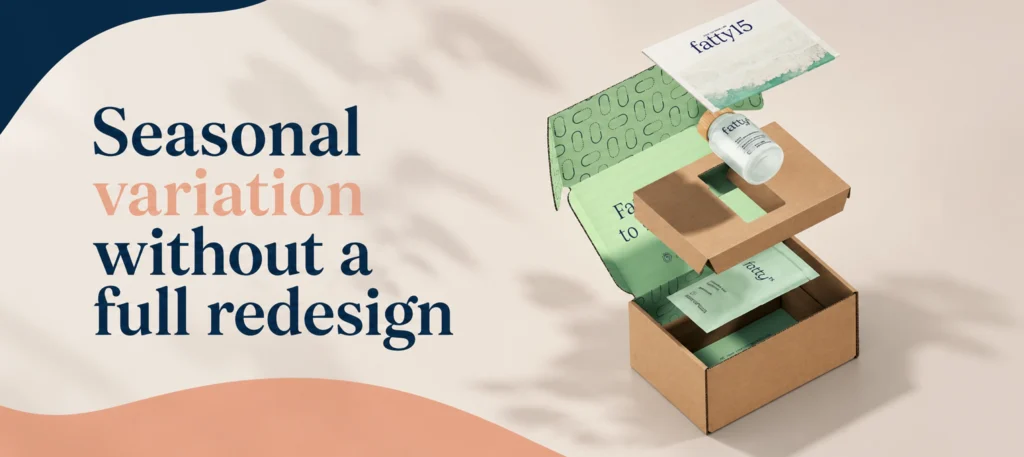
You don’t need twelve box designs a year. You need one well-designed box and cheap ways to make each month feel different. Reprinting a new box design monthly multiplies plate, proof and stock costs for little retention gain.
The layered approach works better:
- Keep the outer box constant for brand recognition on the doormat.
- Rotate tissue paper colour or print seasonally. Four variants a year is plenty.
- Swap the sticker seal monthly. It’s the cheapest item in the box.
- Change the insert card every month. It’s the natural home for themes, letters and next-month teasers.
- Reserve one special edition a year, usually December, for a printed sleeve or a full alternate design.
This is also the honest way to test. If a seasonal tissue-and-sticker month lifts social shares, you’ve learned something for the price of tissue and stickers.
Testing with 100 units before you commit
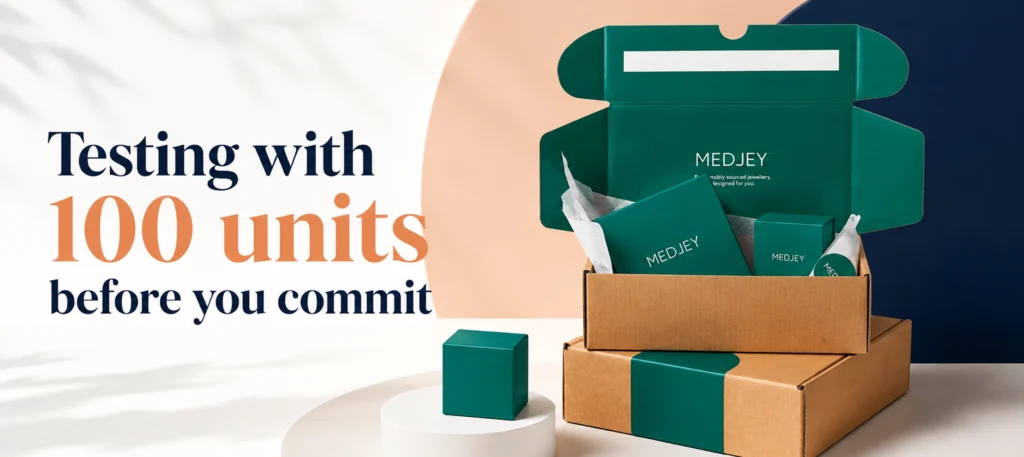
Most packaging suppliers ask for 500 to 1,000 units minimum, which forces a year’s commitment on an untested design. A 100-unit minimum order lets a subscription brand trial a box for one monthly cycle, read the response, and adjust before scaling.
First-hand example from our own order book: subscription founders who start with us typically run 100 to 250 units of a first design, then change something meaningful in the second order. The most common revision is height, almost always downwards, once the founder has packed a real month’s box and seen the empty space. The second most common is adding interior print after seeing the plain version land flat on camera.
That iteration is only affordable if the minimum run is small. At All Custom Packaging we print custom mailer boxes from 100 units with free design support and a 6 to 8 business day turnaround after design approval, which fits inside a monthly cycle. Prices vary by size and quantity, so a quick quote beats guesswork.
A practical test plan for a new box:
- Order 100 units of your best-guess design.
- Pack a full month’s box. Weigh it. Check the format on Royal Mail’s size guide.
- Film an unboxing on a phone. If the reveal looks flat, fix the interior, not the outer.
- Reorder with revisions at your real monthly volume.
Honest eco choices for subscription boxes
Subscribers see your packaging twelve times a year, so a vague green claim gets twelve chances to be questioned. Be specific instead. Corrugated and kraft board are widely recycled in UK kerbside collections, and that’s a claim you can make plainly: recyclable, paper-based, kerbside-collected.
Three UK specifics worth building into your decisions:
- Skip the plastic where you can. Paper tape, paper void fill, no laminated window film. The UK’s Plastic Packaging Tax applies to plastic packaging with less than 30% recycled content, and the simplest position for a cardboard-led subscription box is to have little plastic in the first place (see GOV.UK’s Plastic Packaging Tax guidance).
- Know your EPR position. Extended Producer Responsibility makes producers pay towards packaging waste. Obligations start at £1 million turnover and 25 tonnes of packaging handled a year, so most young subscription brands are below the line, but check GOV.UK’s EPR guidance as you scale. Rules change; we inform, we don’t give legal advice.
- Say the disposal route, not a slogan. “Recyclable kerbside” beats “eco-friendly” because your subscriber can act on it. Our guide to biodegradable packaging types explains why recyclable, biodegradable and compostable are legally different claims.
A snug box in plain recyclable corrugated with paper accessories is a genuinely defensible eco position for a UK subscription brand. It’s also, conveniently, the cheap one.
Frequently asked questions
What size should a subscription box be?
As small as safely fits a full month’s contents. Measure your packed items, add about 1 cm of clearance each way, and check the result against Royal Mail formats. If you can get under 35.3 x 25 x 2.5 cm and 750g packed, letterbox postage saves £1.50 or more per delivery.
Can a subscription box fit through a UK letterbox?
Yes, if the packed box stays within Royal Mail’s large letter limit: 35.3 x 25 x 2.5 cm and 750g. The 2.5 cm thickness is the tight constraint. Slim E-flute mailers are made for exactly this, and letterbox delivery means no missed-delivery cards for the subscriber.
How much does subscription box packaging cost in the UK?
For custom printed corrugated mailers, expect roughly £0.70 to £2.50 a unit depending on size, board and quantity, plus postage of £1.55 to £5.95 per delivery at 2026 Royal Mail 2nd Class rates. Prices vary by size, print and volume, so treat these as ranges and get a quote.
What’s the best material for a subscription box?
Corrugated board. E-flute for slim letterbox designs, B-flute single wall for heavier parcel-format boxes. It’s light, stiff, prints well, survives repeat shipping and is recyclable in UK kerbside collections. Rigid board looks premium but rarely justifies its cost for a monthly shipment.
How many boxes should I order for a first run?
Order one monthly cycle’s worth, not a year’s. With a 100-unit minimum you can trial a design in one real shipping month, learn from packing and unboxing it, then revise. Most founders change their box, usually the height or the interior, after the first live month.
Do I need new packaging designs every month?
No. Keep the outer box constant and rotate the cheap layers: tissue colour, sticker seal and insert card. That gives each month a fresh reveal without new print plates or wasted stock, and one special edition a year covers the gifting peak.
Key takeaways
- Mailer boxes are the subscription workhorse: protective, printable inside, no tape needed.
- Royal Mail’s large letter limit (35.3 x 25 x 2.5 cm, 750g) is the line that decides your postage. Under it, from £1.55; over it, from £4.39 (2026 rates).
- Packaging costs recur: a £1.89 per-box difference is £11,340 a year at 500 subscribers.
- Spend on the interior. Inside-lid print, an insert and tissue are the retention layer.
- Test with 100 units for one cycle before committing to volume.
If you’re planning a subscription box, send us the product list and we’ll help you work out the format, size and a printed sample run from 100 units. Free design support included. Start with our custom mailer boxes or get in touch for a quote.