
Is It Safe to Microwave Cardboard? A UK Guide to Reheating Food Safely
You’ve got last night’s curry still in its takeaway box, no plate to hand, and the microwave door standing open. Is it safe to microwave cardboard, or is that a decision you’ll regret? Plain, uncoated cardboard can generally take a short blast on low power. Wax-coated, plastic-laminated or metal-sealed packaging can’t, and treating them the same way is where things go wrong.
Quick answer: Plain fibre cardboard with no shiny coating, foil or metal usually copes with brief microwave bursts (well under 2 minutes, low power). Wax, plastic laminate, glue seams and metal staples are where the real risks sit. If a box isn’t labelled microwave-safe, decant the food onto a proper plate instead, and check current FSA guidance for anything product-specific.
Key takeaways:
– Plain, uncoated cardboard usually tolerates short microwave bursts; coated or metal-sealed packaging doesn’t
– Wax, plastic laminate, metal seams and unlabelled inks are the actual hazards, not “cardboard” as a material
– UK food contact law sets a general safety standard, but there’s no FSA rule that names microwaving specifically
– Recycled cardboard carries its own, separate question around ink and fibre contamination
Can You Put Cardboard in the Microwave?
Yes, if it’s plain fibre with nothing else added. Cardboard and paperboard made from wood pulp or pure cellulose don’t contain anything that reacts badly to microwave energy on their own. The problem starts the moment something else gets added to that fibre.
Look at the box before you commit. No shiny or glossy finish, no metallic sheen, no visible staples or foil strips along the seams. If it ticks those boxes and the food inside has a reasonable amount of moisture, a short burst on a low setting is generally fine.
Worth knowing: an empty or nearly empty box heats up faster and less predictably than one with food in it, because there’s nothing absorbing the microwave energy. Never run a cardboard container empty just to warm it through.
What Actually Makes Cardboard Unsafe to Microwave?
The cardboard itself is rarely the problem. What’s laminated, glued or printed onto it usually is.
Wax and plastic coatings are the big one. Many takeaway boxes get a thin plastic or wax layer to stop grease soaking through, and that layer can melt under microwave heat and transfer straight into your food. If the box has any glossy or waterproof feel to it, treat it as unsafe unless it’s explicitly labelled otherwise.
Metal is the second. Staples, foil-lined seams and some metallic inks reflect microwave energy instead of absorbing it, which is what causes sparking and, in the worst case, a small fire inside the appliance. Pull out any visible staples before you even think about it.
Then there’s glue. Adhesives holding a box together can soften and release fumes under sustained heat. It’s not usually dramatic, but a fully sealed, glued container isn’t the same thing as loose, open cardboard.
The one that catches people out is PFAS grease-resistant coatings, a concern most older safety advice simply doesn’t mention. Some takeaway packaging still uses PFAS-based coatings (“forever chemicals”) to resist grease, and heat can speed up how much migrates into food. UK and EU regulation on PFAS in food contact materials is tightening but still evolving, so treat unlabelled boxes with a bit more caution rather than assuming either way.
Can Cardboard Catch Fire in the Microwave?
Yes, it can, though it’s not common with food-filled boxes used for short bursts. The risk climbs sharply if a box is dry, empty or left in far longer than it should be. Dry fibre with nowhere for the microwave energy to go can scorch, and in rare cases, ignite.
The fix is simple: never microwave an empty cardboard container, keep bursts short, and stay in the room while it’s running. If you see any smoke, sparking or a burning smell, stop the microwave immediately and don’t open the door until it’s cooled.
What Does UK Food Safety Law Actually Say About This?
UK law doesn’t have a rule that names microwaving cardboard specifically. What it does have is a general standard: under the Food Standards Agency‘s food contact materials regulations, anything intended to touch food must not endanger health or change the food in an unacceptable way (GOV.UK, Food Contact Materials Regulations).
That’s a broad legal bar, not a microwave-specific green light. “Food grade” or “food safe” packaging has been assessed against that standard for normal contact and storage, not necessarily for heating in a domestic microwave. Manufacturers that do want their packaging used that way will usually say so on the box itself, and that label is your most reliable signal.
We’d always point readers to check current FSA guidance directly rather than rely on any single article, this one included, for a final safety call on a specific product.
What About Recycled Cardboard, Is It Different?
It can be, mainly because of what’s already in the fibre before your food ever touches it. Recycled cardboard and its printing inks can carry mineral oil hydrocarbons, known as MOSH and MOAH, which have the potential to migrate into food under certain conditions. The EU issued recommendations on acceptable MOAH levels in food back in 2022, and monitoring has continued since, though this remains an evolving area rather than a blanket ban on recycled packaging.
There’s a separate, practical angle too. WRAP’s 2025 Recycling Tracker survey found that fibre-based packaging is the UK’s biggest missed recycling opportunity, with a significant share ending up contaminated and unrecoverable, often because of composite, waxed or plastic-coated formats that were never designed to be recycled in the first place (WRAP, Recycling Tracker Survey 2025).
The most common mistake we see brands make on food packaging artwork is treating “recyclable” and “food-safe for reheating” as the same claim. They’re not. If you’re specifying packaging for a food product, ask your supplier for verified food-grade material rather than assuming recycled content is automatically fine for direct, heated contact.
What About Pizza Boxes, Burger Boxes and Noodle Cartons?
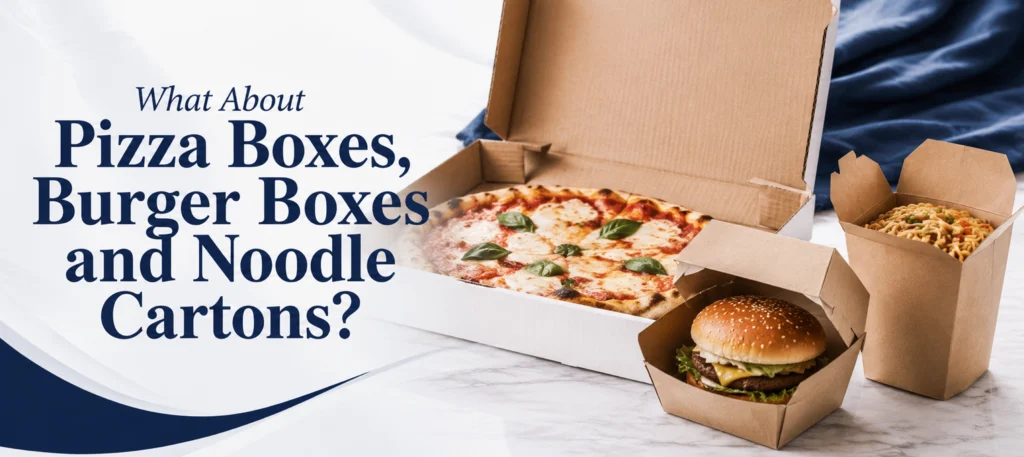
Pizza boxes are usually plain corrugated cardboard with no coating, which makes brief reheating reasonable. The grease-stained base can hide a plastic liner on some budget boxes though, so check before assuming.
Burger boxes vary more. Clamshell-style boxes sometimes use a thin foil or plastic laminate inside for insulation, which rules out the microwave entirely. Plain fibre burger boxes without that lining are more like a pizza box in behaviour.
Noodle and rice cartons are the trickiest of the three. Many are designed to be leakproof, which usually means a plastic or wax coating on the inside, exactly the layer that causes problems under heat. Unless the carton is clearly labelled microwave-safe, decant the contents instead.
If you’re sourcing any of these for your own food business, it’s worth specifying the coating and finish up front with your supplier. Our custom food boxes range is built around exactly this kind of clarity, so customers know precisely what they’re reheating in.
How to Microwave Cardboard Packaging Safely, If You Need To
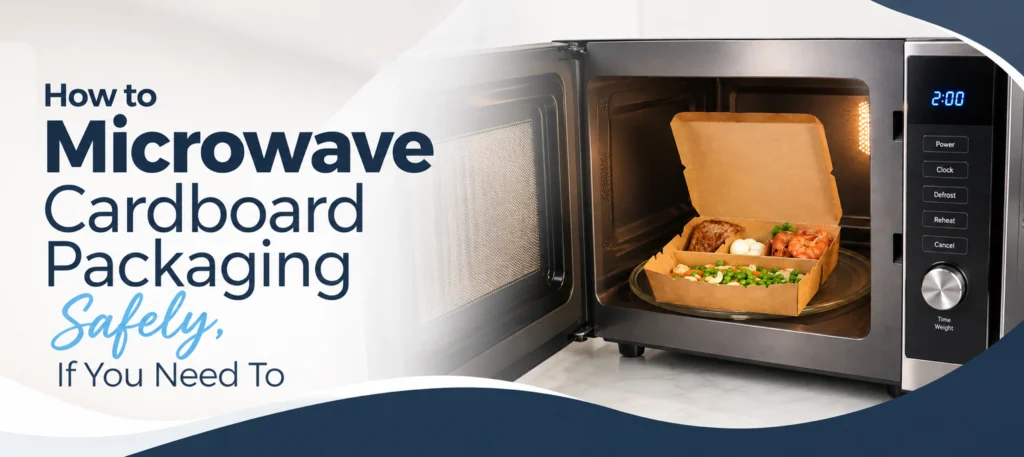
The safest approach with any unlabelled cardboard packaging is low power, short bursts under 2 minutes in total, with every piece of metal removed before you start. That single rule covers most of what goes wrong. Here’s the fuller six-step version.
1. Check for a label first. A “microwave-safe” mark on the box removes most of the guesswork.
2. Remove anything metal. Staples, foil strips, wire handles, take them all out before you start.
3. Use a low power setting. Full power heats coatings and glue faster than the food itself.
4. Work in short bursts. 20 to 30 seconds at a time, checking in between, staying well under 2 minutes total.
5. Never run it empty. Food and its moisture absorb the microwave energy; empty cardboard doesn’t.
6. Stop at the first sign of trouble. Smoke, sparking, a chemical smell or a scorched patch means stop immediately.
If any of that feels like too much faff for a Tuesday lunch, that’s a fair reaction. Tipping the food onto a ceramic plate takes ten seconds and removes the guesswork entirely.
Frequently Asked Questions

Can you microwave a pizza box?
Plain corrugated pizza boxes with no plastic liner can usually take a short, low-power burst. Check for a glossy inner coating first, and avoid it if the box isn’t labelled microwave-safe.
Is it safe to microwave a takeaway box?
It depends entirely on what the box is made from. Plain fibre is generally fine briefly; anything with a wax, plastic or foil lining should be avoided unless the label says otherwise.
How long can you microwave cardboard for?
Keep it well under 2 minutes total, ideally in 20 to 30 second bursts on a low setting, checking the food and box each time.
Does recycled cardboard release chemicals when microwaved?
It can carry mineral oil hydrocarbons (MOSH/MOAH) from recycled fibre and inks, which are monitored under evolving EU and UK standards. This is a genuine consideration, not a reason to avoid all recycled packaging outright.
What should I do if my cardboard box has no microwave label?
Transfer the food to a proper microwave-safe plate or bowl. It takes moments and removes any doubt about coatings, glue or metal you can’t easily check for yourself.
The Bottom Line
Cardboard itself isn’t the villain here. What’s added to it usually is. Plain, uncoated fibre handles short microwave bursts reasonably well, while wax, plastic laminate, metal seams and unlabelled inks are where the genuine risk sits. Recycled content raises a separate question again, around fibre and ink contamination rather than the material itself.
If you’re a food business choosing packaging rather than a home cook reheating leftovers, the fix is upstream: specify verified food-grade material and the right finish for how your customers will actually use the box. Our team can talk you through material options for your specific product, from coated to plain kraft. Get a free quote and we’ll help you land on packaging that does its job without any guesswork at the microwave. For more on sustainable material choices, see our guide to different types of biodegradable packaging.