
Manila Envelope Sizes UK: The C-Series Dimensions, GSM and Royal Mail Postage
Quick answer: In the UK a manila envelope is sized on the ISO C-series, and the common document size is the C4 at 229 by 324mm, which holds an unfolded A4 sheet. “Manila” is a material, not a size. It is the buff, light-brown kraft-style paper the envelope is made from, so a “manila envelope” can be a DL, a C5, a C4 or a board-backed mailer, depending on what you are posting. The size that quietly decides your cost is the Royal Mail format. A thin DL or C5 within 240 by 165 by 5mm and 100g posts at the cheapest Letter rate, while a filled C4 is wider than 165mm and posts as a Large Letter, and a board-backed or bulky gusseted envelope can tip into parcel pricing.
Most “manila envelope” guides online are written by US suppliers. They give sizes only in inches, such as 9 by 12in and 10 by 13in, with no millimetres, no GSM and no Royal Mail rates. None of that matches how a UK buyer orders, or how Royal Mail charges. This guide gives the correct UK C-series sizes in mm and inches, explains the real manila envelope types, sets out sensible GSM ranges, translates the common US sizes so you can order the right UK equivalent, and answers the question no competitor covers for Britain: which postage format your envelope lands in, and how to keep it cheap.
Why “manila” is a material, not a size

The first thing to fix is the word itself, because it causes half the confusion.
Manila is a paper, not a measurement. It is a strong, buff or light-brown paper with a smooth finish, traditionally named after Manila hemp, the fibre from the abacá plant first exported from the Philippines and once used to make the paper and the ropes it came from. Modern manila envelopes are made from wood-pulp kraft paper rather than hemp, but the name and the light-brown colour stuck. You can read the naming history in this account of why it is called a manila envelope. The practical point for a UK buyer is simple. When a supplier says “manila”, they are describing the paper and colour, so you still have to choose the size and the style separately.
That is where the UK and the US part company. American guides treat “manila envelope” as if it were one product at a fixed inch size, usually the 9 by 12in office envelope. In Britain, manila is one of several materials your envelope can be printed on, and the size comes from the ISO C-series that pairs with A-series paper. So the correct question is not “what size is a manila envelope”, it is “which C-series manila envelope do I need for the document I am posting”.
UK manila envelope sizes: the C-series in full

Here is the table the US guides do not print, because they are built around inches rather than the ISO sizes the UK actually uses. It gives each C-series size in mm and inches, the paper it holds, the manila format it usually comes in, an indicative weight, and the Royal Mail format it posts as. Every inch figure is converted straight from the millimetre figure.
| Envelope | Size (mm) | Size (inches, approx) | Paper it holds | Common manila format | Typical weight (gsm, indicative) | Posts as (Royal Mail) |
|---|---|---|---|---|---|---|
| DL | 110 x 220 | 4.3 x 8.7 | A4 folded into thirds | Wallet, plain or window | 80 to 100 | Letter, if under 5mm and 100g |
| C6 | 114 x 162 | 4.5 x 6.4 | A4 folded into quarters, or A6 | Wallet | 80 to 100 | Letter |
| C5 | 162 x 229 | 6.4 x 9.0 | A4 folded in half, or A5 | Wallet or pocket | 90 to 115 | Letter when thin and light, Large Letter once over 5mm or 100g |
| C4 | 229 x 324 | 9.0 x 12.8 | A4 flat, unfolded | Pocket, often board-backed | 90 to 120, board-backed heavier | Large Letter, parcel if thicker than 25mm or over 750g |
| C3 | 324 x 458 | 12.8 x 18.0 | A3 flat, or A4 with room to spare | Pocket or gusseted | 100 to 120 plus | Parcel, it is larger than the Large Letter limit |
The C4 is the manila envelope most UK businesses mean when they say “manila”. It carries an A4 sheet, a certificate or a contract flat and unfolded, which is why it is the default for anything that must not be creased. The C5 and DL are the everyday letter sizes, since a C5 takes an A4 sheet folded once and a DL takes an A4 sheet folded into three, the standard business letter fold. The C-series matches the A-series by design, so the rule is easy to remember: the paper folds down, and the C number tells you what fits. If you are choosing an envelope around A4 documents specifically, our guide to A4 folder dimensions covers the same A4 sizing from the folder side. The C-series figures themselves are set out in full by papersizes.org’s C envelope size chart.
The real manila envelope types

Size is only half the order. The other half is the style, and the UK trade uses a handful of names worth knowing before you buy.
A wallet envelope has its opening and flap on the long edge, so you slide documents in landscape. It is the usual choice for DL and C5 letters that you fill by hand. A pocket envelope has its opening and flap on the short edge, so documents go in portrait. Pocket is the usual choice for C4, because it lets an A4 sheet drop straight in without turning. These definitions are set out by UK printers such as First Colour’s envelope format guide.
Then there are the variations on top of that basic split. A window envelope has a cut-out panel, usually with a thin film behind it, so a printed address shows through and you do not address the envelope twice. A plain envelope has no window. A board-backed envelope has a stiff card backing on one side and is marked “please do not bend”, which is what you use for photographs, certificates and artwork that has to arrive flat. A gusseted or expanding envelope has a folded pleat along the sides and base that opens out, so it holds a thick bundle of paper or a small product without straining the seams. Each of these choices changes the thickness and weight of the finished item, which, as the postage section explains, is what decides your rate.
What GSM to choose, and why the competitors skip it
GSM is grams per square metre, the standard weight measure for paper, and it is the spec US manila guides leave out entirely. It matters because it decides whether your envelope feels flimsy, whether it survives a franking machine, and how much a full mailing weighs.
As an indicative guide, standard pocket and wallet manila envelopes commonly sit around 80 to 115 gsm. Lighter weights near 80 to 90 gsm suit ordinary letters and low-value documents. Heavier weights around 100 to 120 gsm give a sturdier envelope that resists tearing and shows less of the contents. Board-backed envelopes are heavier again, because the rigid card backing adds most of the weight rather than the paper face. Treat these as sensible ranges rather than fixed figures, because the exact GSM varies by manufacturer and range, so confirm the weight on the product specification before you commit to a run. The reason to care is not just feel. A heavier board and a lined or padded envelope add grams, and grams are what push a mailing from one Royal Mail price into the next.
Translating US manila sizes to UK equivalents
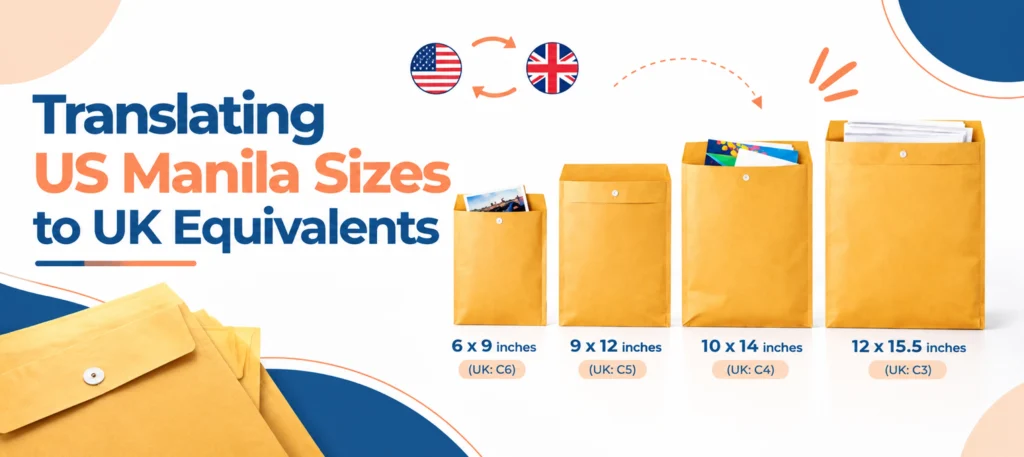
If you have imported a spec from a US template or an American supplier, the inch sizes will not match a UK order form. Here is how the common ones translate.
The classic US 9 by 12in office manila, which is 229 by 305mm, maps most closely to a UK C4 at 229 by 324mm. They share the same 229mm width, and the C4 is only about 19mm longer, so a C4 is the right UK envelope to order in place of a 9 by 12. The US 10 by 13in “catalogue” size, about 254 by 330mm, is a little larger than C4, so choose a C4 for a snug fit or a larger board-backed mailer if you need the extra room. A US 6 by 9in, about 152 by 229mm, is close to a UK C5 at 162 by 229mm. The US 9.5 by 15in legal envelope, about 241 by 381mm, has no clean C-series match, as it falls between C4 and C3, so a UK buyer normally steps up to a C4 for A4 or a gusseted C4 for bulk. The takeaway is that a UK C4 covers most of what a US “manila envelope” means, and it is the size to reach for first.
Royal Mail postage: the part that actually costs you money
This is the section every US guide gets wrong for Britain, and it is where a wrong assumption gets expensive across a mailing run.
Royal Mail prices by format, and the item it measures is the packed envelope, not the paper inside. The two formats that matter for envelopes are Letter and Large Letter. A Letter must stay within 240 by 165 by 5mm and weigh no more than 100g. A Large Letter goes up to 353 by 250 by 25mm and 750g. These limits are set out by UK suppliers such as Priory Direct’s Royal Mail size guide. Above the Large Letter limits, the item becomes a parcel. For the full band-by-band picture on parcels, see our own guide to Royal Mail and Parcelforce parcel sizes.
Now apply that to manila envelopes. A DL or C5 that is thin and light, a few sheets under 5mm and 100g, sits inside the Letter limit and posts at the cheapest rate. The trap is the 5mm thickness limit, because it is easy to breach. Stuff a DL with more than a few folded sheets, or add anything with bulk, and the packed envelope goes over 5mm and drops out of Letter into Large Letter, even though the length and width have not changed. A C4 is a Large Letter from the start, because its 229mm width is already over the 165mm Letter limit, so a flat A4 document in a C4 posts as a Large Letter. Make that C4 board-backed or gusseted and pack it thick, and it can pass 25mm and become a parcel. A C3 is larger than the Large Letter footprint altogether, so it posts as a parcel.
One myth to kill, because it comes straight from US advice. In the United States, square envelopes carry a fixed non-machineable surcharge, and American guides repeat it as if it were universal. Royal Mail does not price that way. It has no published flat square surcharge, and it charges by format and thickness, not by a square penalty. So do not import a US postal rule into a UK decision. Because thickness and weight decide so much, and prices change, check the exact cost for your finished envelope on Royal Mail’s price finder, which is the source of record if a figure cannot be confirmed elsewhere.
Choosing the right manila envelope so it posts cheaply and arrives flat

Put the size, the style and the postage together, and the buying decision gets simple.
If your goal is the cheapest rate, keep the mailing inside the Letter format. In practice that means a DL or C5 in manila, kept genuinely thin, under 5mm packed and under 100g, which covers most ordinary letters and short document sets. The moment you need to send A4 flat and uncreased, you are choosing a C4, and you are choosing the Large Letter rate with it, which is a fair trade for keeping a certificate or contract pristine. If the contents must not bend at all, a board-backed C4 is the right tool, and you accept that the rigid backing adds weight and may take a thick item toward parcel pricing. Two habits save money on a run. First, weigh and measure one finished, filled envelope before you order in bulk, because a few grams or a millimetre of thickness sets the rate on every unit. Second, match the envelope to the fold: DL for A4 in thirds, C5 for A4 in half, C4 for A4 flat, so you are never paying for more envelope than the job needs.
A quick word on recycling, since it comes up. Plain manila envelopes are paper, so they go in normal kerbside paper recycling. The things that complicate that are add-ons, not the manila itself: a plastic window film or a bubble lining has to be separated or sent to the right stream, so if kerbside recyclability matters to you, choose plain or paper-window manila rather than a plastic-lined padded version.
How this differs from greeting card envelopes
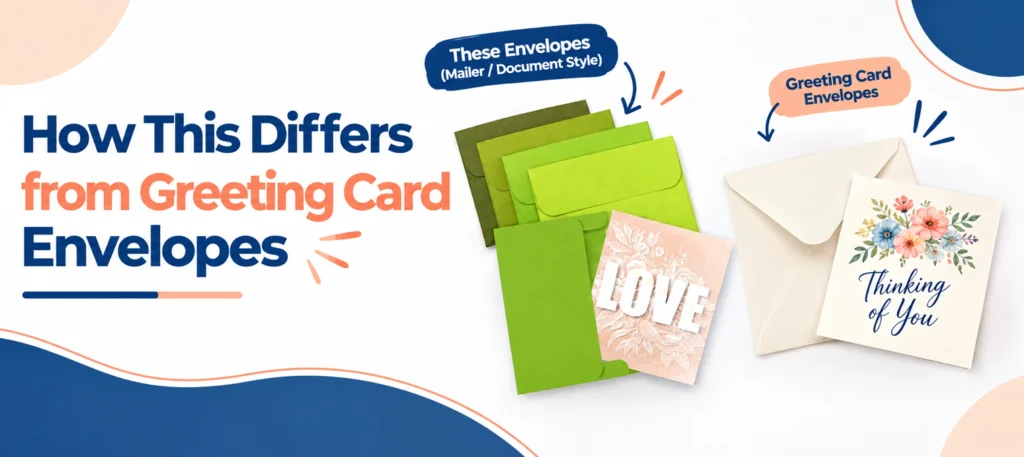
It is worth drawing one line clearly, because the C-series comes up in two different jobs. This guide is about document and mailing envelopes in manila: the pocket and wallet C4, C5 and DL sizes, board-backed mailers and gusseted envelopes used to post paperwork, certificates and flat products. That is a separate question from greeting card envelopes, which pair small C6, C5 and DL sizes to folded A6 and A5 cards and are chosen for colour and finish rather than document capacity. If you arrived here looking for card envelopes, the sizing logic is the same C-series, but the sizes in play are the smaller ones, and postage is judged on the card in its envelope rather than a filled document pocket. This post stays on the larger C4 and C3 end and the manila material, which is the document buyer’s need.
Getting custom manila and printed envelopes in the UK
If you post documents under your own brand, plain stock envelopes leave your logo off the first thing the recipient sees. All Custom Packaging is a UK-based custom packaging and print supplier, and custom envelopes are one of our categories, so we can print manila and other envelope stocks with your logo, return address and brand colours across DL, C5, C4 and bespoke sizes, including window, board-backed and padded formats. Orders start from 100 units and design support is free, so you can set up a branded envelope without a large upfront run, and our team will confirm the size, style and specification with you before production. If you want to match a document size to the right envelope and postage format, take a look at our custom envelopes or talk to our team.
Frequently asked questions

What size is a manila envelope in the UK?
There is no single size, because manila is a material, not a size. UK manila envelopes come in the ISO C-series, and the common document size is the C4 at 229 by 324mm, which holds an unfolded A4 sheet. C5 (162 by 229mm) takes A4 folded once, and DL (110 by 220mm) takes A4 folded into thirds.
Why is it called a manila envelope?
The name comes from Manila hemp, a strong fibre from the abacá plant first exported from the Philippines and once used to make the paper. Modern manila envelopes are made from wood-pulp kraft paper, but the light-brown colour and the name stayed. It describes the paper, not a size or shape.
What is the UK equivalent of a US 9 by 12 manila envelope?
A UK C4, which is 229 by 324mm. The US 9 by 12in envelope is about 229 by 305mm, so it shares the C4’s 229mm width and is only around 19mm shorter. A C4 is the right UK size to order in place of a 9 by 12.
What GSM should a manila envelope be?
As an indicative range, standard pocket and wallet manila envelopes are commonly around 80 to 115 gsm, with heavier 100 to 120 gsm stock giving a sturdier envelope. Board-backed envelopes weigh more because of the rigid card backing. Confirm the exact GSM on the product specification, as it varies by range.
Is a C4 envelope a large letter or a parcel with Royal Mail?
A C4 (229 by 324mm) is wider than the 165mm Letter limit, so a flat A4 document in a C4 posts as a Large Letter, within the 353 by 250 by 25mm and 750g Large Letter limits. If it is board-backed or packed thicker than 25mm, or over 750g, it becomes a parcel. Check the exact price on Royal Mail’s price finder.
Do square or manila envelopes carry a surcharge in the UK?
Not the US-style square surcharge. That fixed non-machineable charge on square envelopes is a US rule. Royal Mail prices by format and thickness, not by a square penalty, so a manila envelope is charged as a Letter, Large Letter or parcel based on its size, thickness and weight.
Key takeaways
- In the UK, “manila” is a material, a buff kraft-style paper, not a size. UK manila envelopes are sized on the ISO C-series.
- The common document size is the C4 at 229 by 324mm, which holds an unfolded A4 sheet. C5 takes A4 folded once, DL takes A4 folded into thirds.
- Manila envelope types matter: wallet opens on the long edge, pocket on the short edge, plus window, board-backed for flat delivery, and gusseted for bulk.
- GSM is commonly around 80 to 115 gsm for standard manila, heavier for board-backed. Treat figures as indicative and confirm on the spec.
- Postage is set by the packed envelope. A thin DL or C5 can post as a cheap Letter under 5mm and 100g, a C4 is a Large Letter, and a bulky or board-backed envelope can become a parcel. Royal Mail has no US-style square surcharge.