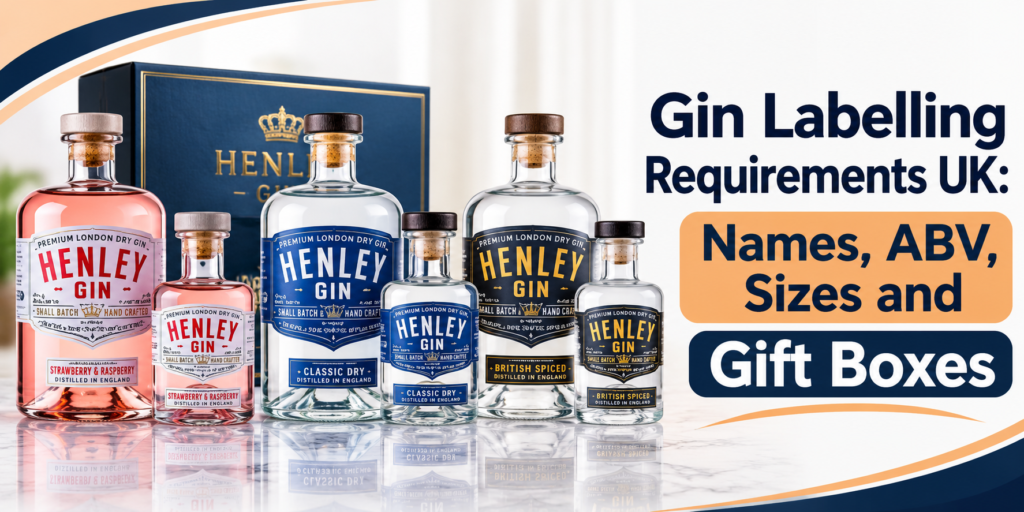
Gin Labelling Requirements UK: Names, ABV, Sizes and Gift Boxes
A bottle of gin sold in Great Britain must show its legal name, its alcoholic strength, its volume, any allergens, a lot mark and the name and address of the business responsible. The name, strength and volume must be readable together, and the name “gin” itself requires at least 37.5% alcohol.
The legal name is where most mistakes happen. Gin must also taste mainly of juniper, and “distilled gin” and “London gin” add production rules. A fruit gin that leaves the category moves to a different name, usually “spirit drink” or “liqueur”.
This guide sets out the gin labelling requirements for Great Britain, with the Northern Ireland differences, from choosing the name to dressing the gift box. It draws on Defra’s guidance, the Trading Standards guides on Business Companion, the legislation and HMRC, all checked in October 2026.
What a bottle of gin must show
Spirit drinks count as food in law, so the general food labelling rules apply, with spirit drink rules adding to some of them and replacing others. Business Companion’s guide to spirit drink labelling explains how the two fit together.
| Information | What the rules ask |
|---|---|
| Name | The sales denomination, such as “gin” or “London gin”. A brand name cannot replace it. |
| Alcoholic strength | A figure followed by “% vol”, to one decimal place at most, accurate to 0.3% either way. |
| Volume | In millilitres, centilitres or litres. |
| Field of vision | Name, volume and strength visible at the same time, without turning the bottle. |
| Allergens | Listed after “Contains:” when there is no ingredients list. |
| Business name and address | The food business that takes responsibility, with a British Islands address for sales in Great Britain. |
| Lot mark | A batch code, with an “L” in front if it might be mistaken for other information. |
| Origin | Where leaving it out could mislead, for example a Union Flag on a gin made abroad. Stating an origin brings its own rules for the main ingredient. |
| Language | English, with other languages allowed alongside. |
Some things a food label normally carries are optional on gin. An ingredients list and a nutrition declaration are not required, although any you choose to give must follow the full rules. No best-before date is needed either, because drinks of 10% alcohol or more are exempt.
Which name your gin can use
In Great Britain, spirit names come from Annex II to assimilated Regulation (EC) No 110/2008. Some labelling guides cite Regulation (EU) 2019/787 instead, but that regulation applies in Northern Ireland, not in England, Scotland or Wales.
| Name on the label | Minimum strength | What the drink must be |
|---|---|---|
| Gin | 37.5% | Agricultural ethyl alcohol flavoured with juniper berries, using only flavouring substances or flavouring preparations, with a taste that is predominantly juniper |
| Distilled gin | 37.5% | Made by redistilling agricultural ethyl alcohol of at least 96% vol in traditional gin stills, with juniper and other natural botanicals; approved flavourings may also be used; gin made simply by adding essences or flavourings does not qualify |
| London gin | 37.5% | A distilled gin whose flavour comes only from redistillation with all its plant materials, from a distillate of at least 70%; afterwards only water and agricultural ethyl alcohol of the required purity may be added, with sweetening up to 0.1 g of sugars per litre and no colouring |
| Sloe gin | 25% | A liqueur made by steeping sloes in gin, possibly with sloe juice added, using natural flavourings only |
| Juniper-flavoured spirit drink | 30% | Agricultural alcohol, grain spirit or grain distillate flavoured with juniper berries, with the juniper still noticeable |
“Dry” has a fixed meaning too. Gin and distilled gin may add the word only if any added sweetening stays at or below 0.1 g of sugars per litre of the finished drink. London gin, which already has that limit, may add it on the same footing.
London gin describes a method, not a place. The category definition sets production limits but contains no requirement to distil in London.
A drink that meets a category must use that name, or the name of another category it also meets. One that meets none, but is still a spirit drink, is sold as a “spirit drink”. Business Companion adds that words such as “style”, “type” or “flavour” cannot attach a category name to a drink that does not qualify, so “gin-style spirit” is not a way round the rules.
Pink, flavoured and lower-strength gins
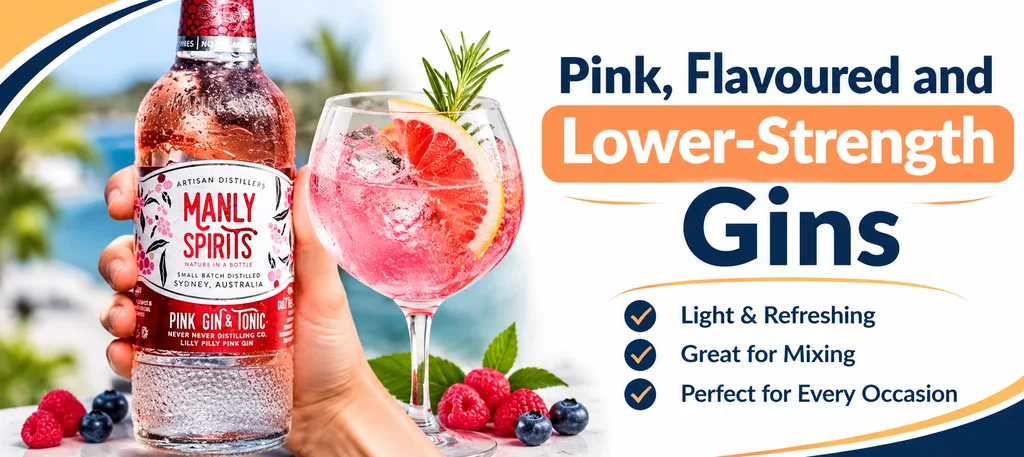
A pink or flavoured gin can still be sold as “gin” if it meets every part of the gin definition. That means at least 37.5%, flavourings that are flavouring substances or preparations, and a taste that remains mainly juniper.
Adding a food is different. Defra’s spirit drinks guidance explains that adding a foodstuff, such as fruit, can mean a spirit no longer fits its category. Business Companion notes that fruit can also pull the strength below the minimum.
The usual route is then the sales denomination “spirit drink”, with a compound term naming the gin and the food, such as “Raspberry Gin”. In Great Britain the compound term follows its own layout rules.
- The whole term is in the same font, size and colour, with nothing interrupting it.
- It is no larger than the sales denomination.
- “Spirit drink” is shown separately and is never part of the compound term.
- All the alcohol comes from the gin; no other alcohol is added.
- It cannot replace the sales denomination.
Business Companion’s worked example uses vodka: “Strawberry Vodka” as the compound term, with “Strawberry Spirit Drink” as the sales denomination. A raspberry gin below 37.5% follows the same pattern.
A sweeter drink can take the liqueur route instead. If it has at least 15% alcohol and, for most liqueurs, at least 100 g of sugar per litre, its sales denomination can be “liqueur”, with a compound term such as “Raspberry Gin Liqueur”. Defra gives “gin liqueur” as a compound term that can replace the legal name in Northern Ireland only.
Water alone cannot do any of this. A compound term cannot be used for a gin that has simply been diluted below 37.5%, and Business Companion treats that dilution as not permitted. A juniper spirit bottled between 30% and 37.5% can use “juniper-flavoured spirit drink” if it meets that definition.
Sloe gin is a separate case. It is a category of its own with a 25% minimum, not a compound term, and its definition allows “liqueur” to be added to the name.
For gin liqueurs and lower-strength spirit drinks, the Gin Guild publishes Primary Authority advice assured by Buckinghamshire and Surrey Trading Standards, last reviewed in October 2025.
Alcohol-free and low-alcohol “gin”
A drink with little or no alcohol cannot borrow the name. Defra rules out names such as “alcohol free rum” or “low alcohol gin”, because such a name is not a compound term or an allusion, and the drink does not meet the category’s minimum strength.
The same guidance bans “gin alternative”, and applies the ban to websites and marketing descriptions as well as labels. Business Companion suggests a descriptive name instead, such as “non-alcoholic botanical spirit”.
There is one narrow allowance. A drink such as a “low alcohol gin and tonic” can use the gin name when all its alcohol comes from gin. A “zero alcohol gin and tonic” is not possible, because there is no alcohol present.
The descriptors themselves have thresholds. Under the Department of Health and Social Care guidance cited by Business Companion, “alcohol-free” means 0.05% or less and “low alcohol” 1.2% or less.
That may change. The government’s 10 Year Health Plan for England, published in July 2025, said it would consult on raising the alcohol-free limit to 0.5%. The 2018 descriptor guidance was still unchanged when this guide was checked.
Strength, bottle size and type size

Show the strength as a number followed by “% vol”, for example “40% vol”, “Alc 40% vol” or “Alcohol 40% vol”. With one decimal place at most and a tolerance of 0.3% either way, a gin labelled 41.3% vol must measure between 41.0% and 41.6%.
Bottled spirits from 100 ml to 2,000 ml must be sold in fixed volumes known as specified quantities, listed in GOV.UK’s weights and measures guidance. For spirit drinks they are 100, 200, 350, 500, 700, 1,000, 1,500, 1,750 and 2,000 ml.
Below 100 ml or above 2,000 ml, any volume can be used. That is why 5cl miniatures and smaller tasters are allowed, while a 75cl gin bottle is not, because 750 ml is on the list for wine but not for spirits.
Volumes must be stated in metric units. An imperial figure can sit alongside, but it cannot stand out more than the metric one.
Text size has a floor as well. Mandatory information needs a lower-case x-height of at least 1.2 mm, falling to 0.9 mm where the pack’s largest surface is under 80 square centimetres. Check which applies to a miniature by measuring its largest surface.
Allergens, dates and lot marks
Allergens still apply to gin. Where there is no ingredients list, declare them after “Contains:”, for example milk in a cream gin liqueur. Cereals used to make the distilled base spirit are exempt, because distillation removes the proteins that cause reactions.
If you add a best-before date anyway, Business Companion says it must follow the rules for a mandatory date.
A lot mark is still required. A dated label can sometimes double as the lot mark, but an undated gin needs its own batch code. Put an “L” before the code if it could otherwise be hard to tell apart from other details on the label.
Business Companion’s date and lot marking guide also calls it good practice to repeat the lot mark on a presentation box, giving whisky in a box as its example. Stock can then be found in a recall without opening every box.
Claims: gluten-free, calories and health
Gin can be labelled “gluten-free” only at 20 mg of gluten per kg or less, or “very low gluten” at 100 mg per kg or less. “No gluten-containing ingredients” is not a permitted claim, and a gluten-free claim needs contamination controls and regular testing behind it.
The only nutrition claims allowed on spirit drinks concern low alcohol, reduced alcohol or reduced energy, and any of them brings a nutrition declaration with it. Health claims are not allowed on spirit drinks at all.
Duty stamps ended on 1 May 2025
UK duty stamps are no longer needed. HMRC ended the Alcohol Duty Stamps Scheme on 1 May 2025. It had covered retail containers of 35 cl or more holding drinks of 30% alcohol or more, which included a standard 70cl bottle of gin.
According to HMRC’s brief on ending the scheme, producers no longer need to build a stamp into the label. Bottles already stamped can still be sold, and stamps can be removed without telling HMRC.
For new artwork, the panel once kept for a stamp is free for other uses. HMRC also said, in February 2025, that no new on-pack marking was replacing the scheme at that stage.
Gift boxes, tubes and neck tags

Packaging can undo a compliant label. Business Companion’s general labelling guide says mandatory information must not be hidden, including on parts of a pack that are only visible once it is open.
A sealed gift box or tube that covers the bottle label can create that problem at the point of sale. The safer layout prints the name, strength and volume on the outer pack too, or shows the label through a window, and repeats the lot mark. A printed band, covered in our guide to sleeve packaging, can add those details to a plain box.
A round bottle sits naturally in a tube. Our gift tube packaging and cardboard tubes with metal lids take your print on the outside, and the metal lid can be printed as well. Windows are available depending on the specification.
For sets and miniatures, bottle boxes with dividers keep each bottle in its own space, and any box in our gift boxes range can carry the name, strength and volume in its print. Inserts are cut to the product’s own dimensions, so movement inside the box is controlled.
A pack of identical bottles must show how many it holds and the size of each, such as “3 x 5cl”, unless both can be read through the pack. Business Companion’s general guide sets out a different rule for sets of different items that are not sold separately.
Bottle neck hang tags are a good home for the botanicals, the serve and a gift message. Keep the mandatory details on the bottle label, since a tag can be removed. Cardboard bottle sleeves add a printed layer without a full box.
The artwork layout can reserve clear panels for the information the product is required to display. All Custom Packaging can help organise the available print space, but the brand or its regulatory adviser remains responsible for confirming the accuracy and completeness of the required product information.
Artwork and responsible drinking messages
Gin artwork has its own rulebook. The Portman Group’s Code of Practice on naming, packaging and promotion applies to marketing aimed primarily at the UK, and its complaints panel has ruled on gin packs more than once.
In 2019 it upheld a complaint against Unicorn Tears Raspberry Gin Liqueur, finding that its cartoon-style unicorn had a particular appeal to under-18s. In July 2025 it cleared the packaging of Mystical Unicorn Gin Liqueur on that point.
The difference was presentation. The panel read the detailed, fine-line artwork and restrained colours as adult fantasy art, unlike the earlier cartoon with thick black key lines and simple imagery. It still called the pack close to the line, given its shimmering pink liquid and sweet flavour. It did uphold a second complaint, because label text promising to “transport you to the mystical land of unicorns” implied the drink could change mood.
For a gift box, brief the designer on both the style of the illustration and the wording. Rule 3.2(j) of the Code says packaging should not suggest therapeutic qualities, enhanced mental or physical capabilities, or a change in mood or behaviour.
GOV.UK’s spirit drinks guidance also says producers should communicate the UK Chief Medical Officers’ low-risk drinking guidelines, and links to guidance on doing it on labels. It uses “should”, not “must”.
Mandatory messages may follow. The 10 Year Health Plan commits to a mandatory requirement for alcoholic drinks to display consistent nutritional information and health warnings. No start date had been published when this guide was checked, so leave room on new artwork where you can.
Making and selling gin: approvals and Northern Ireland
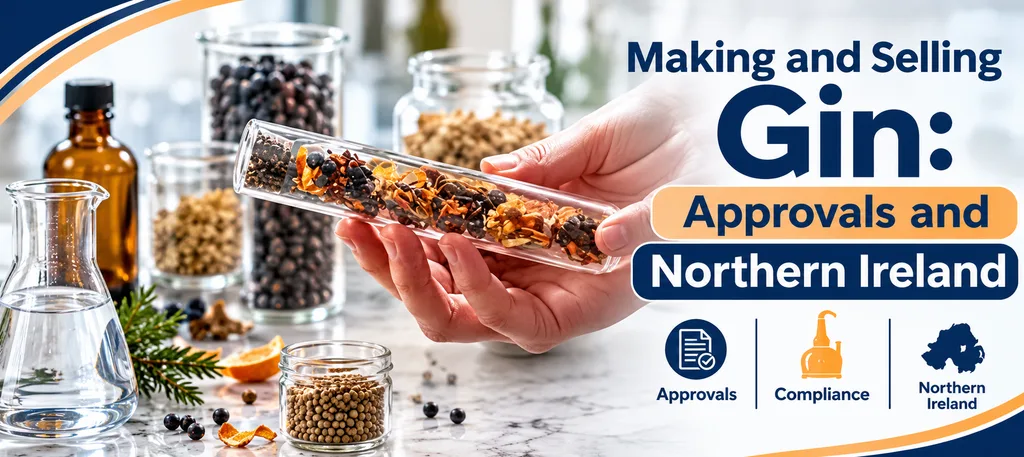
Making gin to sell needs approval first. HMRC’s producer approval guidance says you must hold an alcoholic products producer approval (APPA) before producing alcoholic products in the UK, and its domestic-use exemption excludes spirits.
Some activities fall outside it, including bottling bulk spirit without altering it and compounding duty-paid spirits. A brand using a contract distiller should check which side of that line its own work sits on.
Selling is a separate step. In England and Wales, Business Companion says anyone supplying spirit drinks is likely to need a premises licence and a personal licence under the Licensing Act 2003, from the local council.
Selling online also means posting bottles. Our guide to shipping glass bottles covers leak-proof packing and Royal Mail’s alcohol limits.
Northern Ireland follows Regulation (EU) 2019/787, where the name is called the legal name. Business Companion adds that goods sold only there, with no risk of onward sale to the EU, can follow the GB rules if the outer transport packaging is marked “Not for EU”.
Common mistakes
- “London dry gin” on a gin coloured or flavoured after distillation, or sweetened beyond 0.1 g per litre.
- “Gin” on a fruit gin that has left the gin category.
- A compound term printed larger than the sales denomination, or no “spirit drink” on the label.
- “Alcohol-free gin” or “gin alternative” in a product listing.
- Strength shown to two decimal places, or outside the 0.3% tolerance.
- A 75cl bottle, when the spirits list has 70cl but not 75cl.
- A sealed gift box with no name, strength or volume on the outside.
- Label space still kept for a duty stamp.
- Cartoon artwork a child would be drawn to.
Frequently asked questions
What has to be on a gin label in the UK?
The sales denomination, such as “gin”, the alcoholic strength in % vol, the volume in metric units, any allergens, the business name and address, and a lot mark. Origin is needed where leaving it out could mislead.
What is the minimum alcohol content of gin in the UK?
37.5% for gin, distilled gin and London gin. Sloe gin has its own 25% minimum, and a juniper-flavoured spirit drink 30%. Below those, the drink needs a different name.
Can I call my flavoured gin “gin”?
Yes, if it is at least 37.5%, uses only flavouring substances or preparations, and still tastes mainly of juniper. Once fruit, juice or a similar food is added, use “spirit drink” with a compound term such as “Raspberry Gin”, or “liqueur” if it qualifies.
Do gin bottles still need duty stamps?
No. HMRC ended the Alcohol Duty Stamps Scheme on 1 May 2025, so new labels no longer need a stamp. Stamped bottles already in stock can still be sold.
Does gin need a best-before date?
No. Drinks of 10% alcohol or more are exempt from date marking, but every bottle still needs a lot mark so a batch can be traced.
Does a gin label need a pregnancy warning?
Not by law at present. The 10 Year Health Plan calls today’s alcohol labelling guidelines voluntary and plans mandatory health warnings, with no start date published yet. Meanwhile, GOV.UK asks producers to communicate the Chief Medical Officers’ low-risk drinking guidelines.
Can I sell alcohol-free gin?
Not under that name. Defra rules out “alcohol free” or “low alcohol” with a spirit name, and “gin alternative” too. A descriptive name such as “non-alcoholic botanical spirit” works instead.
Does London dry gin have to be made in London?
No. The name describes a production method: flavour only from redistillation, no colouring and almost no added sweetening. The definition sets no location.
Is it legal to make your own gin in the UK?
Distilling it needs approval first. HMRC requires an alcoholic products producer approval before anyone produces alcoholic products, and its home-use exemption does not cover spirits. Compounding duty-paid spirits and bottling bulk spirit unaltered are on its list of activities that need none.