
How Rigid Boxes Are Made (and Why That Affects Your Lead Time)
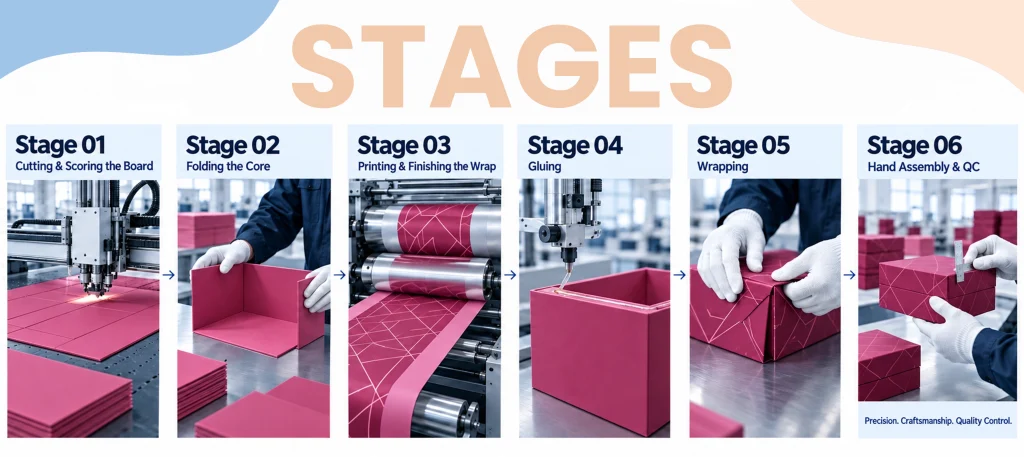
Quick answer: how rigid boxes are made, in short, is six broad stages: the board is cut and scored, folded along those score lines, the printed outer wrap is laminated and finished separately, everything is glued together, the wrap is applied around the folded core, and the finished box is hand-checked before it ships. That last stage, hand assembly and manual quality control, is the real reason a rigid box costs more and takes longer to produce than a folding carton, not a sign of a slow supplier.
Most explanations of rigid box manufacturing stop at listing the steps. This one exists to connect them to something you can actually use: why the quote you get back has the minimum order and the lead time it does.
Stage one: cutting and scoring the board
Production starts with a flat sheet of chipboard, cut to the box’s finished dimensions and scored along every line that will later become a fold. This is done on precision die-cutting equipment, and the accuracy of the scoring at this stage determines how cleanly the box will fold and how square the finished corners sit. A box that folds badly almost always traces back to imprecise scoring here, not to anything that happens later.
Stage two: folding the core
Once cut and scored, the board is folded along those lines to build the basic shape, base or lid, and the folded walls are held in place, commonly with tape, to keep the shape stable through the next stages. This is where the box genuinely becomes three-dimensional for the first time, and it is also where the “rigid” character comes from: unlike a folding carton, this shape is set now and stays set, rather than being flattened for shipping and folded up later by whoever fills it.
Stage three: printing and finishing the wrap, separately
Here is the detail most explanations skip. The printed design does not go directly onto the box. It is printed onto a separate substrate, the wrap, which is laminated and finished, foil, embossing and the rest, before it is ever attached to the folded chipboard core. The core and the decoration are effectively two separate production tracks that only come together near the end. That sequencing is part of why colour and finish behave the way they do on the finished box: what you are printing on at that stage is the wrap’s own surface, not the raw chipboard.
Stage four: gluing
Adhesive, hot-melt, cold glue or a water-based formulation depending on the job, is applied to bond the wrap to the core and to hold the box’s structural joins. This stage needs real control over temperature and cure time; too fast or too slow and the result is a box that delaminates or warps later, which is exactly the kind of defect that shows up weeks after production, not on the day.
Stage five: wrapping
The finished, printed wrap is applied around the outside of the folded core and glued into place, aligned precisely enough that the pattern or the panel lines meet where they should. On a two-piece box this happens separately for the lid and the base, which then come together as the final structure.
Stage six: hand assembly and QC, and why this is the answer to “why does it cost more”
Most rigid box production carries a real degree of manual assembly and hand inspection, checking corners, alignment, closure fit and finish, rather than relying purely on automated line checks the way a simpler folding carton can. This is not a supplier being slow or old-fashioned. It is a structural fact about the product: a folded, hand-wrapped, hand-checked box takes longer to make correctly than one that is die-cut, printed and folded flat by machine in one continuous run.
That is the honest answer to a question buyers often ask without quite framing it this way: why does a rigid box carry a higher minimum order and a longer lead time than a folding carton for what looks like a similar size of job? At ACP, standard production takes 6 to 8 business days after approval, and knowing that hand assembly and inspection sit inside that window, rather than being a delay on top of it, makes the figure easier to plan around.
A sourced answer to “how much thicker is a rigid box, really”
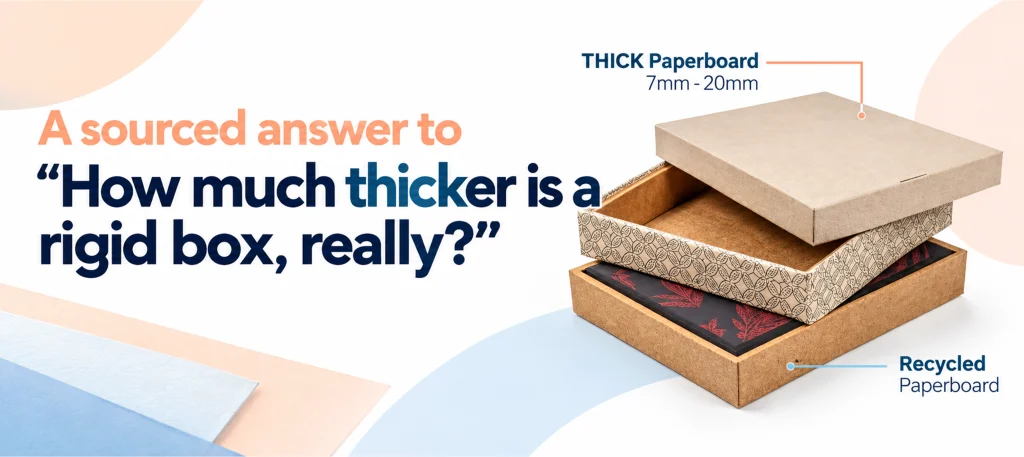
The comparison gets repeated everywhere, often without a source: rigid board runs several times thicker than the board used in a folding carton. Independently checked across manufacturing references, the figure commonly lands between 2 and 6 times thicker, with 4 times a frequently cited middle ground. That range, not a single flat number, is the honest way to state it, since it depends on the specific board grades being compared.
Frequently asked questions
What are the steps in making a rigid box?
Broadly six: cutting and scoring the chipboard, folding it into shape, printing and finishing the wrap separately, gluing everything together, wrapping the finished wrap around the folded core, then hand assembly and quality checking before it ships. The wrap is decorated before it touches the core, not after.
Why do rigid boxes take longer to produce than folding cartons?
Because a normal part of the process is hand assembly and manual quality control, checking alignment, corners, closure fit and finish, which a simpler die-cut and folded carton generally does not need to the same degree. That manual stage is a structural fact of how a rigid box is built well, not a sign of a slow or inefficient supplier.
Is it true rigid boxes are four times thicker than folding cartons?
Roughly, yes, though the honest range is wider: independently sourced comparisons commonly put rigid board at 2 to 6 times the thickness of folding carton board, with 4 times a frequently cited figure within that range. Treat it as a useful ballpark rather than an exact universal ratio.
Does the wrap get printed before or after it’s attached to the box?
Before. The printed design, along with any foil or embossed finish, is applied to the wrap substrate on its own, then that finished wrap is glued around the already-folded chipboard core. The core and the printed decoration are built on two separate tracks that meet late in the process.
Why might a rigid box warp or delaminate later?
Usually because the gluing stage was not properly controlled for temperature or cure time when the wrap was bonded to the core. Getting that stage right is what keeps the finished box flat and properly bonded well after it leaves the factory, rather than showing a defect weeks later.
Understanding how a rigid box is actually built makes the MOQ and lead time on your quote easier to read, not just something to accept. If you would like to see the process applied to your own specification, browse Rigid Chocolate Boxes, Rigid Candle Boxes or start smaller with Small Rigid Boxes from our Rigid Boxes range. Design support is free, and orders start from 100 units.