
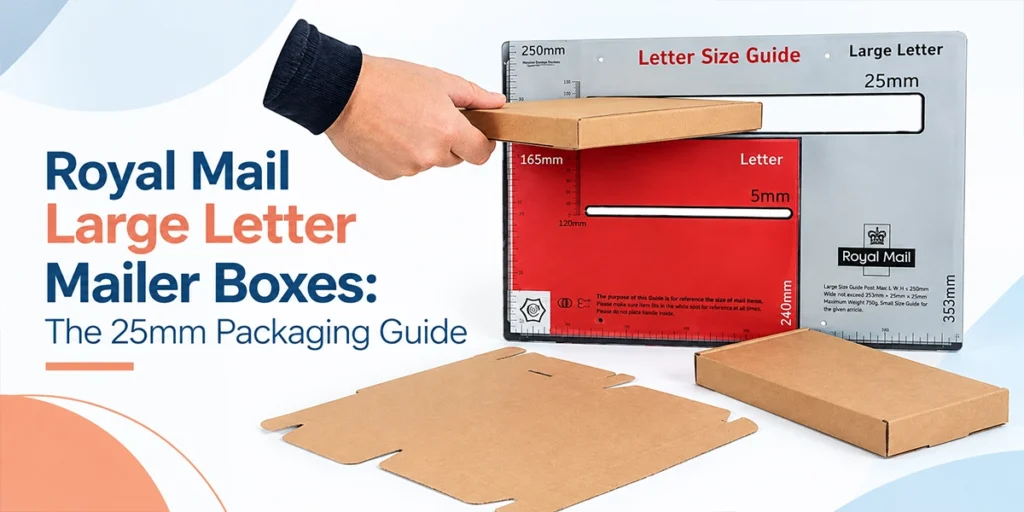
Royal Mail Large Letter Mailer Boxes: The 25mm Packaging Guide
Quick answer: Royal Mail Large Letter mailer boxes must measure no more than 353 x 250 x 25 mm and weigh no more than 750 g once packed, box and all. The 25 mm is the hard part: it is the outside thickness, so the board itself uses some of it, and a box in thin board leaves roughly 20 to 23 mm for the product. Get it right and a 2nd Class item posts for £1.55 to £2.70 instead of £4.25 as a Small Parcel.
Most guides give you the three numbers and a list of box sizes. This one shows where the 25 mm actually goes, what staying under it is worth per order, and why a box that passes as a Large Letter can still fail to fit through a letterbox.
The Large Letter limits, and the one that catches boxes
Royal Mail prices stamped items by size format first, then by weight within that format. These are the limits on its stamp prices published for 7 April 2026:
| Format | Maximum length | Maximum width | Maximum thickness | Maximum weight |
|---|---|---|---|---|
| Letter | 240 mm | 165 mm | 5 mm | 100 g |
| Large Letter | 353 mm | 250 mm | 25 mm | 750 g |
| Small Parcel | 450 mm | 350 mm | 160 mm | 2 kg |
Three details decide whether a box qualifies:
- Every limit applies at once. A box can be well under 353 x 250 mm and still fail on thickness alone.
- The limits apply to the packed item. The box, the tissue, the tape and the label all count, both in size and in the 750 g.
- Treat the thickest point as the measurement. A lid that bows in the middle or a flap that springs up at one corner is what has to pass the 25 mm.
Length and width are easy to control. The 25 mm is where mailer boxes fail, because a box has walls and a padded envelope mostly does not. If you are still choosing between the two formats, our guide to Royal Mail and Parcelforce parcel sizes covers every band side by side.
Why a box loses more of the 25 mm than you think
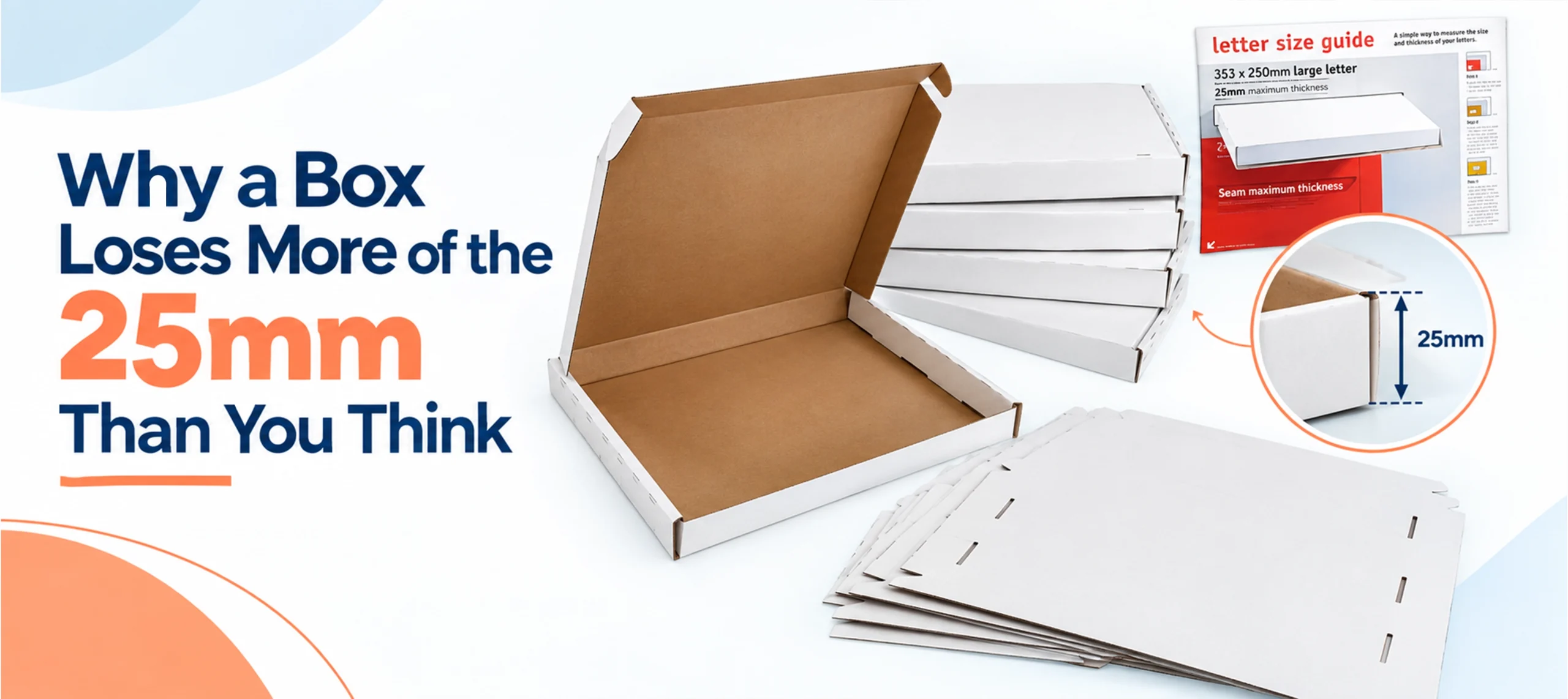
A mailer box has a base and a lid, and both sit inside the 25 mm. So the space left for the product depends on how thick the board is. Corrugated board is made in standard flute sizes, and the typical thickness of each flute is published:
| Flute | Typical board thickness | Taken by a lid and a base | Left inside a 25 mm box |
|---|---|---|---|
| B-flute | 3.2 mm | 6.4 mm | about 18.6 mm |
| E-flute | 1.6 mm | 3.2 mm | about 21.8 mm |
| F-flute | 0.8 mm | 1.6 mm | about 23.4 mm |
Board thickness from published flute tables. Real board varies with the manufacturer, so treat these as a guide and measure a sample.
That is the reason flute choice matters more for a Large Letter box than for almost any other mailer. B-flute is a common, sturdy mailer board, but in a 25 mm box it uses a quarter of the allowance before anything goes inside. The thinner flutes leave room for the product. Our guide to cardboard grades and flutes explains how each one behaves.
The board is only the start. Four other things take millimetres:
- Bulge. A soft or springy product pushes the lid up in the middle. That bow counts toward the 25 mm.
- Tape. A strip across the lid adds a little. Tape over a folded edge or an overlap adds more.
- Labels and inserts. A thick address label or a folded insert card sitting on the product adds its own layer.
- Crush and spring-back. A lid that is forced shut over a product that is fractionally too tall springs up again after packing.
The practical rule that follows from the arithmetic: size the inside of the box so the packed product sits a few millimetres below the internal height, not level with it.
What the saving is actually worth

The reason to fight for every millimetre is the price gap. From 7 April 2026, Royal Mail’s stamp prices for a Large Letter against a Small Parcel look like this:
| Weight up to | 2nd Class Large Letter | 2nd Class Small Parcel | Saving | 1st Class Large Letter | 1st Class Small Parcel | Saving |
|---|---|---|---|---|---|---|
| 100 g | £1.55 | £4.25 | £2.70 | £3.30 | £5.45 | £2.15 |
| 250 g | £1.90 | £4.25 | £2.35 | £3.60 | £5.45 | £1.85 |
| 500 g | £2.40 | £4.25 | £1.85 | £3.60 | £5.45 | £1.85 |
| 750 g | £2.70 | £4.25 | £1.55 | £3.60 | £5.45 | £1.85 |
Royal Mail stamp prices from 7 April 2026. Small Parcel price shown is for up to 2 kg. Business account, online and Signed prices differ, and prices change, so check the current guide before you budget.
On 1,000 orders a year at 2nd Class and up to 250 g, the difference is £2,350. Set that against any extra cost of a thinner, better-fitted box before deciding the Large Letter build is not worth the effort.
The saving only holds if the item really is a Large Letter. An item posted at the Large Letter rate that turns out to be a Small Parcel is underpaid, and an underpaid item can be held until the recipient pays to release it. For a customer, that is the worst possible first delivery.
Large Letter is not the same as letterbox-friendly
This is the distinction most box guides skip. Passing as a Large Letter is about Royal Mail’s price format. Fitting through a front door is about the letter plate on that door, which is a different standard.
Letter plates are covered by BS EN 13724, which sets the aperture at 230 to 280 mm wide (or 325 to 400 mm) and 30 to 35 mm high. The narrower width range sits just above the width of a C4 envelope, which is 229 mm.
Put that next to the Large Letter limit and the gap shows:
- A box can be up to 250 mm wide and still be a Large Letter.
- A letter plate that meets the standard can be as narrow as 230 mm.
- Older letter plates, and many decorative ones, were fitted before the standard and can be smaller still.
So if “fits through the letterbox” is part of the promise you make to customers, keep the box’s width at 229 mm or less, the width of a C4 envelope. The 25 mm thickness sits inside the 30 to 35 mm aperture height, but a bulging lid eats into that margin too. And even then, no box fits every door.
Designing a Large Letter mailer box
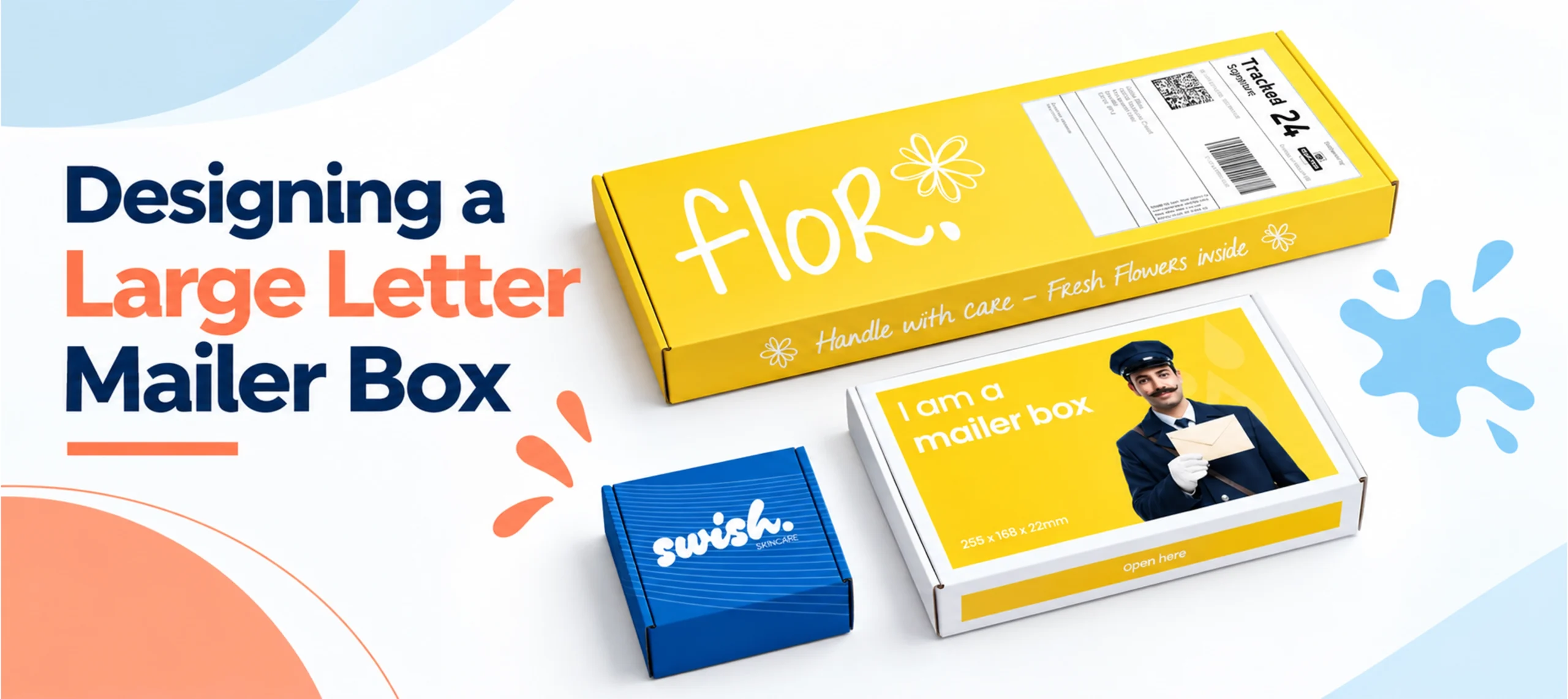
Start from the product, not from a stock box size:
- Measure the product at its largest, including any tissue wrap, and weigh it.
- Choose the thinnest board that still protects it. A flat, robust item such as a book or a printed card set needs less than a glass bottle or a candle. Board grade and thickness are selected around the product’s dimensions, weight and required level of protection.
- Set the internal height a few millimetres above the packed product, then check that the internal height plus two board thicknesses stays under 25 mm.
- Check the footprint. Under 353 x 250 mm for a Large Letter, and 229 mm wide or less if it needs to go through a letterbox.
- Add up the weight. Product, box, wrap and label together must stay at or under 750 g.
The box style matters as well. A slim tuck-front mailer is the usual Large Letter shape. Our custom mailer boxes can be made to your own dimensions, which is what makes a 25 mm build possible rather than hoping a stock size fits. A self-seal strip closes the box without tape across the lid, which removes one source of extra thickness.
For flat products, a cardboard slide mailer or a purpose-shaped book mailer can hold the item with less wasted height.
A fit check before you order a full run
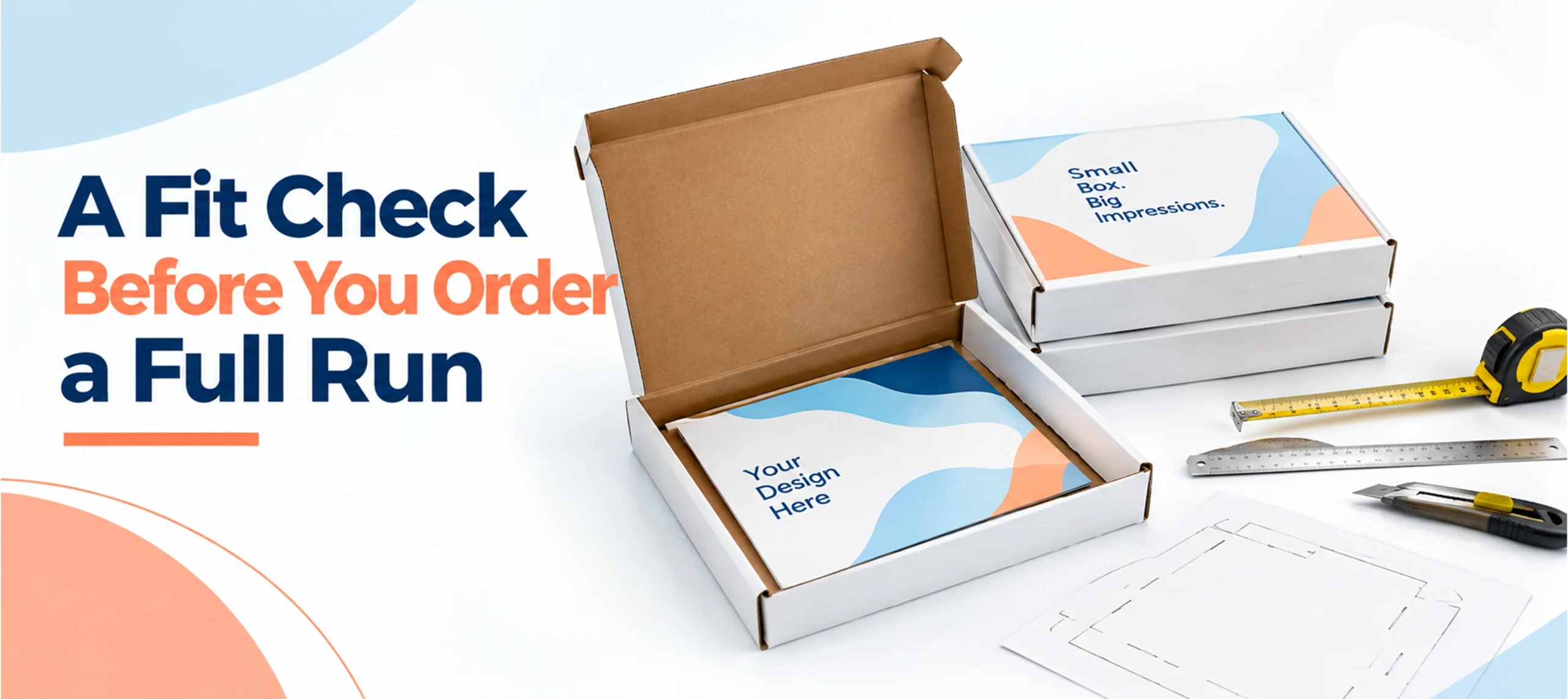
Before approving a size, pack a real one exactly as it will ship:
- Pack the actual product with the actual wrap, insert and label.
- Close it the way your packers will, tape and all.
- Measure the thickness at the centre of the lid and at each corner with a ruler or calliper, not by eye.
- Slide it through a 25 mm gap. A card template with a 353 x 250 x 25 mm slot cut in it takes a minute to make and settles arguments at the packing bench.
- Weigh it on the scale you will use for postage.
- Repeat with the largest and heaviest variant you sell, not the smallest.
If it passes with room to spare, the size is safe. If it only passes when pressed, it will fail on a busy day.
When to step up to Small Parcel
Some products should not be forced into a Large Letter box. Step up when:
- the product is fragile and needs cushioning that will not fit in about 20 mm
- the packed item is heavier than 750 g
- the product is rigid and taller than about 23 mm, so even the thinnest board leaves no room
- the box has to be forced shut to pass, which means it will spring open or crush in the post
The Small Parcel band gives you up to 160 mm of depth and 2 kg. Small parcel boxes sized to that band are the next step, including PIP small parcel boxes.
How we make Large Letter mailer boxes
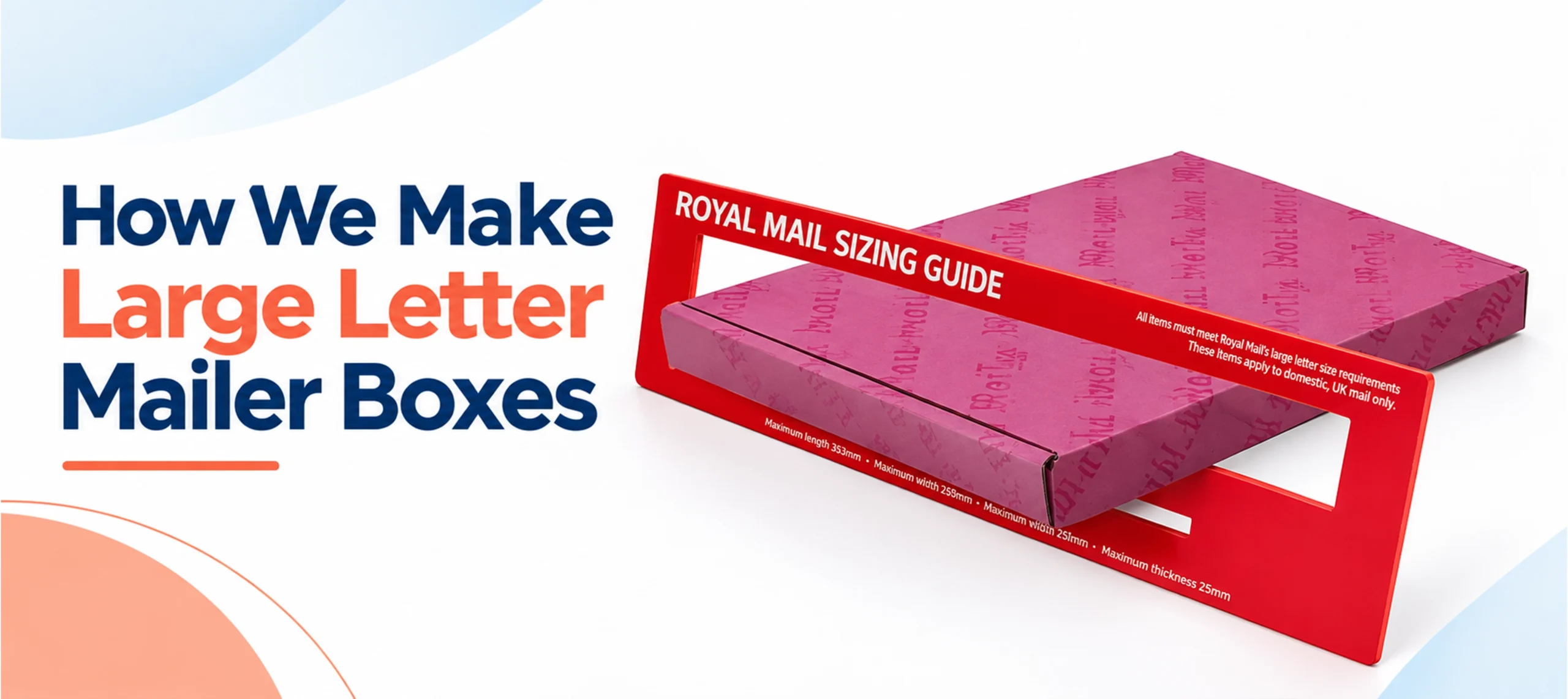
We make mailer boxes to your product’s dimensions, so the internal height is set around your product rather than rounded up to a stock size. The board grade is chosen around the product and the protection it needs, and a self-seal strip is available on demand.
- Orders start from 100 units.
- Free design support, and the size can be checked on a free digital 3D mock-up before anything is produced.
- UK delivery is free.
- Standard production takes 6 to 8 business days after approval.
Frequently asked questions
What size is a Royal Mail Large Letter box?
No more than 353 mm long, 250 mm wide and 25 mm thick, with a maximum weight of 750 g. The limits apply to the item as posted, so the box, wrap, tape and label all count.
Is the 25 mm limit measured inside or outside the box?
Outside. The packed item has to pass at its thickest point. The board of the lid and the base is part of the 25 mm, so the space for the product is always less than 25 mm.
Which cardboard is best for a Large Letter mailer box?
The thinnest board that still protects the product. In published flute tables, E-flute is about 1.6 mm thick and B-flute about 3.2 mm, so an E-flute box leaves roughly 3 mm more room inside a 25 mm box than a B-flute one. Fragile products may need the extra protection of a thicker board and a Small Parcel box instead.
How much cheaper is a Large Letter than a Small Parcel?
At Royal Mail’s stamp prices from 7 April 2026, a 2nd Class Large Letter costs £1.55 to £2.70 depending on weight, against £4.25 for a 2nd Class Small Parcel up to 2 kg. That is a saving of £1.55 to £2.70 per item.
Will a Large Letter box fit through a letterbox?
Not always. Letter plates built to BS EN 13724 can have an aperture as narrow as 230 mm, while a Large Letter can be 250 mm wide, and older letter plates can be smaller still. Keep the box at 229 mm wide or less if it needs to go through a letterbox.
What happens if my Large Letter box is too thick?
It is no longer a Large Letter, so the postage paid is too low. Underpaid items can be held until the recipient pays to release them, which is a poor first experience for a customer. Pack and measure a real sample before ordering a full run.
If you are sizing a box to the Large Letter limit, send us the product’s dimensions and weight and tell us whether it needs to fit a letterbox. We will work out the internal size with you, with free design support and a free digital 3D mock-up to check it on screen first.