What Information Do You Need to Get an Accurate Custom Packaging Quote?
Quick answer: to get an accurate custom packaging quote, send the product and its size and weight, the box style, the internal box dimensions if you know them, the quantity for each design, the material and print you want, the finish, how the box will travel, your artwork status and the date you need it delivered. The details that most often force a second quote are the dimensions, the quantity per design and how the box ships, so get those three right first.
Most quote guides stop at a list of headings. This one explains why each item changes the price, which mistakes cause requotes, and how to check the quote once it arrives. There is a one-page brief near the end you can copy and send.
The ten things a supplier needs to price your packaging
| What to send | Why it changes the quote | If you are not sure |
|---|---|---|
| The product, its size and weight | Sets the box size, the board and any insert | Send a photo with a ruler in shot, or the product itself |
| Box style | A mailer, a tuck-end carton and a rigid box are different builds | Describe how it should open, or send a picture you like |
| Dimensions, and which kind | Internal, external and product size are three different numbers | Give the product size and say so |
| Quantity per design | Set-up work is shared across each design’s run | Ask for two or three quantity tiers |
| Material | Board type and thickness drive most of the unit cost | Describe the protection it needs |
| Colours, one side or both, inside print | Say what you want to see when the box is closed and when it is open | |
| Finish | Lamination, foil, embossing and spot UV each add cost | Pick the one that matters most |
| How it travels | Post, courier, pallet or shelf sets the strength needed | Say how most orders will reach the customer |
| Artwork status | Print-ready files, rough ideas or nothing yet | Say which, and whether you need design help |
| Delivery date and address | Sets whether standard or rush production is needed | Give the date the boxes must arrive, not the date you order |
The rest of this guide takes the items that go wrong most often, one at a time.
Dimensions: the detail that causes the most requotes
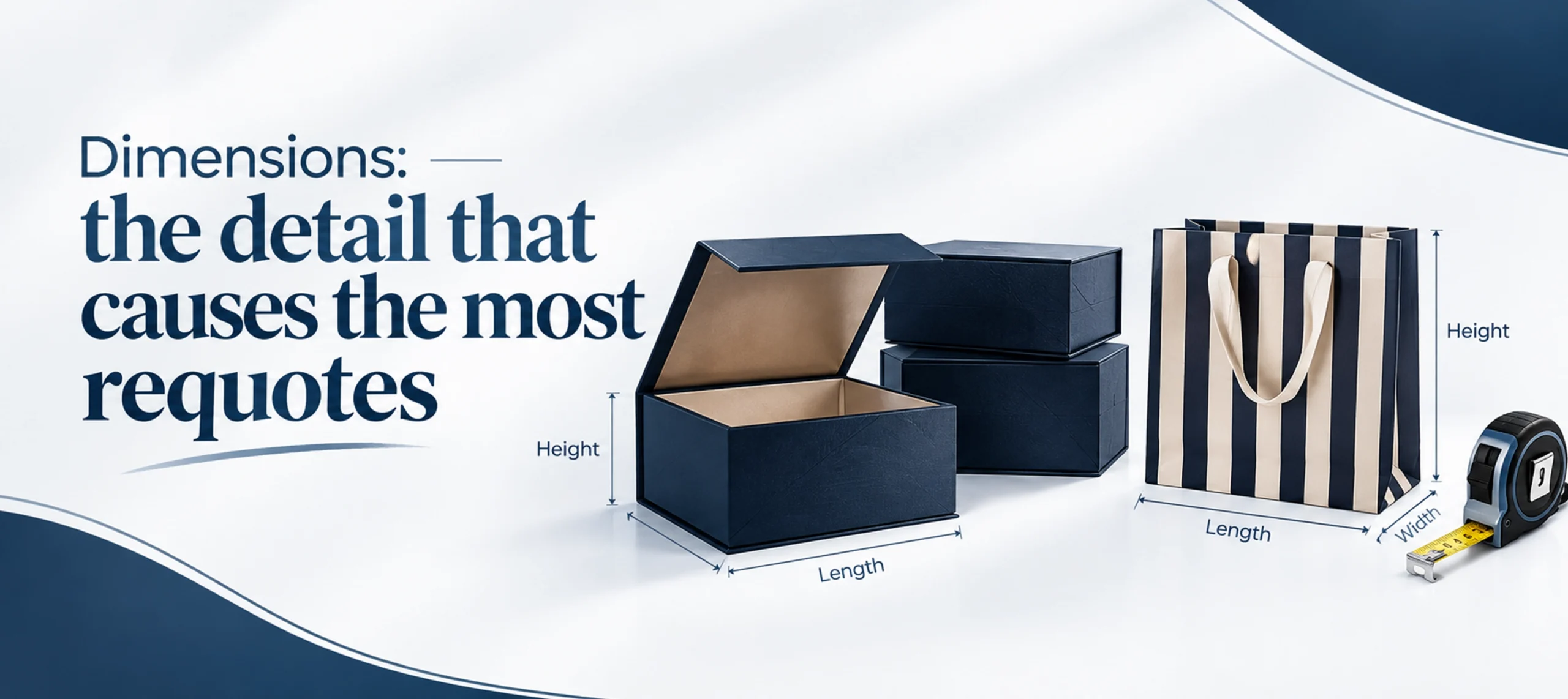
There are three sizes in any packaging brief, and they are easy to mix up:
- The product size. The item itself, at its largest point.
- The internal box size. The space inside the box, which is the product plus any wrap, insert and a little clearance.
- The external box size. The outside of the box, which is the internal size plus the board on each side.
By convention, box sizes are given as internal dimensions in millimetres, length x width x depth, where length is the longer side of the opening, width the shorter side, and depth runs from the opening down to the base. That convention comes from the international fibreboard case code that corrugated suppliers commonly work from.
The mistake is sending one of these numbers while the supplier reads it as another. Send a product size labelled as a box size and the box arrives too tight. Send an external size read as internal and every dimension grows by two board thicknesses. So label it: “product size”, “internal box size” or “external box size”. If you only know the product size, send that and say so. The supplier will add the insert and clearance.
One more reason to be exact: if the box has to pass as a Royal Mail Large Letter or fit a set postal band, the external size is the one that counts. Every band is listed in our Royal Mail and Parcelforce size guide.
Quantity: ask per design, and ask for price breaks
Give the quantity for each design, not only the total. Two designs of 150 are usually priced differently from one design of 300, because the supplier prepares each design separately. At All Custom Packaging, orders start from 100 units. That minimum applies to each design separately.
Then ask for more than one quantity. A quote at three tiers, say 250, 500 and 1,000, shows you where the price per box falls and by how much, and turns a single number into a decision. Why the curve bends that way is explained in our custom packaging cost and MOQ explainer.
If you expect to reorder, say how often. A supplier who knows a box is a repeat item can keep the specification ready. We keep approved dielines, specifications and artwork on file, so a reorder can be matched to the specification you approved before.
How the box travels decides how strong it needs to be
The same product needs a different box depending on its journey:
- Posted in single parcels. The box is the outer packaging. It needs to survive sorting and handling on its own, and its external size decides the postage band.
- Sent by courier. Similar to post, often with heavier items and less predictable handling.
- Shipped on a pallet to a retailer or warehouse. The box may sit inside an outer case and be stacked, so stacking strength matters more than handling on its own.
- Sold from a shelf. Presentation matters most, and the box may never travel alone.
Tell the supplier which one describes most of your orders. The structure is specified around the product’s weight and how it will be handled in transit. It is also why a supplier asks for the product’s weight: two boxes of the same size can need different board if one carries a candle and the other a pair of socks. For a posted box that is a sturdy corrugated build, custom mailer boxes are the usual starting point.
Material, print and finish: describe the result you want
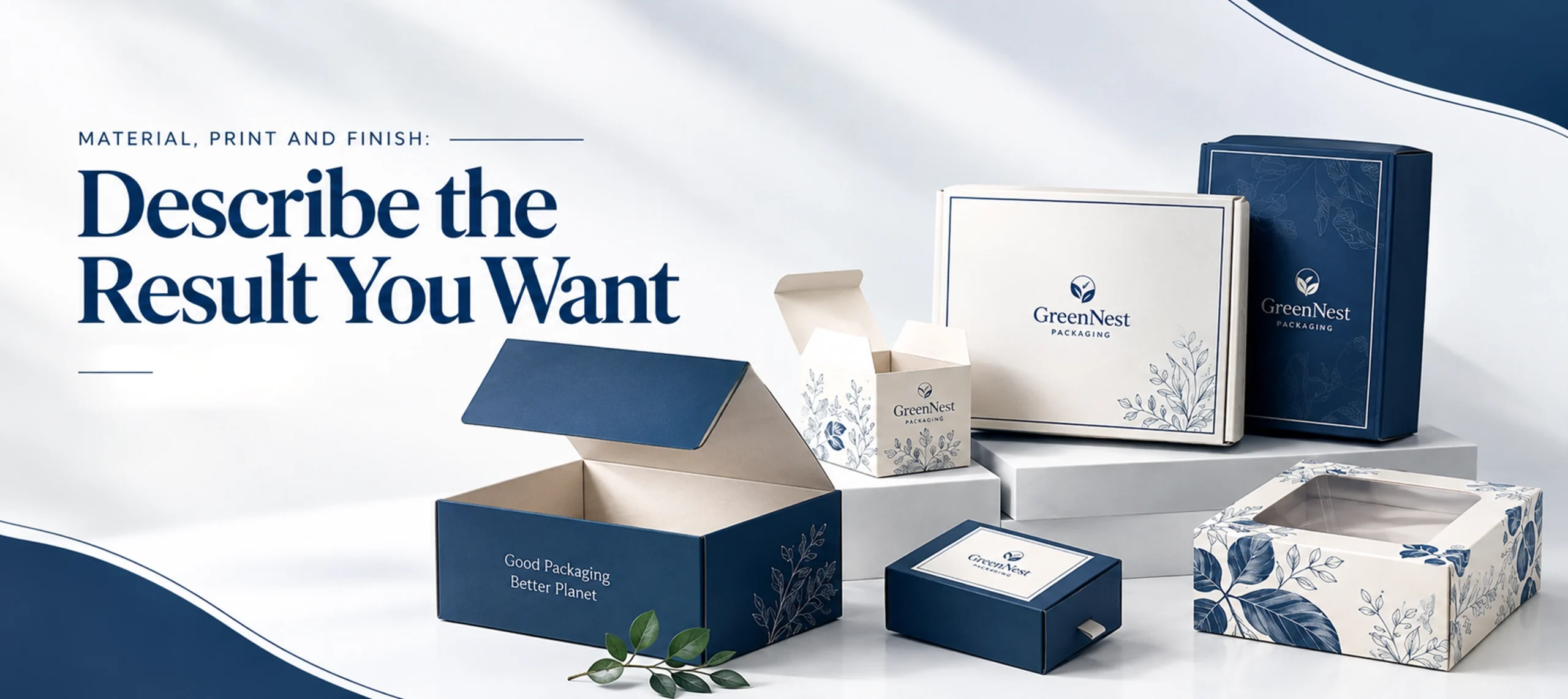
You do not need to know board grades to get a good quote. Describe what the box has to do and how it should look, and the supplier can propose the build. Useful details:
- Protection. Fragile, heavy, or neither.
- Look. Plain kraft, bright white, full colour, or a premium rigid feel.
- Print coverage. Outside only, inside and outside, or a single logo.
- Colour matching. If a brand colour must match, send the Pantone reference or the CMYK values. Pantone references and CMYK values can be used to manage colour consistency, subject to normal variation caused by the chosen board, ink, coating and production method.
- Finish. Name the one that matters most, whether that is a foil logo, a soft-touch feel or a window.
- Inserts. If the product needs holding in place, say so. Custom insert boxes build the insert into the box design from the start.
Each finish and insert is a line on the quote, so naming them up front avoids a second round.
Artwork status: ready, rough or not started
Say which of these describes you:
- Print-ready files. Vector artwork set up on the supplier’s dieline. Our checklist for print-ready artwork covers what that means.
- Rough artwork or a logo. Enough to place, but not yet set up for print.
- Nothing yet. You need the design done as well.
This matters to the timeline more than to the price at All Custom Packaging. Design support is free. A digital 3D mock-up is free. If you are not sure what a dieline is, our explainer on what a dieline is will help.
Regulated products: say so at the start
If the packaging will carry food, cosmetics, supplements or anything else with required on-pack information, tell the supplier when you ask for the quote, not after the artwork is done.
- Panel space. The artwork layout can reserve clear panels for the information the product is required to display. All Custom Packaging can help organise the available print space, but the brand or its regulatory adviser remains responsible for confirming the accuracy and completeness of the required product information.
- Food contact. Packaging that touches food falls under UK food contact rules. Under Article 3 of Regulation 1935/2004, as it applies in the UK, materials must not pass anything into food that could endanger health or change its composition, taste or smell. Food-contact material suitability is confirmed for the specific material before production.
A supplier who knows this up front can quote the right material and leave the right space the first time.
Dates: give the arrival date, and work back from it
Give the date the boxes must arrive, then let the quote show whether that works. Production and delivery are separate stages, and approval comes before both:
- Quote and design. Agreeing the specification and artwork.
- Approval. Every order is approved before bulk production. Depending on the order, you approve from a digital 3D mock-up, a video of the physical sample, or a physical production sample.
- Production. Standard production takes 6 to 8 business days after approval.
- Delivery. UK delivery is free. Delivery comes after production, not inside it, and within the UK it usually needs around 4 to 5 business days once production is finished, depending on the address and the courier service.
If the date is tight, say so in the first message. Rush production is available on request, and its availability and timing are confirmed with the quotation. If you need a physical sample, it is priced and scheduled at the quotation stage too, so ask at the start.
How to check the quote you get back
A good quote restates what you asked for, so you can see it was priced correctly. Check:
- The specification. Size, and whether internal or external; board; print; finish; insert. If anything is missing or different, ask before you approve.
- Quantity and designs. The price per design and the total.
- What is included. VAT, delivery, set-up charges and any tooling. At All Custom Packaging, there are no setup fees, and UK delivery is free, but not every supplier works that way.
- Samples and approval. What you will see before bulk production, and what it costs.
- Timing. Production and delivery shown separately, measured from approval.
- Validity. How long the price holds, which matters if you are comparing several suppliers.
Many trade quotes are shown before VAT, charged at the standard rate of 20%. Put every quote on the same basis before comparing them.
Frequently asked questions
What is the minimum information needed for a packaging quote?
The product and its size, the quantity, and the box style. With those three a supplier can give an indicative price. For an accurate one, add the material, print, finish, how the box travels, artwork status and the date you need it.
Should I give internal or external box dimensions?
Internal, if you are giving a box size, because that is the convention suppliers work to: length x width x depth inside the box. If you only know the product size, send that and label it clearly, and the supplier will size the box around it.
Why did my packaging quote change after I sent more details?
Usually because one of the first details was read differently: a product size taken as a box size, a total quantity split across several designs, or a finish or insert added later. Sending those details clearly at the start is the best way to keep the first quote the final one.
Do I need finished artwork to get a quote?
No. Say whether your artwork is print-ready, rough or not started. The price is mostly set by the box, print and finish, and artwork status mainly affects the timeline.
How many quantities should I ask to be quoted?
Two or three. Prices at, for example, 250, 500 and 1,000 units show how the price per box falls with volume and help you choose a quantity you will actually use.
What should I check before accepting a packaging quote?
That it restates your specification correctly, shows the price per design, says what is included (VAT, delivery, set-up, tooling and samples), separates production time from delivery time, and says how long the price is valid.
Ready to send yours? Fill in the brief above, add a photo of the product if you have one, and send it to us. Orders start from 100 units per design, design support is free, and we will come back with a specification you can check line by line.