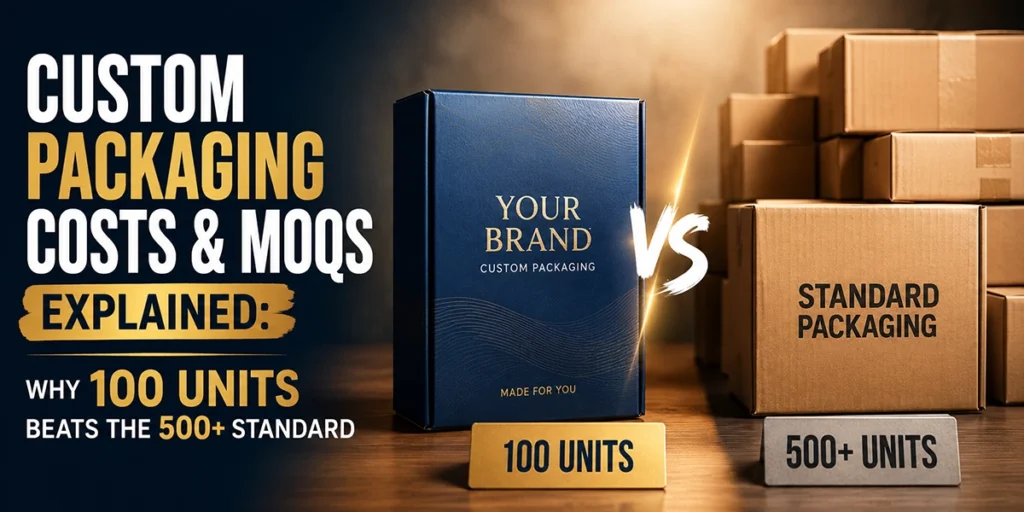
Custom Packaging Costs & MOQs Explained: Why 100 Units Beats the 500+ Standard
Custom packaging cost is driven by six things: box size, board type, print method, finishes, quantity, and setup/tooling. Most suppliers set a minimum order quantity (MOQ) of 500-1,000 units so their fixed setup costs spread thinly enough to be worth running. That math hurts small brands. A lower MOQ from 100 units lets you launch, test a design, and protect cash flow without a warehouse full of stock you’re not sure will sell. You’ll still pay a bit more per box at 100 than at 1,000, but you’ll risk far less money to find out what works.
Ordering custom boxes for the first time throws up the same shock for nearly every small brand: the price per box looks fine, then the supplier says the minimum order is 1,000 units. Suddenly a “cheap” box means a £900 commitment before you’ve sold a single product.
This guide explains what actually drives the cost of a custom box, why those high minimums exist, and why starting from 100 units changes the sums for a new or small business. Figures here are illustrative and vary by size, material and quantity treat them as a way to understand the shape of packaging pricing, not a quote.
What actually drives the cost of a custom box?
Six factors decide what you pay per box. Get these clear and you’ll read any quote or spot when one’s padded. The biggest lever by far is quantity, because most of the “setup” cost is fixed no matter how many boxes you order.
Here’s how each driver pulls the price:
| Cost driver | What it means | Effect on price |
|---|---|---|
| Size & structure | Bigger boxes use more boards. Complex shapes, inserts or reinforced corners take more cutting and gluing. | More board and more steps = higher unit cost. A simple tuck-end mailer is cheaper to make than a rigid box with a magnetic lid. |
| Board / material | Kraft and corrugated (fluted cardboard) sit at the affordable end. Rigid greyboard used for luxury boxes costs more per box. | Kraft/corrugated cheapest; rigid dearest. Over-specifying thickness (“GSM”, the weight of the board) wastes money and adds shipping weight. |
| Print method | Digital needs no printing plates, so it’s economical in small runs. Litho (offset) and flexo give lower unit costs at high volume but carry plate setup costs first. | Digital wins at low quantities; litho/flexo win once volume is high enough to spread the plate cost. |
| Finishes | Matt or gloss lamination, spot UV, foiling (metallic effects pressed onto the card), embossing. | Each finish is a separate pass on the machine. Foiling and embossing are premium add-ons. |
| Quantity | How many boxes you order in one run. | The single biggest lever. Fixed setup spreads across more boxes, so unit cost falls as quantity rises. |
| Setup / tooling | The cutting die (the shaped blade that stamps out your box) and print plates. Paid once per design, whatever the run size. | A fixed lump. At 100 units it’s spread thin; at 5,000 it barely registers per box. This is the real reason MOQs exist. |
Worth knowing: the most common way a quote gets inflated is over-specced board and a finish the product doesn’t need. A candle that ships in a mailer rarely needs rigid board and foil. We see brands spend on both, then wonder why the unit cost is double what they expected.
As a rough UK guide and this genuinely varies by spec, basic printed packaging tends to land around £0.30 £1.50 per unit, standard branded packaging around £1.50 £4.00, and premium rigid boxes or foiled boxes from £4.00 upwards. Your own quote depends on the six drivers above.
Why the unit price drops as you order more
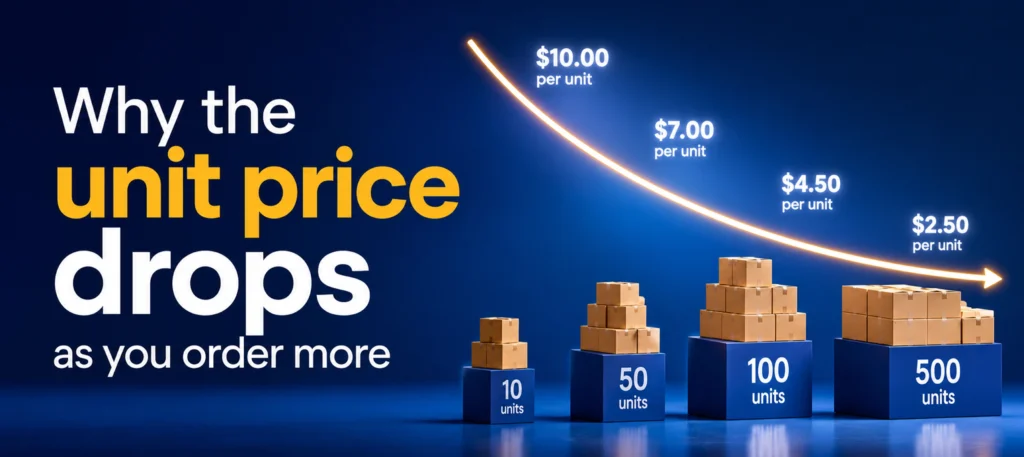
Custom packaging runs on a sliding scale: the more you order, the less each box costs. That’s not a discount for being generous, it’s arithmetic.
Most of the cost of a print run is fixed. The cutting die, the print plates, calibrating the press, the first sheets wasted while colours settle, you pay for those once, whether you make 100 boxes or 5,000. Spread that fixed lump across 100 boxes and each one carries a big share. Spread it across 5,000 and it almost disappears.
Take printing plates as a real example. Industry figures put litho plates at roughly £40 £240 per colour. A four-colour job with about £700 of plates works out at around £1.40 per box across 500 units but only about £0.14 per box across 5,000. Same plates, very different per-box cost and this varies by size and quantity. (Source: PackProPKG, packaging MOQ costs guide.)
That’s the whole logic behind minimum order quantities, and it’s why the curve looks like this:
How custom box unit cost falls as order quantity rises
A downward curve showing illustrative unit cost per custom box dropping steeply from 100 units to 1,000, then flattening out towards 5,000 units. Illustrative cost per box (£) Order quantity (units) £3.00 £2.25 £1.50 £0.75 100 250 500 1,000 2,500 5,000 Steep drop early Curve flattens Unit cost falls fast, then levels off Illustrative only the exact numbers depend on your box size, board and finish. The shape is what matters: the biggest savings come early, then the curve flattens.
Notice where the curve bends. The steepest saving is in the first jump going from a tiny run up to a few hundred. After about 1,000 units, ordering more saves you very little per box. That flat part matters: past a point, buying “in bulk to save money” just parks cash in stock you might not shift.
Why do high MOQs exist and why is 500+ the industry default?
High minimums exist because they suit the supplier, not the small buyer. A supplier setting an MOQ of 500 or 1,000 is protecting themselves against running a job where the fixed setup swamps the value of the order.
There’s a real cost to starting any print run. Litho and flexo printing need physical plates and a cutting die made before anything prints, plus press calibration and wasted setup sheets. If a supplier only runs on those methods, a 100-unit order isn’t worth their machine time so they set the floor at 500 or 1,000 and quote accordingly. (Source: GWP Group, litho vs digital packaging guide.)
Digital printing changed that. It needs no plates, so the setup cost is far lower and short runs become viable. That’s why some suppliers can start at 100 units where others insist on 1,000. It’s the technology behind the press, not goodwill.
Low MOQ vs high MOQ for a small brand: the real trade-off
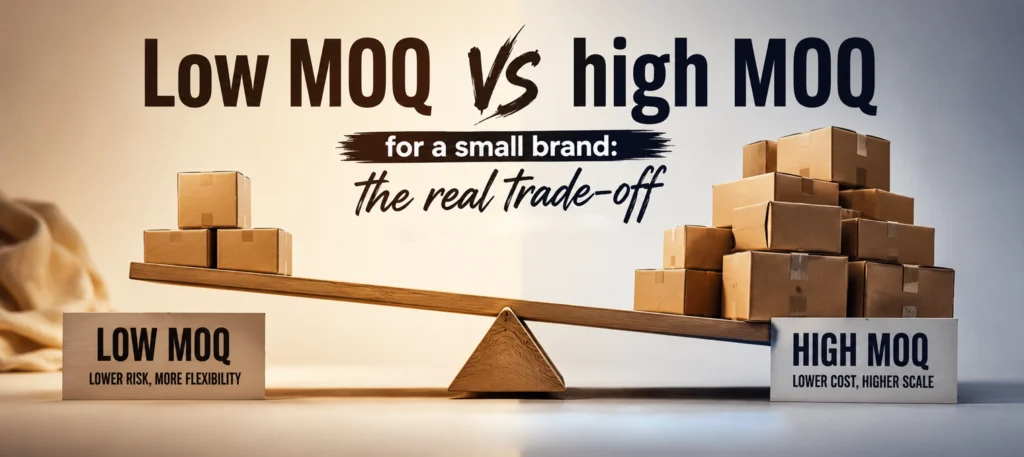
The honest position: a high MOQ gets you the lowest possible price per box. A low MOQ gets you the lowest total risk. For a new or small brand, risk usually matters more than shaving pennies off a unit you haven’t sold yet.
Here’s the same spend laid out both ways for a small brand testing its first branded mailer. Figures are illustrative:
| Details | Low MOQ 100 units | High MOQ 1,000 units |
|---|---|---|
| Illustrative unit cost | Higher per box (say ~£1.80) | Lower per box (say ~£0.95) |
| Illustrative total outlay | ~£180 | ~£950 |
| Cash tied up before first sale | Low | High |
| Can you test a design cheaply? | Yes order, sell, tweak | Not really you’re committed |
| Risk of dead stock | Low | High if the design or product flops |
| Best for | New launches, seasonal runs, design testing | Proven sellers with steady demand |
The unit price on the right looks better. But you’ve spent five times as much to get there, and if the design needs a tweak to a colour that prints darker than the screen, a size that’s tight around the product you’re stuck with 1,000 boxes you don’t want. We see this most with first-time orders, where a small run to check the print and fit in real life saves a costly reprint later.
The sensible path for most small brands: start low, learn what sells, then scale the quantity up once demand is proven. That’s exactly the point at which the unit-cost curve rewards you.
How to get the best unit price without over-ordering
You don’t have to choose between a fair price and a sane order size. A few decisions do most of the work:
- Right-size the board. Match the box strength to the product, not to instinct. Over-specced boards and thickness add cost and shipping weight for no benefit. If it’s a light product in a mailer, you rarely need rigid boards.
- Keep finishing purposefully. One good finish beats three competing ones. Foiling and embossing look great and cost real money. Use them where they earn their keep, like a hero gift box, not on an inner shipper nobody keeps.
- Match print method to run size. Small run? Digital keeps setup low. Large, repeat run? Litho or flexo can pull the unit cost down once the volume justifies the plates.
- Order to real demand, not to a discount. The curve flattens after about 1,000 units. Chasing a slightly lower unit price by doubling your order often just ties up cash and warehouse space.
- Get a full quote, not just a per-box price. Ask for setup, tooling, design, and delivery in the same figure. A low per-box price with separate setup and shipping fees can cost more than a slightly higher all-in price.
On that last point it’s worth choosing a supplier whose price is genuinely all-in. At All Custom Packaging we start from a 100-unit minimum, include free design support and free 3D mockups, charge no setup fees, and include free UK delivery on qualifying orders. Turnaround is 6-8 business days after you approve the design, and you approve a physical sample on video before we run the full batch. That last step is how you avoid the classic small-brand reprint: you see the real box before committing to the quantity.
If you’re weighing up a first run, request a free quote and mockup with your size, quantity and material. It’s the quickest way to see the real numbers for your product.
Key takeaways
- Six factors drive custom packaging cost: size, board, print method, finishes, quantity and setup/tooling. Quantity and setup are the big levers.
- High MOQs (500-1000+) exist because fixed setup costs plates and dies only make sense spread across a big run, especially on litho and flexo presses.
- Digital printing removes plate costs, which is why some suppliers can start from 100 units.
- The unit-cost curve is steepest early and flattens after roughly 1,000 units, so over-ordering to “save money” often just ties up cash.
- For small brands, a low MOQ lowers total risk: test designs, protect cash flow, avoid dead stock then scale quantity once demand is proven.
Frequently asked questions
What is MOQ in custom packaging?
MOQ stands for minimum order quantity, the smallest number of boxes a supplier will produce in one run. It exists because setup costs like cutting dies and print plates are fixed, so suppliers need enough units to make a job worth running. Custom packaging MOQs commonly sit at 500-1,000 units, though some suppliers start from 100.
Why is custom packaging cheaper per unit in bulk?
Because most of the cost is fixed setup tooling, plates, press calibration paid once per design. Spread that across 100 boxes and each carries a big share; spread it across 5,000 and it nearly disappears. The saving is steepest in the first few hundred units, then the curve flattens.
Is a low minimum order quantity worth a higher unit price?
For a new or small brand, usually yes. A low MOQ from 100 units costs a little more per box but far less in total, so you risk less cash, can test a design, and avoid dead stock. Once a product proves it sells, scaling the quantity up brings the unit price down.
Why do most packaging suppliers ask for 500 or 1,000 units minimum?
Because they run litho or flexo presses that need physical plates and dies made before printing. Those fixed costs only make sense across a large run, so they set the floor high. Suppliers using digital printing skip the plates and can offer lower minimums.
How much does custom packaging cost per unit in the UK?
It varies by size, board, print and quantity, so treat any figure as illustrative. As a rough guide, basic printed packaging often lands around £0.30 £1.50 per unit, standard branded packaging £1.50 £4.00, and premium rigid or foiled boxes from £4.00 up. Always ask for an all-in quote covering setup, design and delivery.
Can I get custom printed boxes made in small quantities?
Yes. Suppliers using digital printing can produce custom boxes from around 100 units, sometimes fewer for simple digital work. At All Custom Packaging the minimum is 100 units, with free design support and no setup fees, which makes short first runs practical for small brands.