Milk Carton Sizes UK: The Correct Pint and Litre Dimensions
Quick answer: In the UK, milk is sold in imperial pints and litres, not the US quarts and gallons that fill almost every milk carton size guide online. The standard retail sizes are 1 pint (568ml), 2 pint (1.136 litre), 4 pint (2.272 litre) and 6 pint (3.408 litre), alongside the 250ml, 500ml, 1 litre and 2 litre cartons used mainly for long life and plant based milks. The figure that quietly breaks the American guides is the pint itself, because a UK pint is 568ml while a US pint is only 473ml, so their sizes run about a fifth smaller than the same words suggest here. Format matters as much as volume too. Fresh milk usually sits in a gable top carton or an HDPE plastic bottle, long life and plant milk sit in an aseptic brick carton, and each format carries its own footprint and its own recycling route.
Search “milk carton dimensions” and nearly every result is written for the United States, in ounces, quarts and gallons, then converted to centimetres by machine. None of that maps onto a British shelf, where you buy milk by the pint and the litre and never by the quart. This guide gives the sizes that actually apply in the UK, maps each one to the pack format it usually comes in, and then answers the two questions a packaging buyer needs next: what the cartons are made of, and how they get recycled under the rules landing in 2026.
Why US milk carton guides do not fit the UK
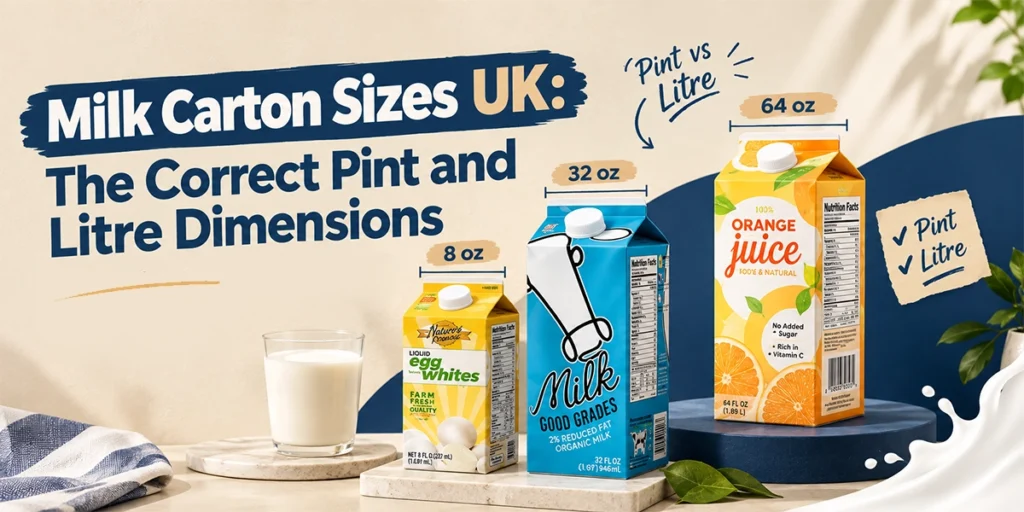
The short version is that the two countries have never measured milk the same way. American guides quote half pints, quarts and gallons. British shops sell pints and litres. So a size chart built around a US gallon is describing a container you simply will not find in a UK chiller.
The deeper trap is the pint, because it looks like a shared word but hides two different volumes. A UK pint is 568ml, precisely 568.26ml. A US pint is 473ml. That is a gap of about 95ml, so a UK pint holds roughly 20% more than a US pint of the same name. When an American guide lists a half pint as 8oz it means 237ml, while a British half pint is 284ml. Convert those US figures to centimetres, as those guides do, and the numbers look authoritative while describing the wrong container for this market. The everyday version is set out plainly in the Milk and More measurement guide, which notes that 1 pint is roughly 568ml and 1 litre is about 1.76 pints.
The pint stays legal here for a reason. Under UK weights and measures law it remains a lawful unit for selling milk in returnable containers, which is why doorstep milk still comes by the pint. Everything else on the shelf is dual marked, so a 2 litre bottle also tells you it is around 3.5 pints. A guide that ignores the pint is missing the unit half the country still thinks in.
The standard UK milk sizes
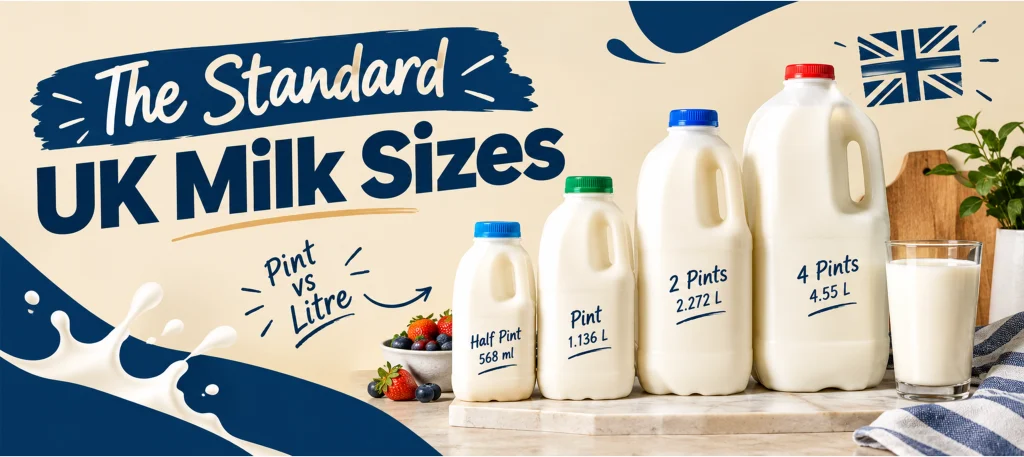
Here are the sizes a UK buyer actually meets, with every conversion worked from the correct 568ml pint. This is the table the US guides do not print, because they are not built around the pint that applies here.
| UK size | In pints | In millilitres | In litres | Usual pack format |
| 1 pint | 1 pint | 568ml | 0.568 litre | HDPE bottle, glass bottle, small gable top carton |
| 2 pint | 2 pints | 1,136ml | 1.136 litre | HDPE bottle |
| 4 pint | 4 pints | 2,272ml | 2.272 litre | HDPE bottle with handle |
| 6 pint | 6 pints | 3,408ml | 3.408 litre | HDPE bottle with handle |
| 250ml | about 0.44 pint | 250ml | 0.25 litre | Aseptic brick carton, small gable top |
| 500ml | about 0.88 pint | 500ml | 0.5 litre | Gable top or aseptic carton |
| 1 litre | about 1.76 pints | 1,000ml | 1 litre | Aseptic brick or gable top carton |
| 2 litre | about 3.52 pints | 2,000ml | 2 litre | HDPE bottle or large gable top carton |
Every conversion above is fixed arithmetic from the 568ml pint. Two pints is 568 times two, which is 1,136ml. Four pints is 2,272ml, six pints is 3,408ml, and a litre divided by 568 gives about 1.76 pints. The odd looking pint values on the carton sizes, 0.44 of a pint for 250ml and 0.88 for 500ml, are just those millilitre figures divided by 568, and they are why a 500ml carton feels like “just under a pint” in the hand.
The split by format matters more than it first looks. The pint based sizes, 1 through 6 pint, are overwhelmingly sold in HDPE plastic bottles in supermarkets, and as glass bottles on doorstep rounds. The millilitre and litre sizes are where cartons dominate, especially for long life milk and the growing range of plant based milks that now sit beside dairy. So “milk carton” and “milk bottle” are not the same packaging decision, and the rest of this guide is about the carton.
The milk carton formats, and the bottles they compete with
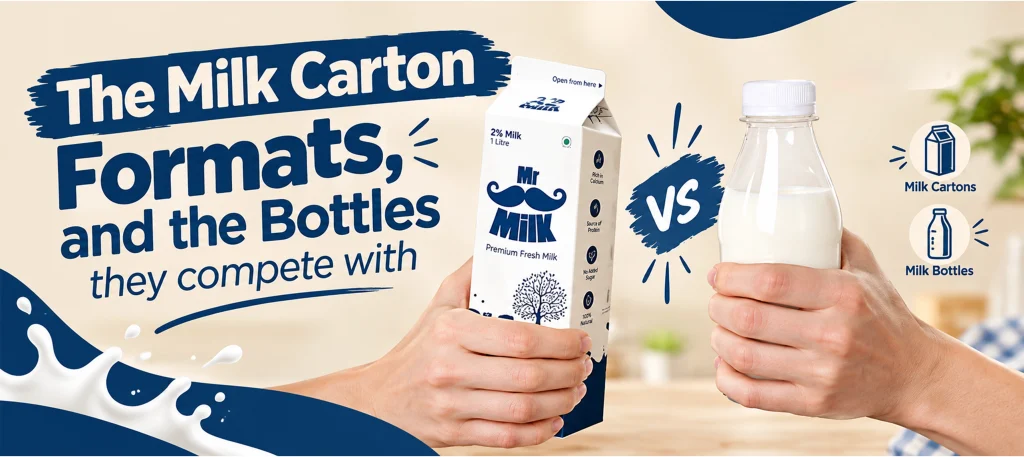
There are two true carton formats in UK milk, plus two bottle formats they share the shelf with. Getting the names right saves a lot of confusion when you brief a supplier.
The gable top carton is the peaked “house roof” carton used mostly for fresh chilled milk and juice. It is made from a paperboard base with a thin polyethylene coating so it holds liquid, and it is filled and sealed at the dairy. This is the classic school milk shape.
The aseptic brick carton is the rectangular block most people picture as a “Tetra Pak”, though that is a brand name rather than a category. It is built from layers of paperboard, polyethylene and, for long life products, a very thin aluminium foil layer that keeps out light and air. That construction is what lets long life and plant milk sit on an ambient shelf for months without refrigeration. Tetra Pak’s Tetra Brik Aseptic range runs from 80ml up to 2 litres, which covers every UK carton milk size.
The two bottles are worth naming because they are what cartons compete with here. HDPE bottles, the translucent plastic jugs, hold the vast majority of fresh supermarket milk in 1, 2, 4 and 6 pint sizes, with a moulded handle on the larger two. Glass bottles, mainly a doorstep and premium format, are usually the 1 pint. Neither is a carton, and neither recycles the same way a carton does, which is the part that trips people up later.
One quick clarification, because the word “carton” gets stretched. A beverage carton is a liquid holding pack. A folding carton, the flat printed box that most retail products ship in, is a different thing made from a single layer of paperboard with no liquid barrier. If your question is really about printed retail boxes rather than milk packs, our guide to folding cartons and rigid boxes covers that side properly.
Typical UK carton dimensions (indicative)
Carton dimensions are not standardised the way the volumes are. They vary by filling machine, brand and whether the pack is chilled or aseptic, so treat the figures below as indicative starting points rather than fixed specifications. Confirm the exact size with the carton manufacturer or your filler before you commit any artwork.
Gable top cartons are built on a square base. A common base for the 1 litre size is around 70mm by 70mm, with smaller formats down to roughly 57mm by 57mm for mini cartons. The body of a 1 litre gable carton stands somewhere near 200mm tall before the folded roof, and the gable itself adds about 25mm to 38mm on top. As a rough rule, the taller and narrower the carton, the more of a gable top it is likely to be.
Aseptic brick cartons pack the same volume into a tighter rectangular block. A 1 litre brick sits in the region of 195mm by 70mm by 95mm, though squat and slim variants exist for the same volume. The brick shape earns its place because it stacks and ships with almost no wasted space between packs, which is a large part of why long life milk travels and stores so efficiently. Smaller 250ml and 500ml bricks follow the same proportions at reduced scale.
Because those numbers are indicative, use them to sanity check a quote or a shelf plan, not to size a tool. If a dimension has to be exact, for a case count, a shelf gap or a shipper, measure the real carton you intend to use or ask the manufacturer for the drawing.
What the little e mark on a milk carton means
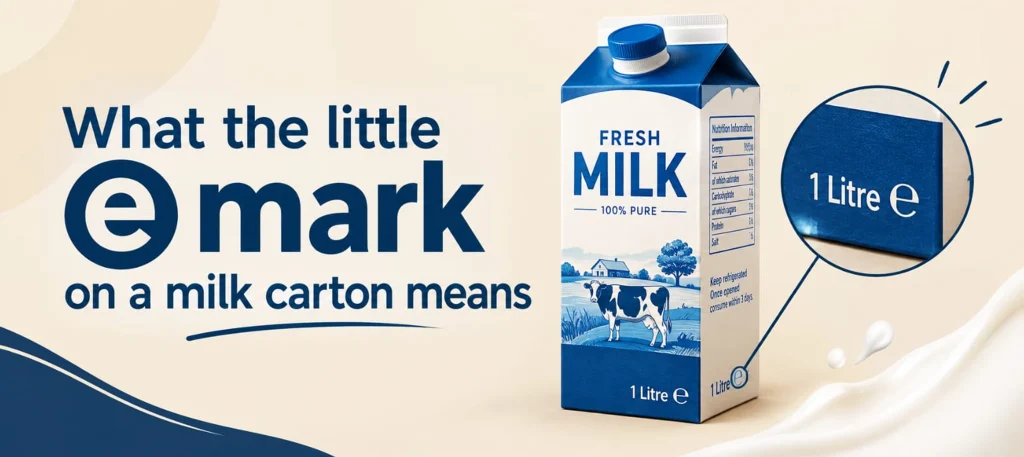
Look closely at a milk carton and you will often see a lower case “e” sitting next to the 1 litre or 568ml declaration. That mark is doing real work, and it is not decoration.
The “e” is the estimated sign, and it tells you the pack was filled under the UK average quantity system rather than individually measured to an exact figure. Under that system a batch has to average at least the stated volume, with only small, controlled shortfalls allowed on individual packs and clear limits on how far any one pack may fall short. In other words a carton marked 1 litre with an “e” is not promising that every single carton contains exactly 1,000ml, but that the batch as a whole meets the rules. The system is set out in the Weights and Measures (Packaged Goods) Regulations 2006, and the average quantity rules explained by Business Companion are the plain English reference for how it works.
For a packaging buyer the practical point is small but useful. The volume and the “e” mark belong to the fill and the filler, not to the printed artwork, so they are a labelling responsibility that stays with the brand owner filling the product. If you are ever unsure what has to appear on a food or drink pack, the current rules on GOV.UK are the place to check before you sign off a print run.
Are milk cartons recyclable in the UK?
Yes, and this is the area changing fastest, so it is worth getting current rather than repeating old advice. Beverage cartons are recyclable, but they are a mixed material, and that is the whole story. A carton is mostly paperboard, bonded to a thin layer of polyethylene, with an added aluminium layer in the aseptic long life type. Separating those layers needs dedicated equipment, which is why cartons have historically gone to specialist facilities rather than straight into every kerbside bin.
That picture is being redrawn in 2026. Under England’s Simpler Recycling reforms, local councils are being brought into line so that beverage cartons are collected at kerbside rather than only at front of store points or dedicated carton banks. Alongside that, cartons are moving onto a single clear on pack instruction. The Alliance for Beverage Cartons and the Environment (ACE UK), which represents carton makers Tetra Pak, Elopak and SIG, has confirmed that food and drink cartons, both chilled and aseptic, carry the standard OPRL “Recycle” label from 1 April 2026. Trade coverage of the same change reported liquid cartons set to carry a Recycle label from 2026.
A note on where coverage actually stands, because the honest answer is that it is moving. ACE UK reported carton collection at around 69% of UK local authority areas in mid 2025, and expected that to pass the 75% threshold the “Recycle” label requires by April 2026. So the direction is clear, but the exact figure on any given day depends on how many councils have switched, and the safe wording for a brand is to point people at their own council’s current list rather than to promise a national number.
This is also where the greenwashing line sits. A carton is not “eco friendly” as a blanket claim. It is a recyclable mixed material with a specific and improving disposal route, and that is what you can honestly say. The difference between recyclable, compostable and biodegradable is exactly the sort of distinction that gets brands into trouble, and our guide to biodegradable, compostable and recyclable packaging unpacks why they are not interchangeable.
Designing a custom printed carton for the UK
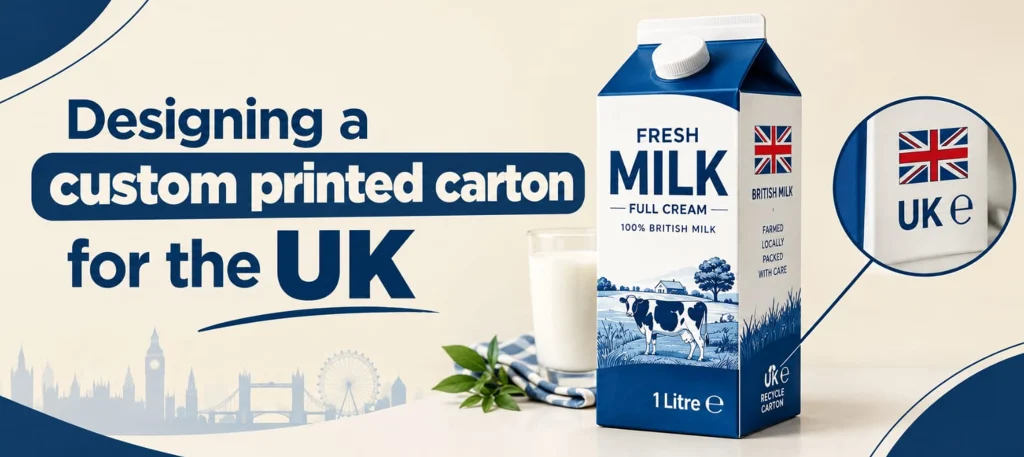
If you are a UK brand putting a drink or a liquid into a carton, the sizing above is your starting point, but the buying decision has a few extra layers. Pick the volume your customer expects first, in the pint or litre terms they shop in, then match the format to how the product will live. A chilled product suits a gable top. A long life or plant based product suits an aseptic brick. Only then does the artwork sit on top.
Two things matter more for cartons than for a plain retail box. The first is food and liquid contact. Milk sits directly against the pack, so the material and any barrier or coating must be confirmed as suitable for direct food and liquid contact for that specific product before production, and the regulatory responsibility for the filled product stays with the brand owner. We do not assert a food safety certification we have not verified for your exact material. The second is that the printed carton and the filling are often two separate jobs, so it is worth being clear from the start about what you need printed and what has to be filled and sealed by a dairy or co packer.
At All Custom Packaging we produce custom printed cartons and food packaging to your dimensions and artwork, with the material and any barrier confirmed as fit for your specific use before anything goes to production. Orders start from 100 units and design support is free, so you can prototype a size and a look without committing to a huge run. If you want a hand matching a UK carton size to the right format and material, talk to our team and we will confirm the specification with you before production. You can also see the range on our custom food packaging pages.
Frequently asked questions
Is a UK pint the same as a US pint?
No, and the gap is bigger than most people expect. A UK pint is 568ml, precisely 568.26ml. A US pint is 473ml. That is about a 95ml difference, so a UK pint holds roughly 20% more. Any milk size guide that quietly assumes a US pint is describing smaller packs than a British shopper actually buys.
What are the standard UK milk sizes?
In pints, the standard retail sizes are 1 pint (568ml), 2 pint (1.136 litre), 4 pint (2.272 litre) and 6 pint (3.408 litre). In carton and plant milk terms you also see 250ml, 500ml, 1 litre and 2 litre. The pint sizes are mostly plastic bottles, while the millilitre and litre sizes are where cartons are most common.
How many pints are in a litre?
A litre is about 1.76 UK pints, because 1,000ml divided by the 568ml pint is 1.7606. Going the other way, a UK pint is 0.568 of a litre. A 2 litre pack is therefore around 3.5 pints, which is why it is dual marked on the label.
What is the difference between a gable top carton and an aseptic carton?
A gable top carton is the peaked shape used for fresh chilled milk, made from paperboard with a polyethylene coating, and it needs refrigeration. An aseptic brick carton is the rectangular long life format, built from paperboard, polyethylene and a thin aluminium layer, and it can sit on an ambient shelf unopened. Same job, different construction and different shelf.
Are milk cartons recyclable in the UK?
Yes. Cartons are a recyclable mixed material of paperboard, polyethylene and, in long life types, a thin aluminium layer. Under England’s Simpler Recycling reforms more councils collect them at kerbside, and cartons carry the OPRL “Recycle” label from 1 April 2026. Coverage varies by council, so the reliable answer for any address is to check the local authority’s current list.
Does the little e mark mean the carton holds exactly that volume?
No. The “e” is the estimated sign, showing the pack was filled under the average quantity system, so the batch must average at least the stated volume with only small controlled variation on individual packs.