
Toy Packaging Safety Requirements UK: UKCA, Warnings and What’s Actually Law
Quick answer: UK toy packaging safety requirements cover three things: the UKCA or CE mark, which can legally sit on the packaging itself rather than only the toy, at a minimum height; an age-suitability warning with its reason, such as a choking hazard, where the toy is unsuitable under 36 months; and, for a plastic bag with a wide enough opening, a genuine physical safety rule under EN71-1 about the material being air-permeable. A suffocation warning printed on the bag is not actually a legal requirement on its own, even though it is close to universal in practice.
Most guides to toy compliance cover the toy and leave the packaging as an afterthought, or repeat the suffocation-warning advice as if it were law when it is not quite that. This one is scoped to the packaging specifically, and sourced to the UK’s own official product-safety guidance rather than general advice pages.
Where the UKCA or CE mark can actually go
Under the current UK rules, the UKCA (or, where still transitionally accepted, CE) mark does not have to be printed on the toy itself. Business Companion, the UK’s official business-facing product-safety guidance service, confirms the mark must be on the toy or its packaging, and be permanent and easy to read. For a small toy where there is genuinely no room, the mark can instead appear on a label attached to it, or on an accompanying leaflet. In practice, that means a well-designed box can legally carry the mark on your behalf, provided it stays permanent and legible on the finished packaging, not just in the artwork file.
The age warning: what actually has to be said
Where a toy is unsuitable for children under 36 months, the rule is not just “add a warning.” Business Companion is specific that the warning must state the reason, such as a choking hazard from small parts, and that it can be given either as words or as a recognised pictogram. A bare “not suitable under 3 years” with no reason attached falls short of what is actually required; the reason is the part sellers most often drop.
Traceability: who has to be named
Toy packaging also carries a traceability requirement that is easy to overlook once the safety warnings are sorted. The packaging or the toy must show the name and address of the manufacturer, or the UK importer’s details if the manufacturer is outside the UK, along with a type, batch, serial or model number so a specific run can be identified if a problem is ever traced back.
The suffocation warning: convention, not quite law
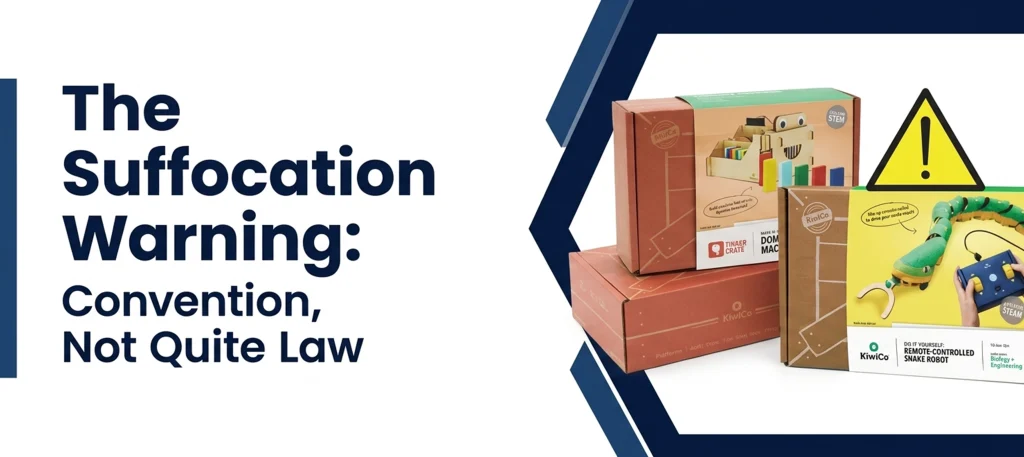
Here is the correction worth knowing. Search “toy packaging suffocation warning UK” and most results present it as a flat legal requirement. It is not, in the strict sense: there is no general UK law that mandates a child-suffocation warning on every plastic bag. What actually drives its near-universal use is that major UK retailers treat it as a condition of supply, so in practice almost every plastic bag sold through a mainstream retail channel carries one anyway. If you are selling direct rather than through a retailer that demands it, you are not automatically breaking the law by leaving it off, though it remains good practice and is expected the moment a retailer is involved.
The rule that actually is law: EN71-1 and bag openings
While the warning wording itself is convention, there is a genuine, specific physical safety rule that does apply, and most general compliance guides skip it entirely. Under EN71-1, the harmonised standard covering toy safety, a drawstring plastic bag with an opening circumference over 380mm has to be made from a material that is air-permeable, precisely because a large, sealed opening on a non-breathable bag is the actual suffocation hazard the rule exists to prevent. This is a specification question for your packaging, not a wording question for your warning label, and it is worth raising directly with whoever supplies your bags or wrapping.
Putting it together on a real box

A toy packaging spec that actually holds up checks four things: the UKCA/CE mark sits somewhere permanent and legible, on the box if not the toy; the age warning states its reason, not just an age figure; the manufacturer or importer’s name, address and a batch reference are printed somewhere; and, if a plastic bag with a wide opening is involved anywhere in the pack, its material meets the EN71-1 air-permeability rule regardless of whether a suffocation warning is also printed on it. This applies whether you are speccing a single run or working across a full Toy Boxes range, since the requirements do not scale down for a smaller order.
None of this is something a packaging supplier can confirm on your behalf. The artwork layout can reserve clear panels for the information the product is required to display, but All Custom Packaging can help organise the available print space; the brand or its regulatory adviser remains responsible for confirming the accuracy and completeness of the required product information. Treat this article as a starting point for the packaging conversation, not a substitute for checking your specific toy against the current regulations.
Frequently asked questions
Does the UKCA mark have to be printed on the toy itself?
No. It can legally sit on the toy, on a label attached to it, on an accompanying leaflet, or on the packaging, provided it stays permanent and legible on whichever surface carries it. A well-designed box can carry the mark on the toy’s behalf where there genuinely is no room on the product itself.
Is a suffocation warning legally required on toy packaging bags?
Not by a general UK law mandating it on every plastic bag. It is close to universal in practice because major UK retailers make it a condition of supply, so most bags sold through mainstream retail carry one regardless. Selling direct without going through such a retailer does not automatically require it, though it remains good practice.
What is the actual legal rule for plastic bags used in toy packaging?
Under EN71-1, a drawstring plastic bag with an opening circumference over 380mm must be made from air-permeable material. This is the genuine, specific physical safety requirement in this area, distinct from the suffocation-warning wording, which is convention rather than a direct legal mandate.
What has to be on a toy’s age warning label?
The warning must state the reason a toy is unsuitable for a given age, such as a choking hazard from small parts, not just an age figure on its own. It can be given as words or as a recognised pictogram, but the reason has to accompany it either way.
What traceability information does toy packaging need?
The name and address of the manufacturer, or the UK importer if the manufacturer is based outside the UK, along with a type, batch, serial or model number so a specific production run can be identified if it is ever needed.
Whether you need a bespoke Custom Toy Packaging build or a straightforward Large Toy Boxes With Lids format, our design team can lay out clean, dedicated panels for your mark, warning and traceability information so nothing gets lost in the artwork.