
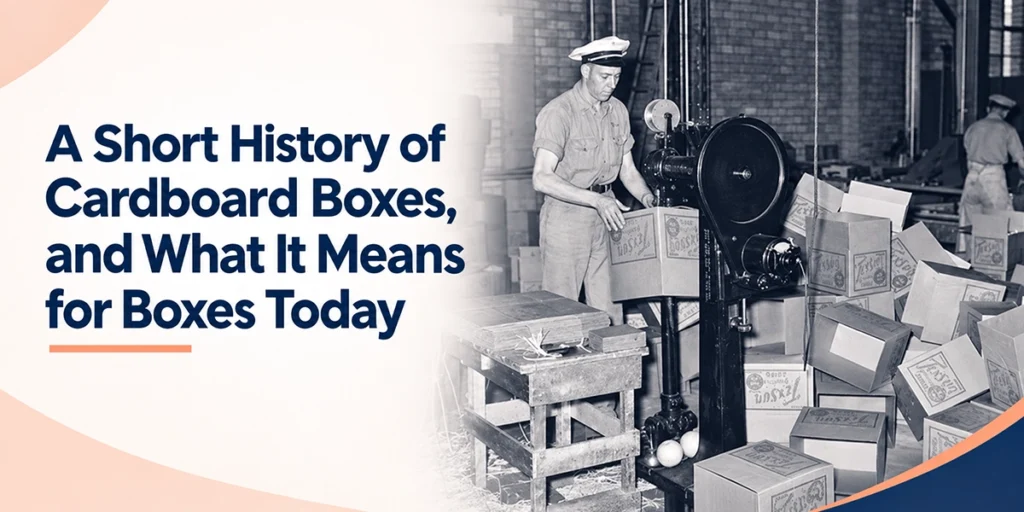
A Short History of Cardboard Boxes, and What It Means for Boxes Today
Quick answer: The history of cardboard boxes runs through two separate inventions. The first commercial paperboard box, a flat-board carton, is sometimes credited to an English firm in 1817. Corrugated board came later: pleated paper was patented in England in 1856 as a hat liner, an American patent for corrugated shipping material followed in 1871, and board with liners on both sides arrived in 1874. In 1890 the Scottish-born printer Robert Gair found a way to cut and crease boxes in one step, which made mass-produced folding boxes possible. By the early 1900s, corrugated cartons were replacing wooden crates.
Two different boxes: paperboard and corrugated
“Cardboard box” covers two materials with separate histories:
- Paperboard cartons are made from a single thick sheet. Cereal boxes and cosmetic cartons are paperboard.
- Corrugated boxes have a wavy middle layer, the flute, between flat liners. Shipping boxes and mailers are corrugated.
Their stories meet when the cut-and-crease method used for cartons was applied to corrugated board.
A timeline of the cardboard box
| Year | Event |
|---|---|
| 1817 | The first commercial paperboard box is produced in England, sometimes credited to M. Treverton and Son |
| About 1840 | Cardboard boxes are used in France to carry silkworm moths and eggs |
| 1856 | Pleated (corrugated) paper is patented in England, as a liner for tall hats |
| Around the 1860s | Folding cartons appear, shipped flat for customers to set up |
| 1871 | Albert Jones of New York patents single-faced corrugated board for wrapping bottles and glass lamp chimneys |
| 1874 | G. Smyth builds the first machine for making corrugated board in quantity, and Oliver Long adds liners to both sides |
| 1879 | Mechanical die cutting and creasing of box blanks is developed |
| 1890 | Robert Gair invents the pre-cut paperboard box |
| 1895 | The first corrugated box is made in the United States |
| Early 1900s | Corrugated cartons begin replacing wooden crates and boxes |
| 1908 | “Corrugated paper-board” and “corrugated cardboard” are both in use in the trade |
| 1915 | The gable-top milk carton is patented |
| Mid-1950s | Corrugated cases carry fruit and produce from farm to shop with less bruising |
| Late 1960s | FEFCO develops a numbered code for box designs |
Dates are drawn from the history sections on corrugated fiberboard, the cardboard box and paperboard, and from FEFCO for the box code.
The accident that made mass-produced boxes

Robert Gair, born in Scotland, was running a printing and paper-bag business in Brooklyn in the 1870s. While printing seed bags, a metal rule that normally creased the bags slipped and cut them instead. Gair realised that cutting and creasing in one operation could turn a flat sheet into a ready-to-fold box. By 1890 he was making pre-cut boxes in bulk, supplied flat and folded when needed.
When corrugated board became widely available around the turn of the twentieth century, applying the same idea to it was a short step. That combination, strong fluted board cut and creased in one pass, is still how most shipping boxes are made.
From glass to groceries to ecommerce
The first corrugated boxes carried glass and pottery, which is why Albert Jones patented his board for wrapping bottles. Lightweight flaked cereals then pushed cartons into the kitchen: the Kellogg Company was the first to sell cereal in cardboard cartons. In the mid-1950s, corrugated cases let fruit and vegetables travel from farm to shop without bruising.
The most recent chapter is ecommerce. The printed mailer box, designed to be both the shipping box and the unboxing, has grown with online shopping. The newest edition of FEFCO’s code added a new series of designs for retail and online selling.
What the history means for boxes today
Each step in the timeline is still visible in how boxes are specified and ordered:
- Flutes. The letters A, B, C, E and F are said to follow the order the flute profiles were introduced, not their size. Today’s flute and board grade options still use those letters.
- Liners on both sides. Oliver Long’s 1874 board is what we now call single wall.
- Cut and crease. Gair’s accident became die cutting.
- Shipped flat. Folding cartons were supplied flat from the 1860s, which is still how most cartons and mailers arrive.
- Box codes. FEFCO’s code, created in the late 1960s to replace long written descriptions, still lets buyers and suppliers name the same design. Its current edition is available from FEFCO.
- Cartons for liquids. The gable-top carton patented in 1915 is the shape behind today’s milk cartons.
For how Gair’s idea works on a modern press, see our die cutting process guide. Today’s carton shapes are covered in our guide to milk carton sizes.
If you are choosing between a flat-board carton and a rigid box today, see folding cartons vs rigid boxes.
Myth check
- “Cardboard was invented in China in the 15th century.” This is often repeated, but we could not find a reliable source for it. Paper itself has a long history in China. The boxes in this timeline begin in 19th-century Europe and America.
- “Robert Gair invented the box in Scotland.” Gair was born in Scotland, but his box-making work was in Brooklyn, New York.
- “The corrugated box and the cereal box are the same thing.” They are not. Cereal boxes are paperboard; shipping boxes are corrugated.
Boxes made the modern way
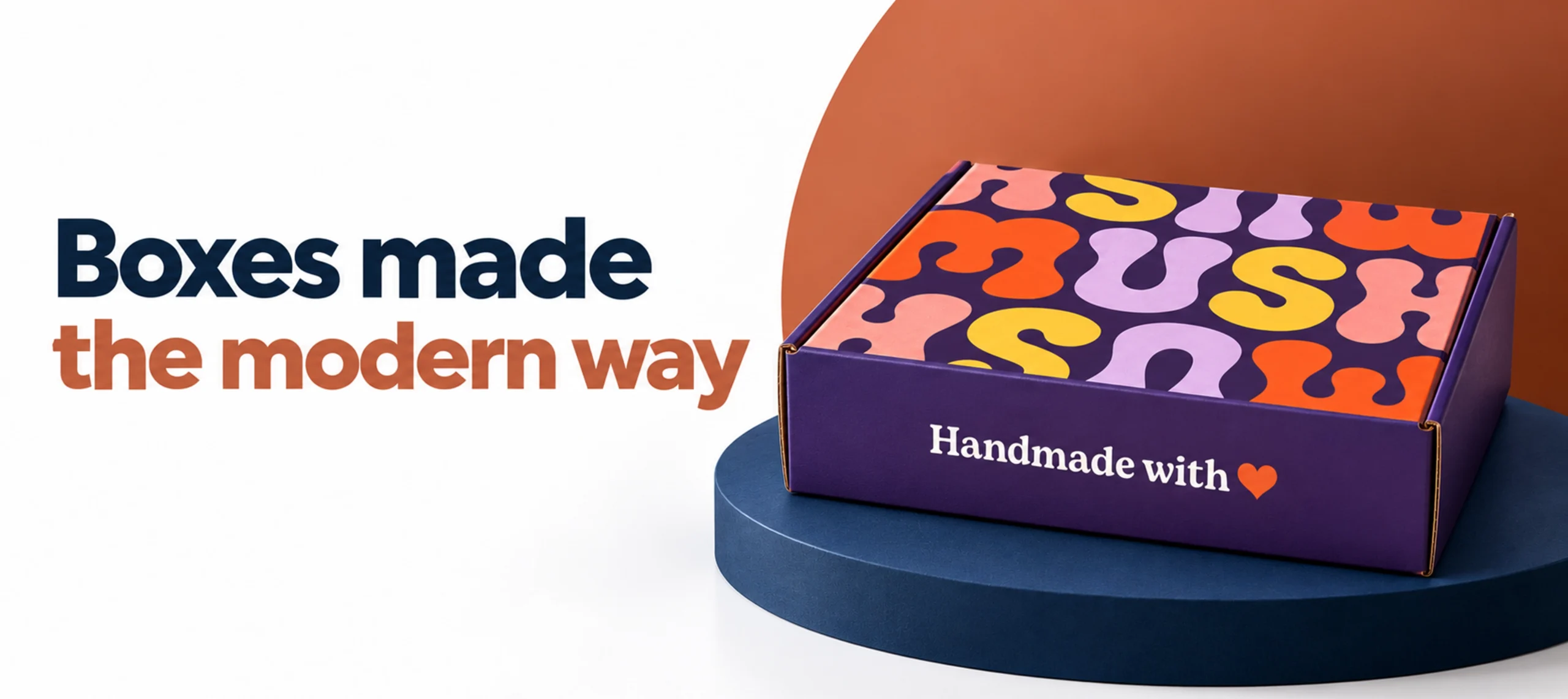
We make cardboard boxes, mailers and cereal boxes to your sizes, cut and creased from flat board and supplied ready to fold, much as Gair intended.
- Orders start from 100 units.
- Design support is free.
- A digital 3D mock-up is free.
Cardboard box history questions
Who invented the cardboard box?
No single person. The first commercial paperboard box is sometimes credited to an English firm in 1817. Albert Jones patented corrugated shipping board in 1871, Oliver Long added the second liner in 1874, and Robert Gair invented the pre-cut box in 1890.
When was corrugated cardboard invented?
Pleated paper was patented in England in 1856. Corrugated board for shipping was patented in 1871, and board with liners on both sides followed in 1874.
What was the first cardboard box used for?
The first corrugated boxes carried glass and pottery. Earlier paperboard boxes carried goods such as silkworm eggs in France around 1840.
When did cardboard boxes replace wooden crates?
From the early 1900s, corrugated cartons began replacing wooden crates and boxes for shipping.
Who first used cardboard cereal boxes?
The Kellogg Company was the first to use cardboard cartons for cereal.
Was the cardboard box invented in Britain?
Partly. The first commercial paperboard box and the 1856 patent for pleated paper were both English, and Robert Gair was born in Scotland. The corrugated shipping box itself was developed mainly in the United States.
Want boxes made for your products? Send us your sizes and we will quote.