
Jam Labelling Requirements UK: Fruit and Sugar Statements, Names and Jars
A jar of jam sold in Great Britain carries its reserved name with the fruit, plus “prepared with 50g of fruit per 100g” and “total sugar content: 62g per 100g” in view of the name. Northern Ireland changed course on 14 June 2026: jam there now needs 450 g of fruit per kilo rather than 350 g, and the sugar line is no longer required.
These rules come from the Jam and Similar Products Regulations of each UK nation. They cover jam, extra jam, jelly, marmalade, curds and mincemeat, and Business Companion says they apply to jars sold at a market stall as well as on a shop shelf.
This guide takes the jam labelling rules in the order a label is built: the name, the two statements, the rest of the label, then the jar and any gift box. Treat it as general guidance; your council’s Trading Standards team can check a specific recipe and label.
Is it jam? The reserved names and fruit minimums
“Jam”, “extra jam”, “jelly”, “marmalade” and several other names are reserved descriptions. A product that meets the recipe must use the name, and a product that does not meet it must not (Business Companion’s jam guide).
| Name | What it is | Minimum fruit per 1,000 g in Great Britain | Northern Ireland |
|---|---|---|---|
| Jam | Fruit pulp or purée, sugar and water, set to a gel | 350 g (250 g for blackcurrants, redcurrants, rosehips, rowanberries, sea buckthorns and quinces) | 450 g (350 g for that group) from 14 June 2026 |
| Extra jam | Unconcentrated pulp; apples, pears and some others cannot be mixed in | 450 g (350 g for the same group) | 500 g (450 g for that group) from 14 June 2026 |
| Jelly | Fruit juice or a water extract of fruit, set | 350 g (250 g for the group) | 450 g from 30 June 2026 |
| Extra jelly | As jelly, with the same mixing bans as extra jam | 450 g (350 g for the group) | 500 g from 30 June 2026 |
| Marmalade | Citrus fruit only | 200 g of citrus, at least 75 g of it from the flesh | Same figures, named “citrus marmalade” or after the fruit |
| Mincemeat | Vine fruits, citrus peel, suet or equivalent fat, sweetening and vinegar | 300 g of vine fruits and peel, at least 200 g of it vine fruits, plus 25 g of suet or fat | Same figures |
| Lemon curd and other fruit curds | Fat or oil, sugar, egg and fruit | At least 40 g of fat or oil and 6.5 g of egg yolk solids | Same figures |
The figures come from Schedule 1 of the Jam and Similar Products (England) Regulations 2003. Wales and Scotland use the same jam and extra jam minimums. In mincemeat, “vine fruits” means muscatels, raisins, sultanas or currants, and nothing else.
There is a minimum for soluble solids too. Jam and the other products in the table must reach at least 60% soluble solids, measured by refractometer. That is the dissolved solids, mostly sugar, rather than “60% sugar” in the recipe, and curds and mincemeat need 65%.
The 60% floor does not apply where sweeteners replace some or all of the sugar, or to “reduced sugar” products, which sit between 25% and 50% soluble solids. Business Companion adds that a “reduced sugar” product needs at least 30% less sugar under the wider claims rules.
The fruit in the name
The fruit goes into the name itself, as in “strawberry jam” or “Seville orange marmalade”. With two fruits, both are named in descending order of weight. With three or more, list them in that order, or call the product “mixed fruit” or give the number of fruits, as in “three fruit jam” (regulation 5).
Only certain extra ingredients keep a recipe inside the jam rules. Schedule 2 allows honey in place of sugar, liquid pectin, citrus peel, spirits, wine, nuts, herbs, spices and vanilla, plus a few named juices and permitted additives.
A recipe outside those limits cannot be called jam, but it can still be sold. Business Companion confirms that “conserve”, “preserve” and “fruit spread” are not reserved descriptions, so they suit recipes with other ingredients, less fruit or less sugar. Customary names such as “mint jelly” also remain allowed where they will not mislead.
The two statements: fruit and sugar
Jam, extra jam, jelly, extra jelly, marmalade and sweetened chestnut purée must carry two statements in Great Britain.
- “Prepared with Xg of fruit per 100g”, where X is the grams of fruit used for every 100 g of finished jam.
- “Total sugar content: Yg per 100g”, where Y is the soluble solids reading for every 100 g.
The fruit figure comes from your recipe and the yield. If 1,200 g of strawberries go into a batch that finishes at 2,000 g of jam, the jam was prepared with 60 g of fruit per 100 g.
The sugar figure is a measurement, not a recipe sum. Regulation 5 asks for the soluble solids content read by refractometer at 20°C, accurate to within 3 refractometric degrees. A craft-fair guide that ranks for this search says both figures are calculated from the recipe, but for the sugar line that is not what the regulation says.
The sugar line can be left off where the label makes a nutrition claim about sugar and carries the full nutrition labelling. Business Companion’s QUID guide also confirms that jam needs no separate fruit percentage, because these statements already give it.
Both statements must be readable together with the product name, in one field of vision and in clearly visible characters. Business Companion points out that the net weight must also share that field of vision with the name, so the name, the fruit line, the sugar line and the weight all belong on one face of the jar.
A jam made from two or more fruits and named after them, rather than called “mixed fruit”, should show each fruit’s amount, as in “made with 45g of raspberry and 35g of apple per 100g”, according to Business Companion. Curds, flavour curds and mincemeat need neither statement.
Northern Ireland changed in 2026
| Rule | England, Wales and Scotland | Northern Ireland |
|---|---|---|
| Jam, fruit per 1,000 g | 350 g | 450 g from 14 June 2026 |
| Extra jam, fruit per 1,000 g | 450 g | 500 g from 14 June 2026 |
| Jelly and extra jelly | 350 g and 450 g | 450 g and 500 g from 30 June 2026 |
| “Prepared with Xg of fruit per 100g” | Required | Still required |
| “Total sugar content: Yg per 100g” | Required | No longer required from 14 June 2026 |
The changes came through two Northern Ireland statutory rules, SR 2026/5 on breakfast foods and SR 2026/103 on jam. Both let stock that was lawfully on the market or labelled before the change sell until it runs out.
A different rule covers GB-made jam stocked by Northern Irish shops through the Retail Movement Scheme. It follows the jam regulations of the GB nation it came from. FSA guidance lists jams, marmalades, preserves and fruit curds among the goods that need no individual “Not for EU” label, though box-level labelling still applies to most of them.
The rest of the label
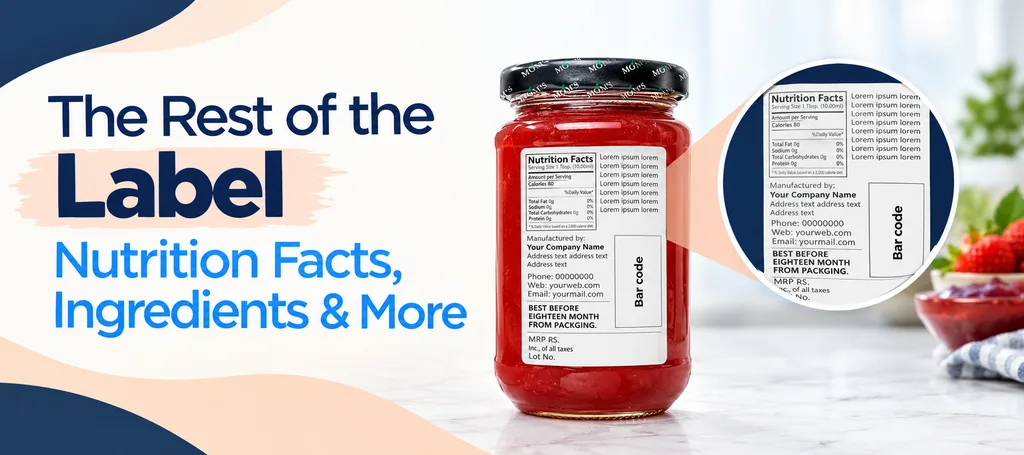
Prepacked jam also needs the general food information. That means an ingredients list with any allergens emphasised, a best-before date, a lot mark unless the date serves as one, and storage advice where needed. It also needs a business name and postal address, the net weight, and nutrition information unless the business qualifies for an exemption. Sulphur dioxide above 10 mg/kg, which can come from sulphited fruit, has to be named and emphasised as an allergen.
In Great Britain, jam and marmalade must be marked with their net weight unless the pack holds under 5 g (Schedule 1 of the 1988 Miscellaneous Foods Order). On a 340 g or 454 g jar, the weight figures need to be at least 4 mm tall, and on a 113 g jar at least 3 mm.
Jam you pot yourself and sell from your own stall still needs the jam name and both statements, because Business Companion says those rules apply however the product is sold. The general list then shrinks to the name and an ingredients list with allergens emphasised.
Selling online adds one step. The general prepacked guide says the full label information, apart from the best-before date, must also be on the product page before the customer buys.
Laying out the jar label and the gift box
The four-together rule shapes the front of the jar. A label that works in practice:
- Front: the name with its fruit, the fruit line, the sugar line and the weight, with the brand.
- Back or side: ingredients with allergens emphasised, best-before date and lot mark, storage advice, the business name and address, and a nutrition table if one is needed.
For a 340 g jar of strawberry jam sold in Great Britain, the front panel could read as follows.
| Line | Example |
|---|---|
| Name | Strawberry Jam |
| Fruit line | Prepared with 50g of fruit per 100g |
| Sugar line | Total sugar content: 62g per 100g |
| Weight | 340 g |
When the jar travels in a lidded gift box, a hamper or a sleeve, the same information must be readable without opening or removing anything. Print it on the box, add a label to the box, or leave a window that shows the jar’s front label. Each jar can sit in its own cut-out in our jam jar packaging boxes, with a window placed over the front label if you want it to do the work.
For a trio of preserves, a 3 jar gift box can be made with windows over each jar’s front panel, or with a printed panel for all three. Mixed hampers follow the same principle: empty Christmas hamper boxes can be printed with a panel that repeats what the closed lid would otherwise hide.
The artwork layout can reserve clear panels for the information the product is required to display. All Custom Packaging can help organise the available print space, but the brand or its regulatory adviser remains responsible for confirming the accuracy and completeness of the required product information.
Common mistakes
- “Jam” on a recipe below the fruit minimum, or with an ingredient outside the permitted list.
- A sugar figure worked out from the recipe instead of read by refractometer.
- The fruit and sugar lines on the back, away from the name.
- “Extra jam” with apple or pear mixed in.
- Raspberries or cranberries counted as the vine fruits in mincemeat.
- A Great Britain label used on jam made and sold in Northern Ireland after 14 June 2026.
- A hamper lid that hides every jar’s front label.
Frequently asked questions
What must a jam label include in the UK?
In Great Britain: the reserved name with the fruit, the fruit line (“prepared with Xg of fruit per 100g”) and the sugar line (“total sugar content: Yg per 100g”), plus the net weight. The rest is the general list: ingredients with allergens emphasised, a best-before date, a lot mark, the business name and postal address, and nutrition information unless exempt.
Can I sell homemade jam in the UK?
Yes, as a registered food business. The FSA’s food business registration guidance covers home kitchens and stalls, and asks you to register with your council at least 28 days before trading. The jam rules then apply in full.
What is the legal definition of jam in the UK?
A gelled mixture of sugar, fruit pulp or purée and water, made with at least 350 g of fruit per kilo in Great Britain, or 450 g in Northern Ireland since 14 June 2026. A few fruits have lower figures, and the jam needs at least 60% soluble solids unless it is reduced sugar.
How do I work out the sugar content for a jam label?
Read the soluble solids with a refractometer at 20°C. The regulation asks for that reading, accurate to within 3 degrees, rather than a figure calculated from the recipe.
Can I call my chilli or whisky jam “jam”?
Spices and spirits are on the permitted list, so a recipe can stay jam if it also meets the fruit and soluble solids minimums. Ingredients outside the list mean a different name, such as “conserve” or “chilli preserve”.
Do lemon curd and mincemeat need the fruit and sugar statements?
No. They are reserved names with their own recipes, but the fruit and sugar statements apply to jams, jellies, marmalades and chestnut purée, not to curds or mincemeat.
Stocking up for Christmas markets and hampers? Our stickers and labels range includes printed jar labels with room for the front-panel statements, and the boxes above can repeat that panel on the outside. Orders start from 100 units. Design support is free. A digital 3D mock-up is free. For the quote, send the artwork, the quantity, the delivery postcode and the date the order is needed by.