
Business Card Size UK: The Correct Dimensions and Why They Matter for Packaging
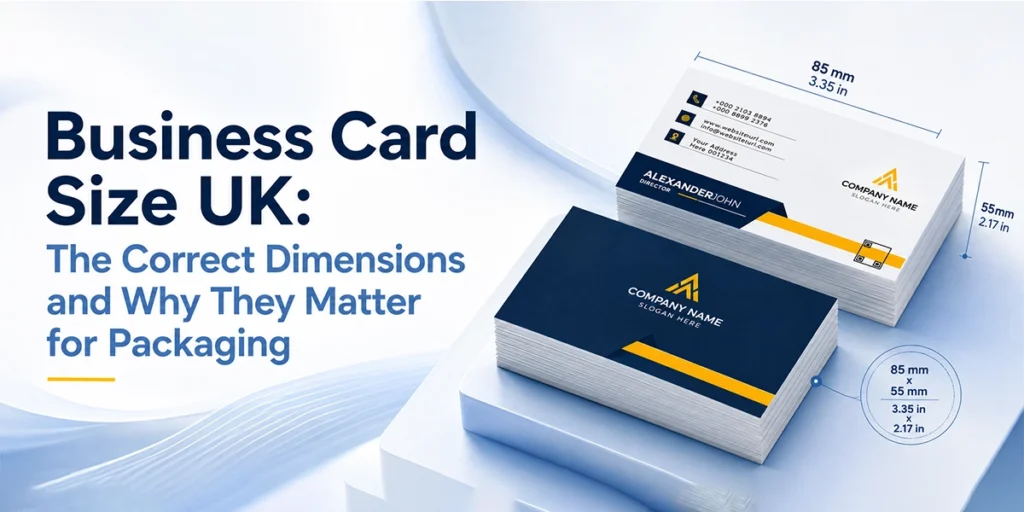
Quick answer: The standard UK business card size is 85mm x 55mm (8.5cm x 5.5cm), the same footprint as a credit card. That is different from the US standard of 3.5in x 2in (88.9mm x 50.8mm). The exact size matters because it decides whether a card sits flush in a wallet, a presentation folder slot or a die cut insert, and whether it survives a trip through the post inside a mailer box.
Order business cards at the wrong size and the problem rarely shows up straight away. The card looks fine on screen, prints fine, then does not sit right in the folder it was meant to slot into, or it curls the moment it is packed alongside a product. This guide covers the correct UK dimensions, how the US size differs, what the EU situation actually is, and the part most size guides skip: how card size and thickness interact with the packaging built around them.
What is the standard business card size in the UK?
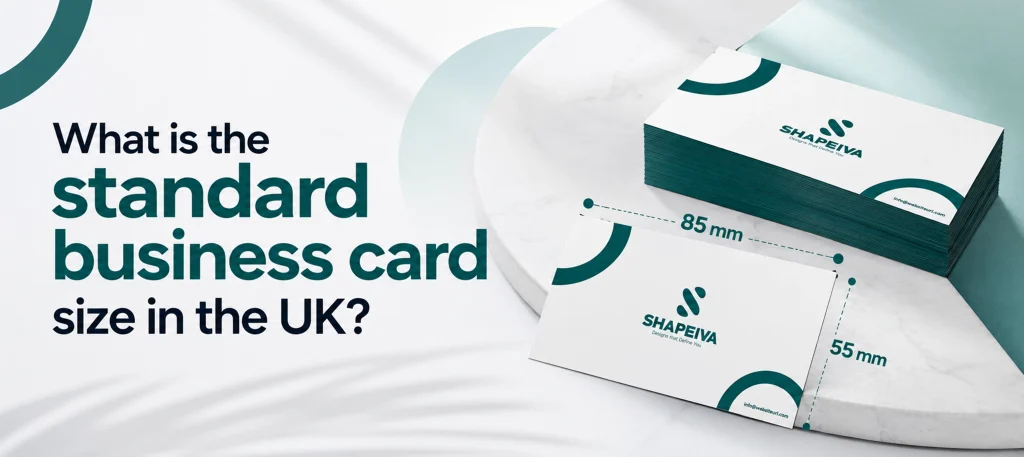
A standard UK business card measures 85mm by 55mm. That is 8.5cm by 5.5cm, or 3.35in by 2.17in if you are working in inches. It is not a coincidence that this is almost identical to a debit or credit card (ISO/IEC 7810 payment cards measure 85.60mm by 53.98mm). Business cards were sized to slide into the same wallet pockets and card holders, so a card cut to the wrong dimensions is the one that will not sit flush with the others.
Printers usually add 3mm of bleed on every side for production, which takes the working artwork size up to roughly 91mm by 61mm before trimming. That detail matters for anyone designing the card itself, but the finished, trimmed size a customer actually holds and packs is 85mm by 55mm.
UK vs US business card size: why the mix up happens
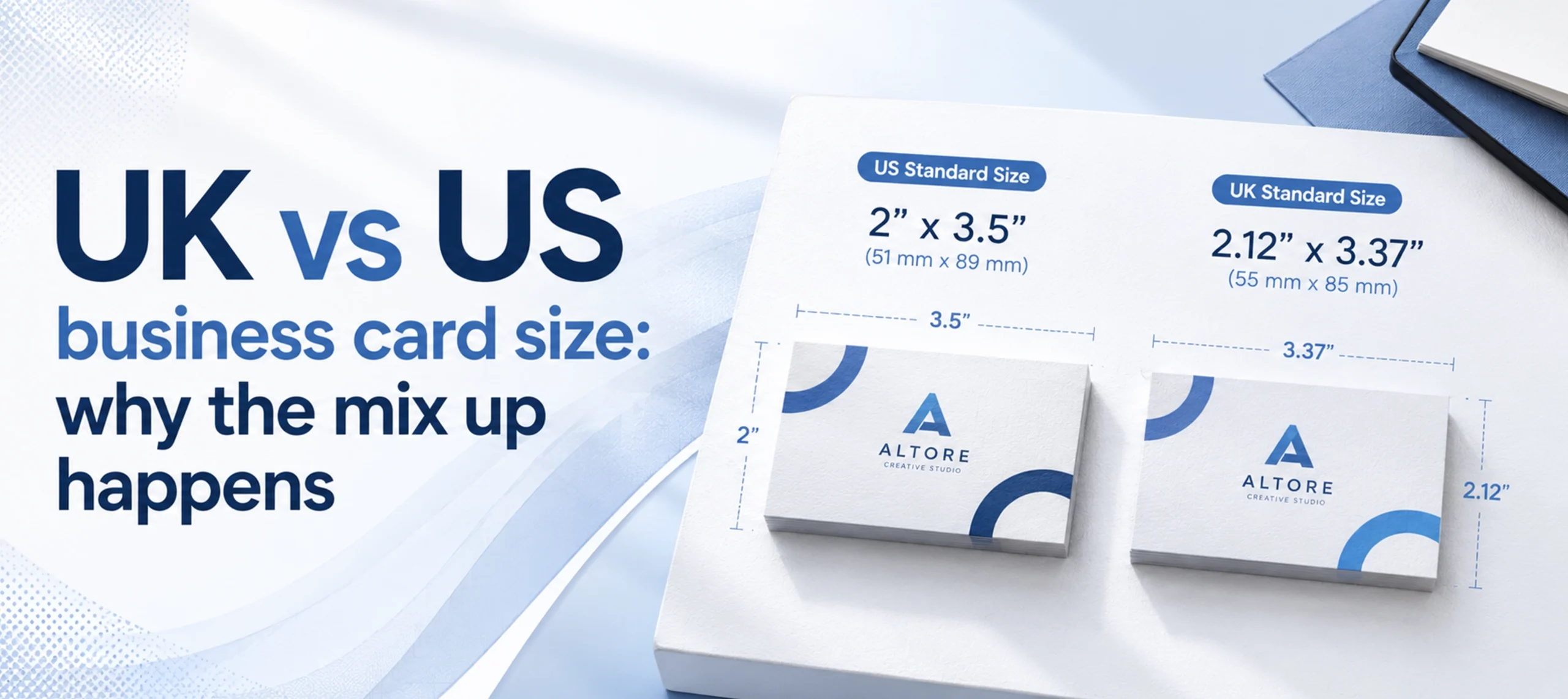
The US and Canadian standard is 3.5in by 2in, which converts to 88.9mm by 50.8mm. Set that next to the UK figure and the card is about 4mm wider and 4mm shorter than the UK version.
| Region | Size in mm | Size in inches | Fits a UK card slot cut to 85 x 55mm? |
|---|---|---|---|
| UK | 85 x 55mm | 3.35 x 2.17in | Yes, this is the reference size |
| US and Canada | 88.9 x 50.8mm | 3.5 x 2in | Not reliably. Roughly 4mm too wide and 4mm too short |
| ISO/IEC 7810 ID-1 (payment and ID cards) | 85.60 x 53.98mm | 3.37 x 2.13in | Close, within about a millimetre of the UK figure |
A 4mm difference sounds trivial until you have ordered 500 cards cut to a US template for a UK presentation folder with a die cut slot. The cards are too wide to slide in cleanly and too short to sit flush at the bottom, so they either jam the slot or rattle around loose in it.
The mix up happens because a lot of design templates and stock design tools default to US dimensions without saying so. If you download a “standard business card template” from a US based design tool, there is a real chance it is built to 88.9 x 50.8mm, not the UK size. Check the mm figures on a template before you send artwork to print, rather than trusting the label.
Business card width and height compared (mm)
UK: 85 wide, 55 high. US and Canada: 88.9 wide, 50.8 high. ISO/IEC 7810 ID-1: 85.6 wide, 53.98 high. The UK and ISO figures are close to identical. The US card is wider and shorter than both. Source: UK and US printing industry standards, cross checked August 2026; ISO/IEC 7810 (Wikipedia, verified 2026-08-26).
What about EU sizes?

This is where a lot of guides get vague, so it is worth being precise about what is and is not confirmed. The UK’s 85 x 55mm size is often described as shared with “the European standard,” and in everyday commercial printing that is close enough to true. The precisely defined international card format, ISO/IEC 7810 ID-1, used for bank cards and national ID cards across the EU, is 85.60mm by 53.98mm. That is roughly a millimetre narrower in height than the UK’s 55mm figure.
In practice, a card cut to either figure will sit in almost any UK wallet, card holder or standard folder slot without anyone noticing the difference. Where it can matter is if you are sourcing card stock, a die cut slot or a card feeder mechanism from a European supplier working to the strict ISO tolerance rather than the looser 85 x 55mm figure UK printers use. If your business trades across EU markets and precision matters for your packaging, ask your supplier which figure they cut to rather than assuming the two are identical.
Why the exact size matters more than people think
Most business card guides stop at “here is the size, here is how to design it.” For a packaging business, the more useful question is what happens once that card has to interact with something else: a folder, a box, a tag, or a machine. A few millimetres out and the card does not fail on its own. It fails against whatever it was meant to fit.
Presentation folders and card slots
Presentation folders with a business card slot are die cut to hold a card of a specific size, usually 85 x 55mm in the UK. That slot is normally cut with very little spare room, because a loose card falls out in transit and a tight one will not go in at all. A card printed to the US size, or trimmed inconsistently by a supplier who was not paying attention, can end up too wide to slide in without folding a corner, or too short to click into the bottom edge of the slot. All Custom Packaging’s Presentation Folders range includes folders built with a business card slot as standard, so if you are ordering folders and cards from different suppliers, confirm both are working to the same figure before you commit to a full print run.
Swing tags and matching inserts
Businesses often design a swing tag, a thank you card or another small printed insert to sit alongside a business card in the same box or bag, matching its width or proportions so the set looks deliberate rather than mismatched. If the business card was printed to one size and the tag was designed against a different assumed size, the pair will not line up visually even if each item is perfectly printed on its own. Custom Swing Tags are cut to whatever reference size you give a supplier, so confirm that size once, at the start of a project, and use it for every companion piece.
Packing a card inside a box or mailer
A lot of small businesses slip a business card into a product box or mailer as a simple branding touch. ACP’s own Business Card Boxes range exists for exactly this reason, holding a stack of cards flat and protected rather than loose in a drawer. Thickness matters as much as width and height here. A card printed on ordinary paper, rather than proper card stock, can crease, curl or slide around loose during a delivery. A creased card looks like an afterthought rather than a considered detail. A card that is too rigid and too large for the box can also press against the product or stop a lid closing flush. If you are including a card as an insert in a Custom Mailer Boxes, getting this right is less about the millimetre count and more about matching the card’s stiffness and footprint to the space it is travelling in.
Automated card printers and feeders
Anywhere a business card runs through a machine rather than a person’s hands, such as a loyalty card printer, a badge printer or an automated card feeder in a print shop, the equipment is calibrated to a standard card size and a standard thickness. A card that is even slightly off spec, too thick, too thin, or cut a millimetre outside tolerance, is the one that jams the feeder or prints off centre. If your cards are going anywhere near automated equipment, stick to the standard 85 x 55mm size and a standard card weight rather than a custom variant.
Business card thickness (GSM) and why it matters for packaging
GSM stands for grams per square metre. It is a measure of paper weight, not printed size, and it is the number that decides whether a card feels flimsy or substantial in the hand. Standard printer paper is usually around 80 to 100gsm. Business cards are cut from far heavier stock, typically in the 300 to 400gsm range, roughly the thickness of a supermarket loyalty card or a slightly heavier greetings card.
That extra weight is not just about feel. It is what stops a card bending in a wallet, creasing inside a mailer, or going limp after a few days on a desk. For anyone using a business card as a packaging insert rather than a handout, thickness has a direct, practical effect.
Under about 250gsm, a card starts to behave more like a leaflet than a card. It can crease against other contents in a box, curl in humid conditions, or slide around loose enough to mark the product sitting next to it. Well above 400gsm, a card becomes closer to a small rigid panel, which is unnecessary weight and cost for something meant to travel loose inside a box, and can be too stiff to sit flat in a folder’s card slot. The 300 to 400gsm range holds its shape without adding bulk it does not need. These are trade standard ranges rather than one fixed number, and the exact weight a supplier recommends will vary with the finish and the coating used.
A quick fit check before you order
Before placing a full print run, it is worth running through a short check, particularly if the cards are going into another piece of packaging rather than straight into someone’s hand.
- Confirm the card is specified at 85 x 55mm, not 88.9 x 50.8mm. Check the actual mm figure on the artwork file, not just the template name.
- Confirm the card stock is somewhere in the 300 to 400gsm range, not a standard paper weight.
- If the card is going into a presentation folder slot, get one sample card and test it in one sample folder before the full batch is printed.
- If the card is travelling inside a mailer or product box, pack it flat against a firm surface inside the box rather than loose, so it cannot fold or curl in transit.
- If you are printing a swing tag or insert to match the card, confirm both were designed against the same reference size before either goes to print.
Frequently asked questions
What is the standard business card size in the UK? 85mm by 55mm (8.5cm by 5.5cm), the same footprint as a UK debit or credit card.
Is a UK business card the same size as a credit card? Almost exactly. A UK business card is 85 x 55mm, and a UK payment card is 85.60 x 53.98mm under the ISO/IEC 7810 standard, a difference of about a millimetre that is not noticeable by eye or in a standard wallet slot.
What is the US business card size? 3.5in by 2in, which converts to 88.9mm by 50.8mm. It is close to the UK size but noticeably wider and shorter, enough to cause problems in a UK sized card slot or holder.
Do EU countries use a different business card size to the UK? Not in any way that matters for everyday printing. The commonly used figure is the same 85 x 55mm as the UK. The precisely defined ISO/IEC 7810 card format used for EU payment and ID cards is 85.60 x 53.98mm, around a millimetre narrower in height, which only tends to matter if a supplier is cutting to a strict international tolerance.
What GSM should a business card be? Most UK business cards are printed on stock between 300 and 400gsm. Lighter than that and the card can feel flimsy or crease easily. Much heavier and it becomes an unnecessarily rigid, costly option for something meant to travel loose in a box or wallet.
Will a US sized business card fit a UK presentation folder slot? Not reliably. A UK folder slot is normally die cut for an 85 x 55mm card, and a US card at 88.9 x 50.8mm is wide enough and short enough to jam or sit loose rather than click in flush.
Key takeaways
- The UK standard business card size is 85 x 55mm, the same footprint as a credit card.
- The US and Canadian standard is 88.9 x 50.8mm, close enough to cause real fit problems if mixed up with the UK size.
- EU sizing is close to the UK figure in everyday use, with a small, precisely defined difference under the ISO/IEC 7810 standard.
- Standard business card stock runs 300 to 400gsm, thick enough to hold its shape in a wallet, folder or parcel without becoming unnecessarily rigid.
- The size and thickness only really matter once the card has to interact with something else: a folder slot, a matching tag, a box, or a machine.
If you are specifying presentation folders with a business card slot, swing tags to match a card, or mailer inserts built around a business card, it helps to check the packaging and the card against the same reference size before the full run goes to print. All Custom Packaging’s design team can help you check that fit. Get a quote, or take a look at our Business Card Boxes, Presentation Folders and Custom Swing Tags ranges.