
Cosmetic labelling requirements UK: what goes on the box vs the bottle
Quick answer Under the UK Cosmetics Regulation (the UK’s kept version of EU Regulation 1223/2009), every cosmetic sold in Great Britain must show eight things: the UK Responsible Person’s name and address, country of origin for imports, the weight or volume, a durability date or PAO symbol, precautions, a batch number, the product’s function, and a full INCI ingredients list. Most of these must appear on both the container and the box. The ingredients list is the exception: the law lets it live on the box alone. That makes your custom box a legal document as much as a marketing one, so plan the panels before you approve the artwork.
If you make soap, skincare, bath bombs or make-up, two surfaces carry your legal wording: the primary container (the bottle, jar, tube or wrapper) and the packaging (the printed box around it). UK law treats them differently, and that difference decides your box design.
We check cosmetic artwork files most weeks, and the same problem keeps appearing. Brands design a beautiful box, then discover the ingredients list has nowhere to go. This guide covers what must be printed where, what the symbols mean, and how to design a box that passes Trading Standards without looking like a pharmacy leaflet.
One thing before we start: this is practical guidance from a packaging supplier, not legal advice. Rules change, so always check the current guidance on GOV.UK before you print.
Which rules apply to my product?
Cosmetics, candles and food each follow a different labelling regime, and mixing them up is a common (and expensive) mistake. Here’s the 30-second sort:
| You sell… | Regime that applies | What it’s about |
|---|---|---|
| Soap, bath bombs, skincare, make-up, shampoo, lip balm | UK Cosmetics Regulation | Ingredients, safety, Responsible Person, notification |
| Candles, wax melts, reed diffusers, room sprays | CLP (GB CLP Regulation) | Chemical hazard warning labels |
| Food you pack on your premises before sale | PPDS (“Natasha’s Law”) | Full ingredients with allergens emphasised |
Soap and bath bombs sit under cosmetics law, not CLP. A wax melt is never a cosmetic, because it doesn’t go on your body. If you sell across categories (say, candles and bath bombs in one gift set), each product follows its own regime. We’ve covered the other two in detail: see our guides to CLP labelling for candle makers and PPDS food labelling (links at the end).
The eight things UK law says a cosmetic label must show
GOV.UK’s guidance on making cosmetic products available in Great Britain lists the mandatory label elements. In plain English:
- Responsible Person’s name and address. The UK person or company legally accountable for the product’s safety. A real UK postal address, printed on the container and the box.
- Country of origin. Only needed if the product is imported into the UK, for example “Made in France”.
- Nominal content. The weight or volume at the time of packing, in grams or millilitres. Products under 5 g or 5 ml (samples, single-use sachets) are exempt.
- Durability. A “best before” date if the product lasts 30 months or less, shown with the egg-timer symbol or the words. If it lasts longer than 30 months, you use the open-jar PAO symbol instead (more on this below).
- Precautions for use. Any warnings required for the ingredients, such as “avoid contact with eyes”.
- Batch number. A code that identifies the manufacturing batch, so a faulty batch can be traced and recalled.
- Function. What the product does, unless it’s obvious from how it looks. A lipstick explains itself. An unlabelled white cream in a jar doesn’t.
- Ingredients list. Headed “Ingredients”, using INCI names (the standardised international ingredient names, so “Aqua” rather than “water”), in descending order of weight as added. Colourants use CI numbers, and nanomaterials must be followed by “(nano)”.
Fragrance allergens on the UK’s declarable list must be named individually in the ingredients list when they exceed 0.001% in leave-on products or 0.01% in rinse-off products. Your safety assessor will flag which ones apply to your formula.
The wording must be easy to read, hard to rub off, and in English for the GB market.
Box vs container: where each element must appear
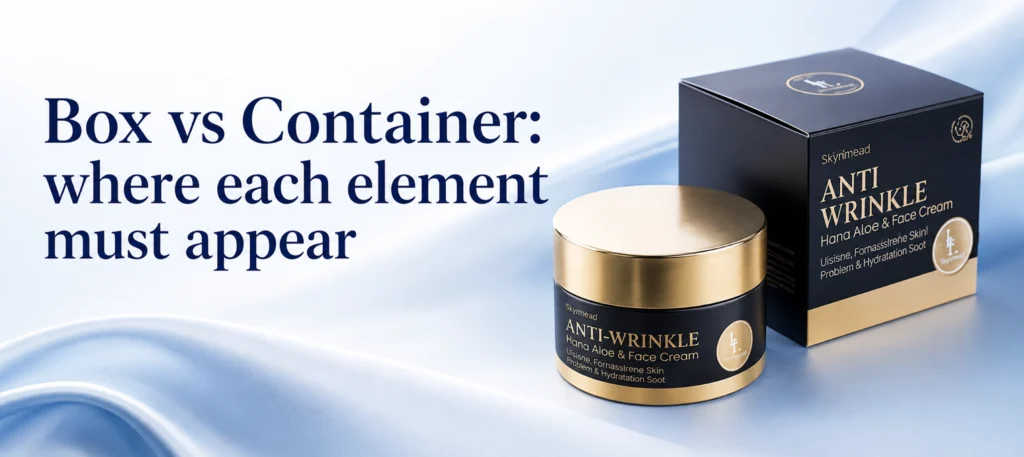
Here’s the part most guides skip, and the part that matters most when you’re briefing a box supplier. This table is based on GOV.UK and Business Companion (the government-backed Trading Standards guidance):
| Label element | Container (bottle, jar, tube) | Outer box | Notes for your box design |
|---|---|---|---|
| Responsible Person name and address | Required | Required | Both surfaces. Don’t bury it in 5 pt type on a flap. |
| Country of origin (imports only) | Required | Required | Usually sits next to the RP address. |
| Nominal content (g or ml) | Required | Required | Exempt under 5 g / 5 ml. Front panel is conventional. |
| Best before / PAO symbol | Required | Required | Keep the PAO symbol and its “12M” next to each other. |
| Precautions | Required | Required | If space is genuinely too tight, a leaflet plus the hand-in-book symbol is allowed. |
| Batch number | Required | Required | If the container is too small to carry it, the box alone can. Leave an unprinted patch for overprinting. |
| Function | Required | Required | Not needed where the presentation makes it obvious. |
| Ingredients list | Not required | Required | The law allows the INCI list to appear “solely on the packaging”. Your box can do the whole job. |
Two practical takeaways. First, if your product sells in a box, that box carries almost the full legal payload, so it needs the same compliance care as the bottle label. Second, the ingredients rule is a gift to designers: you can keep the jar minimal and put the long INCI list on the box’s back panel.
There’s a catch, though. If a customer can bin the box and lose the only copy of the ingredients, that’s legal, but think about repeat use. Many brands repeat the list on the container anyway when space allows.
The three symbols, decoded
Open-jar (PAO) symbol. An open cream pot with a number like “12M” inside or beside it. It means “period after opening”: the product stays safe for that many months once opened. Used when shelf life exceeds 30 months.
Egg-timer symbol. Shorthand for “best before this date”. Used with a date when the product’s minimum durability is 30 months or less. You use the egg-timer or PAO, not both requirements at once: which one depends on the product’s tested shelf life.
Hand-in-book symbol. A hand pointing at an open book. It tells the shopper “the information you’re looking for is on an enclosed leaflet, tag or card”. Only for cases where printing on the pack is genuinely impractical, such as very small items. Unwrapped soap at a market stall can even use a notice beside the product instead.
Before anything gets printed: Responsible Person and SCPN
Printing a compliant box means nothing if the product behind it isn’t registered. Before a cosmetic goes on sale in Great Britain, three things must exist:
- A UK Responsible Person (RP). A person or business with an established UK address (a PO box or mail-forwarding service doesn’t count). For most small brands, that’s you. The RP keeps the Product Information File and answers to regulators.
- A Cosmetic Product Safety Report (CPSR). A safety assessment of your exact formula, signed off by a qualified assessor. Yes, even for a kitchen-table soap business. The rules make no distinction between a hobbyist and L’Oréal.
- An SCPN notification. The RP must notify the product to the Office for Product Safety and Standards (OPSS) through the Submit Cosmetic Product Notifications service before it’s made available. It’s free to use. Skipping it is a criminal offence, and GOV.UK warns of fines and up to three months’ imprisonment.
This system is busy: GOV.UK reported 861,686 product notifications from 24,112 registered Responsible Persons between the SCPN’s launch in 2020 and May 2026. Small brands make up a large share of those, so the process is well-trodden.
Why does a box supplier care? Because the name and address you print must match your SCPN registration. We’ve seen brands reprint entire runs because they moved premises after notifying and before printing.
Designing a box that passes: a printer’s-eye view
This is the part no consultancy guide covers, because consultancies don’t sit with the dieline. (A dieline is the flat template showing where a box folds and cuts; we explain it fully in our dieline guide.) Here’s what we check on every cosmetic box artwork file:
Reserve the back panel early. A typical skincare INCI list runs 25 to 40 ingredients. At a readable size, that’s most of a back panel on a 50 mm wide carton. Lock that space in before the designer fills it with brand story.
Keep legal text off folds and glue flaps. Text that crosses a crease cracks, and anything on a glue flap disappears when the box is assembled. Trading Standards expects wording to be visible and legible on the finished box, not the flat sheet.
Mind your contrast on kraft. Brown kraft board looks lovely and muddies small type. Dark ink on kraft works; white ink needs a double hit to stay crisp at small sizes. If your ingredients list prints in 7 pt reversed-out white on uncoated kraft, expect trouble reading it.
Print small text in solid black. Tiny type built from four colours blurs if the press drifts by a hair. We set legal text in 100% single-colour black on every cosmetic job. It’s the difference between crisp and fuzzy at ingredient-list sizes.
Leave a landing zone for the batch code. Most small brands inkjet or stamp batch numbers after printing. An unprinted, uncoated patch about 20 x 10 mm means the code actually adheres and stays legible. Spot UV and soft-touch lamination both repel inkjet ink.
Watch the window. Window boxes sell cosmetics brilliantly, and every square centimetre of film is a square centimetre you can’t print legal text on. If the window eats the back panel, the ingredients list has to fit somewhere else. Plan the die-cut around the legal text, not the other way round.
Put the PAO symbol near the durability wording. Scattering related elements across three panels technically complies but invites a Trading Standards query. Group the RP address, origin, batch space and durability marks in one tidy information panel.
Proof against the checklist, not the vibe. Before approving, read your proof against the eight-point list above. We do this check on request for cosmetic customers, and it catches something on roughly one file in three. The most common miss? No space left for the batch code.
Soap and bath bomb boxes: the small-brand specifics
Handmade doesn’t mean exempt. A bar of soap is legally a cosmetic, with the same CPSR, SCPN and labelling duties as a mass-market moisturiser.
The rules do bend to the product’s shape, though. Unwrapped soap sold loose can show its ingredients on a notice next to the display. The moment you put that soap in a printed box, the box becomes the packaging and should carry the required information. For bath bombs, which are usually sold wrapped or boxed rather than labelled directly, the box often carries everything. That makes the box artwork the main compliance surface for a typical bath bomb brand.
If you’re at the “craft fair to first stockist” stage, this is usually the moment proper printed boxes replace hand-written labels. Wholesale buyers check labels, and an incomplete one is an easy reason to say no.
Common artwork mistakes we see (so you don’t repeat them)
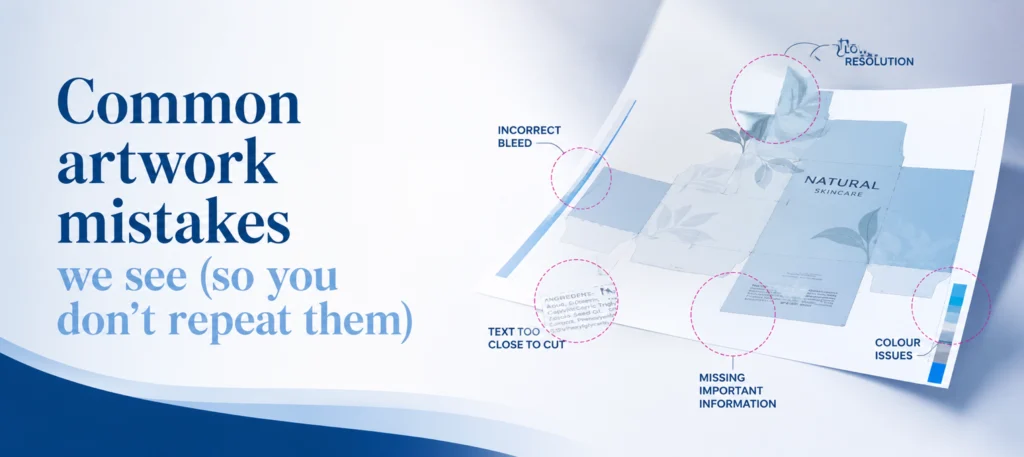
The five we correct most often on cosmetic jobs: ingredients list with no “Ingredients” heading; common names instead of INCI names (“shea butter” instead of “Butyrospermum Parkii Butter”); no PAO or best-before mark at all; an RP address that’s a website URL rather than a postal address; and no room anywhere for a batch code. All five are cheap to fix at artwork stage and painful to fix after 500 boxes arrive.
FAQ

Do I have to put my home address on my soap labels? The Responsible Person’s name and UK postal address must appear on the container and packaging, and for many small makers that’s a home address. Some brands use their registered office or other business address instead, provided the Product Information File is accessible there. Check the current GOV.UK guidance before choosing.
Do handmade cosmetics sold at craft fairs need full labels? Yes. The UK Cosmetics Regulation applies from your first sale, whatever the scale. Loose, unwrapped soap gets one concession: ingredients can appear on a notice by the display rather than on each bar.
What does the “12M” open-jar symbol mean? It’s the period-after-opening (PAO) mark: the product remains safe to use for 12 months after first opening. It’s used on products with a shelf life over 30 months.
Can the ingredients list go on the box only, not the bottle? Yes. GOV.UK confirms ingredients “can be provided solely on the packaging”, meaning the outer box. Everything else on the mandatory list needs to be on both, with limited small-container exceptions.
What do I need to do before selling a cosmetic in the UK? Appoint a UK Responsible Person, hold a CPSR safety assessment and Product Information File, and notify each product through the SCPN service before sale. Then label the container and box with the eight mandatory elements.
Does this apply to candles and wax melts too? No. Candles and wax melts aren’t cosmetics; they follow CLP hazard-labelling rules instead. Bath bombs and soap are cosmetics and follow the rules in this guide.
Key takeaways
- The UK Cosmetics Regulation requires eight label elements; most go on both the container and the box.
- The full INCI ingredients list can legally live on the box alone, so treat the box as a compliance surface, not decoration.
- Register first, print second: SCPN notification and a matching RP address come before artwork approval.
- Design for compliance early: back-panel space, fold-free legal text, solid-black small type, a batch-code landing zone, and window die-cuts that respect the information panel.
- Soap and bath bombs follow cosmetics rules at any scale, with a notice allowed for loose unwrapped soap.
- Rules move. Confirm details against current GOV.UK guidance or OPSS before printing.
If you’re ready to put a compliant box around your product, our team designs custom cosmetic packaging, soap boxes and bath bomb boxes from 100 units, with free design support and a compliance-layout check on your artwork before anything hits the press. Get a quote and we’ll help you plan the panels.