
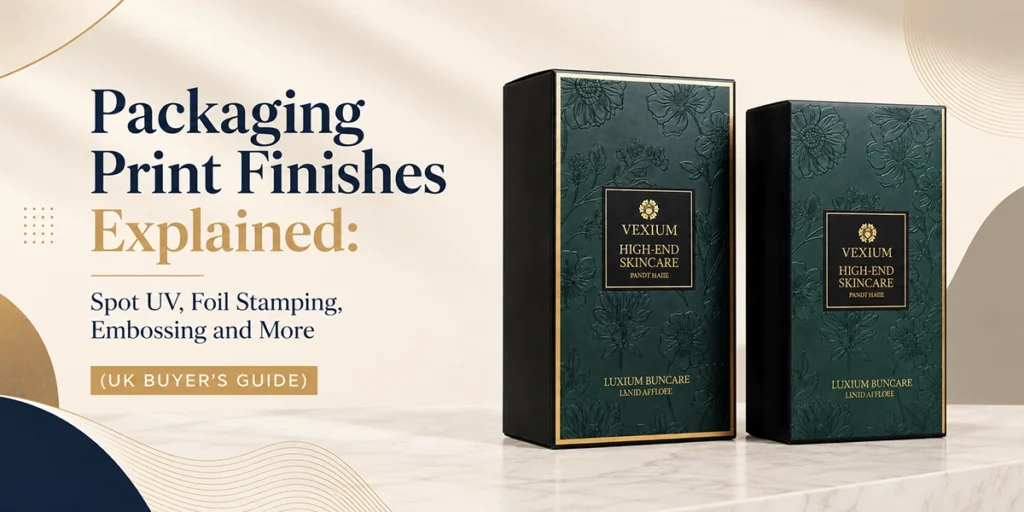
Packaging Print Finishes Explained: Spot UV, Foil Stamping, Embossing and More (UK Buyer’s Guide)
A print finish is any treatment applied to your box after printing, and it changes how the box looks, feels and costs. Varnishes and aqueous coatings are the cheapest way to protect print. Lamination and spot UV sit in the mid tier. Foil stamping and embossing cost the most because they need custom metal dies, but they deliver the strongest luxury signal. Most finishes work on white board; kraft suits debossing and foil far better than spot UV. Prices vary by box size and quantity, so treat every figure below as a guide.
Pick up any box you’ve kept rather than binned. Chances are it has a finish on it. That soft, almost suede feel on a premium candle box? Soft-touch lamination. The shiny logo that catches the light on a matt background? Spot UV. The gold lettering you can feel with a fingertip? Hot foil, probably embossed too.
Finishes are where small brands most often overspend or underspend. We see both every week in our press room. This guide covers every finish we run for UK businesses, what each one looks and feels like, roughly what it adds to your unit cost, and which ones behave badly on kraft board.
One thing before we start. Finishes decorate the surface. They don’t change the board underneath. If you’re still choosing between board strengths, read our guide to cardboard grades and GSM first. And if you’re weighing brown kraft against white board, that decision shapes which finishes will even work, as you’ll see below.
The Finish Decision Table
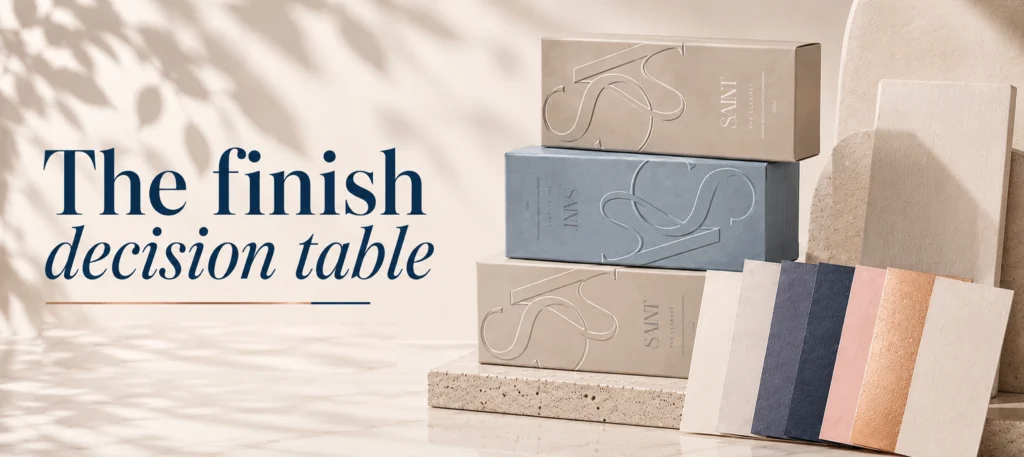
No supplier guide we could find pairs finishes with brand goals, cost tiers and board compatibility in one place. So here’s the table we talk customers through on the phone.
| Finish | Look and feel | Best for | Cost tier | Works on kraft? | Recyclability |
|---|---|---|---|---|---|
| Machine varnish | Subtle sheen, thin protective layer | Budget orders that need scuff protection | £ | Yes, barely visible | Kerbside recyclable |
| Aqueous coating | Soft satin or gloss, water based | Food packaging, eco-led brands | £ | Yes | Kerbside recyclable |
| Gloss lamination | High shine, wipe-clean plastic film | Toys, bold colour-heavy retail | ££ | Not recommended | Restricted (see below) |
| Matt / silk lamination | Smooth, muted, fingerprint-resistant | Understated premium, cosmetics | ££ | Not recommended | Restricted (see below) |
| Soft-touch lamination | Peach-skin, velvety feel | Luxury unboxing, candles, skincare | ££ | No | Restricted (see below) |
| Overall UV coating | Very high gloss, cured hard | Maximum shine on a budget | ££ | Poor result | Generally recyclable |
| Spot UV | Glossy highlights on matt background | Modern luxury without metallics | ££ | Poor result | Generally recyclable |
| Cold foil | Metallic print, can be overprinted | Metallic effects across large areas | ££ | Patchy result | Generally recyclable |
| Hot foil stamping | Crisp, solid metallic blocks | Classic luxury, gifting, spirits | £££ | Yes, excellent | Generally recyclable |
| Blind embossing | Raised design, no ink | Quiet, tactile branding | £££ | Yes, excellent | Kerbside recyclable |
| Debossing | Pressed-in design | Rigid box lids, kraft branding | £££ | Yes, excellent | Kerbside recyclable |
| Registered emboss + foil | Raised and metallic together | Flagship products, gift boxes | £££+ | Yes | Generally recyclable |
| Window patching | Clear film panel showing the product | Bakery, food, candles, toys | ££ | Yes | Separate film before recycling |
Cost tiers are illustrative and relative: £ adds pence per unit, ££ is a moderate uplift, £££ involves die or tooling charges on top. Actual prices vary by box size, coverage area and quantity, so always get a quote for your specific job.
How Finishes are priced (and why quantity changes everything)
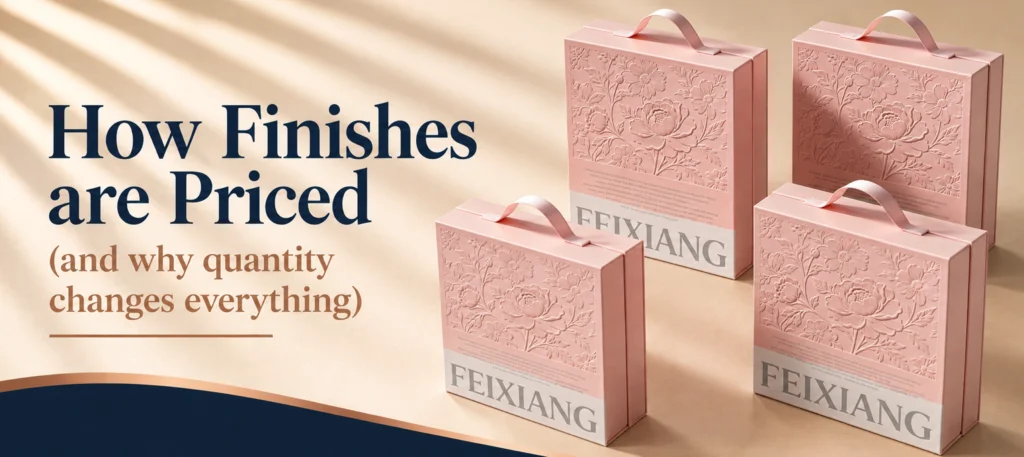
Three things drive finishing cost: materials, tooling and machine time. Varnish is cheap because it runs inline with the print. Foil and embossing cost more because each design needs a custom brass or magnesium die cut before a single box is finished.
That die is a one-off charge. Spread over 100 units it stings. Spread over 5,000 it almost disappears from the unit price. This is why foil quotes look steep at low quantities and surprisingly reasonable at volume.
Worth knowing: we keep dies on file. Reorder the same design and you skip the tooling charge entirely.
Illustrative cost ladder
The chart below shows relative cost per unit, indexed against basic varnish at 1. It’s a guide to how finishes compare, not a price list. Size, coverage and quantity move every bar.
Relative cost index of packaging print finishes (varnish = 1)
Relative added cost per unit (varnish = 1, illustrative) Machine varnish1.0 Aqueous coating1.2 Lamination2.0 Spot UV2.5 Cold foil2.8 Debossing3.5 Hot foil stamping4.0 Foil + embossing5.0 Illustrative index based on typical ACP production jobs at comparable quantities. Actual prices vary by box size, coverage area and order quantity. Die charges apply to foil and embossing.
Lamination: gloss, matt and soft-touch
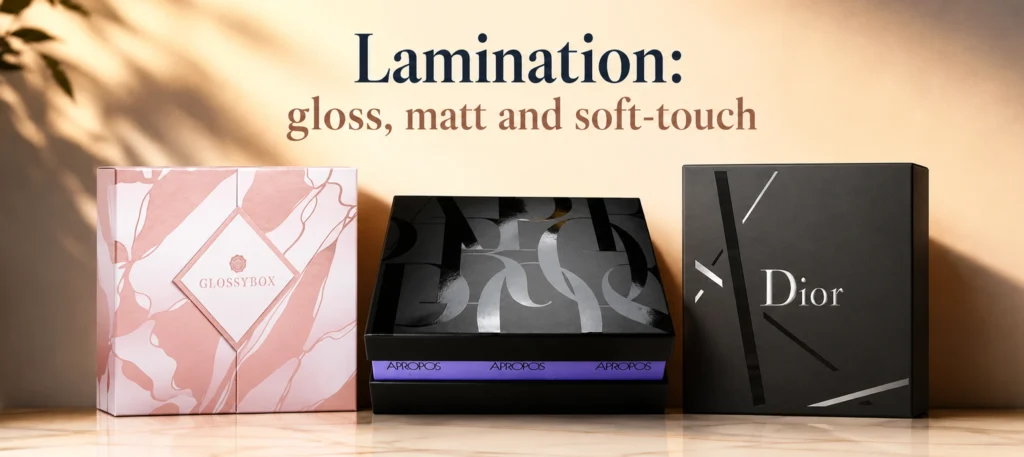
Lamination bonds a thin plastic film over the whole printed sheet. It’s the workhorse premium finish because it protects print and changes the feel of the box in one pass.
Gloss lamination is shiny and wipeable. Colours pop. It suits toys, food gifting and anything aimed at children’s shelves. It also shows every fingerprint’s opposite: it hides handling well but can look mass-market on luxury goods.
Matt and silk lamination kill the shine and give a smooth, contemporary surface. Silk sits between gloss and matt. Matt lamination is the default on most cosmetic boxes we produce. It photographs beautifully, which matters if your customers share unboxings.
Soft-touch (velvet) lamination has a micro-textured film that feels like peach skin. Customers hold soft-touch boxes longer. That’s not a scientific claim, just something we notice at trade shows, and it’s the reason skincare and candle brands keep choosing it.
One caveat here. Lamination is the finish most likely to compromise recycling, and we’d rather tell you that now than after you’ve printed 5,000 boxes. Full detail in the recyclability section below.
Varnishes and coatings: the budget-friendly protectors
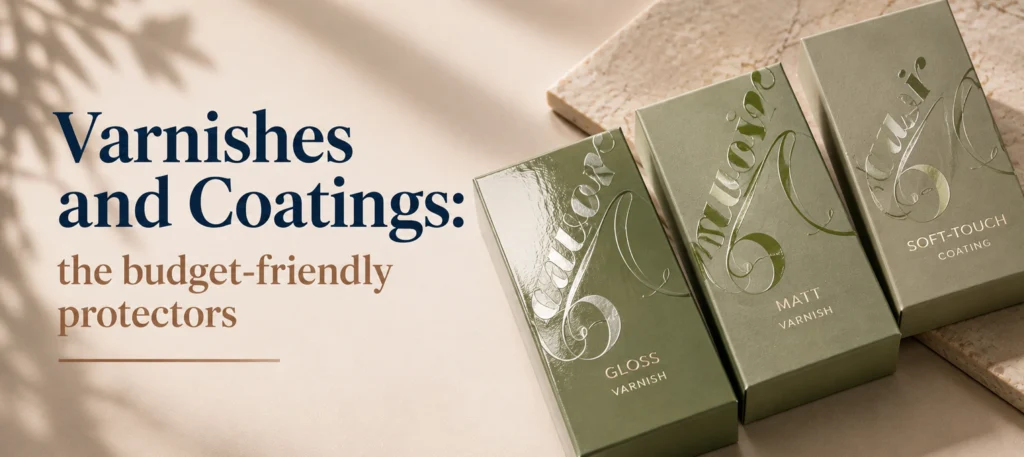
Machine varnish is a thin clear coat applied on press. It stops ink scuffing in transit and adds a whisper of sheen. If your budget stops at protecting the print, this is the answer.
Aqueous coating is water based, fast drying and available in gloss, satin or matt. Because it’s water based rather than a plastic film, it keeps paper and card kerbside recyclable. Food brands like it for exactly that reason.
Overall UV coating floods the sheet with liquid varnish cured instantly under ultraviolet light. The result is glassy and hard wearing. It delivers maximum gloss without laminating.
Spot UV: gloss exactly where you want it
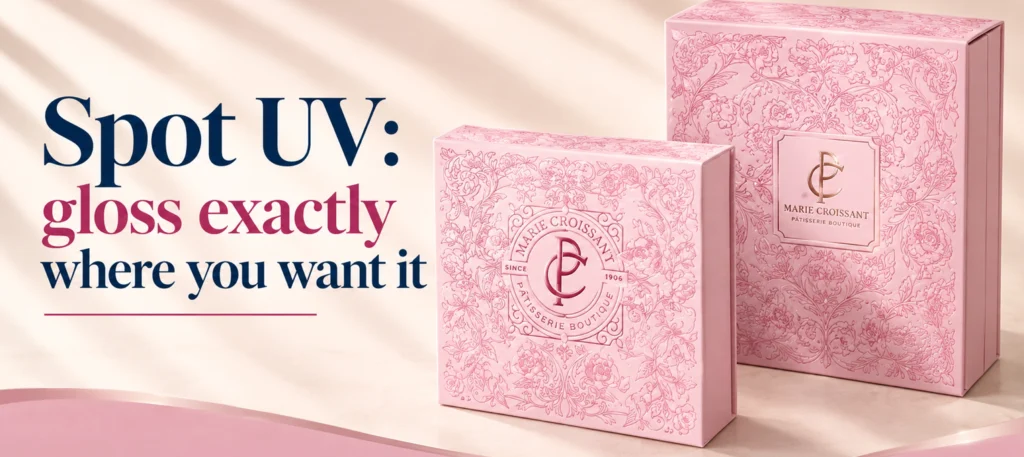
Spot UV applies that same UV-cured gloss to selected areas only, usually over a matt laminated or uncoated background. The contrast does the work. A matt black box with a gloss black logo reads as premium from a metre away, and the effect gets stronger when the light moves.
It suits modern, minimal branding. Tech accessories, skincare, coffee. It’s also the cheaper route to a luxury feel because it needs no metal die, unlike foil.
Watch-outs from our artwork desk: spot UV needs breathing room. The most common file mistake we see is spot UV applied to text under about 8pt, where the gloss floods the letter shapes and turns crisp type into blobs. Keep spot UV elements bold and simple. And don’t ask for it on kraft: the rough brown fibre swallows the gloss and you pay for an effect nobody can see.
Foil stamping: hot, cold and why the die matters
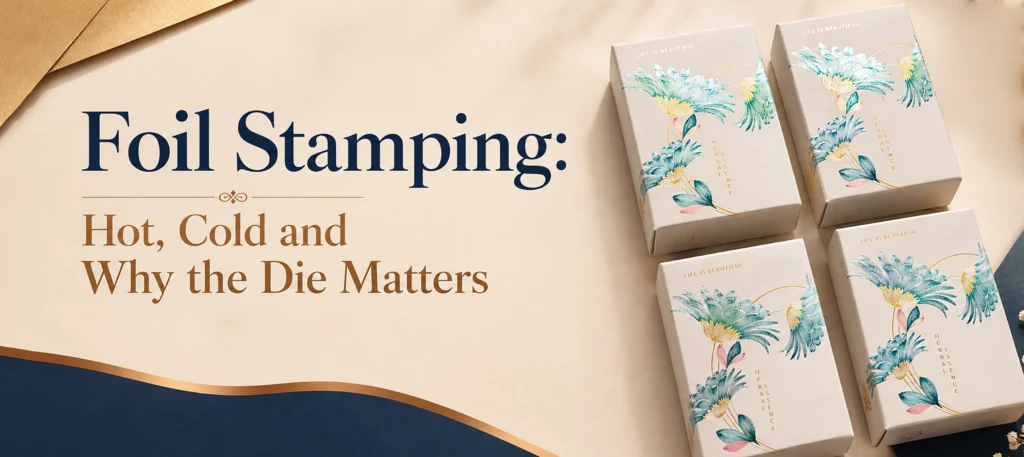
Hot foil stamping (also called foil blocking) presses a heated metal die through a ribbon of metallic foil onto the board. The result is a solid, opaque, mirror-like mark. Gold and silver are the classics, but foils come in copper, rose gold, holographic, matt and even black gloss.
Foil is the one metallic effect that works brilliantly on dark and kraft boards, because it sits on top of the surface rather than depending on it. Gold foil on brown kraft is one of the most-ordered combinations we run, especially for candles and artisan food.
Cold foil transfers foil using adhesive printed on a standard press, no heated die needed. It’s cheaper at volume and can be overprinted with colour, so you can create metallic blues or greens. The trade-off is a slightly less brilliant shine, and it needs a smooth coated surface, so it underperforms on kraft.
Watch-outs: fine serif type and thin rules can fill in or break up when foiled. We ask customers to keep foiled line work above roughly 0.25 mm thickness. Your supplier should check this at proof stage; we flag it before anything reaches a press.
Embossing and debossing: branding you can feel
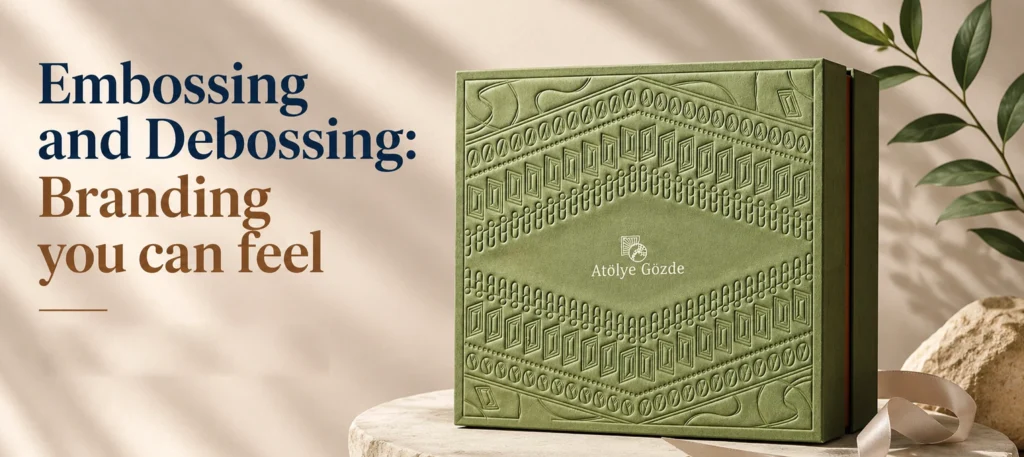
Embossing raises part of the design above the board surface using a shaped die and counter-die. Debossing presses it in. Both add a tactile layer that flat print can’t touch, and both work beautifully on uncoated stock and kraft, where the fibre texture around the impression adds character.
Three variants worth knowing:
Blind embossing uses no ink or foil at all, just the raised shape. It’s quiet, confident branding. Think of a logo you find with your thumb before you see it.
Registered embossing aligns the raised area precisely with a printed or foiled element underneath. Tolerances are tight, which is part of why it costs more.
Combination embossing raises and foils in a single hit with one combined die. It’s the flagship finish on spirits boxes and premium gift packaging.
Watch-outs: embossing needs board thick enough to hold the impression. On thin stock the reverse side shows the bruise, which matters if the inside of your box is visible. On rigid boxes we usually deboss the lid rather than emboss it, because a pressed-in mark survives stacking and shipping without flattening.
Window patching: show the product
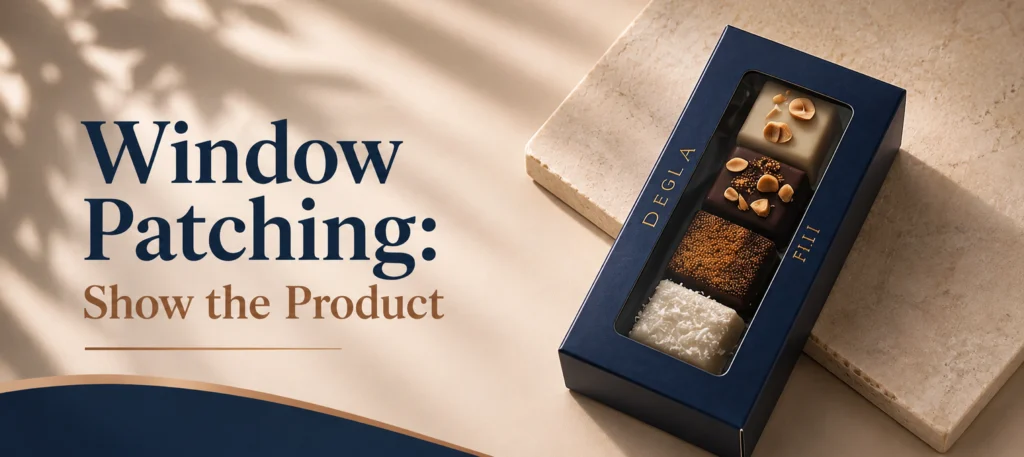
Window patching die-cuts an aperture in the box and glues a clear film behind it. Bakeries, candle makers and toy brands use it because seeing the product sells the product.
Standard windows use PET film. If recyclability matters to you, ask about films designed to be peeled off before recycling, and say so on the box. An unmarked filmed window usually means the whole box goes in the general waste bin, which defeats the point of choosing card.
Kraft vs white board: which finishes actually work
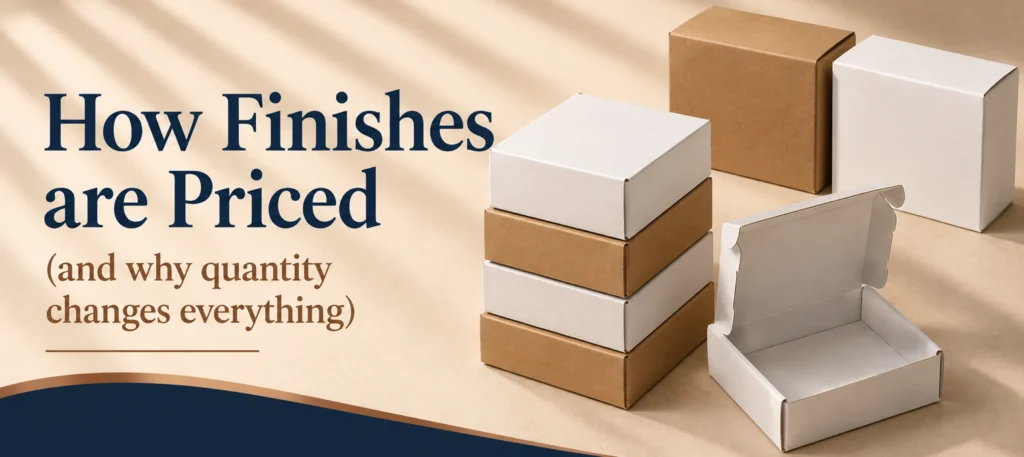
This is the question behind half the finishing calls we take, so here’s the short version.
Kraft board loves: hot foil, blind embossing, debossing, machine varnish, aqueous coating. The contrast between rough brown fibre and a crisp foil or deep deboss is the whole appeal.
Kraft struggles with: spot UV (gloss disappears into the fibre), lamination (defeats the natural look and the recycling benefit), cold foil (patchy adhesion), and fine four-colour photography (ink sinks in and dulls).
White board (SBS) takes everything. Its smooth coated surface is the blank canvas: lamination, spot UV, foil, emboss, photographic print, all behave predictably.
If you haven’t settled the board question yet, our kraft vs white guide covers print quality, cost and sustainability in full.
The recyclability bit nobody puts in their sales copy
Here’s where we’ll be straight with you, because UK rules now put numbers behind this.
Plain printed card with varnish or aqueous coating recycles in kerbside collections without fuss. Foil stamping, spot UV and embossing generally don’t stop a box being recycled either, because they cover a small area of an otherwise fibre-based pack.
Lamination is different. The UK’s On-Pack Recycling Label scheme (OPRL) states that “packaging with one sided coatings/laminations can be recycled” while “double sided laminations or coatings cannot be reprocessed”, and it caps plastic coating content at 15% for lightweight papers. Meanwhile DEFRA’s Recyclability Assessment Methodology, which grades packaging Red, Amber or Green for Extended Producer Responsibility fees, classes two-sided laminated paper as Red unless consumers get clear guidance to peel the film off.
Why should a small brand care about a fee methodology? Because under EPR, packaging that grades badly costs the businesses in its supply chain more. Recyclability is now a line item, not just a value.
Our honest steer: if sustainability is central to your brand story, choose aqueous coating or uncoated kraft with foil or deboss detailing, and skip lamination. A soft-touch laminated box telling an eco story is the kind of contradiction customers increasingly spot. Regulations change, so check GOV.UK for the current EPR rules before making claims on pack.
Five finish mistakes we see every week
- Spot UV over small text. Anything under about 8pt floods and blurs. Use spot UV on shapes and logos, not body copy.
- Laminating an eco-positioned box. The film undermines both the recycling claim and, under RAM grading, potentially your EPR fees.
- Embossing thin board. The impression telegraphs through to the inside. Move up a board weight or switch to foil.
- Foiling hairline type. Serifs and thin strokes fill in. Keep foiled elements bold.
- Choosing finishes before fixing artwork. A die is cut to your approved design. Change the logo after tooling and you pay for a new die. Approve artwork first; this is exactly what our free proofing stage exists to catch.
Frequently Asked Questions

What is the difference between spot UV and foil stamping?
Spot UV is a clear gloss varnish cured onto selected areas, giving shine and contrast without colour. Foil stamping presses metallic or pigmented foil onto the board with a heated die, giving a solid, opaque, mirror-like finish. Spot UV is usually cheaper because it needs no custom die; foil delivers the stronger metallic luxury cue.
Is laminated packaging recyclable in the UK?
Sometimes. OPRL guidance says one-sided laminated card can be recycled, while double-sided lamination cannot be reprocessed. DEFRA’s Recyclability Assessment Methodology grades two-sided laminated paper Red for EPR purposes unless the film is designed to be peeled off. If recyclability matters, choose aqueous coating instead.
What is soft-touch lamination?
Soft-touch, sometimes called velvet lamination, is a matt film with a fine micro-texture that feels like peach skin. It resists fingerprints and signals luxury through touch. It’s popular on cosmetics, candles and premium gifting, but like all lamination it can restrict recycling.
Does embossing work on kraft board?
Yes, very well. Kraft’s visible fibre makes blind embossing and debossing look and feel more crafted, not less. Debossing is often the safer choice on rigid kraft lids because the pressed-in mark doesn’t flatten in transit.
How much does foil stamping add to the cost of packaging?
Foil adds a one-off die charge plus a per-unit cost that depends on the foiled area and quantity. At around 100 units the die dominates the price; at several thousand units it becomes minor. Prices vary by size, coverage and quantity, so get a specific quote.
What is the cheapest way to make packaging look premium?
Matt aqueous coating with strong artwork is the lowest-cost route. One step up, spot UV over matt gives a genuine luxury effect without any die charges. On kraft board, a small blind deboss or single foil hit adds craft feel at modest cost, especially on reorders once the die exists.
Key takeaways
- Finishes split into three cost tiers: coatings (£), lamination and spot UV (££), and die-based foil and embossing (£££).
- Dies are one-off charges, so foil and embossing get much cheaper per unit as quantities rise, and reorders skip the charge.
- Kraft suits foil, embossing and debossing; spot UV and lamination need smooth white board to perform.
- One-sided laminated card can be recycled in the UK; double-sided can’t, and RAM grades it Red for EPR fees.
- Fix artwork before tooling, keep spot UV off small text, and keep foiled line work bold.
Every box we produce at All Custom Packaging can carry these finishes from just 100 units, with free design support and proofing before anything goes to press. If you’d like a second opinion on which finish fits your artwork and budget, send your design over for a free quote and our studio will mark it up honestly, including where a cheaper finish would do the same job.