
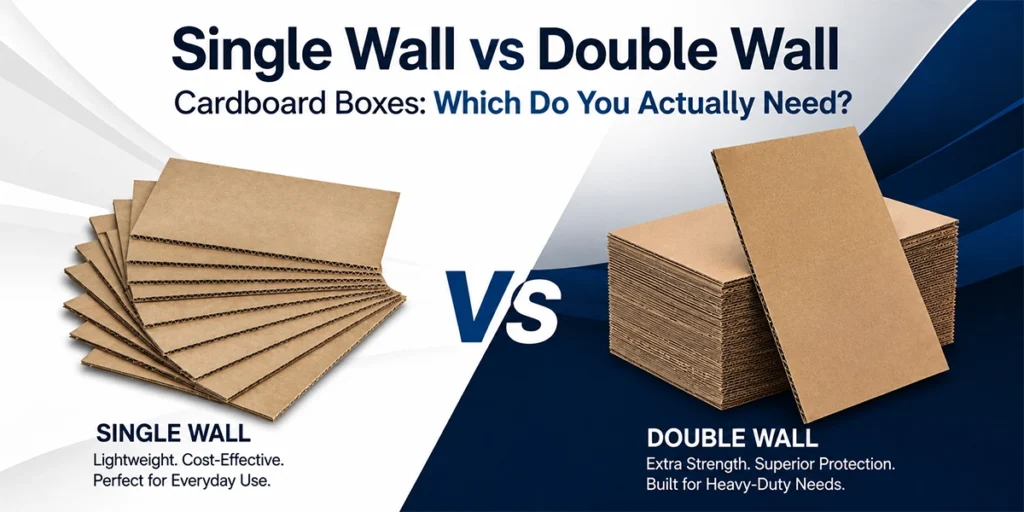
Single Wall vs Double Wall Cardboard Boxes: Which Do You Actually Need?
Single wall board (one fluted layer, two liners) is rated around 32 ECT as a trade standard. It typically handles parcels up to about 10 to 15kg. Double wall board (two fluted layers, three liners) steps up to roughly 44 to 48 ECT and covers 15 to 30kg loads, palletised stock, and anything fragile enough that a dented corner means a refund.
The genuine failure mode is not usually “the box burst.” It is a slow top-load compression collapse a day or two into a stack, well after the van has left. If you already know your rough weight and just need the flute and grade for that product, ACP’s Cardboard Grades, GSM and Flutes Explained guide covers that buying decision directly.
This piece goes one level deeper into the single-versus-double decision itself: the real strength numbers behind “roughly doubles,” what triple wall actually adds, a decision matrix by weight and shipping route, what under-speccing looks like in a warehouse, and whether the extra board thickness quietly costs you on postage too.
Single wall vs double wall: what’s actually different
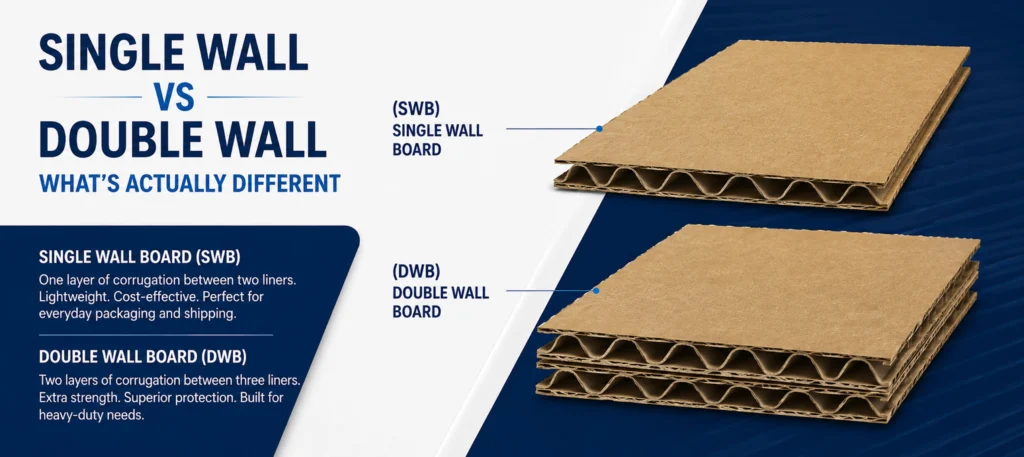
Single wall board is one fluted layer glued between two flat liners, about 3 to 4mm thick. Double wall repeats the same pairing twice: two fluted layers and three liners, sandwiched together at roughly 6 to 7mm. Triple wall adds a third flute and a fourth liner, running about 10 to 12mm.
Nothing about that construction is exotic: every extra wall is the same basic unit, a liner, a flute, a liner, glued on again. What changes is how much load-bearing structure sits in the same footprint, and that is the entire reason cost, weight and shipping size all move together whenever you step up a wall.
Double wall boards usually pair two different flute sizes rather than repeating one. BC board (B flute plus C flute) is the standard heavy-lifting combination. EB board (E flute plus B flute) keeps a fine outer print surface while adding real rigidity behind it, which is why premium subscription boxes often use it instead of BC.
How much stronger is a double wall, really? ECT and BCT in plain numbers
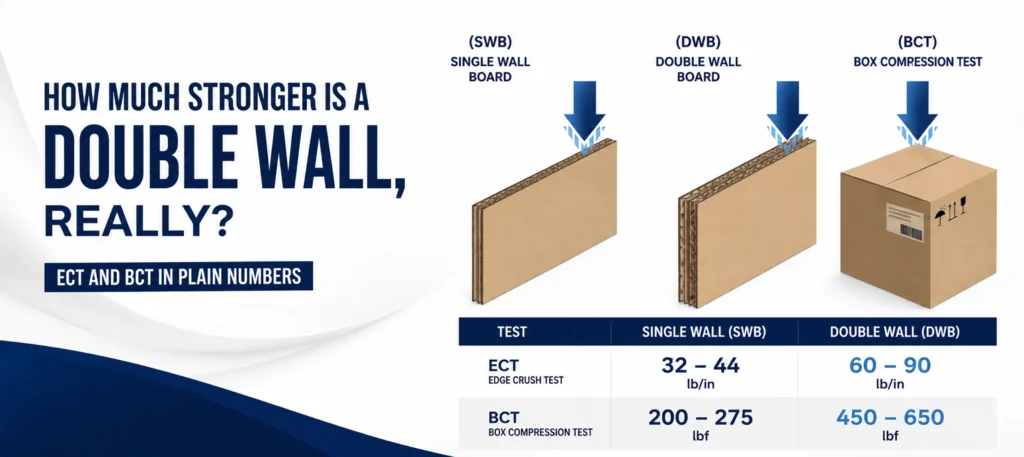
“Roughly doubles” is the right idea but not a precise one, and precision is exactly where most buying guides stop. The trade actually rates board on the edge crush test (ECT), which measures how much force a small sample of board takes on its edge before it buckles. It is measured in kilonewtons per metre, or in the sourcing convention most UK suppliers still quote from, pounds per linear inch.
Cross-checked across multiple independent industry references, the common ECT rating steps are 23, 26, 32, 44, 48, 51, 61 and 90. Single wall board is typically specified around 32 ECT. Entry-level double wall starts around 44 to 48 ECT, moving up to 51 ECT or higher for demanding applications. Triple wall commonly sits at the top of the same scale, from around 61 up to 90 ECT.
| Wall type | Typical ECT rating | Approx. kN/m | What it means in practice |
|---|---|---|---|
| Single wall | ~32 ECT (range 23 to 44) | ~4.0 to 7.7 kN/m | Standard e-commerce parcels, most retail shipping |
| Double wall | ~44 to 48 ECT (up to 51+) | ~7.7 to 8.9 kN/m | Heavier, palletised or fragile-plus-heavy loads |
| Triple wall | ~61 to 90 ECT | ~10.7 to 15.8 kN/m | Export crates, industrial and bulk freight |
A word on where those numbers come from, since this is exactly the kind of figure that gets asserted without a source elsewhere online. The ECT ratings above are cross-checked across three independent industry references: a packaging supplier’s technical page, a corrugated board explainer, and a box manufacturer’s strength guide. All three converge on the same rating steps.
The kN/m column is this piece’s own unit conversion (1 lb/in equals approximately 0.175 kN/m), applied to those figures. It is not a separate European or UK-published kN/m table. We could not locate a UK or EU manufacturer spec sheet publishing kN/m ratings directly; GWP Group’s own board-grades page returned a 404 on direct checking. Treat the kN/m column as a translation of a US-convention rating, not an independently sourced European standard, and use a supplier’s own UK-specific figure over this table wherever one is quoted to you directly.
ECT measures the board material, not the finished box. The test that measures a complete, assembled box under a compression plate is the box compression test (BCT), and it is BCT, not ECT alone, that tells you what a box will actually survive in a real stack.
The two are connected by a standard method known as the McKee formula, published by McKee, Gander and Wachuta in 1963. It calculates a box’s compression strength from the board’s ECT rating, the board’s thickness, and the box’s own perimeter, together. The practical upshot is that a bigger box needs a higher ECT rating than a smaller one to reach the same real stacking strength. That is exactly why “just use double wall for everything big” is not actually a shortcut to safety.
As an illustration of the kind of range this produces, one US packaging supplier’s own published reference table puts a 23 ECT board’s stacking capacity at roughly 9kg, 32 ECT at roughly 29kg, and 44 ECT at roughly 43kg. That table is not an ACP or UK figure, and not a guarantee for any specific box design, so treat it as a sense of scale rather than a number to design against.
Real BCT depends on box size, height and how it is stacked. That dependency is the entire point of the McKee formula existing in the first place.
What about a triple wall?

Triple wall gets one line in most buying guides, including ACP’s own flutes guide, because most UK sellers never need to think about it. It earns a proper look here because “what’s above double wall” is a genuine question once you are palletising or exporting.
Triple wall board runs three fluted layers and four liners, around 10 to 12mm thick, rated from roughly 61 up to 90 ECT on the same scale used above. That is not a UK parcel spec. It is built for export crating, bulk industrial packaging, and loads handled by forklift and pallet truck rather than carried by hand, where the box itself may be the only thing standing between a product and a warehouse floor for weeks.
The trade-off is exactly what you would expect: triple wall is heavier, bulkier and meaningfully more expensive per box than double wall, for strength a normal e-commerce parcel will never call on. If you are shipping single units to consumers, triple wall is very likely the wrong answer even for something heavy and fragile. Double wall with a properly fitted internal insert usually solves that problem better, and cheaper, than a thicker wall count on its own.
Decision matrix: which wall count does your shipment actually need

Weight alone is not the full picture, which is why the flutes guide’s product-by-product table is useful but not the whole story for this specific decision. Four variables actually move the answer: the weight itself, how fragile or high-value the contents are, how far and how roughly the parcel will travel, and whether it ships alone or gets palletised.
| Scenario | Typical recommendation | Why |
|---|---|---|
| Under 10kg, domestic courier, durable goods (clothing, books, homeware) | Single wall, C or B flute | Handles standard UK courier networks without paying for unused strength |
| Under 10kg, but fragile or high-value (electronics, glass, ceramics) | Single wall with a fitted insert, or light double wall | Internal fit matters more than wall count for breakage; extra flute alone will not stop a loose item rattling |
| 10 to 15kg, domestic, durable goods | Single wall, higher grade (150gsm+ liners) | Still within single wall’s range with the right liner spec |
| 15 to 30kg, or fragile-plus-heavy | Double wall, BC board | This is the weight band where double wall’s extra crush resistance earns its cost |
| Any weight, palletised or stacked storage | Double wall minimum | Static stacking load over days or weeks is a harsher test than one courier journey |
| International or multi-leg shipping (multiple handling points, longer transit, customs handling) | Double wall, even under 15kg | More handling events and longer dwell time raise real damage risk beyond what the weight alone suggests |
| Export crating, bulk/industrial freight | Triple wall | Genuinely outside parcel-courier territory |
The international row is the one most weight-based guides skip entirely. A 12kg parcel making one domestic courier hop, and a 12kg parcel passing through several international handling points, a customs check and a longer dwell time in transit, are not the same risk. Box spec should reflect that even though the weight is identical.
What actually happens when you under-spec

“It might get damaged” undersells what really goes wrong. Knowing the specific failure mode helps explain why the fix is not always “use thicker board everywhere.”
Corner crush is the most common single-parcel failure. Corners take a disproportionate share of drops and knocks, because they are the first point of contact almost every time a box is dropped, kicked or caught on a shelf edge. A corner that crushes flat loses its column strength at exactly the point holding the rest of the stack up.
Top-load compression failure is the slower, less obvious one, and it is the specific failure the box compression test exists to predict. A box that survives being carried, and even survives a short stack, can still fail if left compressed under other boxes for days. Corrugated board’s crush resistance is a function of sustained load over time, not just peak force in a single instant.
This is what a warehouse manager means by a “pallet collapse,” and it is rarely one dramatic crush. It is the bottom layer of boxes slowly bowing and buckling under the accumulated weight above, over time.
Moisture compounds both failures. Corrugated board is hygroscopic. Once ambient humidity rises, a board that tested well bone dry can lose a meaningful share of its rated crush strength well before it looks or feels wet. That is why a stack that was fine in a dry warehouse can fail after a damp delivery van or a humid storage unit.
The commercial consequence is rarely “the customer complains about the box.” It is a damaged product, a replacement or refund, a return shipping cost, and in a subscription or repeat-purchase business, a customer who does not reorder. Under-speccing to save a few pence a unit on board is frequently more expensive than the board would have cost, once refund and replacement rates are counted rather than assumed away.
The real cost difference, and why it is not the whole calculation
Double wall board costs more than single wall for the honest reason that it uses more material: an extra liner and an extra fluted layer, both bought, glued and shipped. Industry sources commonly cite double wall running roughly 20 to 40% more per box than an equivalent single-wall size. The true difference for any specific order depends on box size, print finish and order quantity, so treat that percentage as an illustrative planning range, not a quote.
That range only tells half the story, because it prices the box and ignores the failure cost on the other side. A single-wall box that is genuinely under-specced for its job does not fail occasionally for free. It fails at a rate, and every failure costs a replacement unit, a return shipment, and the staff time to process both.
The right comparison is never “cheap box versus expensive box.” It is the per-unit board cost against the per-unit damage rate at that spec, and the second number is usually the one nobody has actually measured.
Does extra wall thickness cost you on shipping too?

This is the part almost no buying guide connects, and it is a real, calculable cost once you check the numbers, not a rounding error.
UK couriers, including Parcelforce, commonly charge parcels on volumetric (“DIM”) weight rather than actual weight, using a widely used formula: length times width times height in centimetres, divided by 5,000, equals volumetric weight in kilograms. Whichever is higher, the actual weight or the volumetric weight, is what gets charged.
ACP’s Royal Mail and Parcelforce parcel sizes guide covers the current UK size bands directly. Parcelforce in particular is moving toward litre-volume measurement rather than simple length-plus-girth, which makes this exact effect more relevant, not less.
Here is the arithmetic: take a box built to hold 30 x 25 x 20cm of product and packing. Using ACP’s own wall-thickness figures, adding roughly 3.5mm of single-wall board per side brings the external size to about 30.7 x 25.7 x 20.7cm, a volumetric weight of roughly 3.27kg.
Build the same internal capacity in double wall, at roughly 6.5mm per side, and the external size grows to about 31.3 x 26.3 x 21.3cm, a volumetric weight of roughly 3.51kg. That is a 0.24kg increase in chargeable weight from board thickness alone, before the box’s own extra physical weight, which typically runs 20 to 40% heavier than an equivalent single-wall box on top of that.
On one parcel, that is a rounding error. Multiplied across a few hundred shipments a month sitting near a courier’s weight-band threshold, it becomes a real, recurring line on a shipping bill. It is the clearest honest reason not to default to double wall for stock that single wall genuinely covers.
Treat the figures above as an illustrative calculation built from stated assumptions, not a fixed rule for every box design. Confirm your own supplier’s board thickness and your courier’s specific pricing formula before relying on the exact numbers for a live shipping decision.
Frequently asked questions

How much stronger is a double wall box than a single wall box? Roughly double the edge crush rating in typical grades: about 32 ECT for single wall against 44 to 48 ECT for entry double wall. Real stacking strength (BCT) also depends on box size and height, so “double the ECT” does not automatically mean “double the safe stacking height” for every box.
Can a single wall box really hold 20kg? With the right grade and liner weight, single wall commonly covers up to about 15kg, and some heavier single-wall specs push toward the top of that range. Past roughly 15 to 20kg, or for palletised and stacked storage, double wall is the safer default rather than pushing single wall to its limit.
Is double wall worth the extra cost for a small business? It depends on what fails if the box does not hold. For heavy, fragile or high-value contents, the cost of one damaged-in-transit replacement usually exceeds the per-box premium many times over. For light, durable goods, double wall is often paying for strength the shipment will never test.
What is the actual difference between single wall, double wall and triple wall? Wall count is the number of fluted layers: one for single (about 3 to 4mm), two for double (about 6 to 7mm), three for triple (about 10 to 12mm). Each added wall roughly steps up the ECT rating band, the weight, and the cost. Triple wall is built for export crating and bulk freight, not standard parcel shipping.
Does a heavier double-wall box cost more to post? It can, in two separate ways. The box itself typically weighs 20 to 40% more than an equivalent single-wall box, and its slightly larger external dimensions can increase the volumetric (DIM) weight couriers charge against, which matters most for shipments sitting near a weight-band threshold.
Can single wall and double wall boxes both be reused? Yes, provided the board is not crushed, damp or coming apart at the seams. Neither wall count meaningfully loses strength after one careful prior use. Fresh tape on each reuse matters more than wall count for a safe second trip.
Getting this spec right on the first order is worth more than the box itself once refunds and replacements are counted. If you would rather talk it through than guess from a table, get in touch with All Custom Packaging with your product weight and route, and we will help you spec it directly.