
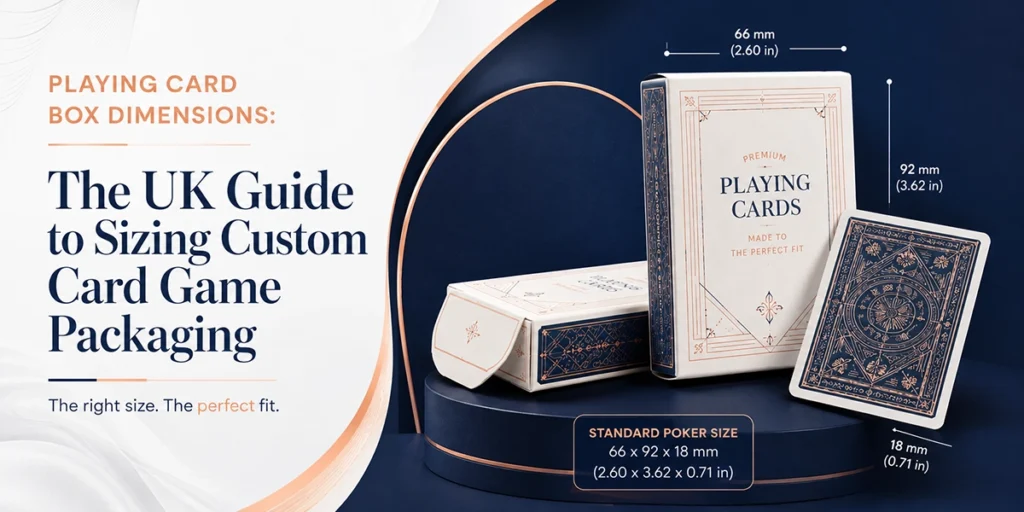
Playing Card Box Dimensions: The UK Guide to Sizing Custom Card Game Packaging
Quick answer: A single deck of standard poker cards measures 63.5mm x 88.9mm, and the tuck box built to hold just that one deck is small, typically around 90mm x 65mm x 20mm. The moment you add a second deck, a rulebook, tokens, or any other component, you are no longer sizing a single-deck tuck box. You are sizing a card game box, and those commonly run from around 150mm up to 230mm or more on the longest side. Mixing the two figures up is the single most common mistake buyers make when briefing a supplier, and it is why you will find wildly different “standard” box dimensions quoted across different sites.
This guide sets out the real UK sizes for both single-deck and multi-component card packaging, how much clearance a tuck box actually needs around the cards, which board and finish choices suit a card box specifically, and how to brief a supplier correctly once your game needs more than one deck.
What do people mean by “playing card box dimensions”?
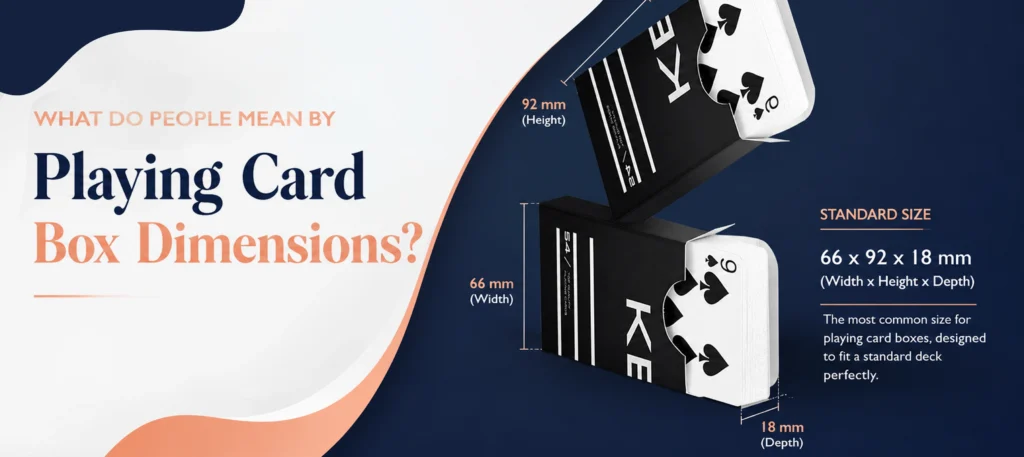
The phrase gets used for at least three different products, and that is the root of most of the confusion.
The card itself has a fixed size. A standard poker card measures 63.5mm x 88.9mm, and that number does not change no matter what box it ends up in.
A single-deck tuck box is the small case built to hold one deck and nothing else, the kind that slides a shrink-wrapped deck out of a shop shelf. It only needs to be a few millimetres larger than the cards themselves.
A card game box is a different product. It holds a deck plus something else, a rulebook, a set of tokens, a scoring pad, or a second deck, and it is built around all of those components together, not around the cards on their own. It is often a lidded box or a two-piece box rather than a slide-out tuck box.
Ask which of these a supplier is quoting before you commit to a size. A “standard playing card box” on its own could mean either one.
Standard playing card dimensions (the reference point)
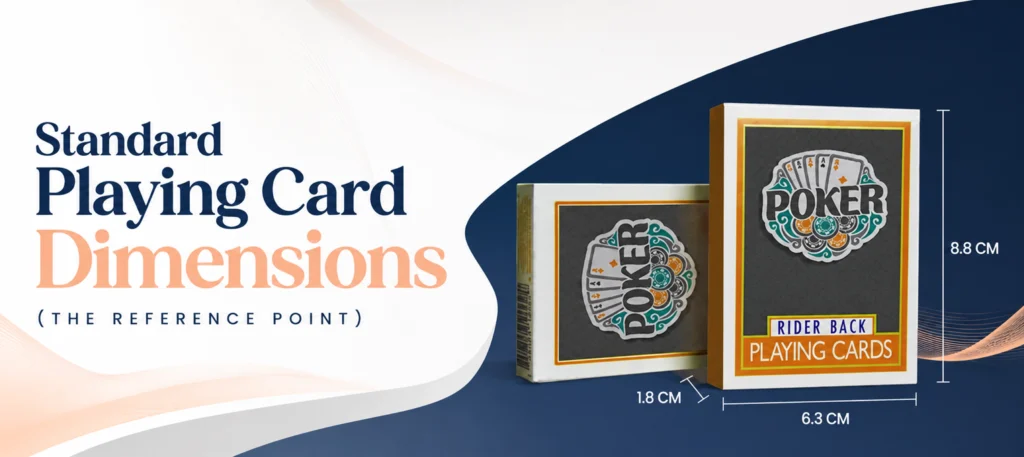
Every box size in this guide is built around the card size that has to fit inside it, so it helps to start there.
A standard poker card measures 63.5mm x 88.9mm (2.5in x 3.5in). This is the size used for most card games, including standard decks sold for casino, family and party games.
Bridge size cards measure 57mm x 89mm (2.25in x 3.5in), about 6.5mm narrower than a poker card at almost the same height. Card manufacturers and bridge players generally explain the narrower width the same way: bridge and canasta hands are often fanned out to thirteen cards or more, and a narrower card is easier to fan and read without needing an enormous hand span. If you are boxing bridge or canasta decks, do not assume a poker-size box will fit. It will not.
Tarot cards run larger again, around 70mm x 120mm, which is why tarot boxes and poker boxes are never interchangeable even though both hold “one deck.”
If your game uses a non-standard card size, mini cards, jumbo cards, or a custom cut, get the exact card dimensions confirmed before a box is designed around them. A box built to a rounded or assumed card size is one of the easiest ways to end up with a poor fit.
Single-deck tuck box dimensions
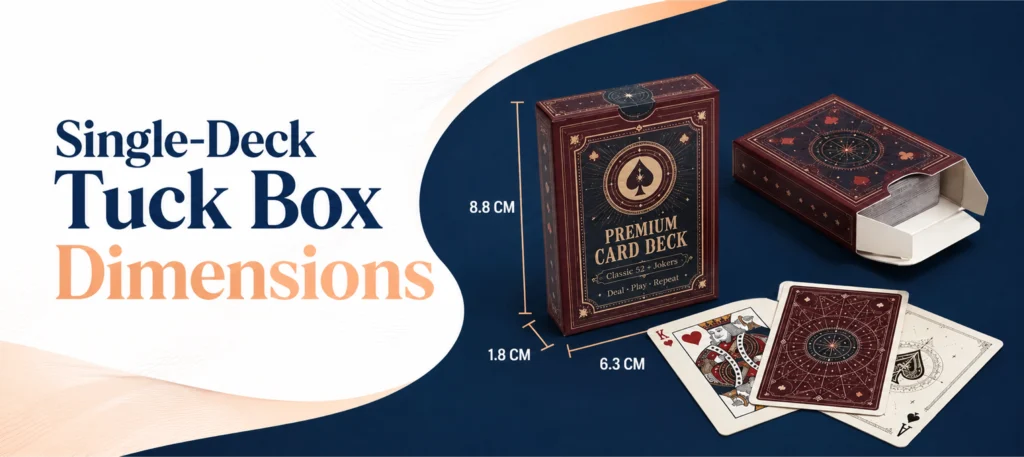
A tuck box sized for one standard 52 to 54 card poker deck typically measures around 90mm x 65mm x 20mm, though you will see this quoted anywhere from 88mm to 92mm wide and 19mm to 25mm deep depending on the supplier and the exact card count. It is a trade convention rather than a fixed international standard, so a small amount of variation between suppliers is normal.
That range is not vague for no reason. Depth in particular depends on how many cards are inside and how thick each one is. Card stock for a printed deck commonly runs somewhere in the 280 to 330gsm range, and a thicker stock or a bigger deck (a tarot deck typically carries around 78 cards rather than 52) needs a deeper box to match. The card stock itself is the card manufacturer’s specification, not the box supplier’s, but it is worth knowing because it is the reason “one standard depth” does not really exist.
| Card type | Card size | Typical single-deck tuck box |
| Poker (standard 52 to 54 card deck) | 63.5mm x 88.9mm | Approx. 90mm x 65mm x 20 to 25mm |
| Bridge (narrower, fans more easily) | 57mm x 89mm | Approx. 90mm x 58mm x 19 to 25mm |
| Tarot (larger, more cards per deck) | 70mm x 120mm | Approx. 122mm x 72mm x 30 to 38mm |
| Mini / travel deck | 44mm x 63mm | Approx. 46mm x 65mm x 17 to 19mm |
Treat these as a starting point for a brief, not a fixed spec. The right figure for your box depends on your exact card count, card stock and whether the deck is sleeved.
Multi-deck, bulk and game-box sizes: the confusion this guide fixes
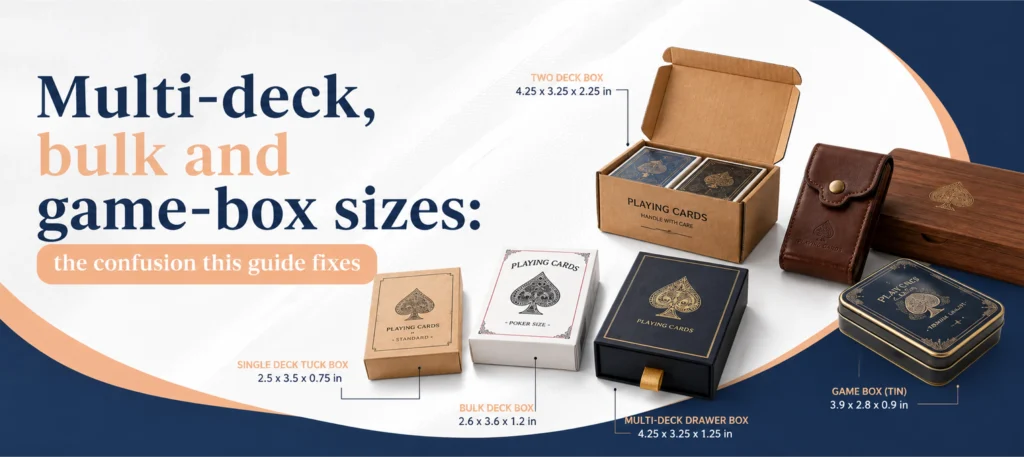
This is where most sizing guides either go quiet or, worse, quietly swap in a completely different product without saying so.
Search around for “playing card box dimensions” and you will find at least one figure sitting in the 150mm to 230mm range presented as if it were a standard single-deck size. It is not. A box that size is doing a different job. It might be holding two or more decks together, a deck alongside a rulebook and tokens, or acting as a bulk or wholesale case that ships a dozen decks at once.
One site we checked while researching this guide labelled a 178mm x 152mm x 51mm box as a “standard single deck” size. That figure does not match a single 63.5mm x 88.9mm card by any reasonable clearance. It lines up far more closely with a multi-deck or wholesale case size quoted elsewhere. We are flagging that mismatch here rather than repeating it, because it is exactly the kind of confusion that leads to an oversized, underfilled box turning up at the door.
| What you are packing | Typical size range | Box style that usually suits it |
| One deck only | Approx. 90mm x 65mm x 20mm | Slide-out tuck box |
| Two decks, or one deck plus a slim rulebook | Approx. 100mm to 140mm on the longest side | Two-piece lid and base box, sometimes with a simple card divider |
| A full card game (deck, rulebook, tokens, scoring pad) | Approx. 150mm to 230mm+ depending on components | Lidded rigid or folding carton box, usually with a die-cut insert to hold each component in place |
| Bulk or wholesale case (multiple decks for retail or events) | Approx. 200mm to 230mm+ | Shipping or display case, not a retail-facing tuck box |
If you only take one thing from this guide, take this: before you ask a supplier for a “playing card box,” decide which row of that table you are actually in. The specification, the board, and the price all follow from that answer.
Getting the fit right: too snug, too loose, and correct

Getting the outer size roughly right is only half the job. The clearance between the cards and the inside of the box decides whether the finished product actually works.
A box cut too close to the card size is hard to use in practice. Cards catch on the opening edge on the way in and out. Sleeved cards can jam completely, and repeated tight insertion wears the corners of the box itself over a surprisingly short time. Hobbyist card game makers who 3D print or hand-assemble their own tuck boxes report exactly this problem: a box built to the card’s exact dimensions, with no allowance at all, often needs sanding or trimming before a sleeved deck will go in cleanly.
A box cut too loose causes the opposite set of problems. The deck rattles around inside, and cards can shift and dog-ear against the box walls in transit. A box that is visibly too big for what is inside it also looks cheap, regardless of how good the print quality is.
The correct zone sits in a narrow band. Comparing published card sizes against their matching tuck box sizes across several suppliers shows a consistent pattern: roughly 1mm to 2mm of clearance on each side. A 63.5mm x 88.9mm card typically sits inside a box cut to around 65mm to 67mm x 90mm to 92mm. That is enough room to slide the deck in and out without a fight, but not so much that it moves around once it is inside.
If your deck is sleeved, add the sleeve thickness on top of that clearance, not instead of it. A sleeved deck that fits a standard unsleeved tuck box is one of the most common fit complaints among card game designers, precisely because the box was sized to the bare cards and never adjusted for the sleeve.
Board and finish options for a card box
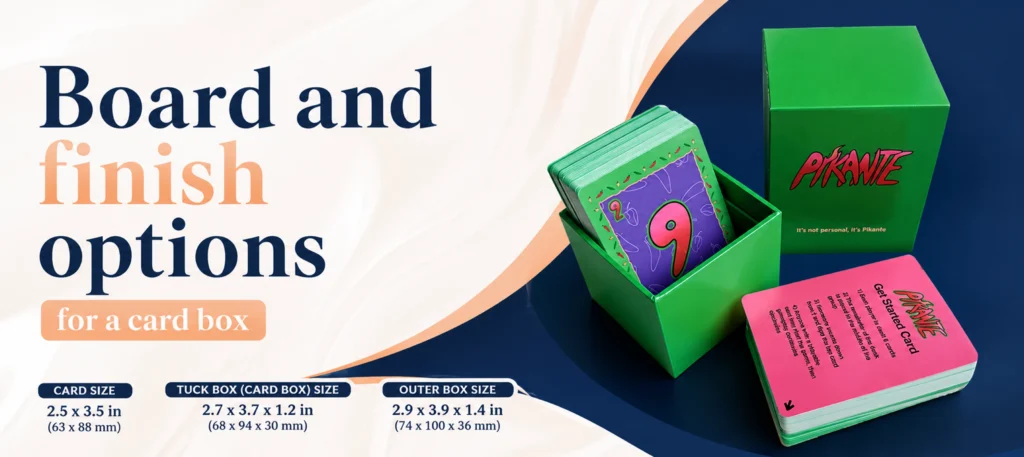
A single-deck tuck box does not need to be heavy duty. It needs to hold its shape through repeated opening and closing, protect the printed cards from light knocks, and show off the artwork on the outside.
All Custom Packaging builds boxes like this from folding carton board as standard. That is the same board family used for cosmetic cartons and retail sleeves. Rigid greyboard is available where a game is positioned as a premium or gift item and needs a sturdier, more substantial feel. Exact board weight is confirmed against your specification rather than fixed to one number, since the right thickness depends on the box size, the deck count and how it will be handled.
Where a card game has multiple components rather than a single loose deck, a die-cut insert built into the box keeps the deck, rulebook and tokens each in their own space instead of shifting around together. That is a genuine, existing capability rather than a bolt-on extra, and it is usually the difference between a game box that still looks organised after a dozen plays and one that turns into a jumble in a drawer.
Finish choices matter more for a card box than for a lot of other packaging, because a card game box is handled directly and often displayed face-out on a shelf. Foil stamping and spot UV both lift a logo or title off a matt background without adding bulk. Embossing and debossing give a tactile edge that reads as premium in the hand. A gloss or matt lamination protects the surface from the wear that comes with a box being picked up and put down repeatedly during play.
Our guide to packaging print finishes covers how each of these works and what they cost in production terms. Our folding cartons versus rigid boxes guide covers the wider trade-off between the two board types, if you are still deciding between a standard tuck box and a rigid presentation case.
Ordering a custom playing card box size
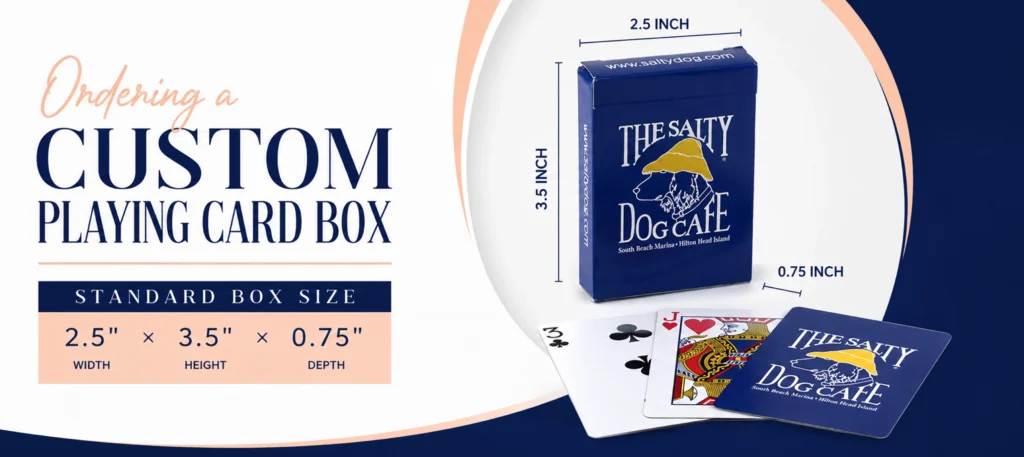
An off-the-shelf tuck box size works well for a standard 52-card deck with no extra components. Once your game deviates from that, a custom size earns its cost quickly.
That covers a few common cases:
- A non-standard card count or card thickness
- A deck that needs to sit alongside a rulebook or tokens in one box
- A premium or collector’s edition using a heavier board and a fuller finish set
- A game sold as a full boxed set rather than a single tuck box
In each of these cases, telling a supplier the exact card size, the deck count, and what else needs to fit inside the box matters more than naming a “standard” size and hoping it works.
Design support is free, so a proposed layout and a digital 3D mock-up get checked against your actual components before anything goes into production. A digital 3D mock-up is free, and there are no setup fees. Orders start from 100 units, and standard production takes 6 to 8 business days after approval.
Browse our Rigid Boxes range for a premium card game case, or our Custom Insert Boxes range if your game needs internal dividers for multiple components. Or simply get in touch with your card size, deck count and component list, and we will confirm the right specification before anything is printed.
Frequently asked questions

What is the standard size of a playing card box? A tuck box built for one standard poker deck typically measures around 90mm x 65mm x 20mm. The exact figure varies a little between suppliers, since it is a trade convention rather than a fixed international standard.
What is the difference between a single-deck box and a multi-deck or game box? A single-deck tuck box is sized to one deck alone, usually around 90mm x 65mm x 20mm. A multi-deck, bulk, or full game box holds two or more decks, or a deck plus components like a rulebook and tokens, and typically runs from around 150mm up to 230mm or more on the longest side. The two are not interchangeable.
How much bigger should a card box be than the cards inside it? Comparing card sizes against their matching tuck boxes across several suppliers shows a consistent clearance of roughly 1mm to 2mm on each side. Add the sleeve thickness on top of that if the deck is sleeved.
What size is a bridge-size card compared to a poker card? A bridge-size card measures 57mm x 89mm, about 6.5mm narrower than a poker card’s 63.5mm x 88.9mm, at almost the same height. The narrower width makes a large fanned hand easier to hold, which is why bridge and canasta decks use it.
What material should a playing card box be made from? Folding carton board suits a standard tuck box, giving it enough structure to hold its shape without adding bulk. Rigid greyboard suits a premium or collector’s box where a sturdier feel matters more than keeping the box slim.
Can I get a custom box for a card game with extra components? Yes. A box built around a deck, a rulebook, tokens or a scoring pad, usually with a die-cut insert to keep each component separate, is a standard capability rather than a special request. Confirm the full component list before the box is sized.
Key takeaways
- A single-deck tuck box (around 90mm x 65mm x 20mm) and a multi-deck or game box (150mm to 230mm or more) are two different products. Confusing them is the most common mistake when briefing a supplier.
- A standard poker card measures 63.5mm x 88.9mm. A bridge-size card is narrower, at 57mm x 89mm, to suit a large fanned hand.
- The correct fit for a tuck box is roughly 1mm to 2mm of clearance per side around the cards, plus extra for a sleeve if the deck is sleeved.
- Folding carton board suits a standard tuck box. Rigid greyboard suits a premium or collector’s edition.
- A card game with a rulebook, tokens or multiple decks needs a box built around all of its components, usually with a die-cut insert, not a box scaled up from a single deck’s dimensions.