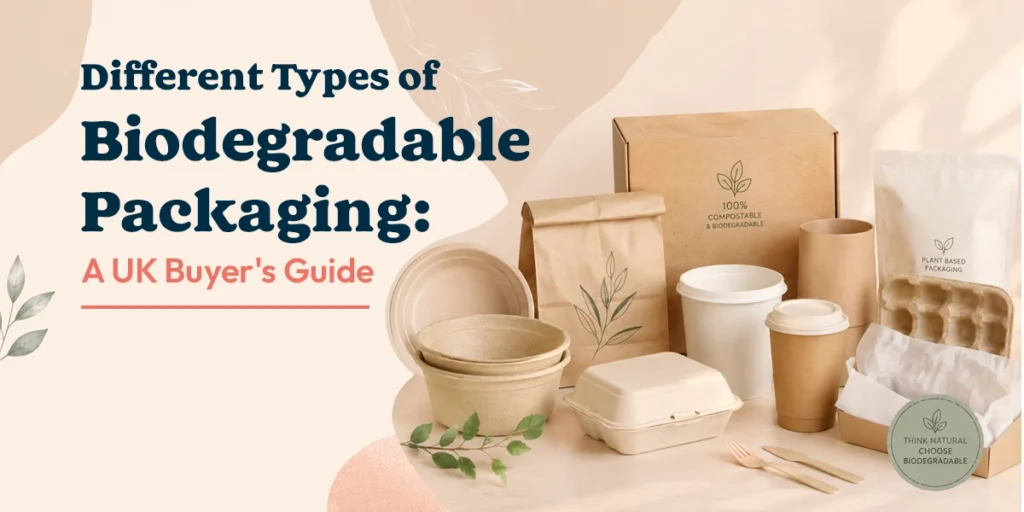
Different Types of Biodegradable Packaging: A UK Buyer’s Guide
Shoppers want less waste, and most UK businesses genuinely want to do better. The trouble is that “biodegradable”, “compostable” and “recyclable” get used as if they mean the same thing, and they do not. Getting the words wrong can now cost you money and put you on the wrong side of consumer law. This guide sorts out the terms, the UK rules that sit behind them, and the materials worth considering.
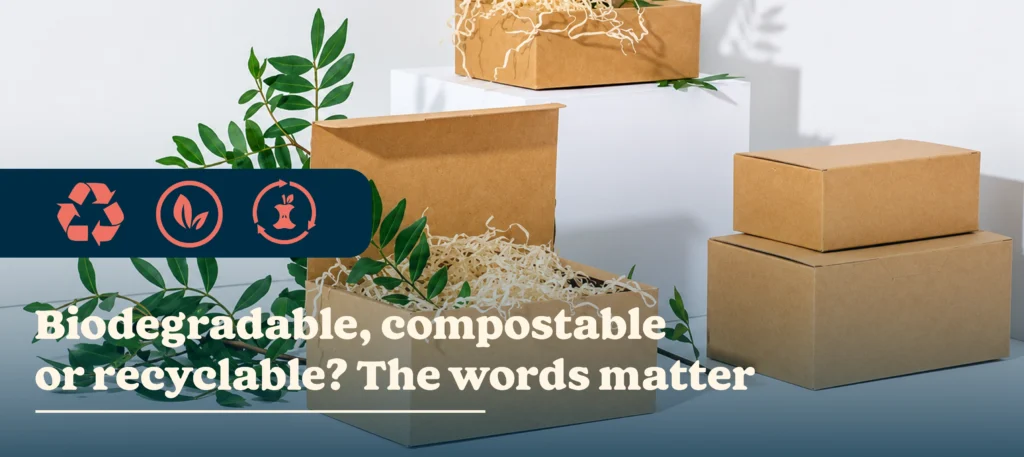
Biodegradable, compostable or recyclable? The words matter
Biodegradable simply means a material will eventually be broken down by microbes. There’s no set timescale, so on its own the word tells a customer very little. Technically, almost everything is biodegradable given enough time.
Compostable is the stricter, more useful term. A certified compostable material breaks down into water, carbon dioxide and biomass within a defined period and leaves no harmful residue. In the UK and Europe the reference standard is BS EN 13432. To meet it, a material has to disintegrate so that under 10% of fragments are larger than 2mm within 12 weeks, and biodegrade by at least 90% within six months under industrial composting conditions. Home composting is a separate, harder test with its own certification.
Recyclable means the material can be collected, reprocessed and made into something new, provided a real collection stream exists for it. Clean paper and board score well here because the UK has mature fibre recycling.
One honest point that many suppliers skip: compostable and biodegradable are not automatically better than recyclable. If your customer has no access to industrial composting, a certified compostable pouch often ends up in general waste, where it behaves much like ordinary plastic.
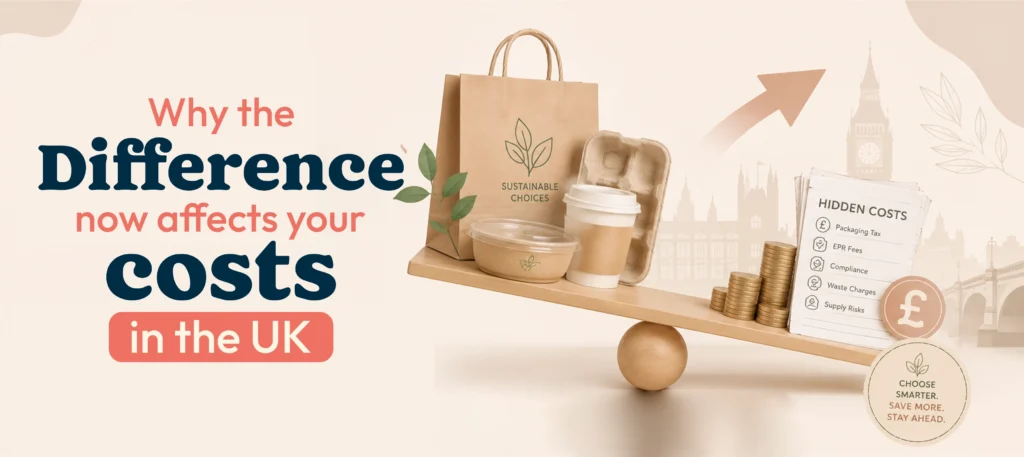
Why the difference now affects your costs in the UK
Extended Producer Responsibility (EPR) and modulated fees
Extended Producer Responsibility for packaging is run by PackUK, and it moves the full cost of dealing with household packaging waste onto the businesses that put packaging on the market. The Year 1 base disposal fees for 2025-26 are charged per tonne of material, and fibre-based materials are far cheaper to be liable for than plastic: paper and card are set at £196 per tonne, against £423 per tonne for plastic and £461 per tonne for fibre-based composite.
From the 2026-27 scheme year the fees are modulated using the Recyclability Assessment Methodology, which gives every material a Red, Amber or Green rating. Green (easy to recycle) pays less, red (hard to recycle) pays a surcharge, and the red money funds the green discount. The illustrative Year 2 figures published by PackUK in December 2025 point to a +20% penalty on red-rated packaging and roughly a 9% discount on green-rated designs, with confirmed fees due in June 2026. Choosing widely recyclable paper and board over hard-to-recycle laminated or mixed materials will reduce your EPR exposure over time.
The Plastic Packaging Tax
If you manufacture or import plastic packaging with less than 30% recycled content, the Plastic Packaging Tax applies. The rate rose to £228.82 per tonne on 1 April 2026. There’s a 10-tonne registration threshold over a rolling 12 months. Paper and board packaging sits outside this tax entirely, which is one practical reason so many UK brands have moved to kraft and corrugated formats.
Simpler Recycling and what your customers can actually bin
Under Simpler Recycling in England, businesses with 10 or more full-time-equivalent staff have had to separate core recyclable streams since 31 March 2025, with smaller firms following by 31 March 2027 and households from 31 March 2026. Paper and card have a clear home in this system. Compostable and biodegradable plastics generally don’t, which is worth remembering before you promise a customer that a pouch is “easy to dispose of”.
The Green Claims Code: say it right or do not say it
The Competition and Markets Authority’s Green Claims Code requires environmental claims to be accurate, clear and backed by evidence. Vague terms like “eco-friendly” and an unqualified “biodegradable” are exactly what the regulator targets, and its January 2026 supply-chain guidance made clear the responsibility runs across the whole chain. Only claim compostability if you hold a recognised certification such as EN 13432, and tell customers how to dispose of the pack. Get this wrong and the penalties can reach 10% of global turnover.
The main types of biodegradable and compostable packaging
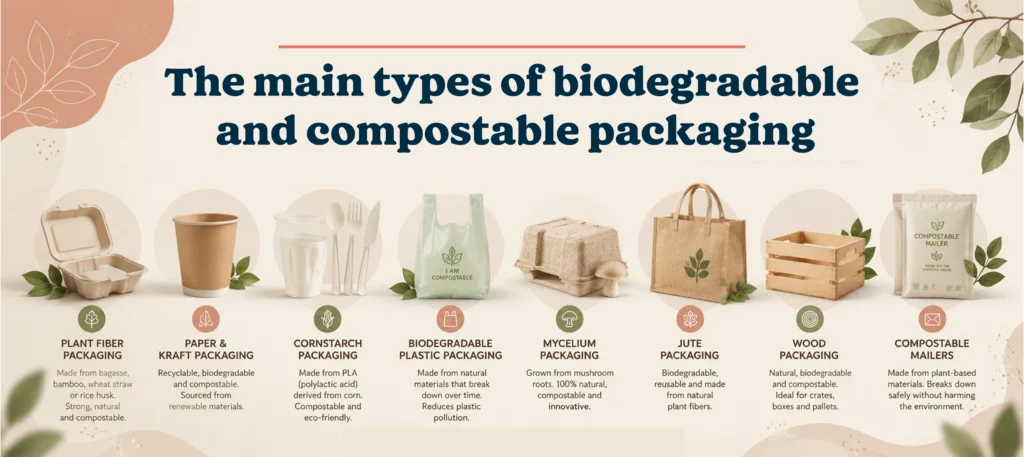
Kraft paper and board: Strong, natural-looking and widely recycled, kraft is the workhorse of eco packaging. It suits mailer boxes, food bags, soap sleeves and retail cartons, and it prints well.
Corrugated cardboard: Fluted board between liners gives you protection for shipping. It’s one of the most recycled materials in the UK, so it tends to score well on recyclability.
Moulded pulp: Made from recycled paper fibre, this is the material behind egg boxes and protective trays. It’s a good plastic-free alternative to foam inserts for electronics, glassware and cosmetics.
Bagasse: The fibre left over after sugar is extracted from sugarcane. It moulds into sturdy, grease-resistant food trays and clamshells and is compostable under the right conditions.
Cornstarch and PLA: PLA is a plant-based bioplastic. Here’s the part most guides get wrong: PLA is compostable only in an industrial facility at high temperature. It doesn’t meaningfully break down in a home compost heap, in landfill or in the sea, and labelling it plainly “biodegradable” is a greenwashing trap. Use it where a genuine composting collection exists.
Mushroom (mycelium): Grown from agricultural waste bound with fungal mycelium, this moulds into protective packaging and breaks down at home. It’s niche, and better suited to protective inserts than printed retail boxes.
Seaweed: An emerging material for films and sachets. Promising for single-serve food items, still early in commercial availability.
Bamboo: Fast-growing and sturdy, used for rigid and moulded formats where a natural look adds value.
Cellulose film: A plant-based clear film, used as a compostable alternative to plastic windows and wraps.
How to choose the right eco material for your product
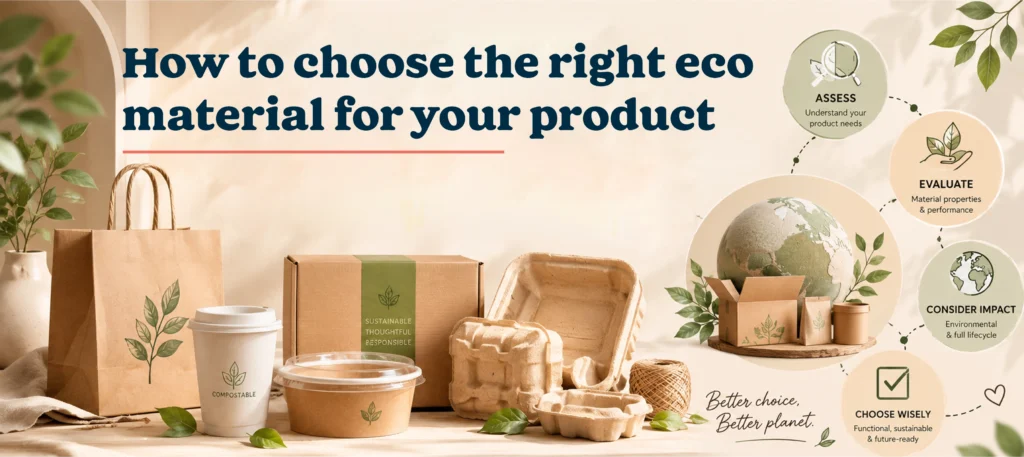
Start with disposal reality, not the nicest-sounding label. If your customers can recycle paper and board at home and at work, a recyclable kraft or corrugated format is usually the honest, low-cost, low-EPR choice. If your product is food-soiled and you have a composting route, certified compostable earns its place. Match weight and protection to the job, keep the material as close to mono-material as you can so it stays easy to recycle, and only make the claims you can prove.
Getting biodegradable packaging made
All Custom Packaging UK makes custom printed boxes in recyclable kraft and corrugated board, with free design help, low minimums and no setup or plate fees. We can advise on which material keeps your packaging recyclable and your claims defensible, then deliver across the UK.
Frequently asked questions
Is biodegradable the same as compostable?
No. Compostable is a certified, time-bound breakdown into safe compost. Biodegradable on its own has no set timescale and means very little without a standard behind it.
Is compostable packaging always better than recyclable?
Not necessarily. If your customers cannot access composting, recyclable paper or board is often the more practical and lower-cost choice.
Does biodegradable packaging avoid the Plastic Packaging Tax?
Paper and board packaging is outside the tax. The tax targets plastic packaging with less than 30% recycled content, at £228.82 per tonne from April 2026.
Can I print “biodegradable” on my packaging?
Only if you can back it up. The CMA Green Claims Code expects accurate, evidenced claims, so use a recognised certification and explain disposal.
Which eco materials do you offer?
We focus on recyclable kraft and corrugated formats for boxes, mailers and bags, which suit most UK brands and keep EPR costs down.