

Royal Mail and Parcelforce Parcel Sizes : The Full UK Guide to Choosing the Right Box and Avoiding Extra Charges
If you send parcels in the UK, this is what you need to know: Royal Mail sorts every item into one of four size bands (Letter, Large Letter, Small Parcel, Medium Parcel), each with its own maximum dimensions and weight. Anything bigger than Royal Mail’s Medium Parcel band needs Parcelforce instead. Since 7 April 2026, Royal Mail has also charged a separate £11 correction fee on oversized Tracked 24 and Tracked 48 return items, on top of any extra postage. The box you choose decides which band you land in, and a badly chosen box is often the real reason postage costs more than it should.
Key takeaways
- Royal Mail has four UK size bands: Letter, Large Letter, Small Parcel and Medium Parcel. Anything bigger or heavier than Medium Parcel (61 x 46 x 46cm, 20kg) needs Parcelforce.
- Royal Mail measures the packed item, not the product inside it. Your box, your tape and your filler all count towards the size band.
- From 7 April 2026, Royal Mail has charged a £11 correction fee on Tracked 24 and Tracked 48 return items that come in over the Medium Parcel size or weight limit. It sits on top of any extra postage owed.
- Parcelforce is changing how it measures large parcels, moving from a length-plus-girth limit to a litre-volume limit for some services. Check the current rules before you book, because this is mid transition.
- Choosing a box that fits your product closely, rather than a generic one size up, is usually the cheapest way to stay inside a lower band.
What are Royal Mail’s parcel size bands?
Royal Mail splits UK post into four bands, set out on . Every item must fit inside all three dimensions and the weight limit for a band at the same time. If even one measurement goes over, the whole item moves up to the next band, and that usually means a higher price.
| Band | Maximum size | Maximum weight | What it typically suits |
|---|---|---|---|
| Letter | 24cm x 16.5cm x 0.5cm | 100g | Single sheets, cards, thin documents |
| Large Letter | 35.3cm x 25cm x 2.5cm | 750g | Books, magazines, flat items, small clothing |
| Small Parcel | 45cm x 35cm x 16cm | 2kg | Small boxed products, cosmetics, jewellery |
| Medium Parcel | 61cm x 46cm x 46cm | 20kg | Most boxed e-commerce orders |
Anything larger than Medium Parcel, or heavier than 20kg, is outside Royal Mail’s standard parcel bands and needs a different service, usually Parcelforce.
A note on tubes: Royal Mail also allows a tube format, generally reported as up to 90cm in length with a combined measurement (length plus twice the diameter) of no more than 104cm. This figure comes from a single source (Elovate’s own published guide) rather than a source we could independently confirm, so treat it as indicative rather than exact if you are sending anything in a tube.
This guide focuses on choosing between Royal Mail and Parcelforce and avoiding extra charges. If you want the wider picture of standard box dimensions in cm and mm, including Evri’s limits alongside Royal Mail’s and Parcelforce’s, see our standard box dimensions and courier limits guide.
When do you need Parcelforce instead of Royal Mail?

Parcelforce is the Royal Mail Group’s service for parcels that are too big, too heavy, or need a faster guaranteed service than the standard Royal Mail bands cover. Full current terms sit on Parcelforce’s own size and weight guide. As of this guide, Parcelforce’s domestic services work like this:
- Parcelforce Standard-size domestic services: parcels up to 30kg, with a maximum length of 1.5 metres and a maximum combined length-plus-girth of 3 metres.
- Parcelforce express48large: parcels up to 30kg, with a maximum length of 2.5 metres and a maximum combined length-plus-girth of 4 metres.
Parcelforce is partway through changing how it measures large parcels. The length-plus-girth rule above is being replaced by a straightforward litre-volume limit: a maximum of 220 litres for standard domestic services (aside from the large tier), and a maximum of 500 litres for express48large. The 30kg weight cap stays the same either way. Because this change is still rolling out, always check the current limit for your exact service before you book, rather than relying on any single guide, including this one.
There is no overall weight limit if you are sending multiple separate parcels in one consignment. Each individual parcel is still capped at 30kg.
How do Royal Mail and Parcelforce compare?

Most guides cover Royal Mail or Parcelforce. Here is both side by side, so you can see exactly where one stops and the other starts.
Maximum weight by band: Royal Mail and Parcelforce
Horizontal bar chart. Letter 0.1kg. Large Letter 0.75kg. Small Parcel 2kg. Medium Parcel 20kg. Parcelforce Standard 30kg. Parcelforce express48large 30kg. Source: Royal Mail and Parcelforce published size guides, verified across multiple independent UK packaging and logistics sources, August 2026. Maximum weight by band (kg) Letter Large Letter Small Parcel Medium Parcel Parcelforce Standard express48large 0.1kg 0.75kg 2kg 20kg 30kg 30kg Source: Royal Mail and Parcelforce published size guides, cross-checked against independent UK packaging sources, August 2026
| Band | Service | Maximum size | Maximum weight | Note |
|---|---|---|---|---|
| Letter | Royal Mail | 24 x 16.5 x 0.5cm | 100g | Documents only |
| Large Letter | Royal Mail | 35.3 x 25 x 2.5cm | 750g | Flat items only |
| Small Parcel | Royal Mail | 45 x 35 x 16cm | 2kg | Most small products |
| Medium Parcel | Royal Mail | 61 x 46 x 46cm | 20kg | Most boxed orders |
| Standard-size | Parcelforce | 1.5m length, 3m length+girth (moving to 220 litres) | 30kg | Larger or heavier boxes |
| express48large | Parcelforce | 2.5m length, 4m length+girth (moving to 500 litres) | 30kg | Long or bulky single items |
What is the £11 correction charge, and how do you avoid it?

From 7 April 2026, Royal Mail introduced an £11 correction charge. Based on the reporting we could verify, it applies to Tracked 24 and Tracked 48 return items that come in over the Medium Parcel limits, on top of any extra postage already owed for the oversized item. We were not able to directly load Royal Mail’s own surcharges page while researching this guide (it returned an access error both times we tried), so we are relying on consistent third-party reporting rather than the primary source itself. If you handle a high volume of returns, confirm the current wording directly with Royal Mail before you rely on it for a costing decision.
Royal Mail has more than one correction-style charge. Some reporting points to a separate charge, introduced from August 2026, for Tracked items incorrectly presented at a Parcelshop. We have not checked the detail of that charge closely enough to state its terms here, but the lesson is the same either way. Getting the format right before you send it saves you the argument afterwards.
Checklist: how to avoid a correction charge
- Weigh and measure the packed item, not just the product. Include the box, any tape, and any filler or void-fill material.
- Check all three dimensions and the weight against the band you are paying for, not just the one measurement you assume is the limiting factor.
- Round up, not down. If a measurement sits right on a limit, treat it as the band above.
- Re-measure returns before you post them. A returned item repacked in a bigger box than it was sent in is a common way to accidentally cross a size band.
- Keep proof of the size and weight you paid for, such as a screenshot of a click and drop label or checkout confirmation, in case a charge is applied and you need to query it.
- If you send a high volume of parcels, standardise your box sizes so your team is not guessing the band on every order.
Which service do I need? A quick decision guide
- Is it a single sheet, card or thin document under 100g and 0.5cm thick? Royal Mail Letter.
- Is it flat, under 750g and no more than 2.5cm thick? Royal Mail Large Letter.
- Does it fit in a box no bigger than 45 x 35 x 16cm and weigh under 2kg? Royal Mail Small Parcel.
- Does it fit in a box no bigger than 61 x 46 x 46cm and weigh under 20kg? Royal Mail Medium Parcel. This covers most boxed e-commerce orders.
- Is it bigger or heavier than Medium Parcel, but under 30kg and within Parcelforce’s standard-size limits? Parcelforce standard-size service.
- Is it long or bulky, exceeding standard-size limits but within express48large’s limits? Parcelforce express48large.
- Is it over 30kg? You will usually need to split it into more than one parcel, since 30kg is the per-parcel cap even on multi-parcel consignments.
How does your box choice decide your price band?

Carrier choice gets most of the attention in guides like this one, but the box itself is usually what actually decides your price. Royal Mail and Parcelforce both price by band, and the band is set by your packed item’s outer dimensions and weight, not by what is inside it.
That means two sellers shipping the identical product can land in two different price bands, purely because one used a box sized to the product and the other used whatever box was on the shelf. A box that is a centimetre or two bigger than it needs to be can be enough to push a Small Parcel into Medium Parcel, or a Large Letter into Small Parcel, because Royal Mail’s bands require every dimension to sit inside the limit at the same time.
This is the part a lot of postage advice skips: the fix usually is not a cleverer carrier choice, it is a better-fitting box. A mailer box sized for small or flat products keeps light items inside the cheaper Royal Mail bands instead of spilling into Medium Parcel through excess void space. A properly sized shipping box does the same job for bulkier orders, keeping them inside Parcelforce’s standard-size limits rather than tipping into a larger, pricier tier. If you are custom ordering boxes, checking your typical product against the size bands above before you finalise a dieline is worth doing before you commit to a print run, not after.
What mistakes push a parcel into a more expensive band?
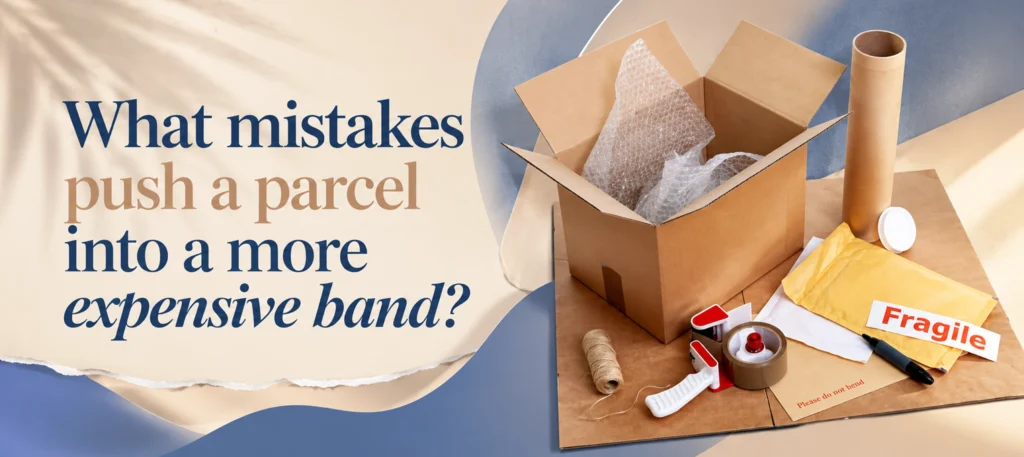
- Using one box size for every product, so smaller items travel in packaging sized for the biggest thing you sell.
- Forgetting that packaging adds to the measurement. A product that is 44cm long can still fail the Small Parcel test if the box, tape and padding push it over 45cm.
- Weighing the product instead of the finished parcel. Filler, tape and branded inserts all add weight.
- Assuming weight is the only limit, when many parcels actually get bumped up a band on a single dimension.
- Re-using a bigger box for a return without repacking it to the size the item was originally sent in.
How do you measure a parcel correctly?

- Pack the item exactly as you would send it, including all filler and protective material.
- Measure the longest side, the widest side and the deepest side, at their widest points.
- Weigh the fully packed parcel, not the product alone.
- Check all three dimensions and the weight against a single band. All four figures must fit inside that band’s limits together. If any one of them does not, move up to the next band.
- If you are close to a limit, size down your box rather than adding more padding to a box that is already borderline.
Sizing the box correctly also reduces damage in transit, since a box with too much empty space lets the contents move around in the post. If damaged parcels are a bigger worry for you than postage cost, our guide on how to stop parcels arriving damaged covers board strength, cushioning and sealing in detail. This guide focuses on sizing for cost, not protection, so the two are worth reading together.
Frequently asked questions

How do I know which Royal Mail size band my parcel falls into? Measure the packed item’s length, width and depth at their widest points, then weigh it fully packed. Compare all four figures (three dimensions plus weight) against the band tables above. If any single figure is over the limit for a band, the whole parcel moves up to the next one.
Is a Large Letter always cheaper than a Small Parcel? Generally yes, because Large Letter is a lower band with a lower weight limit. But it only qualifies if the item is genuinely flat (2.5cm or under) and within 750g. Forcing a boxed item into a Large Letter envelope to save money usually just gets it reclassified, and reclassification can cost more than paying the correct rate upfront.
What happens if my parcel is too big for the postage I paid? It is typically resent through the network at the correct (higher) rate, and for oversized Tracked 24 and Tracked 48 return items sent since 7 April 2026, an additional £11 correction charge has also applied on top, based on the reporting we verified for this guide.
Do I need a Parcelforce account, or can I pay as you go? Parcelforce offers both account and non-account options; the exact size and price terms can differ between them. Confirm which applies to you directly with Parcelforce before costing out a shipment.
Is Royal Mail or Parcelforce cheaper for a heavy box? For anything at or under 20kg that fits inside 61 x 46 x 46cm, Royal Mail’s Medium Parcel band is usually the cheaper standard option. Above that size or weight, you are into Parcelforce’s territory regardless of price, because Royal Mail’s own bands stop at Medium Parcel.
Can I send a parcel over 30kg? Not as a single parcel through the services covered in this guide. You would typically need to split it into two or more parcels, each within the 30kg per-parcel limit.
Does the box itself count towards the weight and size limit? Yes. Royal Mail and Parcelforce both measure and weigh the parcel as sent, including the box, tape, filler and any packaging, not just the product inside it.
Getting your box size right from the start
Guesswork with box sizes is an easy way to overpay on postage without ever noticing it, order after order. If you are reviewing your packaging because postage costs keep creeping up, it is worth checking your current box against the bands above before your next print run. All Custom Packaging supplies mailer boxes and shipping boxes to your own dimensions. Design support is free, and UK delivery is free, so you can size packaging to the band you actually want to ship in, rather than the one your current box happens to land in by accident.