
Standard Box Sizes UK: Dimensions in CM, MM & Courier Limits
Choosing the correct box size is not simply a packaging decision. It affects shipping charges, product protection, storage space, material usage and the overall customer experience.
For UK businesses, even a small difference in the external dimensions of a parcel can affect the delivery service or pricing category available. A product may fit inside a box perfectly, but the parcel can still exceed a carrier’s limit once protective padding, inserts and sealing tape are added.
This guide explains standard box dimensions in centimetres and millimetres, how to measure packaging correctly, common box sizes for different products and the latest size limits published by Royal Mail, Parcelforce and Evri.
Quick Answer
Box dimensions are normally written as:
Length × Width × Height
In the UK, packaging measurements are generally shown in centimetres or millimetres.
For Royal Mail, the commonly used maximum dimensions include:
- Letter: 24 × 16.5 × 0.5 cm, up to 100 g
- Large Letter: 35.3 × 25 × 2.5 cm, up to 750 g
- Small Parcel: 45 × 35 × 16 cm, up to 2 kg
The packed and sealed parcel must remain within every applicable dimension. Exceeding the maximum length, width, depth or weight may move the shipment into another postal format or require a different service.
What Are Standard Box Dimensions?
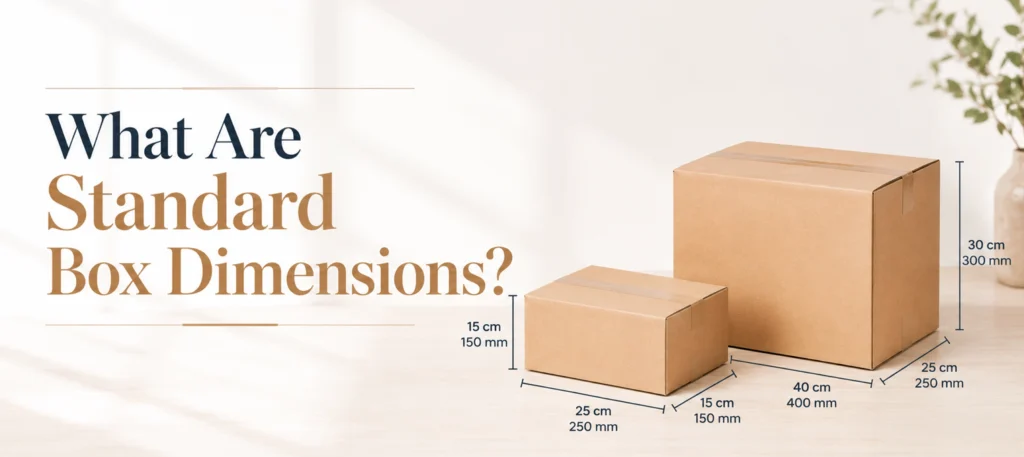
Standard box dimensions are commonly available packaging sizes designed to accommodate frequently shipped products.
They are used for:
- Product storage
- Postal and courier deliveries
- Retail presentation
- Subscription orders
- Ecommerce fulfilment
- Gift packaging
- Warehouse organisation
Box measurements are written in the following order:
Length × Width × Height — L × W × H
Length
The length is normally the longest side of the base.
Width
The width is the shorter side of the base.
Height or Depth
The height is the vertical measurement from the bottom of the box to the top.
For example, a box listed as 30 × 20 × 10 cm has:
- A length of 30 cm
- A width of 20 cm
- A height of 10 cm
Using the correct order is important when comparing packaging with postal and courier restrictions.
Internal vs External Box Dimensions
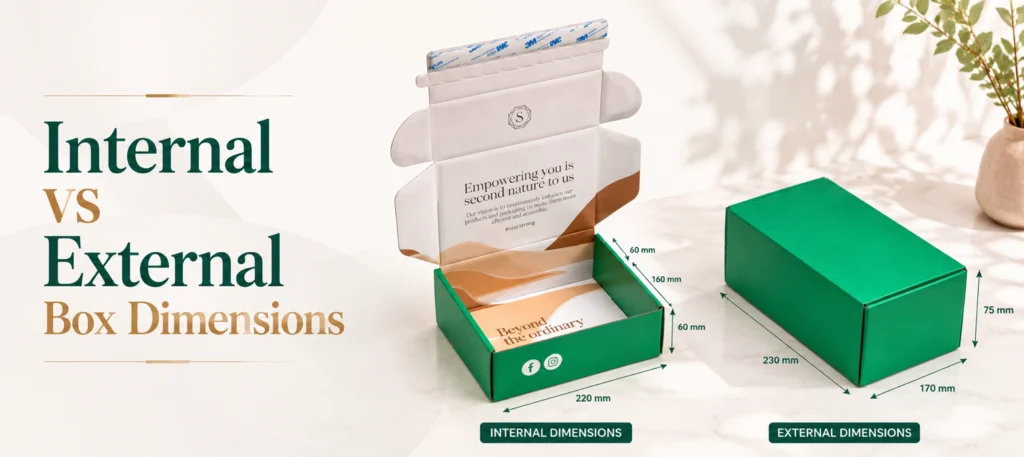
One of the most common packaging mistakes is confusing internal measurements with external measurements.
Internal dimensions
Internal dimensions describe the usable space inside the packaging. Use these measurements when deciding whether the product, inserts and protective materials will fit.
External dimensions
External dimensions describe the complete outside size of the assembled and sealed box. These are the measurements used by postal services and couriers.
The external size is usually slightly larger because of:
- Cardboard thickness
- Folded flaps
- Double-wall construction
- Protective wrapping
- Sealing tape
- Bulging caused by overfilling
A box with internal dimensions of 30 × 20 × 10 cm may therefore have slightly larger external measurements.
Always check whether a packaging supplier is listing internal or external dimensions before placing an order.
How to Measure a Box Correctly
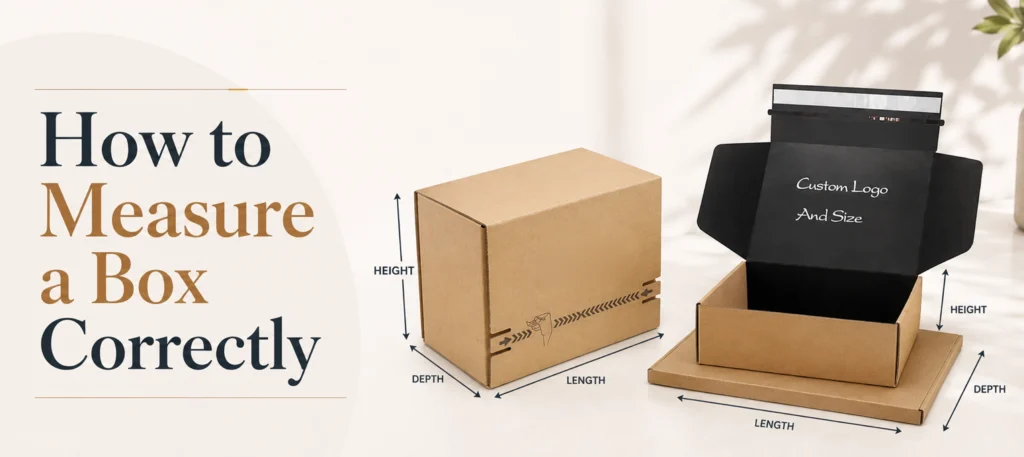
Measure the parcel in the same condition in which it will be handed to the carrier.
Do not measure only the product or an empty, unfolded box.
1. Pack the product
Place the product, inserts, tissue paper, bubble wrap and void fill inside the box.
2. Close and seal the box
Fold all flaps into position and apply the same tape or sealing method that will be used for customer orders.
3. Measure the length
Measure the longest outside edge of the sealed box.
4. Measure the width
Measure the shorter outside edge of the base.
5. Measure the height
Measure from the lowest external point to the highest external point.
6. Weigh the complete parcel
Include the weight of:
- The product
- The box
- Inserts
- Labels
- Void fill
- Wrapping
- Tape
- Promotional materials
Royal Mail recommends measuring all three parcel dimensions and checking the fully packaged item before postage is purchased.
Allow a practical tolerance
Avoid selecting packaging that sits exactly on a carrier’s maximum limit. Manufacturing tolerances, tape and slight bulging can add several millimetres.
Where possible, leave a small safety margin below the maximum permitted dimensions.
Why the Right Box Size Matters
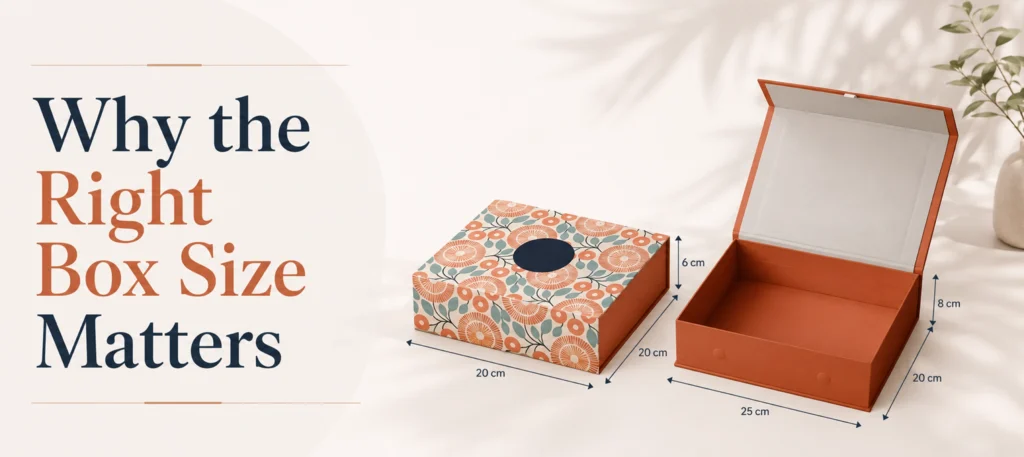
Selecting the right packaging dimensions offers several commercial and practical benefits.
Reduced shipping costs
A smaller parcel may qualify for a cheaper postal format or courier service. Oversized packaging can increase delivery costs even when the product itself is light.
Better product protection
A box that is too large allows the product to move during transit. A box that is too tight may place pressure on the product or split when handled.
The ideal box provides enough room for suitable protection without excessive empty space.
Lower material usage
Right-sized packaging reduces the amount of cardboard, paper, bubble wrap and other void-filling materials required.
More efficient storage
Standardised box sizes stack more easily and use warehouse shelving, pallets and packing areas more efficiently.
Improved handling
Appropriately sized parcels are easier for warehouse staff, couriers and customers to lift and handle.
Stronger brand perception
Customers often associate precise, well-designed packaging with professionalism and product quality.
Better unboxing experience
Packaging that fits the product properly creates a cleaner and more intentional presentation.
Reduced environmental impact
Using less material and transporting less empty space can reduce packaging waste and improve distribution efficiency.
Standard Box Sizes in CM and MM
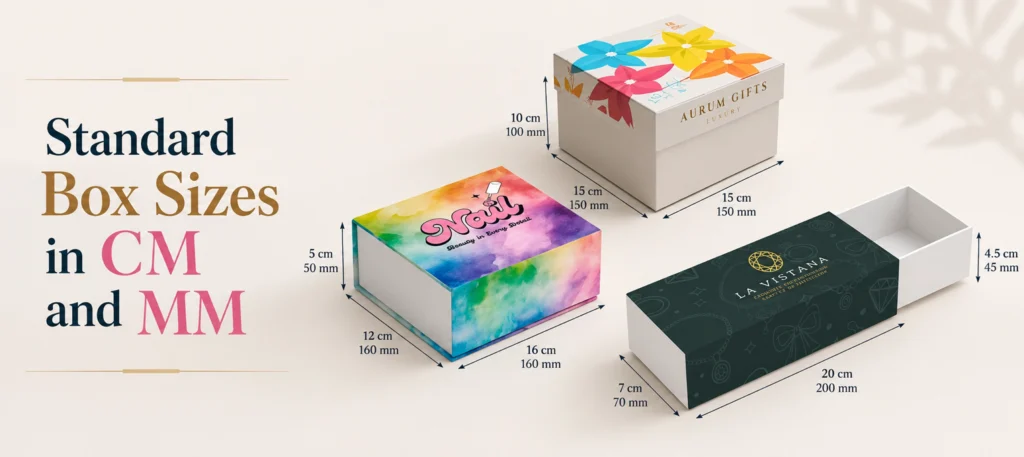
The following dimensions are useful starting points. They are not universal requirements, because the ideal size depends on the product, protection level and delivery method.
Small Box Dimensions
Small boxes are commonly used for jewellery, cosmetics, soaps, accessories and lightweight ecommerce products.
| Box Type | Dimensions in CM | Dimensions in MM |
| Jewellery box | 7.6 × 7.6 × 2.5 cm | 76 × 76 × 25 mm |
| Soap box | 10.2 × 7.6 × 3.8 cm | 102 × 76 × 38 mm |
| Cosmetic box | 12.7 × 5 × 5 cm | 127 × 50 × 50 mm |
| Small mailer box | 15.2 × 10.2 × 5 cm | 152 × 102 × 50 mm |
| Earbuds box | 10.2 × 10.2 × 5.1 cm | 102 × 102 × 51 mm |
| Smartwatch box | 12.7 × 12.7 × 5.1 cm | 127 × 127 × 51 mm |
Compact packaging should still leave enough space for inserts and impact protection.
Medium Box Dimensions
Medium boxes are suitable for apparel, subscription products, footwear, bakery items and multi-product orders.
| Box Type | Dimensions in CM | Dimensions in MM |
| Apparel box | 25 × 20 × 10 cm | 250 × 200 × 100 mm |
| Subscription box | 30 × 25 × 10 cm | 300 × 250 × 100 mm |
| Bakery box | 25 × 25 × 12.7 cm | 250 × 250 × 127 mm |
| Shoe box | 33 × 17.8 × 12.7 cm | 330 × 178 × 127 mm |
| Medium mailer box | 30 × 22.8 × 10.1 cm | 300 × 228 × 101 mm |
When using medium-sized boxes, check the parcel’s external height carefully. Depth is frequently the dimension that causes a shipment to exceed a postal format.
Large boxes are normally required for moving, electronics, equipment, wholesale products and consolidated shipments.
Large Box Dimensions
| Box Type | Dimensions in CM | Dimensions in MM |
| Moving box | 45.7 × 45.7 × 40.6 cm | 457 × 457 × 406 mm |
| Electronics box | 50.8 × 40.6 × 30.5 cm | 508 × 406 × 305 mm |
| Bulk shipping box | 61 × 45.7 × 45.7 cm | 610 × 457 × 457 mm |
| Industrial box | 76.2 × 61 × 61 cm | 762 × 610 × 610 mm |
For heavier or fragile products, the board grade and construction are just as important as the dimensions. Double-wall corrugated packaging may be more suitable than single-wall board.
Product-Specific Box Dimensions
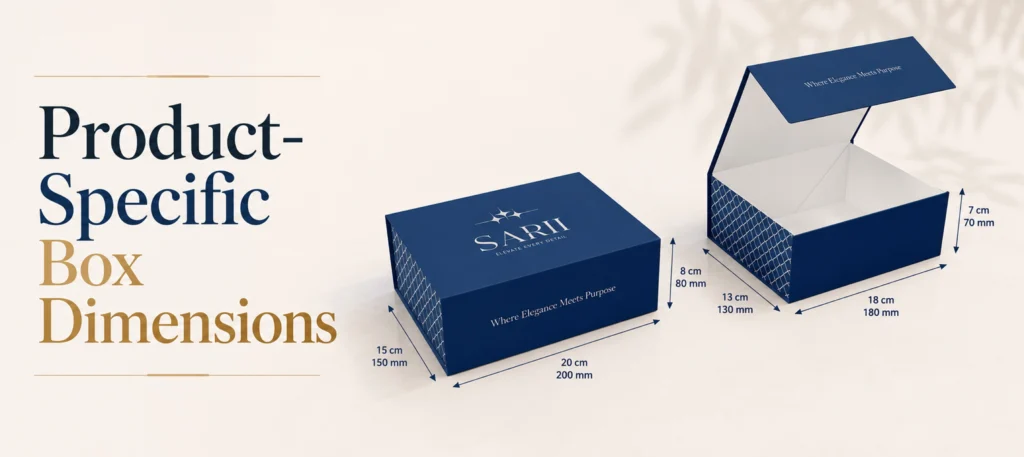
Different product categories have different packaging requirements. The following examples can help during the initial design and sourcing process.
Jewellery Box Dimensions
Jewellery packaging is generally compact and may include foam, velvet or card inserts.
Common sizes include:
- 5 × 5 × 2.5 cm
- 7.6 × 7.6 × 2.5 cm
- 9 × 7 × 3 cm
- 10 × 8 × 4 cm
The internal dimensions must account for the insert as well as the product.
Soap Box Dimensions
Common soap box dimensions include:
- 8 × 5 × 3 cm
- 10.2 × 7.6 × 3.8 cm
- 11 × 8 × 4 cm
- 12 × 9 × 4 cm
Soap packaging should provide a close fit without pressing against the product’s surface.
Cosmetic Box Dimensions
Cosmetics vary significantly in shape, so there is no single universal size.
Typical cosmetic packaging dimensions include:
- 2.2 × 2.2 × 7.6 cm
- 6.4 × 1.9 × 11.4 cm
- 7.6 × 7.6 × 7.6 cm
- 11.4 × 9.5 × 11.4 cm
Custom inserts can help secure bottles, jars and applicators.
Lipstick Box Dimensions
A common lipstick carton measures approximately:
2.5 × 2.5 × 12.7 cm
However, the exact size should be based on the lipstick tube, cap and any internal retaining structure.
Perfume Box Dimensions
Perfume boxes require careful sizing because glass bottles need additional protection.
Common dimensions include:
- 2.5 × 2.5 × 7.6 cm
- 3.8 × 3.8 × 10.2 cm
- 5.1 × 3.2 × 14 cm
- 6.4 × 3.5 × 16 cm
- 7.6 × 7.6 × 15.2 cm
Larger bottles may require card platforms, foam inserts or moulded pulp protection.
Candle Box Dimensions
A frequently used candle box measures:
10.2 × 10.2 × 12.7 cm
The correct size depends on the candle jar diameter, lid, protective insert and required clearance.
Mobile Phone Box Dimensions
A typical mobile phone box may measure approximately:
17.8 × 10.2 × 5.1 cm
The packaging should also provide organised compartments for cables, chargers and documentation.
Shoe Box Dimensions
A common adult shoe box measures approximately:
33 × 17.8 × 12.7 cm
Actual requirements vary according to footwear type and size. Boots, high-top trainers and children’s shoes need different dimensions.
Bakery Box Dimensions
Common bakery packaging sizes include:
- 15 × 15 × 7.5 cm
- 20 × 20 × 10 cm
- 25 × 25 × 12.7 cm
- 30 × 30 × 15 cm
Food packaging should use appropriate food-contact materials and allow enough space to prevent icing, toppings or decorations from touching the box.
Pizza Box Dimensions
Common pizza box sizes include:
- 20.3 × 20.3 × 5.1 cm
- 25.4 × 25.4 × 5.1 cm
- 30.5 × 30.5 × 4.4 cm
- 35.6 × 35.6 × 5.1 cm
The box should correspond to the actual pizza diameter while allowing sufficient clearance around the edges.
Playing Card Box Dimensions
Common playing card sizes include:
- 6.35 × 8.89 cm
- 5.72 × 8.89 cm
- 6.99 × 12.07 cm
- 4.45 × 6.35 cm
The finished carton must be slightly larger than the card deck to account for card thickness and closing flaps.
Promotional Box Dimensions
Promotional and gift boxes commonly use sizes such as:
- 5.1 × 5.1 × 10.2 cm
- 8.9 × 8.9 × 2.5 cm
- 10.2 × 6.4 × 3.8 cm
- 16.5 × 11.4 × 8.9 cm
The best promotional box size depends on the number of products, their presentation order and the type of insert used.
Royal Mail Size Limits
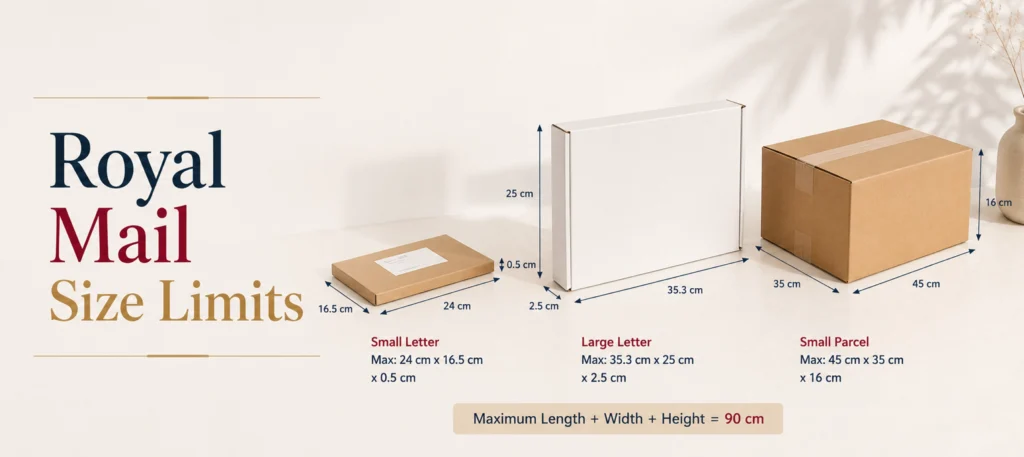
Royal Mail classifies mail according to dimensions and weight.
| Format | Maximum Dimensions | Maximum Weight |
| Letter | 24 × 16.5 × 0.5 cm | 100 g |
| Large Letter | 35.3 × 25 × 2.5 cm | 750 g |
| Small Parcel | 45 × 35 × 16 cm | 2 kg |
Royal Mail also expresses the Letter and Large Letter limits as 240 × 165 × 5 mm and 353 × 250 × 25 mm respectively.
Why a few millimetres matter
A parcel must comply with all relevant limits.
For example, an item measuring:
35 × 24 × 2.6 cm
may fit within the Large Letter length and width limits, but it exceeds the maximum 2.5 cm depth. It therefore cannot be treated as a standard Large Letter format.
This is why measuring the complete sealed package is essential.
Royal Mail pricing
Royal Mail prices vary according to the service, format, weight and whether postage is purchased online or through another channel. Current published prices should therefore be checked before quoting shipping charges to customers. Royal Mail states that online and Post Office prices may differ and publishes separate price guides for each channel.
Avoid hard-coding postal prices into long-term product listings, because rates can change.
Parcelforce Size and Weight Limits
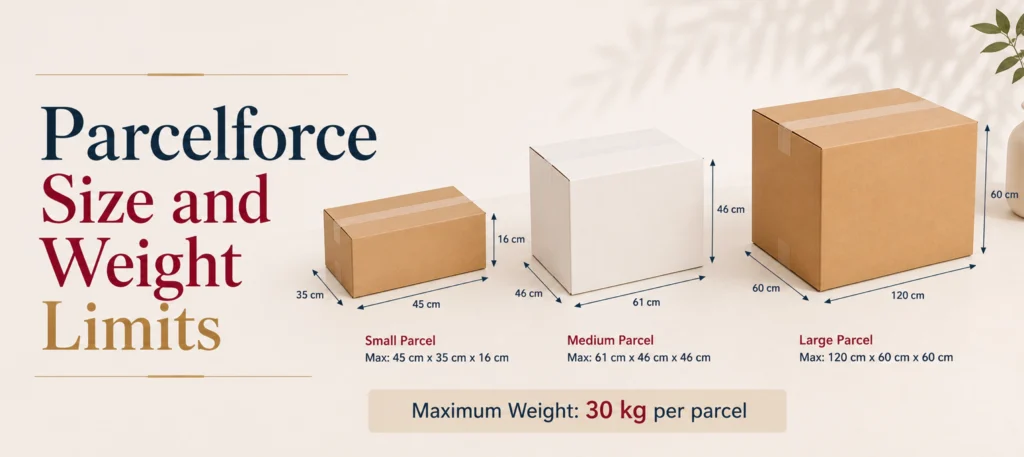
Parcelforce is often used for products that are too large or heavy for smaller postal formats.
For its standard two-day parcel service, Parcelforce currently allows:
- Maximum parcel weight: 30 kg
- Maximum length: 1.5 metres
- Maximum length and girth combined: 3 metres
Larger items may require a dedicated large-parcel service.
Parcelforce’s express48large service allows parcels up to 2.5 metres long, with a maximum volume of 500 litres and a maximum weight of 30 kg.
How to calculate length and girth
A common formula is:
Length + 2 × Width + 2 × Height
The longest side is treated as the length.
For a parcel measuring 100 × 30 × 20 cm:
100 + 60 + 40 = 200 cm
Its combined length and girth is therefore 200 cm.
Always confirm the conditions for the specific Parcelforce service being purchased.
Evri Size and Weight Limits
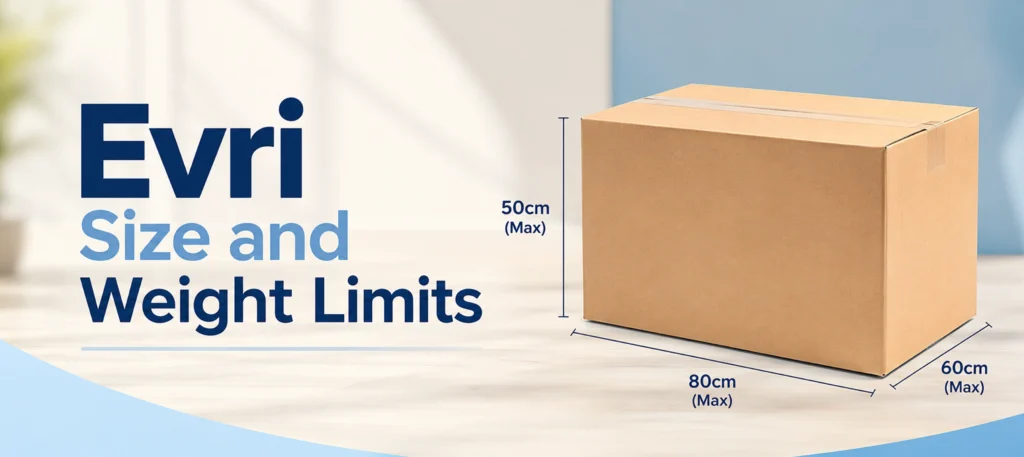
Evri currently allows standard large parcels with:
- A maximum length of 120 cm
- A maximum combined length and circumference of 245 cm
- A maximum weight of 15 kg
Evri asks senders to include the packaging weight and warns that oversized or overweight parcels may result in an additional charge.
Evri also describes a small parcel as measuring up to:
- 45 cm wide
- 35 cm long
- 16 cm deep
- 2 kg in weight
These measurements are the same numerical dimensions commonly associated with a Royal Mail Small Parcel, although the services, prices and terms remain different.
For letterbox-friendly Evri parcels, the published postable dimensions are up to approximately:
35 × 23 × 3 cm
The depth must generally remain between 1 cm and 3 cm.
What Is Dimensional or Volumetric Weight?
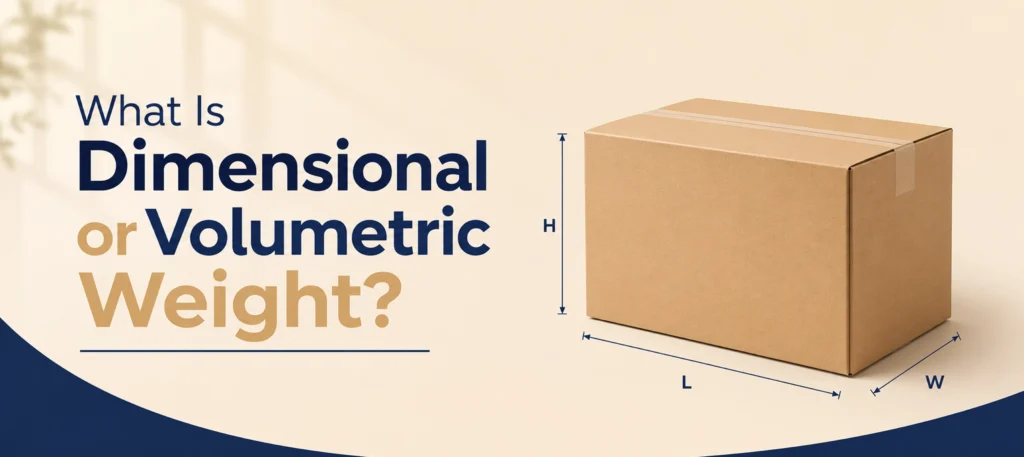
Dimensional weight, also known as volumetric weight, is a calculated shipping weight based on the space a parcel occupies.
Some carriers compare:
- The parcel’s actual weight
- Its calculated volumetric weight
The higher figure may be used for pricing.
A large box containing a lightweight product may therefore cost more to transport than a smaller box containing the same item.
Example
Imagine that a lightweight product weighs only 2 kg but is packed in a box measuring:
60 × 50 × 40 cm
The parcel occupies significant vehicle and warehouse space. Depending on the carrier and service, its chargeable weight may be based on the volume rather than the 2 kg scale weight.
How to reduce volumetric shipping costs
- Use packaging designed around the product.
- Avoid oversized boxes used “just in case”.
- Keep several standard sizes for different order combinations.
- Reduce unnecessary void fill.
- Measure bundled and multi-product orders separately.
- Compare carrier volumetric formulas before selecting a service.
The exact calculation method and divisor vary between carriers, so check the applicable tariff before estimating charges.
Standard vs Custom Box Sizes
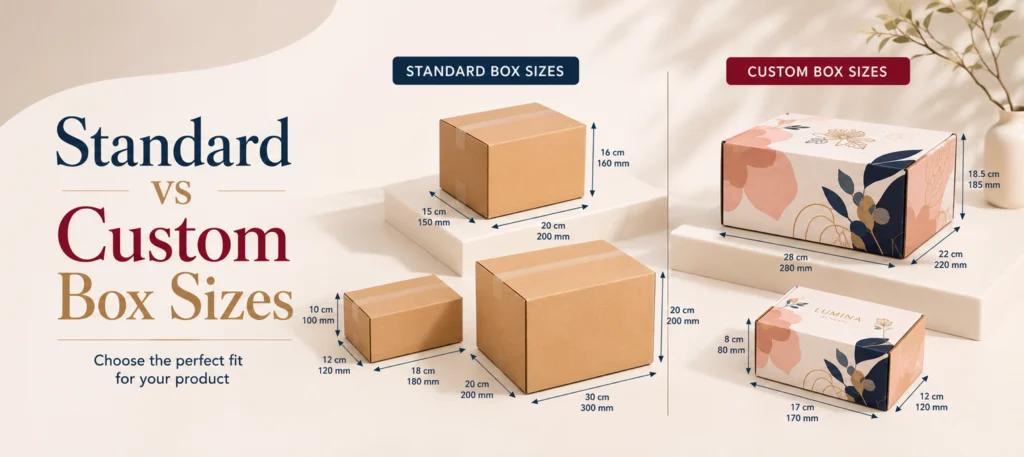
Both standard and custom packaging can be suitable. The right choice depends on order volume, branding requirements, product shape and postage objectives.
| Factor | Standard Boxes | Custom Boxes |
| Initial cost | Usually lower | Usually higher |
| Availability | Often immediately available | Requires production time |
| Minimum order | Frequently low or none | Usually subject to an MOQ |
| Product fit | General | Precise |
| Branding | Limited | Fully customisable |
| Void fill | May require more | Usually requires less |
| Postal optimisation | Depends on available sizes | Can be designed around limits |
| Customer experience | Functional | More distinctive |
Choose standard boxes when:
- You are testing a new product.
- Order volumes are low.
- Products already fit common packaging sizes.
- Fast availability is important.
- Branding requirements are limited.
Choose custom boxes when:
- The product has an unusual shape.
- You want to minimise empty space.
- Packaging is central to the brand experience.
- You ship high order volumes.
- You need fitted inserts.
- You want packaging designed below a specific carrier limit.
Custom packaging may cost more per unit initially, but it can reduce material usage, product damage and shipping inefficiency.
Packaging Design Tips for Better Box Sizing
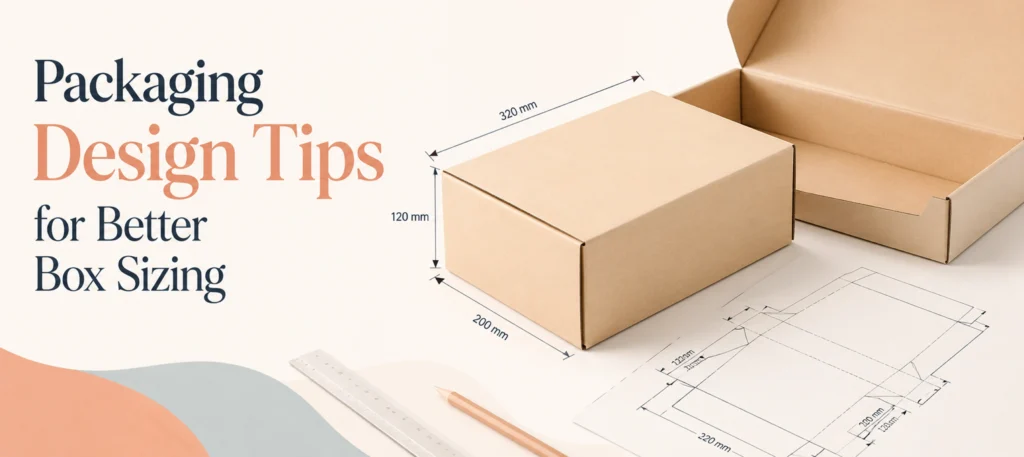
Measure every component
Do not measure only the main product. Include accessories, manuals, cables, inserts and promotional items.
Allow space for protection
Fragile products need cushioning. Add only the amount of clearance needed for the selected protective material.
Test actual packed samples
Assemble, fill, seal, measure, weigh and drop-test a sample before ordering packaging in bulk.
Consider the unboxing sequence
Plan how the customer will see and remove each product. A well-sized box should be easy to open without allowing the contents to move excessively.
Avoid unnecessary air space
Empty space increases material use and may raise transport costs.
Check the board thickness
Rigid board, double-wall corrugated board and heavy paperboard occupy more space than lightweight folding carton material.
Design below carrier limits
Do not design a finished box to exactly 45 × 35 × 16 cm when the parcel must stay within that limit. Allow room for production tolerances and sealing.
Plan for common order combinations
An ecommerce business may need different packaging for:
- One product
- Two products
- A product with accessories
- Gift orders
- Subscription bundles
- Wholesale quantities
A small range of carefully chosen sizes is often more economical than using one oversized box for every order.
Common Box-Sizing Mistakes
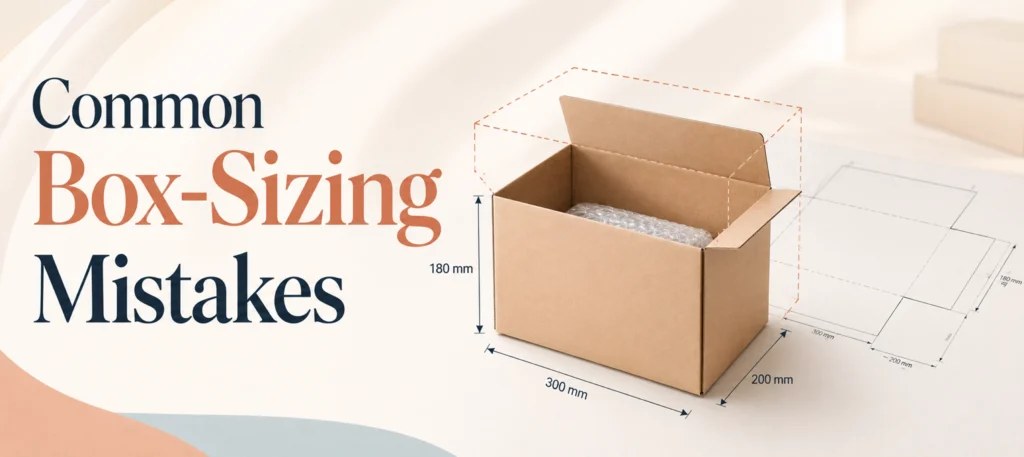
Measuring the product instead of the parcel
The carrier assesses the complete package, not the item inside it.
Confusing internal and external dimensions
Internal measurements determine fit. External measurements determine postage eligibility.
Ignoring insert thickness
Card, foam and moulded-pulp inserts reduce the usable internal space.
Overfilling the box
An overfilled box may bulge beyond the stated dimensions or open during transit.
Oversizing for convenience
A large box may simplify inventory but increase material and delivery costs.
Forgetting packaging weight
The cardboard, padding, tape and labels all contribute to the shipment’s final weight.
Ignoring carrier-specific rules
Royal Mail, Parcelforce and Evri do not apply identical limits or pricing structures.
Skipping samples
Minor dimensional problems become expensive when discovered after thousands of boxes have been produced.
Eco-Friendly Box Sizing and UK Packaging Rules
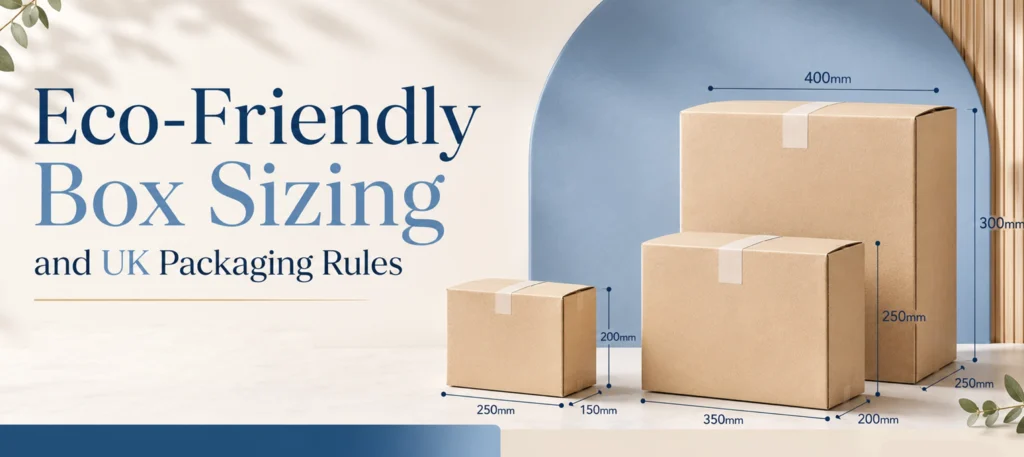
Sustainable packaging is not only about replacing plastic. It also means using the right amount of material for the product.
A right-sized box can:
- Reduce board consumption
- Lower void-fill requirements
- Improve transport efficiency
- Reduce warehouse space
- Make recycling easier
- Limit unnecessary packaging waste
From the 2026–2027 financial year, the UK’s Extended Producer Responsibility system introduces modulated household packaging waste disposal fees based on recyclability.
Packaging covered by the Recyclability Assessment Methodology may receive a red, amber or green rating. Red-rated packaging attracts a higher relevant disposal-fee element, amber acts as the base position and green-rated packaging receives a lower fee through redistribution.
This gives larger obligated producers an additional reason to consider:
- Packaging material selection
- Coatings and laminations
- Mixed-material construction
- Recyclability
- Material weight
- Avoidance of unnecessary components
The exact EPR obligations depend on factors including the organisation’s activities, turnover and packaging tonnage. Businesses should review the latest official guidance rather than assuming that every company has identical reporting or payment duties.
How to Choose the Right Box Size
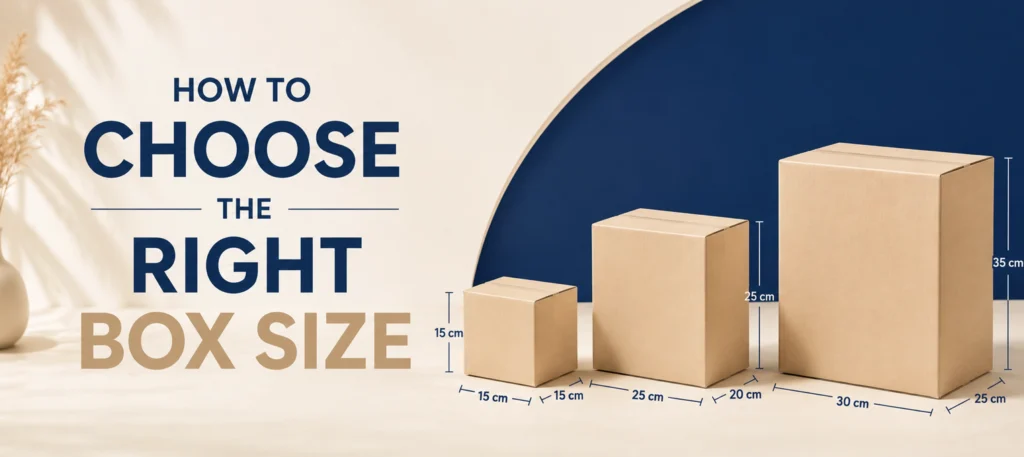
Use the following process before ordering packaging.
Step 1: Measure the product
Record the product’s maximum length, width and height.
Step 2: Identify fragile areas
Determine whether corners, lids, glass sections or controls need additional clearance.
Step 3: Select protective materials
Choose the insert, tissue, bubble wrap, paper or moulded pulp before finalising the box.
Step 4: Calculate the required internal size
Add enough room for the product and its protection.
Step 5: Check the resulting external size
Account for the board grade and construction.
Step 6: Compare carrier limits
Check whether the finished parcel qualifies as a Letter, Large Letter, Small Parcel or courier shipment.
Step 7: Weigh the complete package
Test the finished parcel rather than estimating from the product weight.
Step 8: Produce and test a sample
Check assembly, protection, appearance, measurement and transit performance.
Step 9: Order the appropriate quantity
Only approve bulk production once the sample has passed all required tests.
Choosing a UK Packaging Supplier
A suitable packaging supplier should help you evaluate more than appearance.
Before placing an order, ask about:
- Whether dimensions are internal or external
- Manufacturing tolerances
- Minimum order quantities
- Board grades
- Paper thickness
- Print methods
- Finishes and coatings
- Recyclable alternatives
- Insert options
- Food-safe materials where required
- Sample production
- Lead times
- Delivery and storage requirements
All Custom Packaging UK provides custom packaging solutions manufactured around specific product, branding and presentation requirements.
Options may include:
- Custom product boxes
- Mailer boxes
- Rigid boxes
- Cosmetic packaging
- Bakery packaging
- Retail boxes
- Printed cartons
- Product inserts
- Recyclable material choices
- Custom printing and finishing
The final dimensions should be selected after considering the product, protective materials, packed external size and intended delivery service.
Final Thoughts
Choosing the right box dimensions is not only about whether the product fits.
The ideal packaging must balance:
- Product protection
- Shipping limits
- Material use
- Storage efficiency
- Branding
- Customer experience
- Environmental responsibility
- Total cost
Standard box sizes provide a useful starting point, particularly for new businesses and common products. Custom dimensions become valuable when a precise fit, distinctive presentation or consistent postal classification is required.
Always measure the parcel after it has been fully packed and sealed. A small dimensional difference can determine which postal or courier service is available and how much the shipment costs.
Frequently Asked Questions

What order are box dimensions written in?
Box dimensions are normally written as:
Length × Width × Height
Length is generally the longest side of the base, width is the shorter side and height is the vertical measurement.
Should I use internal or external box dimensions?
Use internal dimensions to confirm that the product and inserts will fit. Use external dimensions when checking postal and courier limits.
How do I measure a box for shipping?
Pack and seal the box exactly as it will be sent. Measure the longest outer side, the shorter outer side and the height. Weigh the complete packed parcel.
What are the dimensions of a Royal Mail Large Letter?
A Royal Mail Large Letter can measure up to:
35.3 × 25 × 2.5 cm
The maximum weight is 750 g.
What is the maximum Royal Mail Small Parcel size?
The commonly published maximum Small Parcel dimensions are:
45 × 35 × 16 cm
The maximum weight is 2 kg.
What happens if my parcel exceeds one dimension?
Even when the other measurements are within the limit, exceeding one maximum dimension can make the parcel ineligible for that postal format. You may need to select a larger format or a different carrier service.
What are common small box dimensions?
Small boxes commonly range from approximately:
- 7.6 × 7.6 × 2.5 cm for jewellery
- 10.2 × 7.6 × 3.8 cm for soap
- 15.2 × 10.2 × 5 cm for small mailers
The correct size depends on the product and protective material.
What are common mailer box sizes?
Common mailer sizes include:
- 15.2 × 10.2 × 5 cm
- 25 × 18 × 8 cm
- 30 × 22.8 × 10.1 cm
- 45.7 × 30.4 × 15.2 cm
These are examples rather than fixed industry rules.
What is volumetric weight?
Volumetric weight is a calculated shipping weight based on parcel size. Some carriers compare it with the parcel’s actual weight and charge according to the higher figure.
Are standard boxes cheaper than custom boxes?
Standard boxes are usually cheaper and faster to obtain in small quantities. Custom boxes can become more economical at scale when reduced void fill, fewer damaged products and improved shipping efficiency are considered.
How much space should I leave around a product?
Leave enough room for the required protective material without creating excessive empty space. Fragile products usually need more clearance than soft or non-breakable goods.
Should I order a box exactly at the carrier’s maximum dimensions?
It is safer to remain slightly below the limit. Tape, manufacturing tolerances and bulging can increase the finished external dimensions.
What is Evri’s maximum parcel size?
Evri publishes a maximum parcel length of 120 cm and a maximum combined length and circumference of 245 cm. The maximum parcel weight is 15 kg.
What is Parcelforce’s standard parcel limit?
For the standard two-day service, individual parcels can weigh up to 30 kg, measure up to 1.5 metres in length and have a maximum combined length and girth of 3 metres.
Can cardboard thickness affect box dimensions?
Yes. Thicker paperboard, corrugated board and rigid board reduce the internal usable space and increase the external dimensions. The material should be selected before finalising the dieline or production size.