
How to Stop Parcels Arriving Damaged: A UK Small Business Protective Packaging Guide
Quick answer: To stop parcels arriving damaged, pick a box that leaves about 5cm of space on every side of the item, wrap the item so it can’t touch the walls, and fill every gap so nothing shifts. Use single-wall corrugated for light, sturdy goods and double-wall for anything heavy or fragile. Seal with a proper H-tape method, and right-size the box so it isn’t crushed in a full delivery cage. The order of the mistake matters more than the material: most damage comes from empty space and a box that’s too big, not from cheap tape.
Damaged parcels are not a rare accident. Research commissioned by DS Smith in December 2025 found that nearly one in four UK shoppers (23%) received a damaged parcel in the past year, which is over 12 million people. For a small seller, one smashed order can wipe out the profit on ten good ones once you count the refund, the replacement postage and the lost repeat custom.
I’m a packaging specialist at All Custom Packaging, and a big part of my week is looking at photos of things that arrived broken and working out what failed. It’s almost never bad luck. It’s usually the same handful of avoidable mistakes. This guide walks through exactly how to pack so your parcels survive the reality of a UK courier network, with the box grades, void fill and carrier rules that actually matter.
Why parcels get damaged (and it’s rarely the courier’s fault alone)
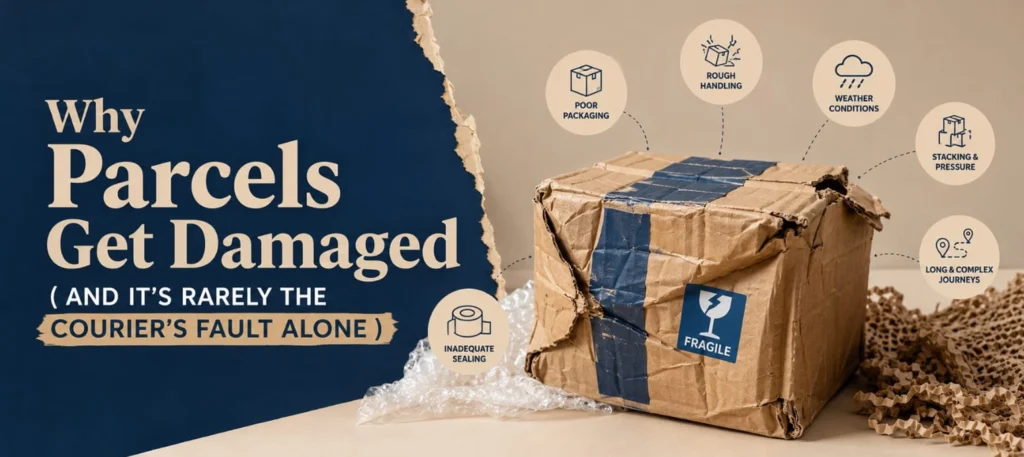
Here’s the uncomfortable truth. Most damage is built in before the parcel ever leaves your kitchen table. Yes, the courier network is rough. But your packaging is the one thing you control, and it’s usually the deciding factor.
When we review damaged-return photos, the same causes come up again and again:
- Empty space inside the box. The item slides, tips and slams into the wall. This is the single most common cause we see.
- A box that’s too big. Oversized boxes get crushed under weight in delivery cages, and they cost you more in volumetric (DIM) weight too.
- Under-specified board. A single-wall box carrying a heavy item just isn’t strong enough to hold its shape when stacked.
- Poor cushioning around fragile items. The item is wrapped, but not enough, so shocks pass straight through.
- Weak sealing. The box bursts at the seam and contents spill or get crushed.
The rough proportions we see across returns look like this:
What actually breaks parcels (ACP damaged-return reviews, indicative)
Indicative breakdown of parcel damage causes from ACP damaged-return reviews:
Internal movement or empty space 40 percent, wrong box size too big 20 percent, under-specified board 18 percent, insufficient cushioning on fragile items 15 percent, sealing failure 7 percent.
What actually breaks parcels ACP damaged-return reviews (indicative %) Internal movement / empty space 40% Wrong box size (too big) 20% Under-specified board 18% Insufficient cushioning 15% Sealing failure 7%
Source:
All Custom Packaging damaged-return reviews (2026, indicative) These figures are our own observations from reviewing customer damage reports, not a formal published study. Treat them as a guide to where to focus, not exact science.
The pattern is clear. Fix movement and sizing first, and you’ve solved most of your problem before you spend a penny more on materials.
Step 1: Right-size the box (the mistake that costs you twice)
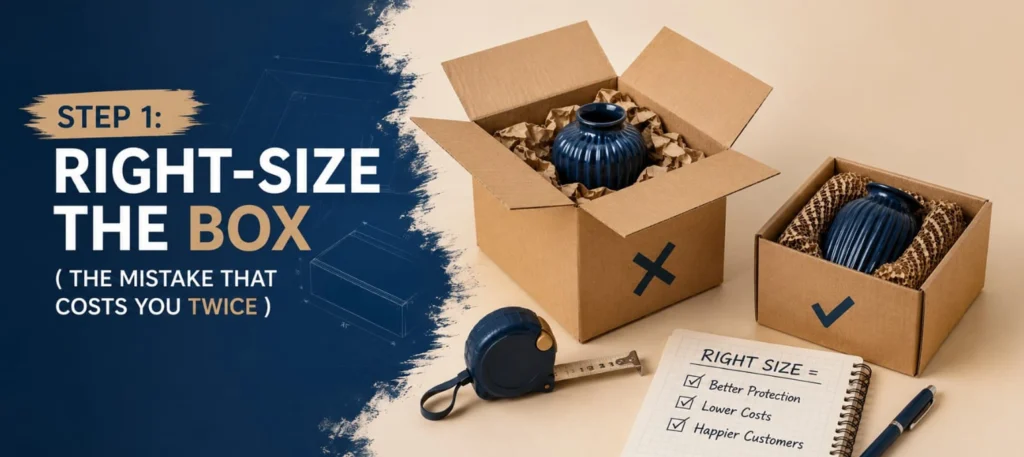
Get the box size right and half your damage risk disappears. Too small, and there’s no room for cushioning, so impacts go straight into the product. Too big, and the item rattles around, plus the box collapses more easily under stacking pressure.
The rule I give every seller: measure your product at its widest points in all three dimensions, then add roughly 10 to 15mm on each side for a snug-but-cushioned fit for sturdy items, or the full ~50mm per side that Royal Mail recommends for genuinely fragile ones.
Oversized boxes also cost you money twice. Carriers charge on volumetric (dimensional) weight when the box is large but light, so you pay for air. And a half-empty box needs far more void fill to stop movement, so you buy more filler on top. Right-sizing is the rare fix that improves protection and cuts cost at the same time.
This is exactly where custom mailer boxes earn their keep. A mailer cut to your product’s dimensions removes the empty space entirely, so there’s almost nothing to shift and far less filler to buy. An off-the-shelf box that’s two sizes too big is doing the opposite of protecting your order.
Definition: DIM (volumetric) weight – carriers work out a parcel’s “size weight” from its dimensions (length × width × height ÷ a divisor). If that number is higher than the actual weight, you’re charged on the size. Big empty boxes get penalised.
Step 2: Choose the right board – single-wall vs double-wall
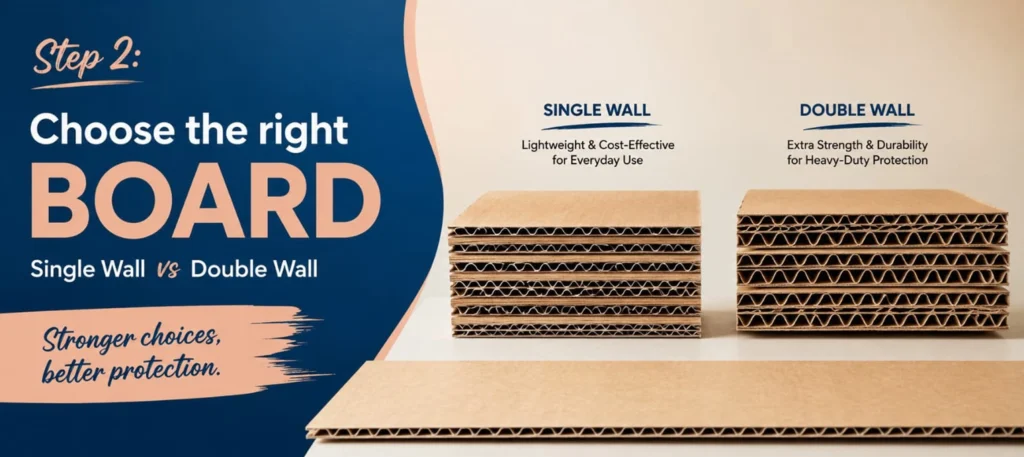
Corrugated board is the fluted cardboard nearly all shipping boxes are made from. The choice that matters most is how many layers of flute it has.
- Single-wall has one fluted layer, roughly 3mm thick. It’s right for most everyday e-commerce: clothing, cosmetics, books, boxed goods and anything light and reasonably sturdy.
- Double-wall has two fluted layers, roughly 6mm thick. Use it for anything heavy, fragile, high-value, or travelling long distances where it’ll be stacked and re-handled more.
You’ll sometimes see board rated by ECT (Edge Crush Test). Higher ECT means more stacking strength.
Definition: ECT (Edge Crush Test) – a lab test measuring how much edge pressure a board withstands before crushing, reported in pounds per inch. A 32 ECT single-wall board resists 32 lb/in; a 44 ECT double-wall board resists 44 lb/in. In plain terms: the higher the number, the more weight can sit on top of your box without it caving.
Typical ratings: single-wall runs about 32 ECT, double-wall about 44–48 ECT, and triple-wall higher still. For most small-parcel sellers, a good single-wall for light goods and a 44 ECT double-wall for heavy or breakable goods covers almost everything.
Don’t over-spec, though. Wrapping a soft cotton tee in triple-wall board just adds weight, cost and shipping charges for no protective gain. Match the board to the job.
Step 3: Wrap and cushion so nothing touches the walls
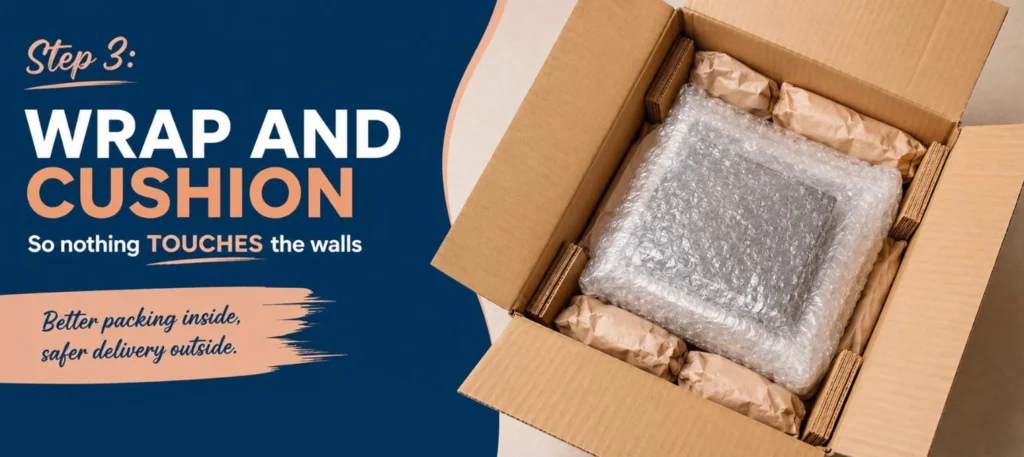
The golden rule for fragile items comes straight from the carriers: the product should never touch another item or the box wall. Royal Mail’s official guidance is to surround each fragile item with at least 5cm of cushioning material on all sides. Parcelforce’s packaging guidelines (effective 11 August 2025) say the same in principle internal packaging must stop items touching each other or the outer box, and eliminate all internal movement.
Void fill options, and when to use each:
| Void fill | Best for | Pros | Watch-outs |
|---|---|---|---|
| Kraft paper / paper cushioning | General e-commerce, blocking and bracing | Kerbside recyclable, keeps EPR fees lower, tidy unboxing | Needs enough volume to cushion heavy items |
| Bubble wrap | Wrapping fragile surfaces directly | Excellent impact absorption on contact | Plastic; check your recycling route |
| Air pillows / air cushions | Filling large voids around sturdy items | Light, cheap to store (inflated on demand) | Royal Mail warns they can pop; not ideal as the only fragile protection |
| Foam inserts / moulded pulp | High-value or awkward-shaped fragiles | Holds the item in a fixed position | Higher cost; moulded pulp needs a mould run |
| Corner/edge protectors | Framed art, ceramics, electronics | Protects the weakest points directly | Add to, don’t replace, void fill |
A note from experience: Royal Mail specifically advises against balled-up newspaper (too flimsy to absorb shocks) and warns that airbags are prone to popping. If you’re shipping something genuinely breakable, paper cushioning or bubble wrap around the item plus a void fill to lock it in place beats loose newspaper every time.
Step 4: The 6-step method to pack a fragile item
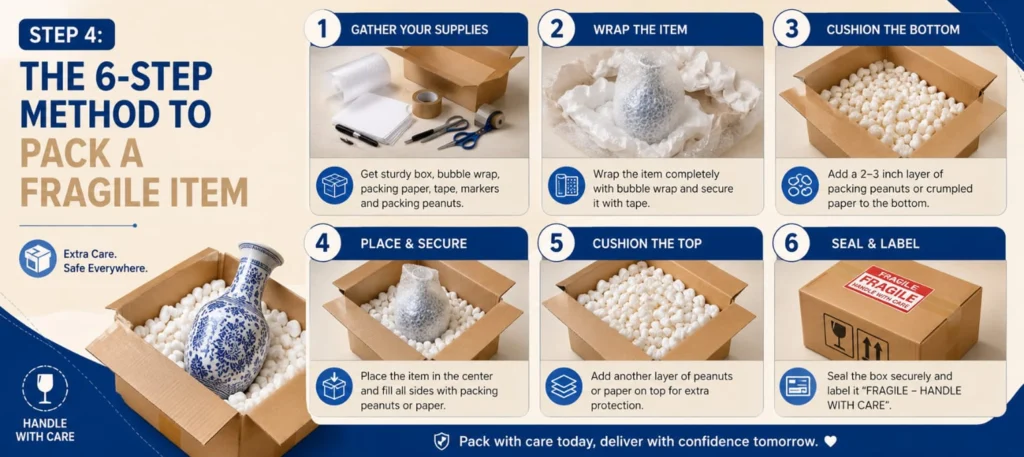
This is the exact sequence I’d use for a mug, a candle, a jar or a small ceramic. It’s built to survive a drop from cage height, which is roughly what your parcel faces.
- Line the base. Put a 5cm layer of cushioning (paper or bubble wrap) in the bottom of the box before anything goes in. Impacts most often come from below.
- Wrap the item. Cover the whole item in bubble wrap or paper, getting under and over every part, and tape it closed. For very fragile pieces, add a second layer.
- Wrap components separately. If there’s more than one item, wrap each one individually so they can’t knock together.
- Centre and surround. Place the wrapped item in the middle of the box so there’s at least 5cm of clearance on every side, including the top.
- Fill every void. Pack cushioning into all remaining space so the item can’t move at all. Aim for firm, not bulging.
- Do the shake test. Seal the top loosely, give the box a proper shake. If you hear or feel anything move, open it and add more fill. Silence means you’re done.
That shake test is the cheapest quality check in shipping, and it’s the one step most sellers skip.
Step 5: Seal it properly (the H-tape method)
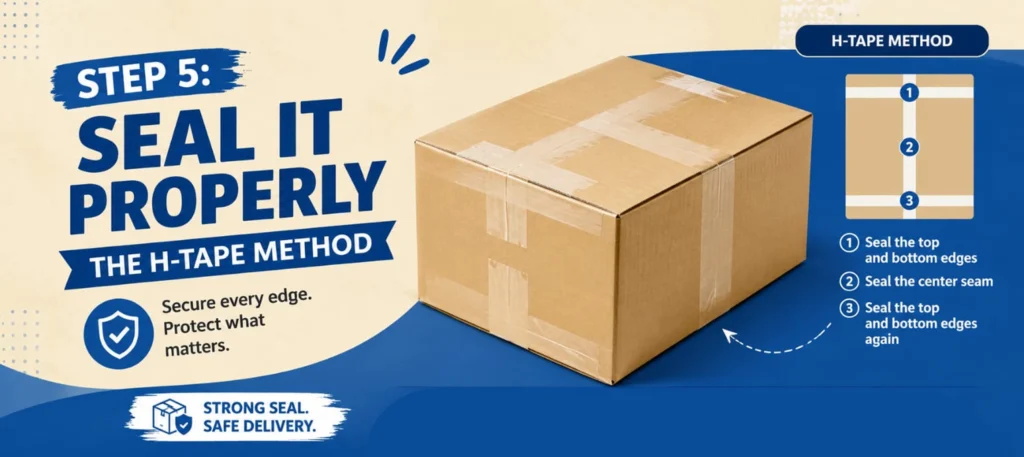
A weak seam is where a well-packed box lets you down. Use strong parcel tape (polypropylene or water-activated paper tape) and seal in an H pattern: run tape along the centre seam, then across both edge seams at each end, top and bottom. That’s the “H” on each face.
One caveat worth knowing: gummed paper tape (the kind you wet) bonds into the board fibres and is very hard to peel off cleanly, which also makes tampering obvious. It’s recyclable with the box, too. For heavier parcels it’s a genuinely better seal than clear plastic tape.
Don’t over-pack to the point the box bulges, though. Parcelforce specifically warns that an overstuffed box can burst open in transit. Firm and square beats crammed and straining.
Step 6: Understand carrier handling reality
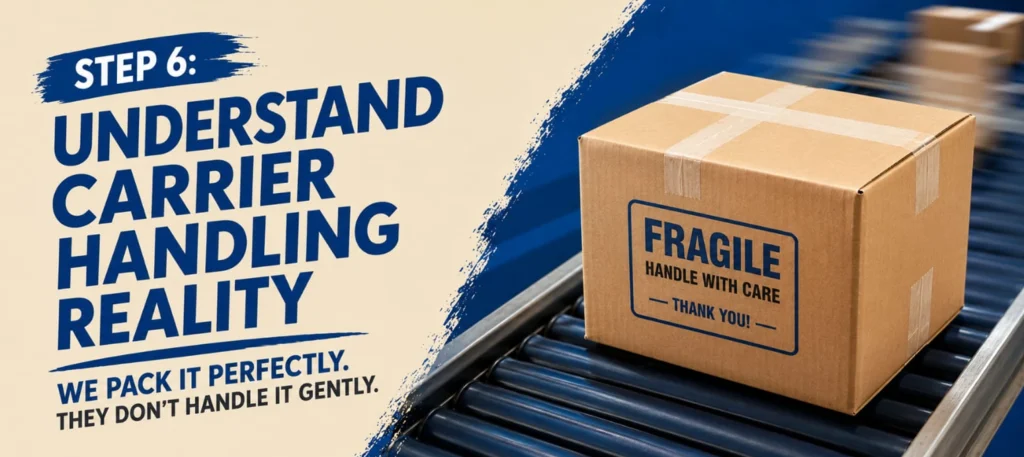
Here’s something sellers don’t want to hear: a “Fragile” sticker is not a protection strategy. UK sorting hubs move millions of parcels, largely automated, and staff can’t give individual boxes special treatment. Fragile labels help a little at the manual handling stage, but they will not save an under-packed parcel. Your packing has to assume rough handling as the default.
Each major UK carrier has its own rules and, crucially, its own claim window:
- Royal Mail / Parcelforce publish detailed packaging guidance and expect fragile items individually wrapped and boxed with clearance from the walls. Royal Mail claims for damage must generally be made within a set period of posting, so keep proof.
- Evri requires damage claims within 28 days of the expected delivery date, and asks you to keep all packaging as evidence.
Two practical habits protect you if something does go wrong. First, photograph the packed parcel before it leaves you. Second, tell buyers to photograph any damage before unpacking fully and to keep the packaging. Under the Consumer Rights Act 2015, the seller (not the courier) is the buyer’s point of contact for goods that arrive damaged, so good packing plus good evidence is your best defence.
Protective packaging by product type
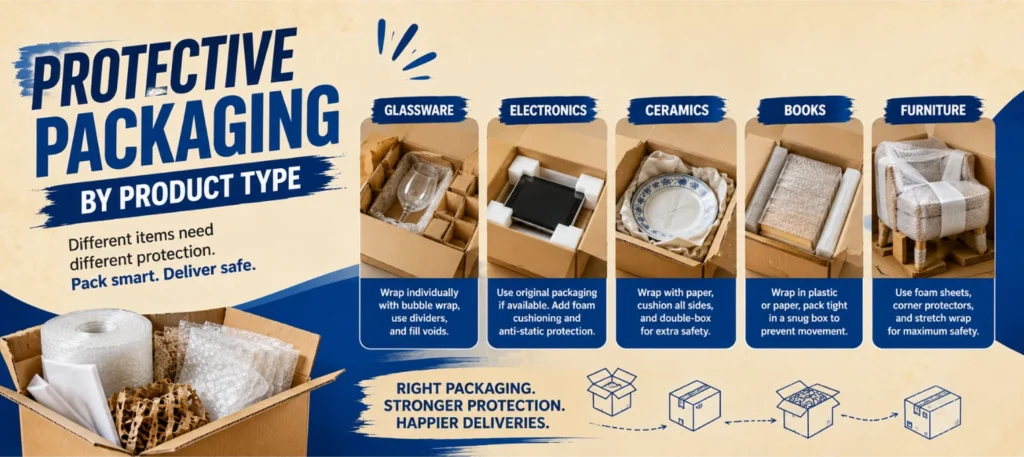
Different products fail in different ways. Here’s how I’d pack the most common small-business categories.
| Product type | Box / format | Board grade | Cushioning approach |
|---|---|---|---|
| Candles (glass/ceramic) | Right-sized mailer or box | Double-wall for glass | Wrap individually, 5cm surround, lock with paper fill |
| Mugs & ceramics | Small double-wall box | Double-wall | Bubble wrap + corner protection, centre with 5cm clearance |
| Cosmetics (bottles/jars) | Custom mailer box | Single-wall (light), double for glass | Snug insert or paper fill, no bottle touching walls |
| Jewellery | Small rigid or mailer + outer | Single-wall outer | Fix in place; the risk is loss/crushing, not shock |
| Apparel | Mailer box or bag | Single-wall | Minimal fill; just stop the box collapsing |
| Framed art / prints | Flat, right-sized box | Double-wall | Edge/corner protectors + rigid backing, no movement |
| Food (jars, bakes) | Insulated or rigid box | Double-wall for glass jars | Individual wrap, void fill, check food-contact rules |
| Electronics | Double-boxed | Double-wall outer | Foam/moulded insert, then double-box for high value |
For genuinely delicate or high-value items, double-boxing (a well-packed inner box suspended in cushioning inside a larger outer box) is the strongest option. The outer box absorbs the impact; the inner box stays isolated.
Key takeaways
- Movement is the enemy. Most damage comes from empty space, not cheap materials. Fill every void.
- Right-size first. A box cut close to the product protects better and costs less in DIM weight. Custom mailer boxes remove empty space by design.
- Match the board. Single-wall for light, sturdy goods; double-wall (44+ ECT) for heavy or fragile. Don’t over-spec.
- 5cm rule for fragiles. Wrap each item and leave at least 5cm of cushioning on every side, per Royal Mail guidance.
- Seal with an H, then shake. H-tape both ends; if the box makes a sound when shaken, add more fill.
- Packing beats stickers. Assume rough handling, photograph parcels, and know your carrier’s claim window (Evri 28 days).
Frequently asked questions

How do I stop my parcels being crushed in the post?
Use the right board grade and don’t oversize the box. A single-wall box under a heavy load, or any box with empty space, collapses under stacking pressure in delivery cages. Choose double-wall (around 44 ECT) for heavy items and right-size so there’s no air to crush.
What is the best void fill for fragile items?
For direct contact with the item, bubble wrap or paper cushioning absorbs shocks best. For filling the surrounding space, paper fill or air pillows lock the item in place. Royal Mail advises against balled-up newspaper and warns airbags can pop, so don’t rely on them alone for fragiles.
Single-wall or double-wall box – which do I need?
Single-wall (about 3mm, 32 ECT) suits most light, sturdy e-commerce goods like apparel, books and cosmetics. Double-wall (about 6mm, 44–48 ECT) is for heavy, fragile, high-value or long-distance parcels. Over-specifying just adds weight and cost.
How much cushioning should go around a fragile item?
Royal Mail recommends at least 5cm of cushioning on every side, so the item never touches another item or the box wall. Centre the wrapped item in the box and fill all remaining space firmly.
Do “Fragile” stickers actually work?
Only a little. UK sorting hubs are largely automated and can’t give individual parcels special handling. Fragile labels help slightly at manual stages but won’t save an under-packed box. Pack as if the parcel will be dropped.
Who is responsible if a parcel arrives damaged – me or the courier?
For the buyer, you are. Under the Consumer Rights Act 2015 the seller is the customer’s point of contact for damaged goods, even though the courier caused it. You then claim against the carrier, so keep proof of packing and know your claim window.