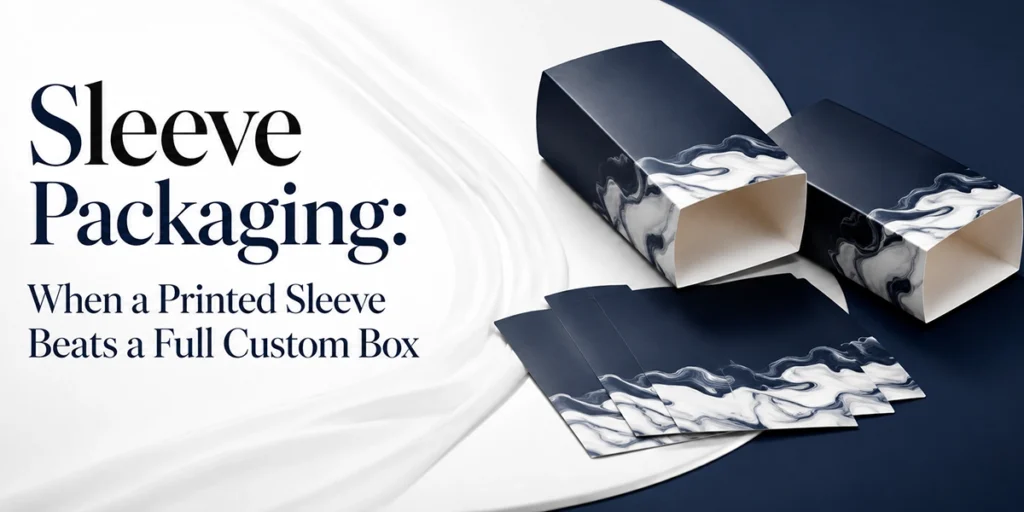
Sleeve Packaging: When a Printed Sleeve Beats a Full Custom Box
Quick answer: Sleeve packaging is a printed band of card that slides over a plain box, tray or product. Choose a sleeve when you sell several variants, order in small batches or change designs seasonally, because you only reprint the sleeve, not the whole box. Choose a full custom box when you need all-over branding, structural strength or a printed interior.
Picture a candle maker with three scents. Same jar, same box, three different labels’ worth of branding. Printing three separate full-colour boxes at 100 units each is the expensive way to solve that problem. A plain kraft box with three printed sleeves is usually the cheaper one, and it’s the option we quote most often for exactly this situation.
This guide covers what sleeve packaging actually is, when it beats printing the whole box, how the £ maths works on seasonal variants, and how to size a sleeve so it doesn’t slide off in transit.
What is sleeve packaging?
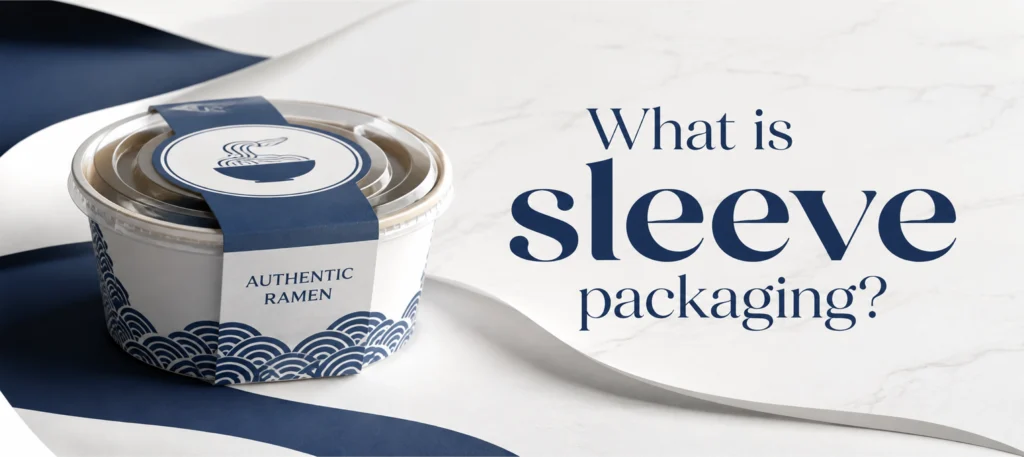
Sleeve packaging is an open-ended printed wrap that goes around an existing box, tray, jar or product bundle. It doesn’t enclose the item. It adds branding, product information and shelf appeal to a plainer base underneath.
You’ll see three related formats, and suppliers use the names loosely:
- Box sleeve: a four-sided card tube that slides over the full girth of a box, usually covering most of its height.
- Belly band: a narrower strip, typically covering a third to half of the pack, wrapped around the middle. Common on soap bars, chocolate and stationery.
- Tray and sleeve: a two-part box where an open tray slides into a printed sleeve, like a matchbox. Here the sleeve is the structure, not an add-on.
The first two sit over packaging you already have. That’s where the cost argument lives.
When a printed sleeve beats a full custom box
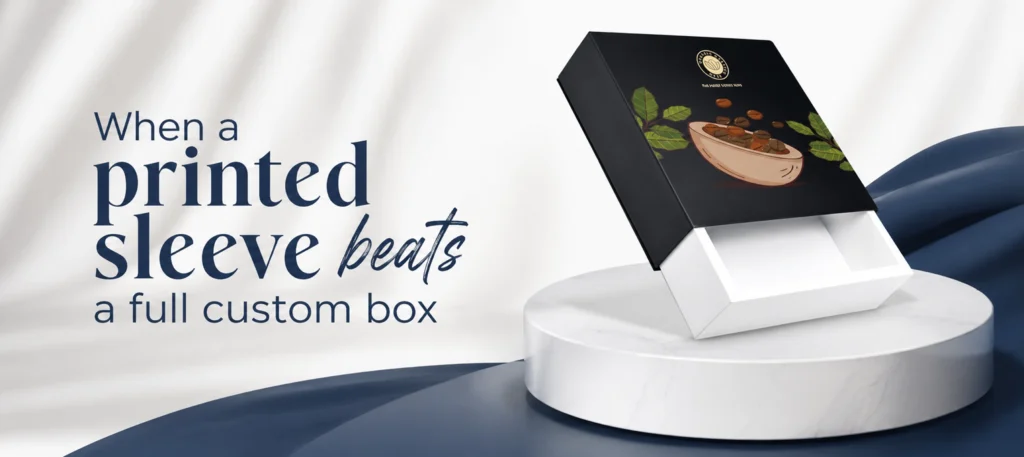
The short version: a sleeve wins whenever the print needs to change more often than the box does.
A sleeve uses far less board than a box, so each unit costs less to print. More usefully, it separates your structural spend from your branding spend. The box becomes a stable, reorderable stock item. The sleeve carries everything that changes: flavours, scents, seasonal artwork, limited editions.
Here’s the decision table we wish more buyers saw before they ordered:
Sleeve vs full custom box: decision table
| Your situation | Better option | Why |
|---|---|---|
| Several flavours or scents, one box size | Sleeve | One plain box run at better volume pricing; one small sleeve run per variant |
| Seasonal or limited editions | Sleeve | Reprint a sleeve for Christmas, not a whole box; leftover plain boxes carry over |
| Small batches (100–300 units) | Sleeve | Sleeves are cheap to print short-run; full-print boxes carry the highest unit cost at low volume |
| Premium look on a budget | Sleeve | A foiled or soft-touch sleeve on a kraft base reads as premium for less |
| Testing a new product or market | Sleeve | Low risk; if artwork changes, you’ve only scrapped sleeves |
| Fragile or heavy product | Full custom box | Protection comes from board grade and structure, which a sleeve doesn’t add |
| Branded unboxing, printed interior | Full custom box | Sleeves only cover the outside; inside print needs the box itself |
| One product, large stable volume | Full custom box | At higher volume the unit-cost gap narrows, and one printed piece is simpler than two |
| Mailing single-parcel e-commerce orders | Full custom box | A sleeve can shift or scuff in transit unless the fit is exact |
One caveat here: a sleeve is a second component. Someone has to slide it on. At a few hundred units that’s an afternoon. At 50,000 units a month, factor in the labour or ask about machine application.
The maths: a seasonal-variant worked example
Numbers first, caveat second. These figures are illustrative round numbers to show the logic. Real prices vary by size, material, print coverage and quantity, so always get a live quote.
UK pricing guides put typical custom-printed boxes between £0.50 and £1.50 per unit depending on spec and volume, and small runs sit at the top of that range. Sleeves use a fraction of the board, so they print for a fraction of the price.
Scenario: a candle brand launches three seasonal scents. It needs 100 packs of each, 300 units total.
Option A – Three full-print box runs
| Item | Illustrative unit cost | Total |
|---|---|---|
| Full-print box, scent 1 (100 units) | £1.10 | £110 |
| Full-print box, scent 2 (100 units) | £1.10 | £110 |
| Full-print box, scent 3 (100 units) | £1.10 | £110 |
| Total | £330 |
Option B – One plain box run plus three sleeves
| Item | Illustrative unit cost | Total |
|---|---|---|
| Plain kraft box, one design (300 units) | £0.55 | £165 |
| Printed sleeve, scent 1 (100 units) | £0.30 | £30 |
| Printed sleeve, scent 2 (100 units) | £0.30 | £30 |
| Printed sleeve, scent 3 (100 units) | £0.30 | £30 |
| Total | £255 |
First-Order Saving
Using a plain box with interchangeable sleeves reduces the initial packaging cost from £330 to £255, creating a saving of approximately £75 (around 23%).
However, the larger financial advantage appears in future seasons.
With Option A, launching new seasonal designs requires another complete full-print box production run, costing approximately £330 each time.
With Option B, the existing plain boxes remain usable because they do not contain seasonal artwork. Only new sleeves need to be produced, reducing the next seasonal update cost to approximately £90.
| Packaging Approach | First Production Run | Next Seasonal Update |
| Full-print boxes | £330 | £330 |
| Plain boxes + sleeves | £255 | £90 |
Key Insight
The plain box and sleeve approach delivers both lower upfront costs and greater long-term flexibility. Ordering 300 units of one standard box format is typically more cost-efficient than producing three separate runs of 100 units, as larger single-format orders benefit from improved production pricing.
This approach allows brands to refresh seasonal designs without replacing the entire packaging structure, reducing waste, lowering reprint costs, and making future product launches easier to manage.
Note: All figures are illustrative estimates only. Final pricing will depend on supplier, material choice, box dimensions, print method, finishing requirements, and order volume.
Materials and print options
Most sleeves are printed on card between 250 and 400gsm. GSM means grams per square metre, which is simply how heavy, and roughly how stiff, the card is. Belly bands can go lighter because they don’t need to hold a shape on their own.
Common choices:
- Kraft card: brown, fibrous, unmistakably natural. Prints well with darker inks and suits the plain-box-plus-sleeve look.
- White coated card: the default for full-colour work. Colours sit brighter than on kraft.
- Finishes: matt or gloss lamination, spot UV, foil stamping and embossing all work on sleeves. Because a sleeve is a small piece of board, premium finishes cost far less than they would across an entire box.
Print method follows quantity. Digital print suits short runs with no plate costs, which is why 100-unit sleeve orders are affordable at all. Litho takes over at higher volumes where its setup cost spreads thin.
How to size a sleeve: snug vs slide
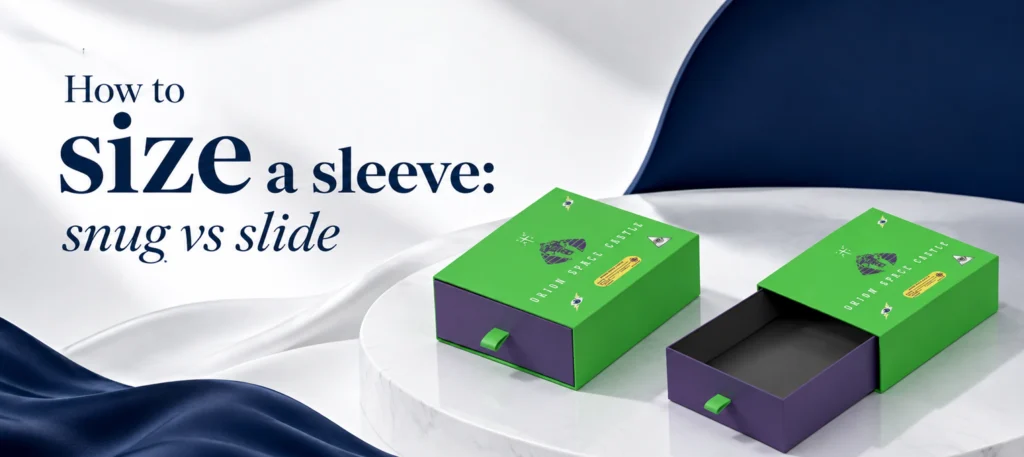
The most common mistake we see is a sleeve ordered to the box’s exact outer dimensions. Card has thickness, and a zero-allowance sleeve either won’t go on or tears at the corners.
The practical method:
- Measure your box’s width and depth across the faces the sleeve will wrap.
- Add an allowance for board thickness and movement. Around 1.5–2mm on width and 1.5–2mm on depth is the widely used starting point.
- Test with a paper strip first. Wrap it around the box, mark the overlap, and check it slides off with light resistance.
You’re aiming for a snug slide: firm enough that the sleeve stays put when the parcel is tipped, loose enough that a customer can remove it without tearing. Too loose and it spins or slips off in transit. Too tight and it scuffs the box every time it moves.
For band height, a belly band covering a third to half of the box height is the usual sweet spot. Full box sleeves normally stop 2–3mm short of the box height so the edges don’t catch.
Any decent supplier will build the dieline for you. A dieline is the flat cutting template for the printed piece, and at All Custom Packaging it’s part of the free design work rather than a paid extra, so you shouldn’t be guessing allowances alone.
The honest sustainability angle
Sleeves have a genuine environmental case, but let’s keep it precise, because “eco” gets thrown around loosely in packaging.
What’s true: a sleeve prints on much less board than a full box, so switching seasonal artwork to sleeves means less printed material made and thrown away when designs change. Unlaminated card sleeves over unlaminated boxes are widely recyclable in UK kerbside collections. And because plain boxes don’t date, you bin fewer obsolete ones.
What’s not automatic: a sleeve doesn’t make packaging sustainable by itself. If you add plastic lamination or heavy foil coverage, you make the sleeve harder to recycle. And under the UK’s extended producer responsibility rules, larger producers pay fees based on the weight and material of packaging they place on the market, so a sleeve is a small addition, not a free one. Check GOV.UK for the current rules and thresholds, as they’re updated regularly.
If recyclability matters to your customers, say exactly what the sleeve is made of and how to dispose of it. We’ve covered material choices in more depth in our guide to different types of biodegradable packaging.
When a full custom box is still the right call
Sleeves aren’t a universal answer, and pretending otherwise would be daft.
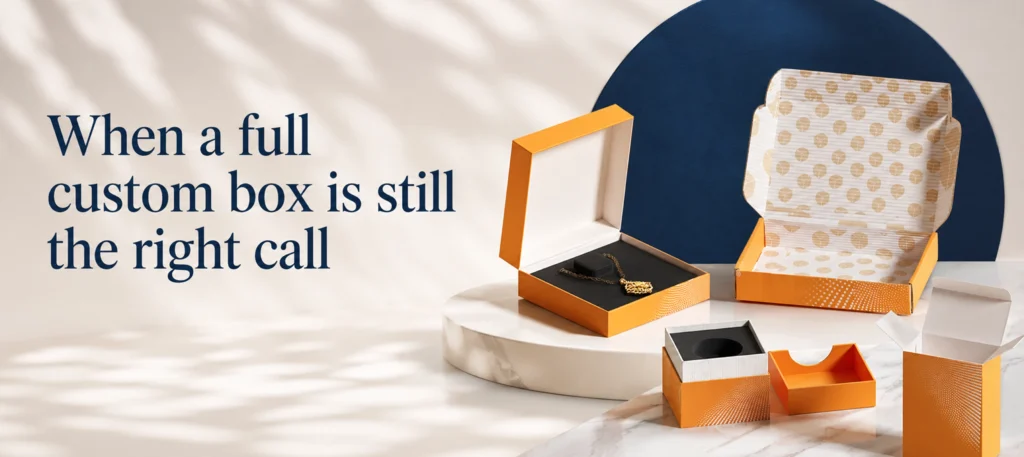
Print the whole box when the box itself does the selling: all-over artwork, a printed interior for unboxing, or a rigid gift box where the structure is the luxury. Print the whole box when protection matters more than flexibility, because strength comes from board grade and construction, not from a wrap. And at large, stable volumes for a single design, the cost gap narrows enough that managing one component instead of two is worth more than the saving.
Where sleeves work hardest
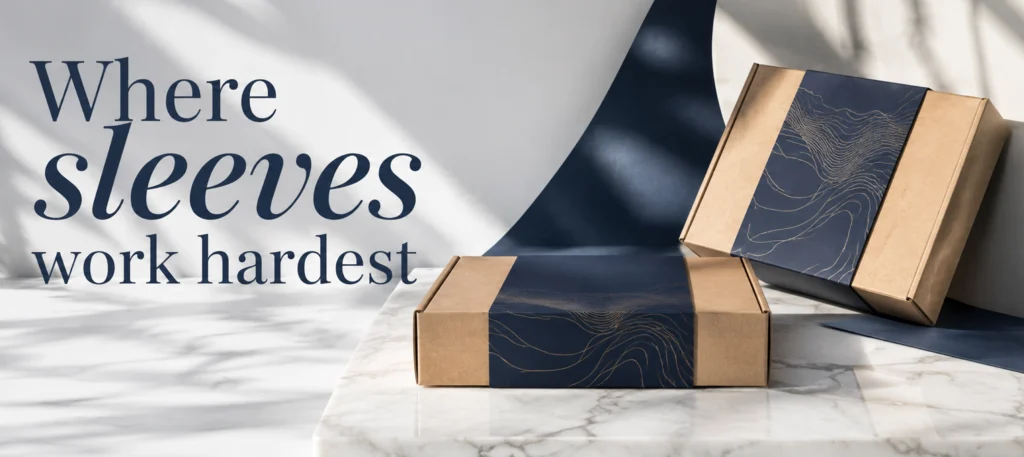
- Food trays: a printed sleeve around a plain food-safe tray is the standard format for bakes, sushi and grab-and-go ranges. Flavour variants become sleeve variants. See our custom food boxes range for tray and sleeve options.
- Candles: seasonal scent launches without seasonal box waste, as in the worked example above. A kraft base from our candle boxes range plus rotating sleeves is a repeat favourite.
- Soap and cosmetics: belly bands leave the product partly visible, which handmade soap buyers actively want. Pair with plain cartons from our soap boxes range.
- Gift sets and bundles: a band physically holds a multi-product set together while branding it, cheaper than a bespoke bundle box. Works well over standard gift boxes.
- Limited editions and collabs: short-run sleeves let you brand a drop of 100 units without touching your core packaging.
FAQ
What is sleeve packaging? Sleeve packaging is a printed, open-ended band of card that wraps around a plain box, tray or product. It adds branding and product information without enclosing the item, and it’s cheaper to print than a full custom box.
What’s the difference between a box sleeve and a belly band? Coverage. A box sleeve covers most of the box’s height and slides over it like a tube. A belly band is a narrower strip, usually a third to half of the pack, wrapped around the middle. Structurally they’re the same idea.
How do you measure a box sleeve? Measure the width and depth of the box faces the sleeve wraps, then add roughly 1.5–2mm to each for board thickness and slide. Test the fit with a paper strip before committing to print. Your supplier should confirm the dieline.
Are printed sleeves cheaper than printed boxes? Per unit, almost always, because a sleeve uses a fraction of the board. The full saving shows up when you run several variants or seasonal designs, since you reprint sleeves while reusing one plain box run.
Is sleeve packaging recyclable? Plain card and kraft sleeves without plastic lamination are widely recyclable in UK kerbside collections. Heavy foil or laminated finishes reduce recyclability, so specify finishes deliberately and tell customers how to dispose of the sleeve.
What’s the minimum order for custom sleeves? It varies widely. Some suppliers ask for 500 units per design; at All Custom Packaging sleeve orders start from 100 units per design, with free design and dieline support included.
Key takeaways
- A sleeve separates branding spend from structural spend: reprint the cheap part, reuse the stable part.
- Sleeves win on variants, seasonal editions, small batches and premium-look-on-kraft budgets.
- Full custom boxes win on protection, printed interiors and single-design volume.
- Size for a snug slide: add 1.5–2mm allowances and test with a paper strip.
- Sustainability claims should name the material and disposal route, not just say “eco”.
If you’re weighing a sleeve against a full-print box for your own product, send us the box dimensions and quantities through our contact page and we’ll price both routes side by side, with free design and a dieline included, from 100 units.