
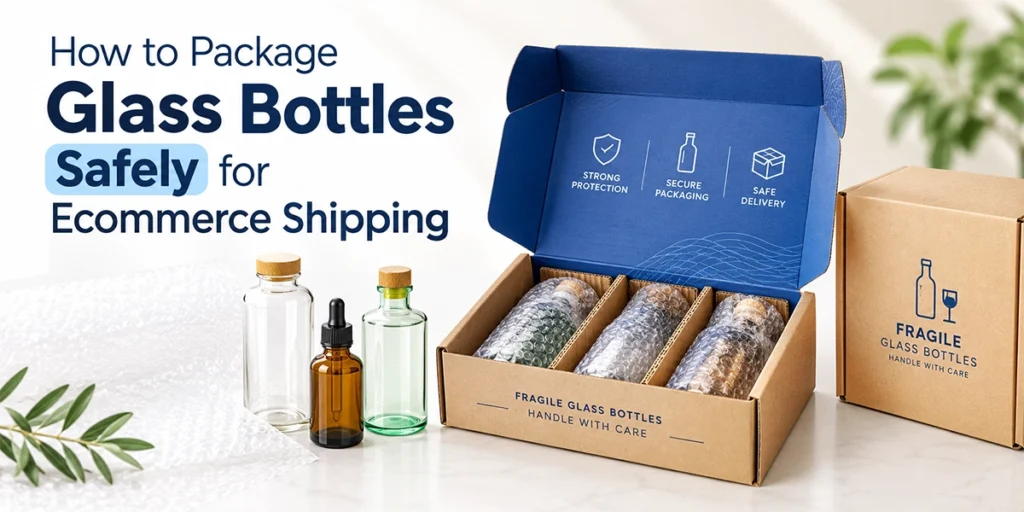
How to Package Glass Bottles Safely for Ecommerce Shipping
Quick answer: to package glass bottles for shipping safely, seal the closure and put each bottle in a leak-proof bag. Then sleeve or wrap it so the neck and base cannot take a direct knock, keep bottles apart with dividers, and pack them tightly in a strong outer box with no empty space. Royal Mail’s rules for liquids also require a leak-proof liner and a leak-proof outer, and “FRAGILE” marked on glass.
Most guides treat a glass bottle like any other fragile item. It is not. It can break and it can leak, and a leak can ruin every other item in the parcel, so the packing has to deal with both.
Where glass bottles actually fail
Knowing the weak points tells you where the protection has to go.
- The neck and shoulder. The narrowest, most exposed part. A knock on the neck, or the bottle levering against a box wall, is a common way for a bottle to break.
- The base. A bottle dropped upright lands on its base. A thin base or a hard landing can crack it.
- The closure. Caps, corks, pumps and droppers can loosen with vibration and let liquid out even when the glass survives.
- Bottle against bottle. Two bottles touching in the same box can knock against each other.
- Empty space. Room to move lets a bottle build up speed before it hits something.
A good pack answers every one of these.
Step 1: seal the closure
Start at the top. Tighten the cap, then add a second barrier: a strip of tape over the cap and neck, a shrink band, or a sealed inner lid if the bottle has one. Corks and droppers need the most care. Tape a cork down, and for a dropper bottle consider shipping the dropper in its own sealed bag rather than fitted.
Step 2: contain any leak
Plan for the occasional bottle to leak or break, and pack so that one failure does not ruin the parcel.
Royal Mail’s restricted goods guidance is specific about liquids. Items must be securely closed and placed in a leak-proof liner, such as a sealed polythene bag, inside a leak-proof outer, with “FRAGILE” marked when the bottles are glass. For alcoholic drinks, the same guidance adds absorbent material around the bottle as well as cushioning.
This is where plastic-free packing needs care. Paper sleeves and card dividers protect glass well, but on their own they do not contain a leak. If you ship liquids and want to cut plastic, keep the leak-proof liner and remove plastic elsewhere in the pack, for example by replacing bubble wrap with a paper or corrugated sleeve.
Step 3: protect the neck and base
Wrap or sleeve each bottle so no part of the glass can touch the outer box.
- Sleeves. A corrugated or expanding paper sleeve slides over the bottle and protects the body and shoulder. Cardboard bottle sleeves are a simple option for single bottles.
- Wraps. Several layers of wrap, with extra at the neck and base, work for one-off shipments.
- Inserts. For a product sold in a presentation box, a die-cut insert holds the bottle by its body and shoulders, with a little clearance around the cap. Inserts can be cut to the customer’s product dimensions.
Whatever you choose, the base and the neck need the most protection, because those are where the knocks land.
Step 4: keep bottles apart
For more than one bottle, give each its own cell. A divider or partition stops bottles touching and spreads a knock across the box rather than into the next bottle. Bottle boxes with dividers do this in one piece. For a mixed order, wrap each bottle and fill the gaps so they cannot drift together.
Bottles are usually packed upright, with the neck protected above. Do not rely on “This way up” arrows alone, because parcels are not always handled the right way up. Pack so the bottle survives on its side too.
Step 5: choose a strong outer box and fill it
The outer box does the heavy work.
- Size. Choose a box that fits the wrapped bottles closely, with just enough room for cushioning. Too big and they move; too small and the glass sits against the wall.
- Board. Heavy glass needs a strong corrugated box. Single-wall may suit a lighter, well-cushioned single-bottle pack; heavier or multi-bottle shipments often need a stronger construction such as double-wall, depending on the bottle weight and the journey. Double wall shipping boxes are the usual choice for the heavier end.
- Void fill. Fill every gap. A box that rattles when shaken will break bottles.
- Box-in-box. For high-value bottles, a retail box packed inside a second, larger shipping box with cushioning between them gives two layers of protection.
Our guide to mailer boxes vs shipping boxes vs product boxes explains when you need more than one layer.
Step 6: seal and label
Tape every seam of the outer box, not just the middle. Mark glass “FRAGILE HANDLE WITH CARE” in capital letters above the address, which is the wording Royal Mail’s compensation policy looks for, and put your return address on the outside. A fragile label asks for care; it does not guarantee it, so the packing still has to do the work.
For the general method of packing anything fragile, including taping, see our guide on how to stop parcels arriving damaged.
Choose the carrier first, then design the pack
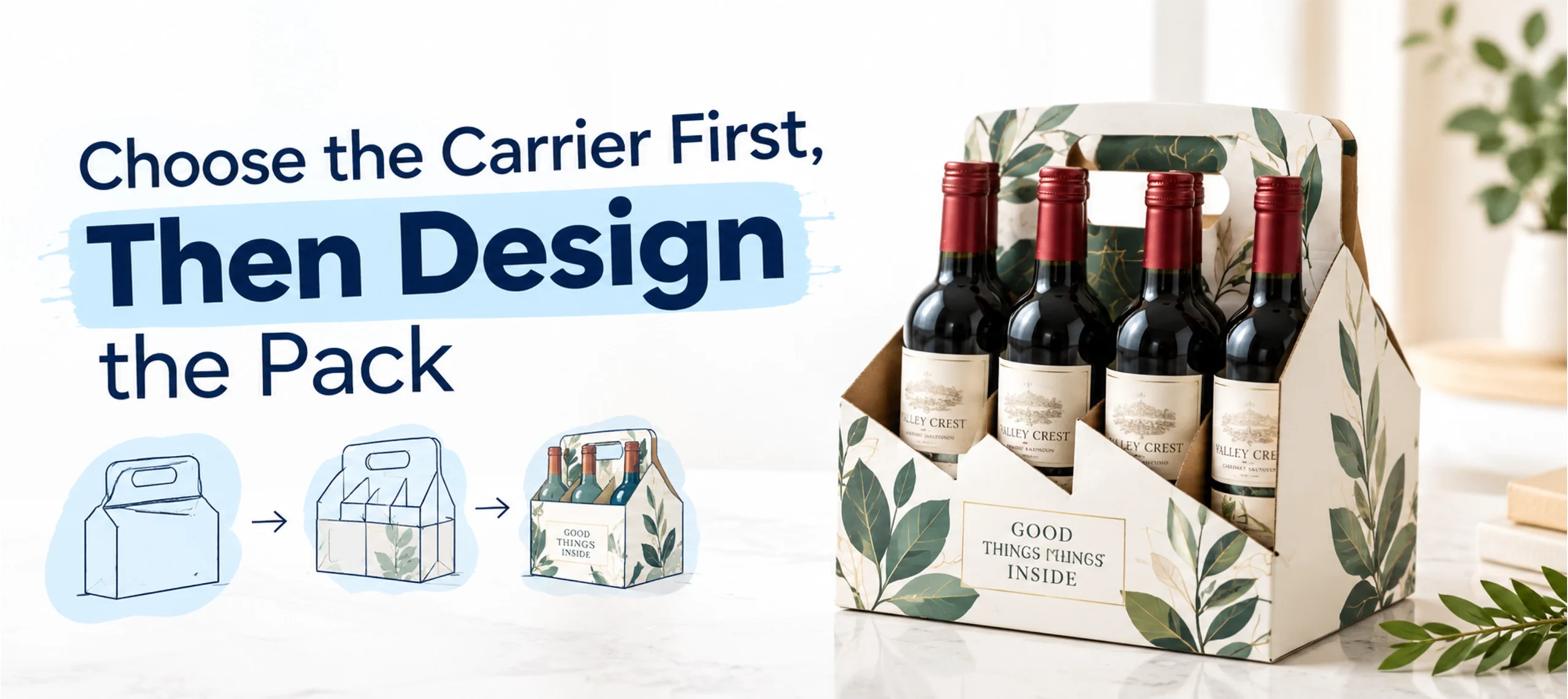
Every carrier sets its own rules for liquids and alcohol, and the same carrier can set different conditions for different services. Royal Mail and Parcelforce, for example, apply extra conditions to larger volumes of liquid. So pick the carrier and service you will actually use, read its current liquid and alcohol rules, and design the pack to meet them, rather than designing the pack and hoping it passes.
Packaging and compensation: why it matters if a bottle breaks
Packing is not only about preventing breakage. It can decide whether the carrier pays out when something does break.
Royal Mail’s compensation policy for damage says it will not compensate where a breakable item has not been packed in a strong container with enough packaging material to protect it against pressure and knocks. The item must also be marked “FRAGILE HANDLE WITH CARE” in capitals above the address. It also says claimants must keep all the packaging and contents of a damaged item, because Royal Mail may need to inspect them. Other carriers set their own terms, so check the cover for the service you use.
When a bottle does arrive broken:
- Ask the customer for photos of the outer box, the inside and the broken bottle before anything is thrown away.
- Keep the packaging and contents if a claim might be made, or ask the customer to.
- Record what failed. Note the product, the bottle, the pack layout and the carrier.
- Use it. Several breakages with the same bottle or the same pack point to a design change, not bad luck.
Royal Mail rules for bottles at a glance
| What you are sending | Key Royal Mail requirements (UK) |
|---|---|
| Non-hazardous liquids | Securely closed; leak-proof liner such as a sealed polythene bag; leak-proof outer; “FRAGILE” on glass |
| Wine, beer and other drinks up to 24% ABV | No more than 1 litre per item; wrapped in polythene sealed with tape; absorbent material and cushioning; “FRAGILE” on glass |
| Spirits over 24% and up to 70% ABV | No more than 1 litre per item and no more than two items per parcel; same packing; presented at a Post Office counter |
| Perfume and aftershave | No more than 150 ml per item and no more than four per parcel; original retail packaging; strong outer; cushioned |
Summarised from Royal Mail’s prohibited and restricted goods guidance as released in 2025. Business-account terms and other carriers’ rules differ. Check the current rules for your service before you ship.
Three tests before you launch
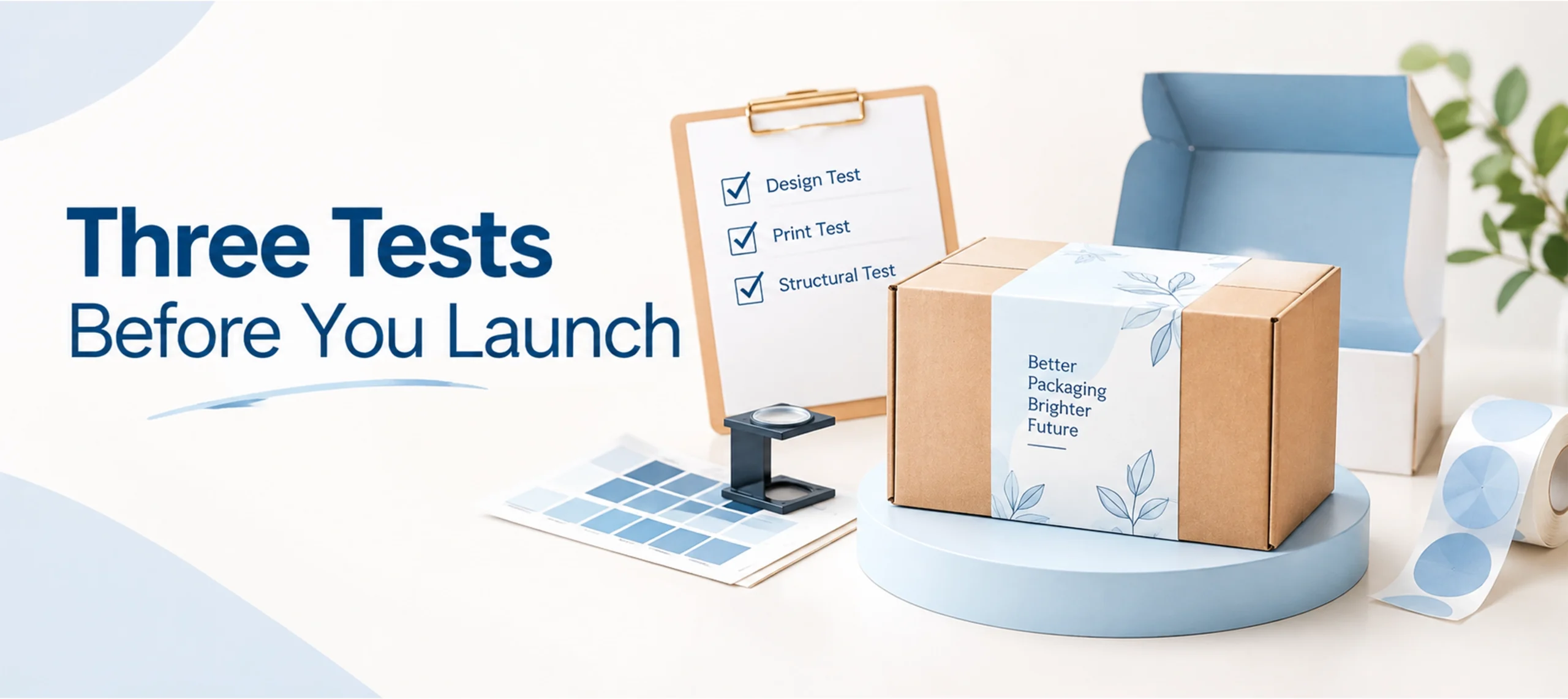
Before the first real order, pack a few samples exactly as they will ship and test them.
- The shake test. Shake the closed box. If anything moves or rattles, add fill until it does not.
- The leak test. Seal a filled bottle, bag it as you will ship it, and leave it on its side overnight. Check the bag in the morning.
- The drop test. Let a packed box fall onto a hard floor several times, landing it on a corner, then an edge, then a flat side, from about the height it would fall from a sorting belt or a doorstep. Open it and check the glass, the closure and the bag.
It costs a few bottles and can save a batch of refunds.
These are screening checks, not a certification. For high-value bottles or a high-volume launch, it can be worth having the pack tested to a recognised transit test protocol by a testing laboratory. ISTA 3A, for example, is a general simulation test for parcel-delivery shipments, and covers conditioning, drops, vibration and impacts. Some packaging manufacturers test their ecommerce bottle ranges to it. A few drops in the warehouse are useful, but they are not the same thing.
How we help with bottle packaging
We make the boxes, sleeves, dividers and inserts around the bottle, to your dimensions. Single-wall and double-wall constructions are both available, and an insert or divider can be cut to hold each bottle in its own place.
- Orders start from 100 units.
- Design support is free.
- A digital 3D mock-up is free, so you see the divider or insert layout on screen first.
Frequently asked questions
How do you package a glass bottle so it does not break?
Seal the closure, sleeve or wrap the bottle with extra protection at the neck and base, and pack it in a strong corrugated box with no empty space. For several bottles, use dividers so they cannot touch.
How do you stop bottles leaking in the post?
Tighten and tape the closure, then put each bottle in a sealed leak-proof bag inside a leak-proof outer. Royal Mail’s liquids rule asks for exactly that, and for alcoholic drinks it adds absorbent material around the bottle.
Can you post glass bottles with Royal Mail?
Yes, within its rules. Liquids need a leak-proof liner and outer, and glass must be marked “FRAGILE”. Alcoholic drinks are limited to 1 litre per item, and spirits over 24% ABV to two items per parcel.
Is plastic-free packaging suitable for glass bottles?
For protection, yes. Paper sleeves, corrugated dividers and paper void fill protect glass well. For liquids, though, Royal Mail asks for a leak-proof liner, such as a sealed polythene bag, so keep that layer and cut plastic elsewhere.
Should glass bottles be shipped upright?
Upright is the usual way to pack them, with the neck protected. Pack so the bottle survives on its side too, because parcels are not always handled the right way up.
Single-wall or double-wall boxes for bottles?
Single-wall may suit a lighter, well-cushioned single bottle. Heavier bottles and multi-bottle orders often need a stronger construction such as double-wall, depending on bottle weight and how the parcel travels.
Shipping bottles and not sure your packaging will hold up? Send us the bottle height, widest diameter, base diameter, neck and closure height, filled weight and closure type. Add how many bottles go in each parcel, and we will suggest a box, sleeve or divider layout to match.