
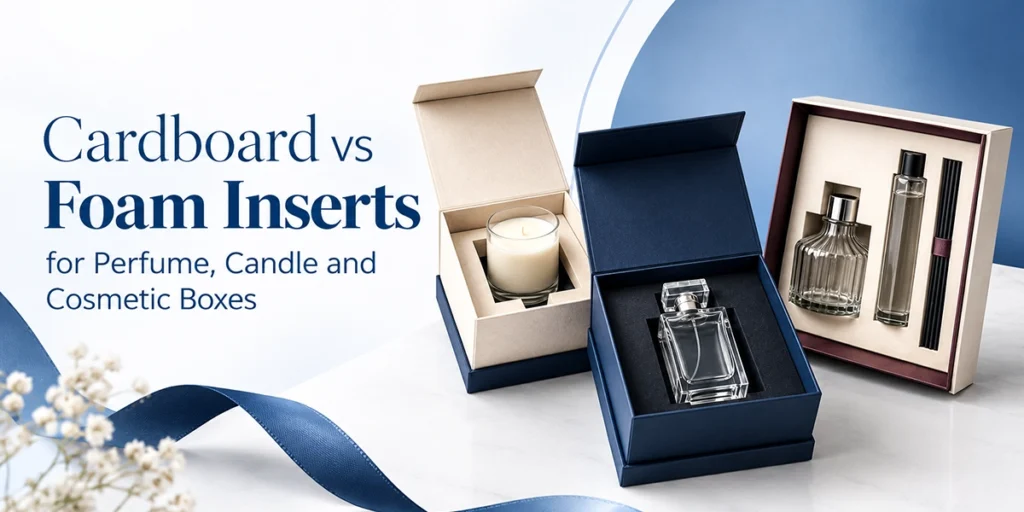
Cardboard vs Foam Inserts for Perfume, Candle and Cosmetic Boxes
Quick answer: cardboard vs foam inserts comes down to one question: does the insert only need to hold the product still, or does it also need to absorb knocks? A cardboard insert is the better fit for holding a product firmly in place, and suits candles, cosmetics and perfume sold from a shelf or shipped inside a separate outer box. A foam insert also absorbs shock, so it suits heavy glass perfume bottles and fragile sets that travel in their own presentation box.
Most comparisons stop at “foam protects better, cardboard is greener”. That is true as far as it goes, but it misses which job the insert is actually doing. This guide starts there, then gives a straight answer for perfume, candles and cosmetics.
What an insert actually does: holding vs cushioning
An insert can do two different jobs, and the two materials are not equally good at both.
- Holding the product in place. A die-cut insert with a cavity or a slot the exact shape of the product stops it sliding, rattling or knocking against the box wall. Cardboard and foam can both do this well when cut to fit.
- Absorbing a shock. When a box is dropped, something has to soak up the impact before it reaches the product. Foam compresses and springs back, which spreads the force. Card offers far less give, so most of the shock passes through.
That is why the channel matters as much as the product. A presentation box that is packed inside a padded outer shipper needs its insert mainly to hold and present. A box that travels on its own through the post needs its insert to cushion as well.
Cardboard vs foam at a glance
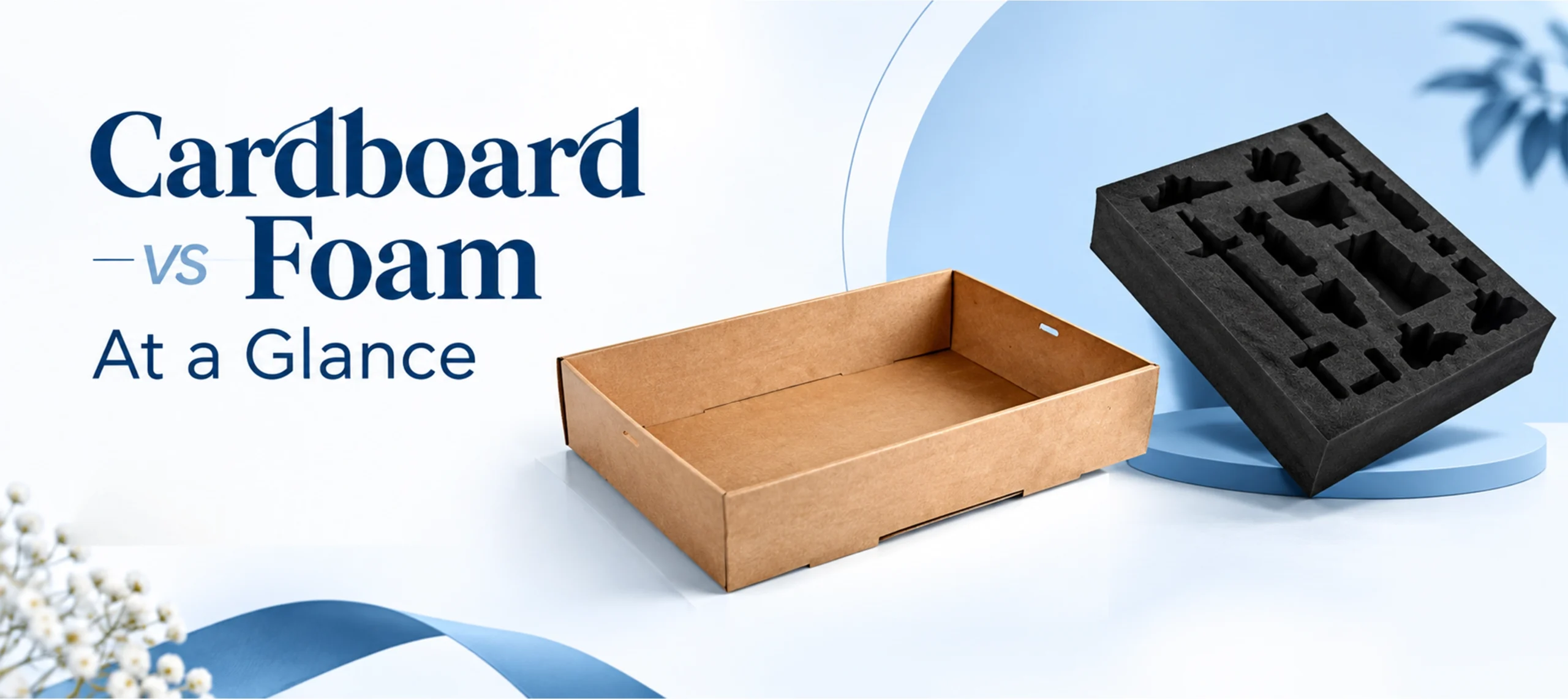
| Cardboard insert | Foam insert | |
|---|---|---|
| Holds product in place | Yes, when cut to fit | Yes, when cut to fit |
| Absorbs impact | Limited | Good |
| Look and feel | Printable, clean, can match the box | Soft, premium, usually black or white |
| Weight and space | Slim and light | Bulkier for the same protection |
| Household disposal | Usually goes with paper and card, depending on finish | Rarely accepted in household collections |
| UK producer fees (large producers) | Paper and card rate | Plastic rate, roughly twice as high |
| Best when | The box sits inside a shipper, or the product is sturdy | The box travels alone, or the product is heavy glass |
Which insert for which product and channel
| Product | Retail shelf | Ships inside outer carton | Ships alone |
|---|---|---|---|
| Perfume, heavy glass bottle | Card | Card or mixed | Foam |
| Glass serum or dropper bottle | Card | Card or mixed | Foam or mixed |
| Candle in a sturdy jar | Card | Card | Card, or mixed for thin glass |
| Candle in thin glass | Card | Mixed | Foam |
| Tubes, compacts, lipsticks | Card | Card | Card |
| Mixed glass and plastic cosmetic set | Card | Mixed | Mixed or foam |
A starting point, not a rule. The next section explains what can move a product from one column to another.
Fragility is more than whether it is glass

Glass is the obvious warning sign, but it is not the only thing that decides the insert:
- Weight. A heavy item carries more energy into a knock, so it needs more holding and often more cushioning.
- Shape. A tall, narrow bottle can tip and lever against the insert; a squat jar sits more steadily.
- Centre of gravity. A top-heavy bottle with a heavy cap is more likely to land on its weakest point.
- Closures. A loose cap, pump or dropper can shift or leak even when the bottle survives.
- Void space. Empty space around the product lets it build up speed before it hits something. The closer the fit, the less the insert has to absorb.
- The outer shipping box. A sturdy, well-filled outer carton takes much of the knock before it reaches the retail box, which can make a card insert enough.
Perfume boxes
Perfume is the case where foam most often earns its place. A glass bottle is heavy for its size, and many have a separate cap that can work loose in transit.
Choose foam when the presentation box is the shipping box, the bottle is heavy or has a separate glass cap, or the bottle and cap need separate cavities. A foam cavity cut to the bottle holds it and cushions it in one piece.
Choose cardboard when the box is sold from a counter or shelf, or always ships inside a padded outer box. A card insert with a cut-out for the neck or a raised platform holds the bottle upright and presents it cleanly.
For perfume and any other heavy glass product that will be posted or couriered, drop test a fully packed sample before approving the bulk run. Pack it exactly as it will ship, drop it on its corners, edges and faces from a realistic height, and check the bottle, cap and seal afterwards. It costs one sample and can save a whole batch.
If you post perfume, check the carrier’s rules as well as the insert. Royal Mail’s restricted goods guidance lists perfumes and aftershaves as restricted goods within the UK. Each item can be no more than 150 ml, with no more than four in a parcel. It must travel in its original retail packaging inside strong outer packaging, cushioned to prevent breakage. A well-designed insert can contribute to the cushioning needed to prevent breakage. Business-account terms can differ, so check the current rules for the service you use.
For the box itself, see our perfume boxes.
Candle boxes
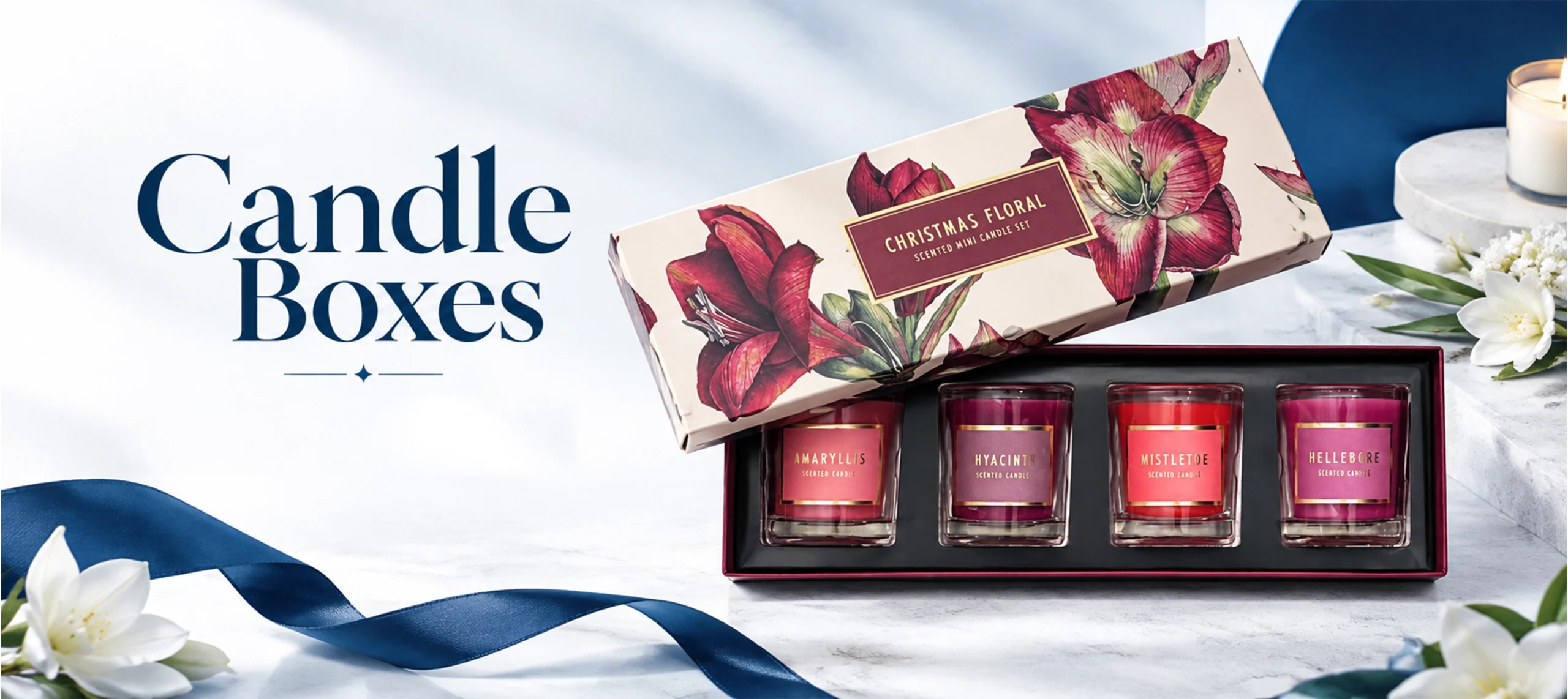
Candles are usually the easier call, and it is usually cardboard.
A container candle in a glass or ceramic vessel is heavy but sturdy. What it mostly needs is to be held still so it does not rattle against the box wall or tip over. A card insert with a circular cut-out does exactly that, and it can be printed to match the box.
Choose foam when the vessel is thin glass, the candle ships on its own in its gift box, or the box holds several candles that could knock together. Choose cardboard for most single candles in a sturdy jar, especially where the box goes into a shipping carton. Our candle boxes can be paired with either, and candle boxes with inserts are a good starting point.
Cosmetic boxes
Cosmetics vary more than the other two, so the answer depends on the items in the box.
- Tubes, compacts, lipsticks and plastic jars are light and not especially fragile. A card insert that holds each item in its own slot is usually enough, and it keeps the set neat.
- Glass serum bottles and droppers behave more like perfume. Foam is worth it if the box travels alone.
- Mixed sets of glass and plastic can use a card insert with a foam section only where the glass sits.
For a set sold in retail, the insert also carries the presentation, and a printed card insert can carry branding or usage steps. Our cosmetic packaging range covers the boxes these inserts go into. If the box needs on-pack product information, our guide to cosmetic labelling requirements in the UK explains what has to appear.
Types of foam and card
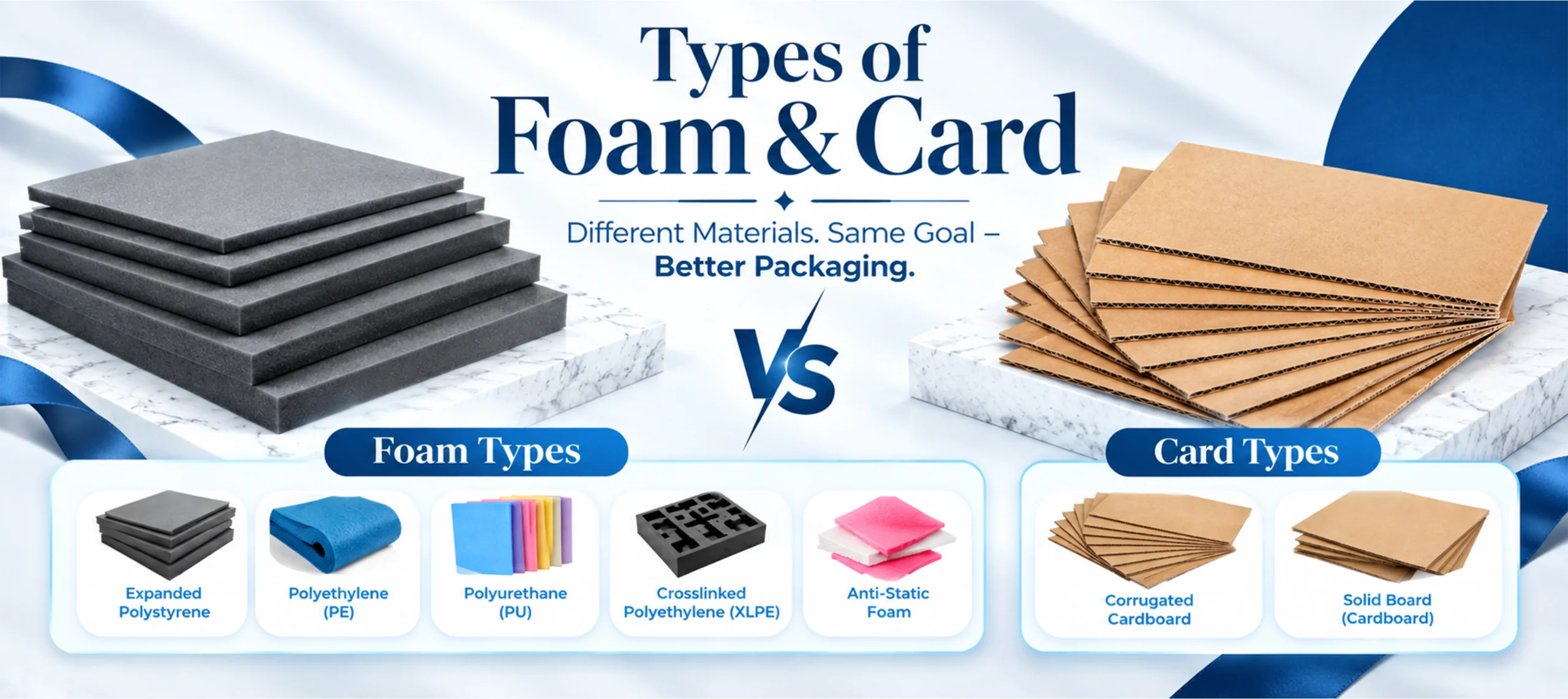
Not all foam, or all card, is the same.
- EVA foam is a dense, closed-cell foam with a smooth, even surface. It is a common choice for premium cavities that are seen when the box opens.
- EPE foam is lighter and softer, often used where cushioning matters more than appearance.
- Polystyrene is the white, beaded foam familiar from electrical goods packaging. It is rarely used for premium presentation.
- Paperboard and corrugated card inserts range from a thin folded card platform to a stiff corrugated divider.
- Flocked or velvet-lined card gives a soft, luxurious finish on a card structure. Our velvet pasting inserts are this kind of insert.
- Moulded pulp is another fibre-based option some brands use for shaped cavities.
When moulded pulp beats both card and foam
Moulded pulp is formed from wet paper fibre in a shaped mould. It can wrap closely around a curved product the way foam does, while staying a fibre-based material like card. It tends to make sense when:
- the product has a curved or irregular shape that a flat card insert cannot hold well
- you want more cushioning than card gives without adding plastic
- volumes are high enough to justify a mould made for your product
It is less suited to short runs, because each shape needs its own mould, and its natural grey or brown surface gives a more functional look than a printed card insert or a smooth EVA cavity.
What happens after the box is opened
End of life is where the two materials differ most in practice.
Foam. Council recycling collections are generally not set up for packaging foam. Council guidance on polystyrene is explicit: it cannot be recycled through household recycling collections because it breaks into small beads that clog recycling machinery. Other packaging foams such as EVA and EPE are also not something most household collections take, so check local rules before telling customers how to dispose of them.
Card. An unlaminated card insert may be easier to process through suitable paper-recycling streams than a laminated one. Final recyclability depends on the full material and finishing specification and the facilities available locally. A flocked or velvet-lined card insert is a mixed material, so it should not be assumed to behave like plain card. We can explain the general recyclability considerations of the selected material and finishing options, so you can make accurate claims on your own packaging.
Beyond the bin. End of life is only part of the picture:
- Material use. An insert sized closely to the product uses less material than a generic block with a small cavity.
- Weight. A lighter insert means a lighter parcel, which matters for postage and for weight-based producer fees.
- Single material. An insert made from one material, such as plain card, is simpler for a customer to dispose of than one that combines card, foam, glue and fabric.
- Mixed-material trade-offs. A card insert with a small foam section can protect a glass bottle with far less foam than a full foam insert, but the two parts should be easy to separate. Say so on the pack if they are.
What foam costs you beyond the insert price in the UK
Two UK schemes treat plastic differently from paper and card, and foam is plastic.
Packaging EPR. Waste fees on household packaging are paid by large producers: firms turning over above £2 million a year that also place over 50 tonnes of packaging on the market. The 2025 base fees were £423 per tonne for plastic against £196 per tonne for paper and card. In proportion: if a foam insert weighs 20 g (weigh your own), 1,000 inserts are 20 kg, which at £423 per tonne is about £8.46, less than a penny each. The rate is roughly double paper’s, but the amount per insert is small. For smaller businesses, these fees do not apply.
Plastic Packaging Tax. A foam insert is a plastic packaging component in its own right. The tax, charged at £228.82 a tonne since 1 April 2026, is paid by UK firms producing or importing at least 10 tonnes of plastic packaging a year. A brand buying finished boxes from a UK supplier does not pay it.
So for most small brands, the cost difference is the price of the insert itself, not tax or fees. For a large producer, it is worth knowing the plastic rate is higher.
Fit: too tight, too loose, and why to test first
The best material fails if the cavity is the wrong size.
- Too tight. The product is hard to lift out, card tears at the cut edges, and foam presses on caps and pumps. Customers pull at the bottle and can damage the insert or the product on the way out.
- Too loose. The product can move inside its own cavity, which brings back the rattle the insert was meant to stop.
- Necks and caps. Leave a little clearance around a bottle neck and cap so the insert holds the body and shoulders rather than pressing on the closure. A finger notch or a lift tab beside the cavity makes the product easy to take out.
- Variation between products. Glass bottles and candle vessels are not all identical. Size the cavity to the largest one you will pack, not a single sample.
This is why an insert should be checked before bulk production. Every order is approved before bulk production. Approval may be based on a digital 3D mock-up, a video of the physical sample, or a physical production sample, depending on the order. A mock-up confirms layout. For a close-fitting glass product, a physical sample is the only way to prove the fit. Ask for one at quote stage, where its price and timing are agreed.
What drives the cost of an insert
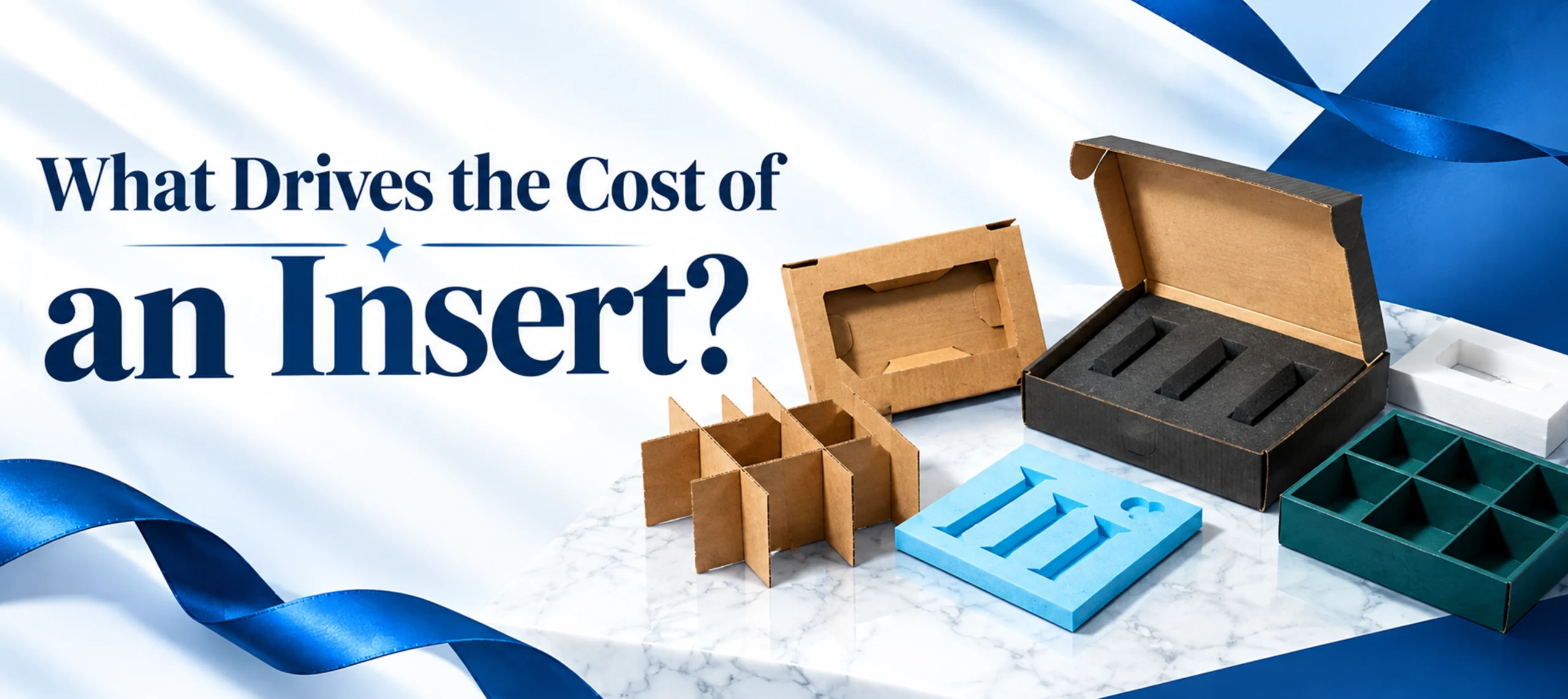
No two inserts cost the same, but the same few things move the price:
- Material and thickness. Denser foam and thicker board cost more per piece.
- Cavity depth. A deep cavity needs thicker material, or several layers built up, to hold the product.
- Number of cut-outs. Each extra cavity adds cutting and makes the part more complex.
- Printing and finishing. A printed card insert, a flocked surface or a velvet lining adds a stage.
- Assembly. A multi-part insert, or a card insert with a foam section fitted into it, takes hand work.
- Order volume. Set-up work is shared across the run, so the price per insert falls as the quantity rises.
How to choose, in four questions
- Does the box travel alone? If yes and the product is glass, lean to foam. If it always goes inside a shipper, card usually does the job.
- How fragile is the product, really? Weight, shape, centre of gravity, closures and void space all count, not only whether it is glass.
- Is the insert part of the look? A printed card insert can carry branding. Foam gives a soft, premium cavity.
- What will your customer do with it afterwards? If easy household disposal matters to your brand, card is the simpler story.
How we make inserts
Die-cutting and inserts cut to the customer’s product dimensions. We make card, paperboard and foam inserts, and EPE and EVA foam are available depending on the product and specification, so the choice can follow the product rather than a stock option. With custom insert boxes, the cavity is drawn as part of the box from the start.
- Orders start from 100 units.
- Design support is free.
- A digital 3D mock-up is free, so the cavity layout can be checked before production.
Frequently asked questions
Are foam inserts better than cardboard inserts?
Foam absorbs impact better, so it is better for heavy or fragile glass in a box that travels on its own. Cardboard holds a product in place just as well when cut to fit, and is lighter, slimmer and printable. For many candle and cosmetic boxes, especially inside a shipping carton, cardboard is the better fit.
What insert is best for a perfume box?
Foam, if the perfume box is also the shipping box or the bottle is heavy glass. Cardboard, if the box is sold from a shelf or always ships inside a padded outer box. If you post perfume with Royal Mail, it must be in its original retail packaging and cushioned to prevent breakage.
Do candle boxes need foam inserts?
Usually not. Most container candles are sturdy and mainly need holding still, which a card insert with a cut-out does well. Foam is worth it for thin glass or candles that ship alone in their gift box.
Can cardboard and foam be used together?
Yes. A card insert can carry the structure and presentation, with a foam section only where a glass item sits. It protects the fragile item with less foam than a full foam insert. Design the two parts so they separate easily, so customers can dispose of each material properly.
Can foam inserts go in household recycling?
Generally not. Council guidance says polystyrene cannot go in household recycling collections, and other packaging foams are also rarely collected at home. Check local rules before giving customers disposal advice.
Is a cardboard insert recyclable?
It can be, depending on the finish. Plain card without lamination may be easier to process through suitable paper-recycling streams, while flocked or velvet-lined card is a mixed material. Final recyclability depends on the full specification and local facilities.
Do foam inserts cost more in UK packaging fees?
Only for large producers. Under packaging EPR, the 2025 base fee for plastic was £423 per tonne against £196 for paper and card. Those waste fees apply only to firms above both the £2 million turnover and 50 tonne thresholds. Per insert, the difference is usually under a penny.
Not sure which your product needs? Send us the product, its size and weight, and how the box will travel. We will suggest card, foam or a mix, and you can check the cavity layout on a free digital 3D mock-up first.