
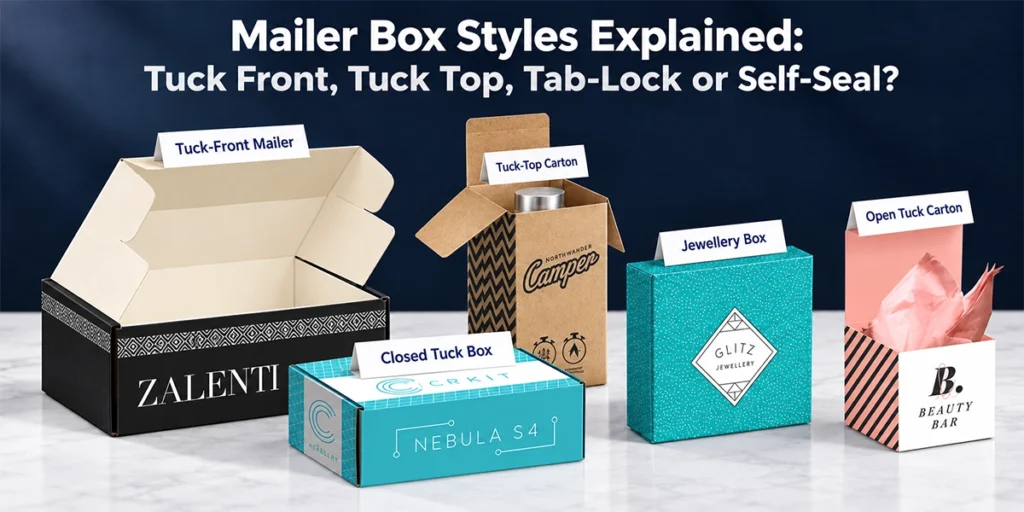
Mailer Box Styles Explained: Tuck Front, Tuck Top, Tab-Lock or Self-Seal?
Quick answer: Most mailer box styles differ in one thing: how the lid closes. A roll end tuck front mailer tucks its lid flap in at the front and is the everyday ecommerce choice: it closes without tape and can be reopened for returns. A tuck top tucks in at the top edge and looks neat; depending on the design, it may close securely on its own or benefit from a seal. A tab-lock mailer locks with tabs into slots for a firmer close. A self-seal mailer closes with a peel-and-stick strip: quick to pack, and a broken seal can make opening more visible, but it is usually single use. Pick by product, packing speed and how you handle returns.
The main mailer box styles at a glance
Supplier names vary. “Tuck top”, “tuck front”, RETT and RETF are used inconsistently, and the same basic box can be sold under several of them. Ask for the dieline or FEFCO code rather than relying on “tuck top” or “tuck front” alone.
| Style | How it closes | Tape needed? | Reclose for returns | Best for |
|---|---|---|---|---|
| Roll end tuck front | Lid flap tucks in at the front, into the side walls | Usually no | Yes | Everyday ecommerce, subscriptions, gifting |
| Tuck top | Lid flap tucks in along the top edge | Depends on the design | Yes | Lighter products, presentation boxes |
| Tab-lock | Tabs push into slots | Usually no | Yes, with care | Products that need a firmer close |
| Self-seal | Peel-and-stick adhesive strip | No | Only with a second strip or tape | Fast packing, opening more visible |
These are the closures you will see most on corrugated mailers. The body of the box, with its folded side walls and base, is broadly similar across them.
Roll end tuck front
This is the classic mailer. It is cut from one piece of board. The side walls roll over on themselves to make double walls, and the lid ends in a flap that tucks down inside the front of the box. Small locking ears or dust flaps hold the lid closed.
- Why brands choose it: no tape, a clean opening, a lid that lifts like a gift box, and it closes again for a return.
- Watch for: the rolled side walls are two layers of board, so the outside is a little bigger than a single-wall box with the same inside. Near a postage limit, check the outside size against the parcel size limits for Royal Mail and Parcelforce.
Many roll-end mailers are based on FEFCO 0427, but confirm the actual dieline, because commercial names and closure details vary (more on codes below).
Tuck top
A tuck top mailer has a lid flap that tucks in along the top edge rather than down the front. It gives a smooth, flat front and suits presentation.
- Why brands choose it: a tidy look and easy opening.
- Watch for: some tuck-style designs close securely without tape; others may benefit from a seal, depending on the dieline, product weight and transit conditions. A seal across the tuck can also make opening more visible.
Tab-lock
A tab-lock mailer closes by pushing tabs into slots cut in the box. The lock is more positive than a simple tuck, and the box still needs no tape.
- Why brands choose it: a firmer close for products that should not pop open, with no tape.
- Watch for: tabs can be fiddly to close quickly, and they can tear if customers pull them open roughly, which matters if you want the box back for returns.
Self-seal
A self-seal mailer has an adhesive strip under a peel-off liner. The packer removes the liner and presses the lid shut.
- Why brands choose it: it is fast to pack and needs no tape, and a broken adhesive seal can make prior opening more visible, depending on the seal construction.
- Watch for: once opened, the strip will not reseal. For returns, ask whether a second strip can be added, or include a returns label and tape.
Other mailer formats
A few formats solve narrower problems:
- Book and flat-item mailers wrap around a flat item, as with our book mailer packaging.
- Slide mailers use a sleeve and tray.
- Rigid mailers give a premium, thick-walled feel for higher-value products.
Our cardboard slide mailer packaging and rigid mailer boxes show both.
Still deciding whether you need a mailer at all? Our comparison of mailers, shipping boxes and product boxes covers that choice.
Returns, security and packing: the deciding questions
Will customers send it back? A tuck front or tuck top mailer closes again, which makes returns easy. A self-seal box needs a second strip or tape.
Do you need to show it has not been opened? A tuck closure opens without a trace. If that matters, put a sealing label or security tape across the tuck. With a self-seal strip, a broken adhesive seal can make prior opening more visible, depending on the seal construction.
How fast do you pack? Self-seal and roll end tuck front are quick to close. Tab-locks take a little more care. Any design that needs a seal or tape adds a step. If a 3PL or packing line closes the boxes, send them the dieline or a sample before approval. A closure that feels easy by hand may be slower or awkward in a repeated packing workflow.
How rough is the journey? For heavier products or long courier journeys, choose a firm closure (tuck front or tab-lock) and consider a seal on top. The closure is only part of it: the board and the fit matter too.
Compare quotes by FEFCO code

Box styles have many names, and two suppliers can use the same name for different designs. The FEFCO code is an international numbering system for corrugated box designs. It gives each common design its own number, and its current edition includes a series for retail and ecommerce designs. In Europe, box styles are usually specified by these four-digit codes: a regular slotted shipping box, for example, is 0201.
When you compare quotes, ask each supplier for the FEFCO code or the dieline, so you are comparing the same box. Our guide to what a dieline is explains the flat template.
Switching style later
Changing style is more than a small edit:
- the dieline changes, so the artwork has to be moved onto the new layout
- inside print panels move, if you print inside
- the packing routine changes (tape or no tape, how the lid closes)
- the outside size can change, which can move the postage band
Treat a style change as a new box: check a mock-up and a sample before the run.
Which style to choose
| Your situation | Usually the better style |
|---|---|
| General ecommerce, returns expected | Roll end tuck front |
| Subscription or gift unboxing | Roll end tuck front |
| Light product, presentation first | Tuck top, sealed if the design needs it |
| Product must not open in transit | Tab-lock, or tuck front with a seal |
| High packing volume, opening should be visible | Self-seal |
| Returns expected and self-seal wanted | Self-seal with a second strip, if available |
| Books, prints, flat items | Book or flat-item mailer |
Try a sample the way customers will
Close, post and reopen a sample the way your customers will:
- pack your product and close it the way your team will
- drop it on a corner and check the lid stayed shut
- open it as a customer would, then close it again as if returning it
- time the closing step
Mailer styles we make
We make custom mailer boxes in the common styles, cut to your dimensions.
Tuck top mailer boxes and tab-lock mailer boxes are both available.
A self-seal peel-and-stick strip is available on demand, as on our self seal mailer boxes. Tell us the product, how you pack and whether you expect returns, and we will suggest a style.
- Orders start from 100 units.
- Design support is free.
- A digital 3D mock-up is free.
Mailer box style questions
What is the most common mailer box style?
The roll end tuck front mailer. It closes without tape, opens like a gift box and closes again for returns.
What is the difference between tuck front and tuck top?
Usually where the lid flap goes: down inside the front, or in along the top edge. Suppliers use the names inconsistently, so compare the dieline or FEFCO code rather than the name.
Do mailer boxes need tape?
Roll end tuck front, tab-lock and self-seal mailers usually do not. Some tuck-style designs close securely without tape; others may benefit from a seal, depending on the dieline, product weight and transit conditions.
Can a self-seal mailer be used for returns?
Not on its original strip, because it does not reseal once opened. Ask for a second strip, or include a returns label and tape.
What is FEFCO 0427?
A FEFCO code for a hinged-lid folder box that many roll-end mailers are based on. The code defines the basic construction, not every commercial name or closure detail, so confirm the actual dieline.
Are tab-lock mailers stronger?
The closure is firmer. How strong the box is overall depends on the board and the fit as much as the closure.
Not sure which style fits your product? Send us the product, how you pack and whether you take returns, and we will recommend one.