
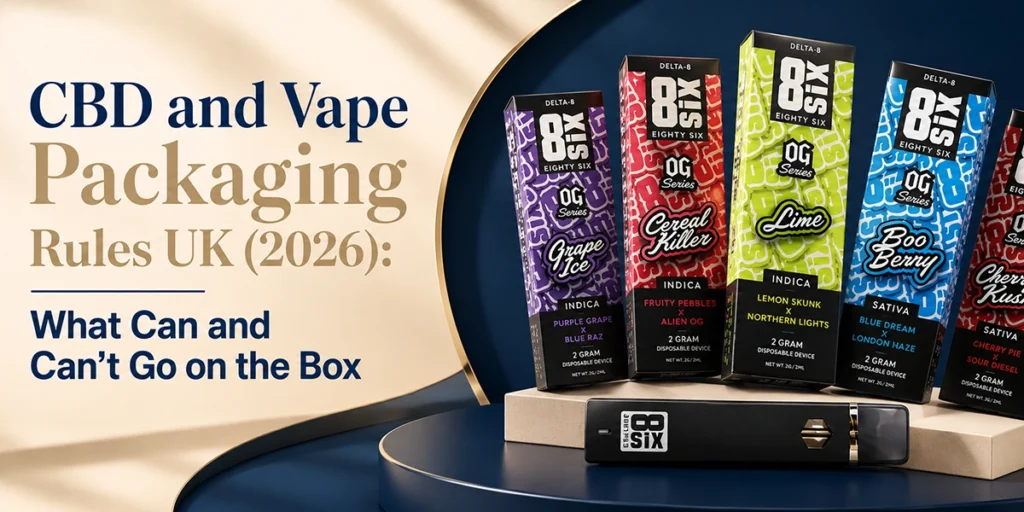
CBD and Vape Packaging Rules UK (2026): What Can and Can’t Go on the Box
UK Custom Vape packaging must be child-resistant, tamper-evident and carry the warning “This product contains nicotine which is a highly addictive substance” across 30% of the front and back. Nicotine e-liquid bottles are capped at 10ml, tanks and pods at 2ml, and every product needs MHRA notification 6-month notification before sale. CBD packaging must carry no medicinal claims, keep controlled cannabinoids such as THC below 1mg per container, and any CBD you eat or drink must be linked to an FSA novel food application. From 1 October 2026, vape packs also start carrying a 42mm x 18mm duty stamp.
This is not legal advice. Packaging and labelling rules for CBD and vape products change often, and getting them wrong can mean seized stock or prosecution. Always check current guidance on GOV.UK, the MHRA and the Food Standards Agency, and speak to your own legal counsel before you print anything. What follows is general information from a packaging supplier’s side of the table.
CBD and vape unlinked products are the two most heavily regulated categories we print boxes for. Not food-safe regulated. Trading-Standards-can-seize-your-stock regulated.
Here’s the pattern we see: a brand orders 1,000 beautiful boxes, then discovers the nicotine warning needs 30% of the front and back, or that the word “calming” on a Custom CBD Boxes counts as a medicinal claim. The artwork gets pulled, the boxes get pulped, and the launch slips by a month.
This guide covers what UK law requires on the box for both categories, what’s changing through 2026 and 2027, and exactly what to tell your packaging supplier so your first print run is also your compliant one.
CBD packaging rules UK: what the law actually requires
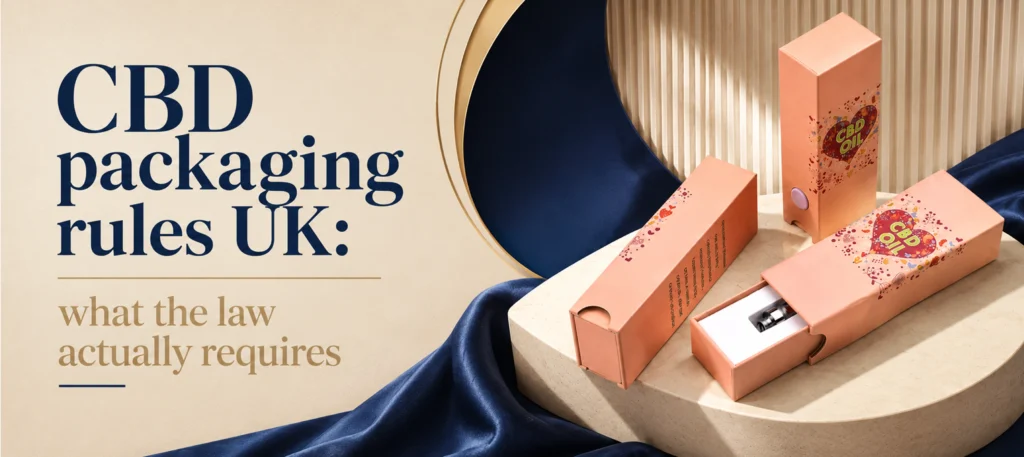
Three separate regulators shape a UK CBD box: the Food Standards Agency (novel foods), the MHRA (medicinal claims) and the Home Office (controlled cannabinoids like THC). Your packaging has to satisfy all three at once.
Ingestible CBD is a novel food
If your CBD product is eaten or drunk oils, gummies, capsules, drinks it’s classed as a novel food in Great Britain. That means it needs authorisation before sale. The FSA’s position since March 2021 is blunt: only CBD food products linked to a credible novel food application on its public list should be on the market, and “products not on the list should be removed from sale”.
For packaging, that changes two things. Your labelling must match the exact product formulation tied to your application. And reformulating means re-checking your position with the FSA, not just reprinting the box.
Worth knowing: the FSA also advises healthy adults to limit CBD from food to 10mg per day roughly 4 to 5 drops of 5% oil. That figure dropped from 70mg in October 2023. Many brands now print a daily-dose guide reflecting it, and several retailers won’t stock you without one.
No medicinal claims. None.
CBD sold as a food or cosmetic cannot claim to treat, cure or prevent anything. No “relieves anxiety”. No “helps you sleep”. No “anti-inflammatory”. If the pack makes a medicinal claim, the MHRA can treat the product as an unlicensed medicine.
There are currently no authorised health claims for CBD on the Great Britain nutrition and health claims register either. So even soft wellness wording is risky. The safest artwork describes the product (strength, format, flavour) and lets the brand do the talking.
One caveat here: this catches design as well as words. Pharmacy-style crosses, clinical iconography and “doctor recommended” flashes all pull you towards medicinal presentation.
THC: it’s 1mg per container, not “0.2%”
You’ll see “0.2% THC is legal” repeated all over the internet. It isn’t the rule for finished products. The 0.2% figure relates to Home Office licensing for industrial hemp cultivation.
For the product in your box, the Home Office’s exempt-product criteria apply: no more than 1mg of each controlled cannabinoid (delta-9 THC, delta-8 THC, CBN) per container, regardless of container size. That’s why serious brands print batch numbers and hold lab certificates for every run Trading Standards can ask for proof.
What goes on a CBD label
For ingestible CBD, standard UK food labelling applies on top of the novel-food position. In practice a compliant pack carries:
- Product name and what it actually is (“food supplement”, “oral drops”)
- CBD content per container and per serving, in mg
- Full ingredient list in descending order, with allergens emphasised
- Recommended daily dose, and a “do not exceed” statement
- The FSA-advised warnings: not for children, or those pregnant, breastfeeding or on medication without medical advice
- Batch number, best-before date, storage instructions
- Net quantity and UK business name and address
CBD cosmetics (balms, creams) follow cosmetics rules instead ingredient listing under INCI names and a responsible person address and CBD vape liquids follow the vape rules below. which regime applies depends on what the product is, not what the marketing says.
Vape packaging rules UK: the TRPR requirements
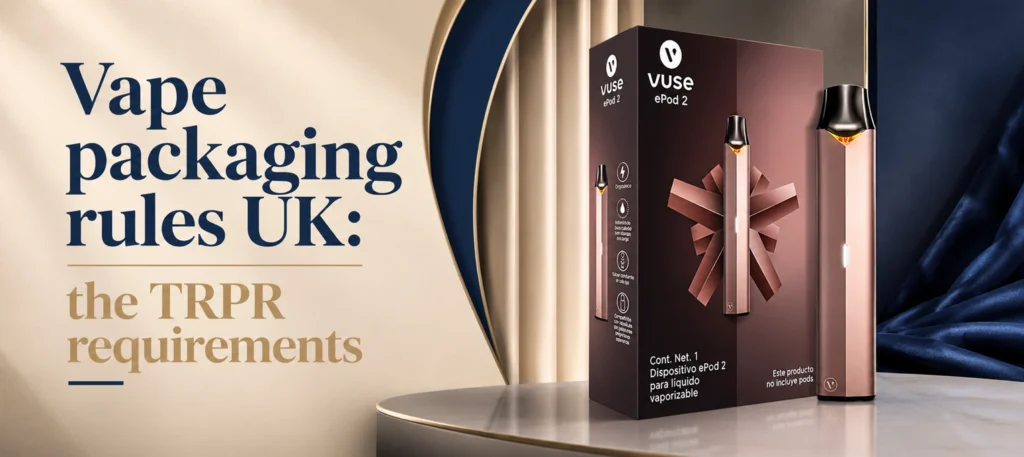
Nicotine vapes and e-liquids are governed by the Tobacco and Related Products Regulations 2016 (TRPR). Unlike CBD, where some of the detail is guidance, these are hard legal requirements with exact numbers.
The numbers that shape your dieline
- 10ml maximum size for a nicotine-containing e-liquid refill bottle
- 2ml maximum tank, pod or cartridge capacity
- 20mg/ml maximum nicotine strength
- 30% how much of the front AND back of the pack the nicotine warning must cover
- 6 months how far ahead of sale the product must be notified to the MHRA, which publishes it before you can legally sell
The warning panel, precisely
Regulation 37 sets the exact wording: “This product contains nicotine which is a highly addictive substance.” It must cover 30% of the surface area of both the front and back of the unit packet and any container pack, printed in black Helvetica bold black on white background.
That’s not a suggestion to your designer. It’s a fixed panel that eats nearly a third of your two best faces before branding starts. Plan for it first, design around it second.
Child-resistant, tamper-evident, leak-proof
Nicotine-containing products and their packaging must be Child-Resistant and tamper-evident. For e-liquid bottles that means closures a child can’t open in normal use; for the outer box it usually means a tamper seal or construction that shows interference. Refillable products also need a mechanism for leak-free refilling.
What must be on or in the pack
- Full list of ingredients, including flavourings
- Nicotine content and delivery per dose
- Batch number
- A recommendation to keep the product out of reach of children
- An information leaflet inside the pack covering instructions for use and storage, contra-indications, warnings for specific risk groups, possible adverse effects, addictiveness and toxicity, and producer contact details
What’s banned from the pack
TRPR prohibits any element or feature that:
- Suggests the product has health benefits or is less harmful than alternatives
- Makes the product resemble a food or cosmetic
- Refers to taste, smell or additives in a promotional way
- Claims environmental advantages
- Carries vouchers, discounts or “two-for-one” style offers
We see the environmental one trip people up most. You can print recycling disposal information; you can’t market the pack as green. (For categories where you can talk sustainability properly, see our guide to Biodegradable Packaging Types.)
And a note for CBD vape brands: Trading Standards has flagged CBD e-liquids packaged to imply health benefits as a recurring problem. A CBD vape in a nicotine-style refill bottle gets the vape rulebook applied to it, medicinal-impression ban included. Nicotine-free liquids sit outside TRPR, but general product safety law still applies this isn’t an unregulated space.
What’s changing in 2026 and 2027
If you’re briefing packaging now, three live developments matter more than anything above.
Single-use vapes are already gone. Since 1 June 2025 it’s been illegal to sell or hold for sale single-use vapes in the UK, nicotine or not, with fines up to £5,000 and unlimited penalties beyond that. If your packaging says “disposable”, it’s describing a product you can’t sell. We no longer print for single-use devices at all.
The Tobacco and Vapes Act became law on 29 April 2026. It hands government powers over vape flavours, packaging, appearance and retail display. The first big use of those powers arrived on 10 July 2026: a UK-wide consultation proposing that vape packaging be restricted to plain white with a matt finish, a single standardised brand name, no imagery beyond legally required warnings, and plain flavour names only “apple”, not “Unicorn Dream”. It closes on 2 October 2026. Nothing is law yet, but if your brand strategy is built entirely on pack graphics, 2027 planning should start now.
Duty stamps land on 1 October 2026. Vaping Products Duty arrives with a duty stamps scheme. The stamp is a physical 42mm x 18mm rectangle applied to the outermost retail packaging, positioned so the pack can’t be opened without breaking the stamp or the packaging. Businesses could register with HMRC from 1 April 2026, stamped stock enters the market from 1 October 2026, and from 1 April 2027 every vaping product outside duty suspension must carry one. Your box now needs a flat, seal-friendly zone reserved for it.
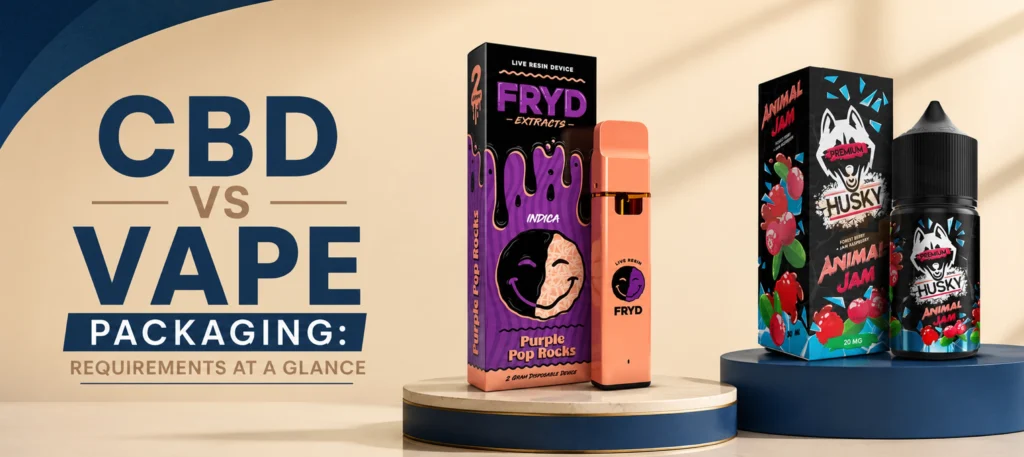
CBD vs vape packaging: requirements at a glance
| Requirement | CBD (ingestible) | Nicotine vape / e-liquid |
|---|---|---|
| Pre-market step | Linked to FSA novel food application (public list) | MHRA notification, 6 months before sale |
| Mandatory warning | FSA-advised wording (children, pregnancy, medication) | Fixed nicotine warning on 30% of front and back |
| Child-resistant packaging | Not a blanket legal rule for foods; strongly advised and often retailer-required | Legally required, plus tamper-evident |
| Size limits | None specific to CBD | 10ml refill bottles; 2ml tanks/pods |
| THC / nicotine cap | Under 1mg controlled cannabinoid per container | 20mg/ml nicotine maximum |
| Claims banned | All medicinal and unauthorised health claims | Health, reduced-harm and environmental claims; food/cosmetic lookalikes; promotions |
| Information leaflet | Not required (label carries the load) | Required inside the pack |
| Duty stamp | No | Yes phased from 1 October 2026 |
| Main regulators | FSA, MHRA, Home Office, Trading Standards | MHRA, Trading Standards, HMRC (duty) |
How to brief your box supplier: the checklist
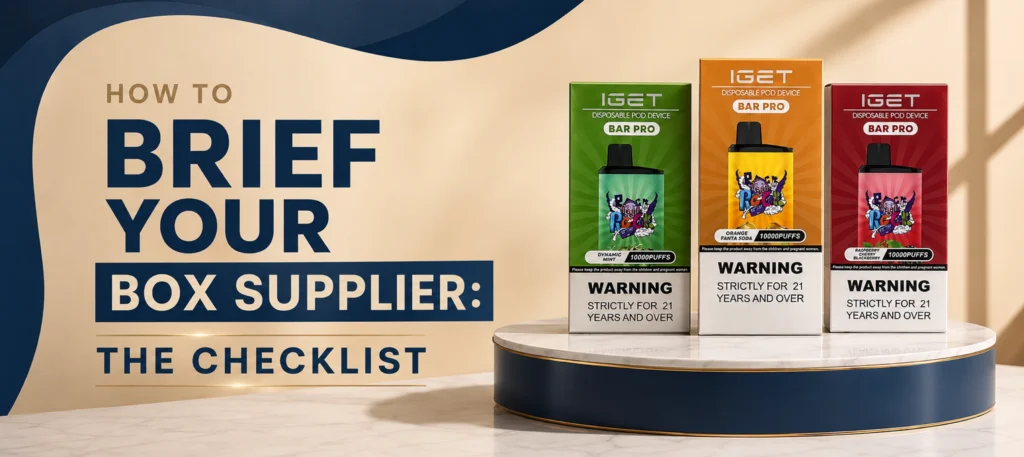
This is the brief we wish every regulated-category customer sent. It saves a proofing round, and sometimes a reprint.
- Say what’s legally in the box. Product type, nicotine yes/no, CBD format (food, cosmetic, vape). The rulebook and therefore the dieline follows from this.
- Ask for the warning panels drawn on the dieline. For nicotine products, the 30% front and back panels should appear on the flat dieline before any design work. If you’re new to dielines, our guide to what a dieline is covers how these flat templates work.
- Reserve the duty stamp zone. From October 2026, vape packs need a flat 42mm x 18mm area on the outer packaging, placed where the stamp will seal the opening.
- Design around the closure. Child-resistant caps are taller and wider than standard ones. Give your supplier the capped bottle dimensions, not the bottle spec sheet, or the box won’t close.
- Leave live space for batch and date coding. An uncoated or matt strip lets you overprint batch numbers and best-before dates per run instead of printing new boxes.
- Plan the leaflet. TRPR’s required leaflet needs room a slightly deeper box or an insert slot beats folding it around the bottle.
- Send final legal text as text, not flattened artwork. Warnings pasted in as images are where typos hide and resolution dies.
- Keep claims off until checked. If a phrase describes an effect on the body,
Get a quote it reviewed before it reaches the artwork stage.
The artwork we reject most often
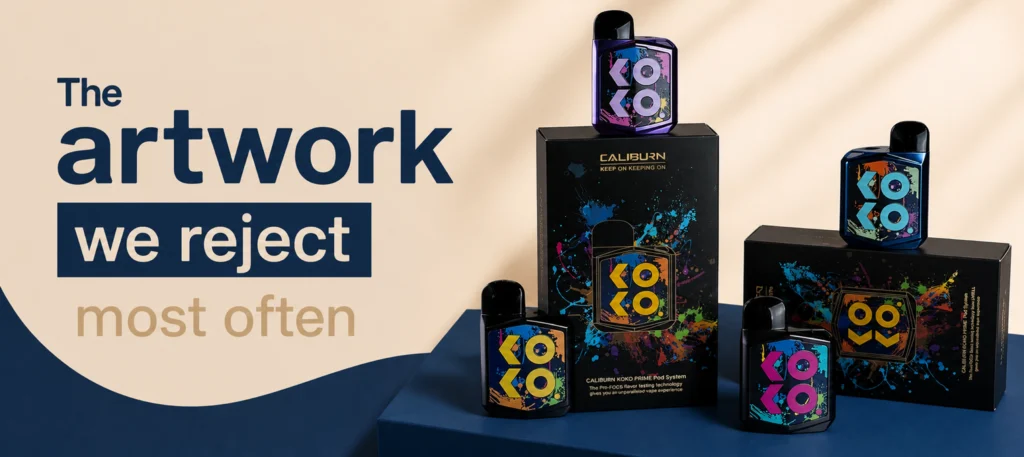
A supplier can’t approve your product for sale that’s on you and your advisers. But an experienced printer should query obvious red flags before plate-making. The ones we flag weekly:
- Nicotine warnings scaled down to “fit the design” (the 30% is measured, not vibes)
- Warning text in the brand font (it must be Helvetica bold, black on white)
- “Helps with sleep/pain/anxiety” on CBD packs
- Cartoon characters and dessert imagery on vape packs child-appeal is precisely what the current consultation aims to kill
- “Eco-friendly” flashes on vape packaging (banned outright)
- No space left for batch, date or the leaflet
If your current supplier takes artwork like this straight to print without a question, that’s not speed. That’s risk transfer.
Frequently Asked Questions
What must legally be on vape packaging in the UK?
The nicotine warning “This product contains nicotine which is a highly addictive substance” covering 30% of front and back, a full ingredient list, nicotine content and delivery per dose, a batch number, a keep-away-from-children recommendation, and an information leaflet inside. Packaging must be child-resistant and tamper-evident.
What is the legal THC limit for CBD products in the UK?
For finished consumer products, each controlled cannabinoid (including delta-9 THC) must stay below 1mg per container under the Home Office’s exempt-product criteria. The often-quoted 0.2% figure applies to hemp cultivation licensing, not finished products.
Do CBD products need child-resistant packaging in the UK?
Not by a blanket law, if they’re foods or cosmetics. But it’s strongly recommended, many retailers insist on it, and the moment a liquid contains nicotine, child-resistant and tamper-evident packaging becomes a legal requirement under TRPR.
Can I put health claims on CBD packaging?
No. Medicinal claims can make your product an unlicensed medicine in the MHRA’s eyes, and there are no authorised health advertising claims for CBD on the GB register. Describe the product; don’t promise outcomes.
What size can e-liquid bottles be in the UK?
Nicotine-containing e-liquid is capped at 10ml per refill container, with tanks and pods capped at 2ml and strength at 20mg/ml. Larger “shortfill” bottles are only lawful because they contain no nicotine when sold.
Will vapes need plain packaging in the UK?
Not yet, but it’s on the table. A government consultation that opened on 10 July 2026 under the Tobacco and Vapes Act proposes white matt packs, a single standardised brand name and no imagery. It closes on 2 October 2026; any rules would follow after that.