
Length, Width and Height Explained: How to Measure Packaging Dimensions Correctly (UK Guide)
Get a box measurement wrong and you find out at the worst possible time: when a batch of finished packaging turns up and the lid does not sit right, or a candle jar rocks around inside its box with too much spare room. Most of the time, the problem started with one mixed up dimension.
Length, width and height sound simple. In practice, sellers send us measurements the wrong way round more often than you would expect, especially when a box has an unusual shape or when internal and external sizes get confused. This guide explains exactly what each dimension means, how UK suppliers write them, and how to measure your own product or box correctly before you order.
Quick answer
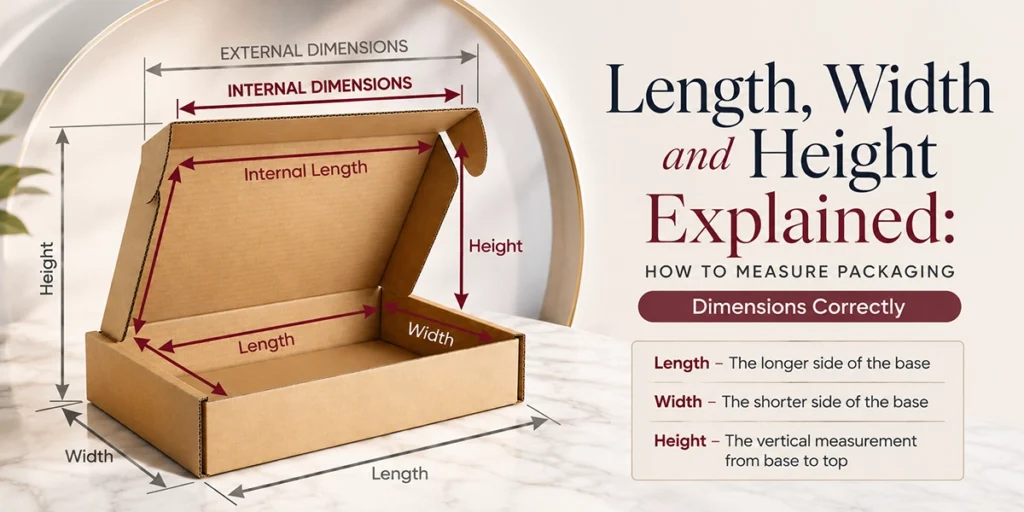
Packaging dimensions are almost always written in this order: length, width, height (L x W x H). Length is the longest side of the base. Width is the shorter side of the base. Height is the vertical measurement, from the bottom of the box to the top. Some UK suppliers write “depth” instead of “height”, and they usually mean the same thing, though it is always worth checking. Measure in millimetres or centimetres for accuracy, and always check whether a size refers to the inside of the box (internal) or the complete outside size (external), because they are rarely the same number.
What length, width and height actually mean
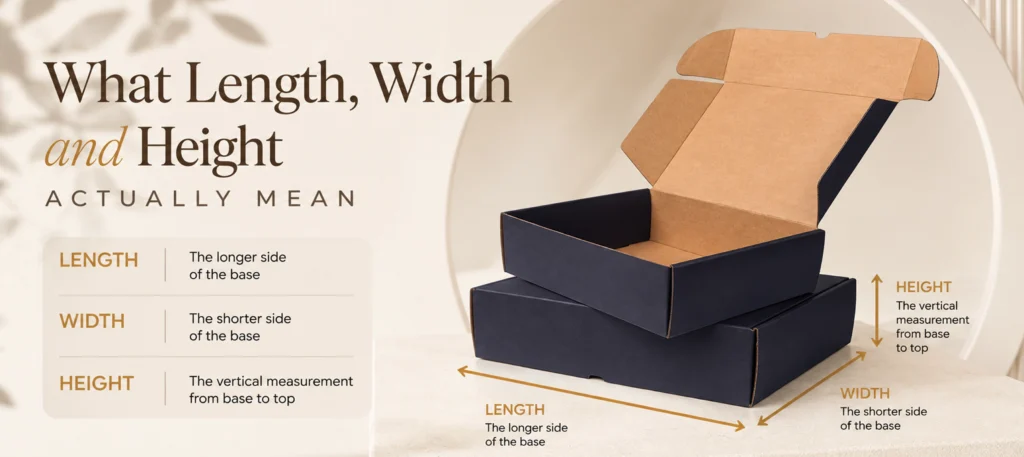
Length, width and height describe the three dimensions of a box in a fixed order. Get the order right and any supplier, courier or spreadsheet will read your measurements the same way you meant them.
Length is the longest side of the box base.
Width is the shorter side of the base, sitting at a right angle to the length.
Height is the vertical measurement, taken from the bottom of the box straight up to the top.
So a box listed as 200 x 150 x 80mm has a length of 200mm, a width of 150mm and a height of 80mm.
Here is a shortcut that works on most fold up boxes with a flap style lid. Look at the top opening. The two sides of that opening are the length (the longer one) and the width (the shorter one). The side running vertically down to the base, the one you cannot see when you look straight down into the box, is the height. If you can picture the opening, you can usually work out length and width without a diagram.
A simple diagram
Picture a mailer box sitting in front of you, lid facing up.
LENGTH (longest side of the opening)
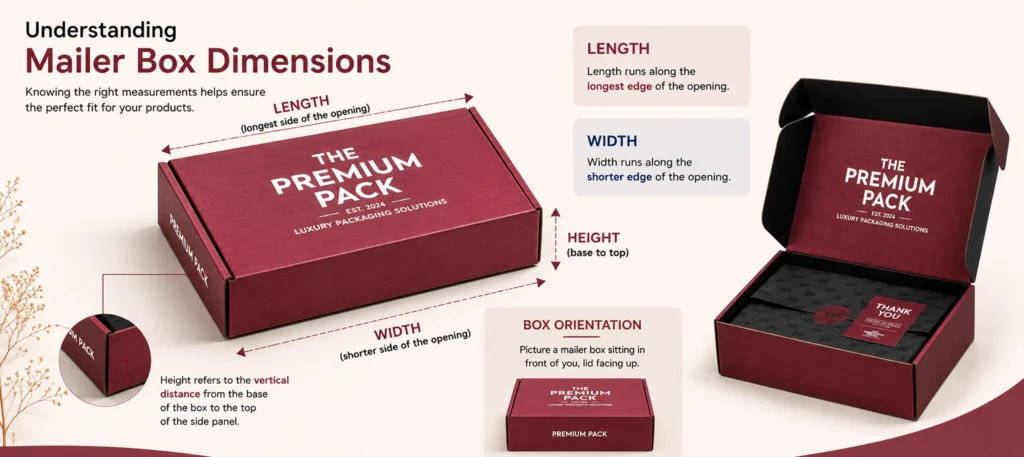
WIDTH (shorter side of the opening)
Length runs along the longest edge of the opening. Width runs along the shorter edge of the opening. Height is the only dimension that is not part of the opening at all, it is the side panel height.
Why some UK suppliers say “depth” instead of “height”
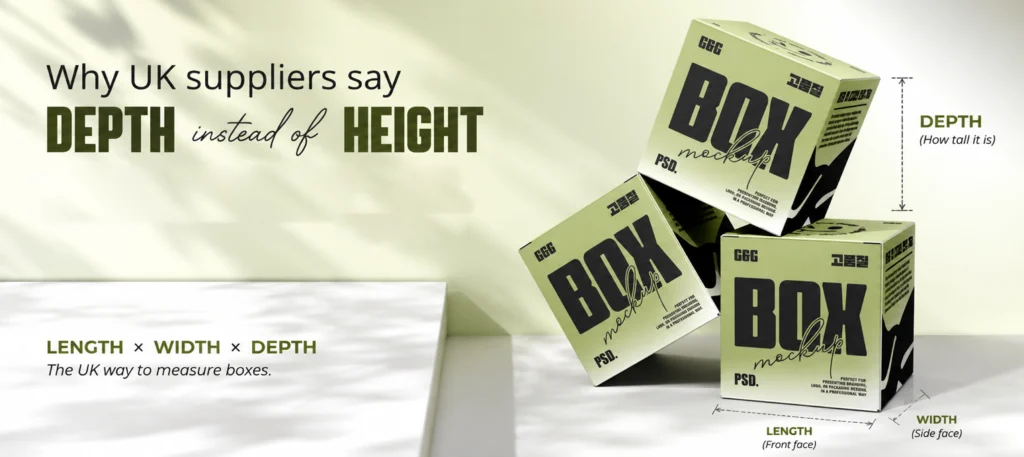
This trips up more buyers than any other part of packaging measurement. In UK packaging, “depth” and “height” usually mean exactly the same thing: the vertical measurement from the base of the box to the top. You will see specifications written as L x W x H or L x W x D, and for most boxes those two are interchangeable.
The confusion starts because “depth” does not always mean the same thing outside packaging. In furniture and some retail listings, depth means how far an item extends from front to back, which is a completely different measurement to height. A wardrobe’s “depth” is not how tall it is.
Worth knowing: if a UK packaging supplier’s spec sheet or quote or starting form uses “depth”, check their own diagram or ask them to confirm which measurement they mean before you approve a size. It almost always matches height, but a two minute check avoids a box that is the wrong shape for your product.
Internal versus external dimensions (why wall thickness matters)
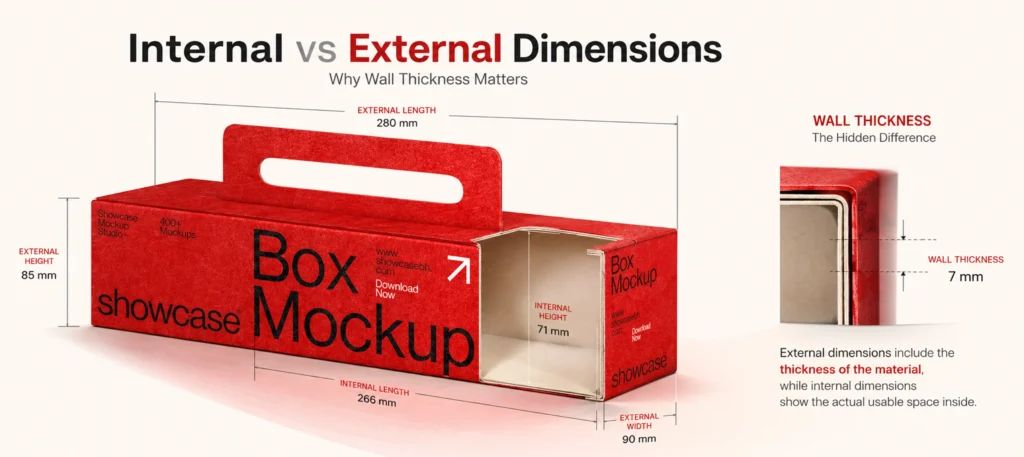
This is the single most common measurement mistake we see when a new customer sends us a size for custom packaging.
Internal dimensions are the usable space inside the finished box. This is the number that matters if you are checking whether your product, plus any insert or protective wrap, will actually fit.
External dimensions are the complete outside size of the assembled, sealed box. This is the number that matters for postage, courier limits, and how many boxes will fit on a shelf or pallet.
The gap between the two comes down to wall thickness. A single wall corrugated box, a double wall corrugated box and a rigid, wrapped board box all add a different amount of material or sustainability. Double wall corrugated can easily add several millimetres more than single wall, on every side. So a box specified with 200mm internal length will always measure slightly more than 200mm on the outside, and exactly how much more depends on what it is made from.
This matters twice over when you are having packaging custom made. First, when you send us your product’s measurements, we need to know whether you are giving us the size of the product itself or the size you want the finished box to be inside, because those numbers should almost never be the same (your product needs some clearance, covered below). Second, if you are also checking a size against a courier’s parcel limits, you need the external number, not the internal one, because that is what gets measured at the point of collection.
Always ask a supplier to confirm whether a quoted size is internal or external. It is a completely normal question and any supplier worth using will answer it in one line.
Tools you need to measure packaging correctly
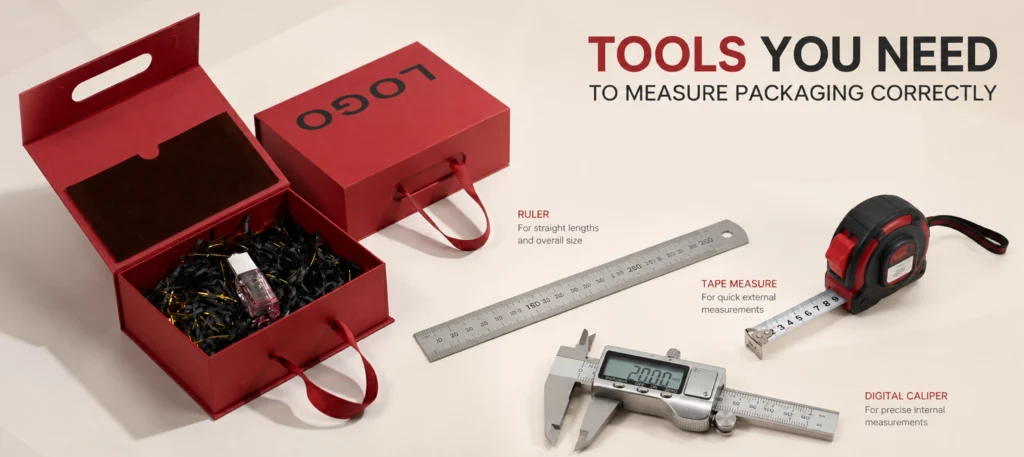
You do not need anything specialist for most packaging measurements.
- A flexible tape measure for boxes, bags and anything with a curved or soft edge.
- A steel rule or ruler for small, rigid items like jewellery boxes or cosmetics cartons, where a millimetre of error actually shows.
- Digital calipers, if you have them, for measuring board or wall thickness accurately. Not essential, but useful if you are working out internal versus external sizes yourself.
- A notepad or your phone, to record all three numbers straight away, in the same order every time. Writing “200 x 150 x 80” the moment you measure stops the length and width getting swapped later.
Millimetres are worth using over centimetres once a product has any awkward angles or curves, simply because there is less rounding. A candle jar that is “10.2cm” wide is really 102mm, and that extra digit can be the difference between a snug fit and a rattling one.
How to measure a box or product correctly, step by step
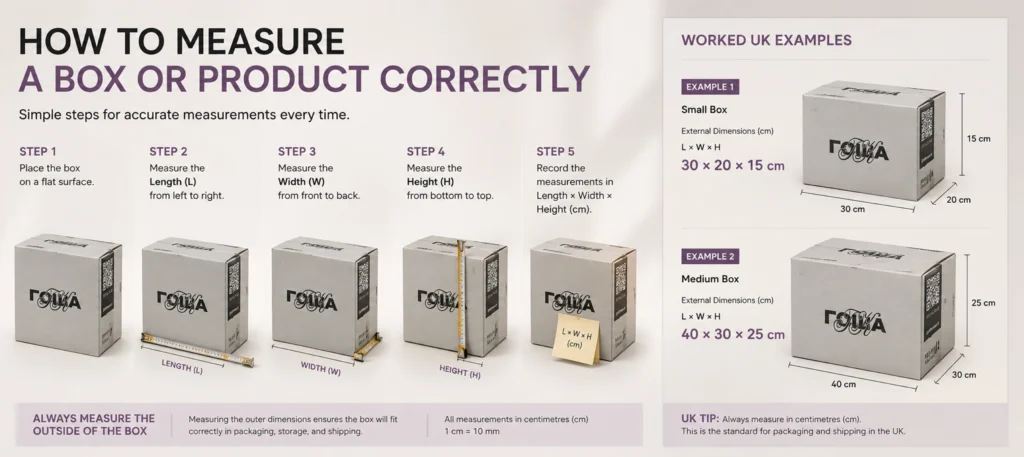
There are two different jobs here, and it helps to know which one you are doing.
Job one: measuring a product, to work out what size box you need.
- Stand the product the way it will sit inside the box.
- Measure its longest base dimension. That is your product length.
- Measure the shorter base dimension, at a right angle to the length. That is your product width.
- Measure straight up from the base to the highest point. That is your product height.
- Measure at the widest point of each dimension, not an average. A jar with a wider lid than base needs the lid measurement, not the jar body.
- Add clearance. Decide what protection you need (tissue, an insert, bubble wrap) and add enough room on each side for it to fit without being crushed. A common allowance is 5 to 10mm per side for a snug presentation box, more if you are adding foam or moulded inserts.
- That gives you the internal size to ask a supplier for.
Job two: measuring an existing box, to check what you have.
- Fold and seal the box exactly as it will be used, flaps closed, any tape applied.
- Measure the longest external edge. That is the external length.
- Measure the shorter external edge, at a right angle. That is the external width.
- Measure from the lowest point of the base to the highest point of the lid or top flap. That is the external height.
- If you need the internal size instead, measure inside the box once it is fully formed, not the flat, unfolded blank. A flat sheet of card gives you completely different numbers to the assembled box.
- Write all three numbers down in length, width, height order, with the unit, every time.
Measure twice. It costs nothing and it is the single easiest way to avoid a wasted print run.
Worked UK examples
Numbers are easier to trust with real examples, so here are three common products worked through properly.
Candle box. A standard Sizes 30cl soy candle jar measures roughly 80mm in diameter and 90mm tall, including the lid. Add 5mm clearance around the jar for a snug two piece box, plus a little extra height for a card insert to hold the jar steady. A sensible internal box size lands around 90 x 90 x 100mm. Written the UK way, that is length 90mm, width 90mm, height 100mm.
Mailer box. A jumper folded flat for a subscription order typically measures about 280 x 220mm and 50mm thick once folded. Add a small margin so the flaps close without straining the seams, and a practical external mailer box size is 300 x 230 x 60mm (length, width, height). Because mailer boxes are usually specified as external sizes, this is the number you would check against a courier’s small parcel limit before ordering.
Gift box. A two piece rigid gift box for a small hamper item, say a candle and a card set, needs to hold both pieces side by side with a liner. Measuring both items laid out flat gives a footprint of roughly 180 x 130mm, and the tallest item stands 70mm high. Allowing for the liner and lid depth, a workable internal size is 190 x 140 x 80mm.
In each case the process is identical: measure the product at its widest points, decide on clearance, then write the result as length, width, height with the unit stated.
How to calculate the volume of a box from L x W x H
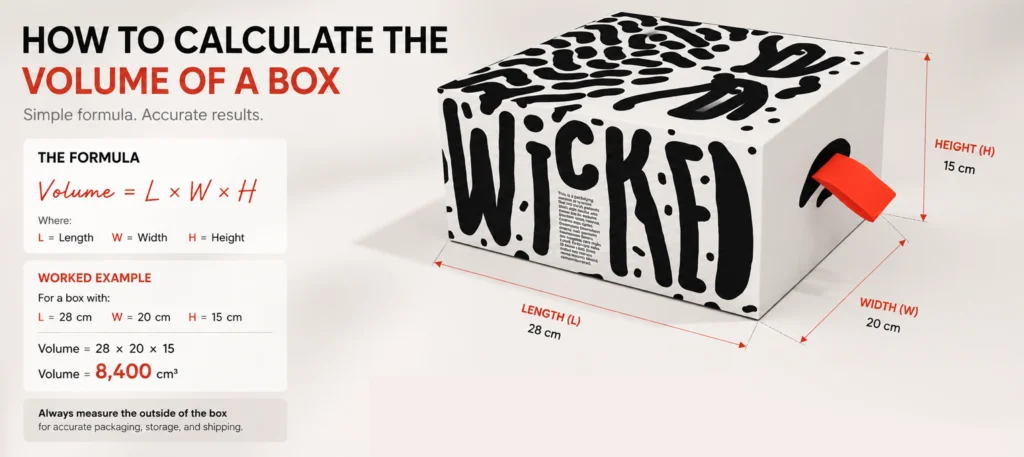
Once you have length, width and height in the same unit, volume is one calculation:
Volume = Length x Width x Height
Take the candle box above: 90mm x 90mm x 100mm = 810,000mm cubed. That is an awkward number to picture, so convert it. There are 1,000 cubic millimetres in a cubic centimetre, so 810,000mm cubed = 810cm cubed. There are 1,000 cubic centimetres in a litre, so that candle box holds roughly 0.81 litres of space, most of which is taken up by the jar itself.
Volume matters for two practical reasons. First, some couriers price parcels on volumetric (dimensional) weight rather than actual weight, which compares the space a parcel takes up against its scale weight and charges whichever figure is higher. A large, lightweight box can cost more to send than a smaller, heavier one. Second, knowing your box volume helps you compare packaging options fairly, since two boxes with very different shapes can hold a similar amount of product.
Common measurement mistakes
| Mistake | Why it happens | How to fix it |
|---|---|---|
| Swapping length and width | Both sides of a base can look similar at a glance, especially on a nearly square box | Always measure the longest base side first and call that length, every time |
| Measuring the product only, not the finished packaging | It feels like the obvious thing to measure | Add clearance for inserts and protective material before quoting a box size |
| Confusing internal and external sizes | Suppliers and couriers do not always specify which one they mean | Ask directly: “is that internal or external?” before you approve any size |
| Measuring a flat, unfolded box blank | The blank is what arrives before assembly, so it is the easiest thing to grab a tape measure to | Fold and form the box first, then measure the assembled shape |
| Mixing units mid-measurement | Switching between a metric tape and an old imperial ruler partway through | Pick millimetres or centimetres and stick to one unit for all three dimensions |
| Ignoring wall or board thickness | Thickness is invisible until you compare internal and external numbers side by side | Ask your supplier what material and wall type is used, then check both sizes |
| Reading “depth” as front-to-back instead of vertical | Depth means something different outside packaging (furniture, drawers) | Check the supplier’s diagram, since packaging depth almost always means height |
Frequently asked questions

What order are box dimensions written in? Length, width, height, usually shortened to L x W x H. Length is the longest side of the base, width is the shorter side, and height is the vertical measurement from base to top.
Should I use internal or external dimensions? Use internal dimensions to check whether your product and any inserts will fit. Use external dimensions when checking courier or postal size limits, or when working out how packaging will stack or store.
Does depth mean the same as height in packaging? Almost always, yes. UK packaging suppliers generally use “depth” and “height” interchangeably for the vertical measurement of a box. The exception is outside packaging, in furniture or general retail listings, where depth can mean front-to-back distance instead. Check the supplier’s own diagram if you are ever unsure.
How do I measure a box for shipping? Fold and seal the box exactly as it will be sent, including any tape. Measure the longest outer edge for length, the shorter outer edge for width, and base to top for height. Then weigh the fully packed parcel, not just the product.
How do I work out the volume of a box? Multiply length by width by height, in the same unit throughout. The result is in cubic millimetres or cubic centimetres, which you can convert to litres by dividing cubic centimetres by 1,000.
What is dimensional (volumetric) weight? It is a calculated shipping weight based on the space a parcel takes up, rather than its actual scale weight. Some couriers charge based on whichever figure is higher, so an oversized box can cost more to send than a smaller one holding the same product.
Do I measure the product or the packaging? Both, at different stages. Measure the product first to work out the internal size you need, adding clearance for protection. Once packaging is made, measure the finished, assembled box to confirm the external size for shipping or storage.
Why do my measurements not match the supplier’s quote? The most common reason is an internal versus external mix up, followed by measuring an unfolded blank instead of the assembled box. Double check both before assuming the quote is wrong.
Getting your measurements right before you order
Getting length, width and height right at the start saves a reprint later. If you already know your product’s measurements and just need the right box, All Custom Packaging’s design team offers free design support to help translate your numbers into a working dieline, and orders start from 100 units, so you are not committed to a huge minimum run while you get the size right.
If you already know the size you need and want to see what is commonly available, our guides to standard UK box dimensions and medium box dimensions set out ready sizing charts and current UK courier limits.