
E-Flute vs B-Flute for Mailer Boxes
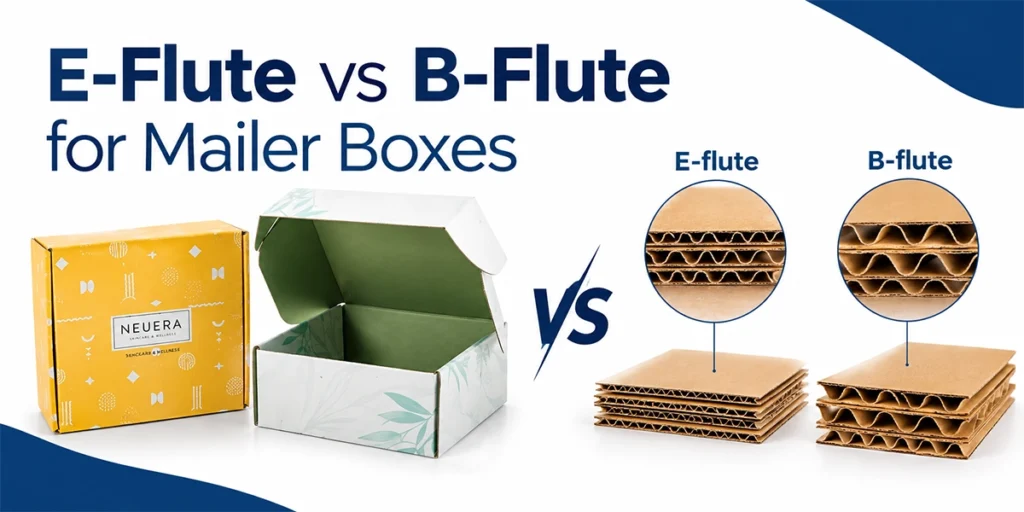
Quick answer: E flute vs B flute comes down to what the mailer has to do. E-flute is about 1.5 mm thick, with a smooth surface for fine print, crisp corners and a slim profile, so it suits small, light, well-presented products. B-flute is about 3 mm thick and gives more cushioning and robustness, so it suits heavier products and boxes that take more knocks. For most light, printed ecommerce mailers E is the natural choice; for heavier or larger ones, B.
Both are single-wall corrugated. The difference is the height of the wavy layer, the flute, inside the board. That one difference changes the look, the protection, the outside size and sometimes the postage.
The trade-off at a glance
| E-flute | B-flute | |
|---|---|---|
| Typical thickness | About 1.5 mm | About 3 mm |
| Print surface | Smoother, finer detail | Good, but fine lines can show the flute |
| Folds and corners | Crisp, sharp | Softer, rounder |
| Cushioning | Less | More |
| Robustness in handling | Good for small boxes | Better for larger and heavier boxes |
| Outside size for the same inside | Smaller | Larger |
| Best for | Small, light, printed mailers | Heavier contents, larger mailers, rougher journeys |
Typical thicknesses come from published flute tables; real board varies a little by mill.
Board makers describe the two in line with this. The corrugated manufacturer DS Smith describes E-flute as having excellent printability and crush resistance, and B-flute as the most widely specified profile for its robustness and compression strength. For the full set of flute types and board grades, see our guide to cardboard grades, GSM and flutes.
Print: the flute matters less than how you print
The usual advice is “E-flute for print”. That is true for one kind of printing, and less true for another.
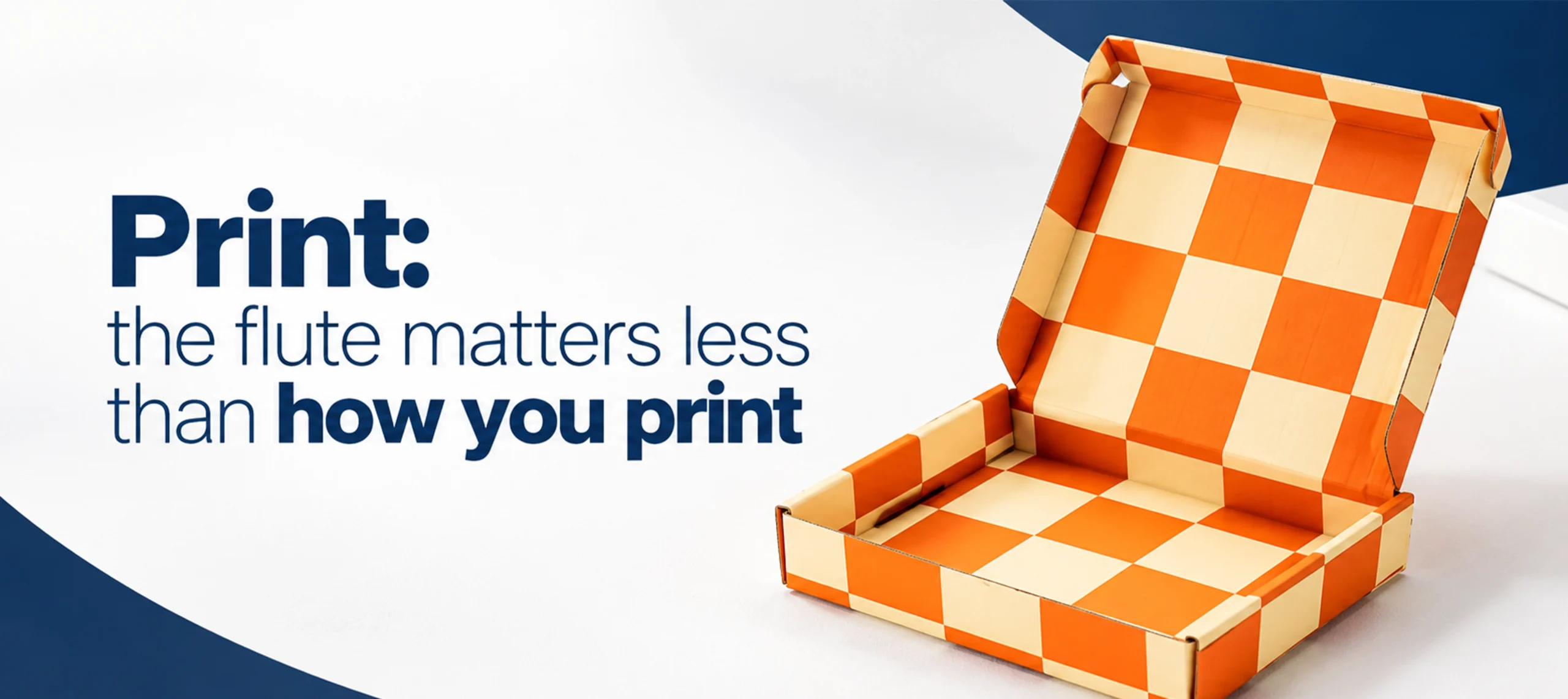
- Printed directly onto the board. The outer liner sits over the flute, and on a taller profile the ridges can show through as faint parallel lines in solid colours and fine type. This is called washboarding. The finer E-flute gives a flatter surface, so it prints cleaner.
- Printed on a sheet, then laminated to the board. A separately printed sheet mounted onto the corrugated hides most of the flute on either profile. Here the print quality comes mainly from the printed sheet, and the flute choice can follow protection instead.
So if your artwork has fine type, large solid areas or photography and is printed direct, E-flute helps. If the box uses a laminated printed sheet, choose the flute for protection.
Protection: what B-flute buys you
The taller B-flute has more height to compress before a knock reaches the product, and a thicker wall that resists bumps and corner damage in handling. That matters when:
- the contents are heavy for the box size
- the box is large, where a thin board can bow or flex
- the box goes through the post on its own rather than inside an outer carton
- boxes are stacked in a warehouse or a courier cage
For a small, light product with an insert or a snug fit, E-flute is usually enough, and its crisp corners look better. For a heavy or large mailer, B-flute gives a margin that E does not.
Postage: the 25 mm case
Board thickness counts toward the outside size, and in the UK the outside size can set the postage. A Royal Mail Large Letter can be no more than 25 mm thick. A mailer’s lid and base both sit inside that 25 mm, so B-flute takes roughly twice as much of it as E-flute, leaving less room for the product.
If your mailer is designed to go as a Large Letter, E-flute (or a finer flute still) is usually the practical choice. For bigger parcels, the extra few millimetres of B-flute rarely change the band, but it is worth checking the packed size near any limit. The size limit for each service sits in our parcel size guide for Royal Mail and Parcelforce.
What changes if you switch flute
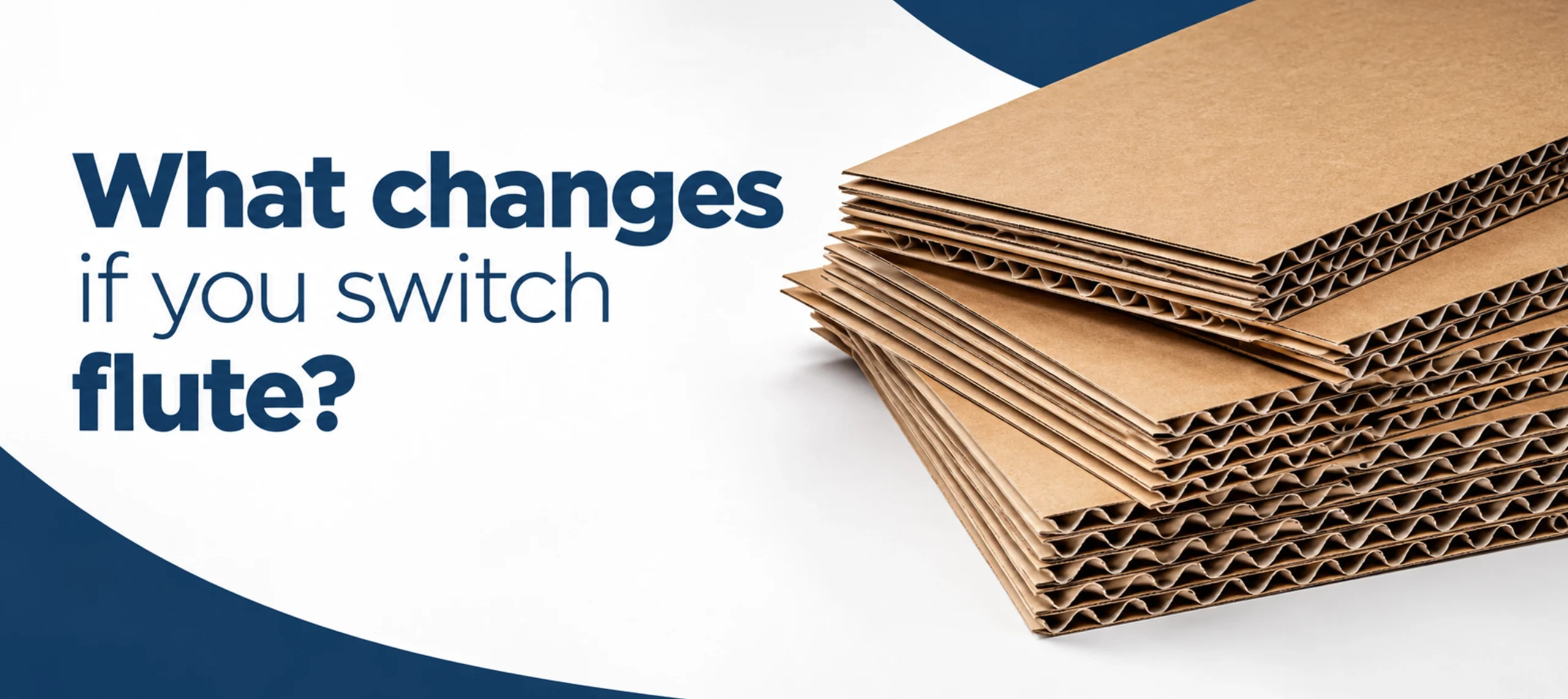
Changing flute is not a like-for-like swap. The inside size is what the box is built around, so the outside grows or shrinks by the change in board thickness on each side. As a rough guide, per axis:
| Inside size stays the same | Outside size, roughly |
|---|---|
| E-flute | Inside plus about 3 mm (two walls of about 1.5 mm) |
| B-flute | Inside plus about 6 mm (two walls of about 3 mm) |
That is a rule of thumb for a single layer of board. Folded mailer walls can be two layers thick in places, so check the supplier’s drawing. When you switch, re-check:
- the postage band at the new outside size
- the insert or fit, if the inside size is also adjusted
- how many flat boxes fit in an outer carton or on a shelf
- the look, because corners and edges change
Box size and storage
Fine flutes are at their best on small boxes. As a mailer gets larger and heavier, a thin board is more likely to bow, and the taller flute’s stiffness becomes more useful. If you sell in several sizes, you do not need one flute for all of them: E-flute can suit the small, presentation-led mailers and B-flute the larger shipping sizes.
Storage runs the other way. Flat E-flute mailers take up less room on the shelf than the same number in B-flute, which matters if space is tight.
Between the two
- F-flute is finer again, closer to a carton, and suits very small, highly printed boxes.
- EB double wall combines an E-flute outer for print with a B-flute layer behind it for strength. Whether you need a second wall at all is a separate decision, covered in our guide to single wall vs double wall boxes.
Decision table
| Your mailer | Usually the better flute |
|---|---|
| Small, light, printed, presentation matters | E-flute |
| Needs to pass as a Large Letter | E-flute, or finer |
| Heavy for its size, or glass | B-flute, with an insert |
| Large mailer, apparel or bundles | B-flute |
| Ships inside an outer carton | E-flute is usually enough |
| Printed direct with fine type or solid colour | E-flute |
| Laminated printed sheet | Choose on protection; either can work |
Test a sample before the run
Ask for a sample in the flute you are considering, pack your heaviest product in it and:
- squeeze the sides and press the corners to feel how the box resists
- stack a few packed boxes to see whether the lids bow
- drop one on a corner and check the product and the box
If the E-flute sample holds up, you get the sharper look and the slimmer profile. If it dents or bows, step up to B. A physical sample is a paid option, with its cost and timing confirmed when you get a quote.
How we choose the flute
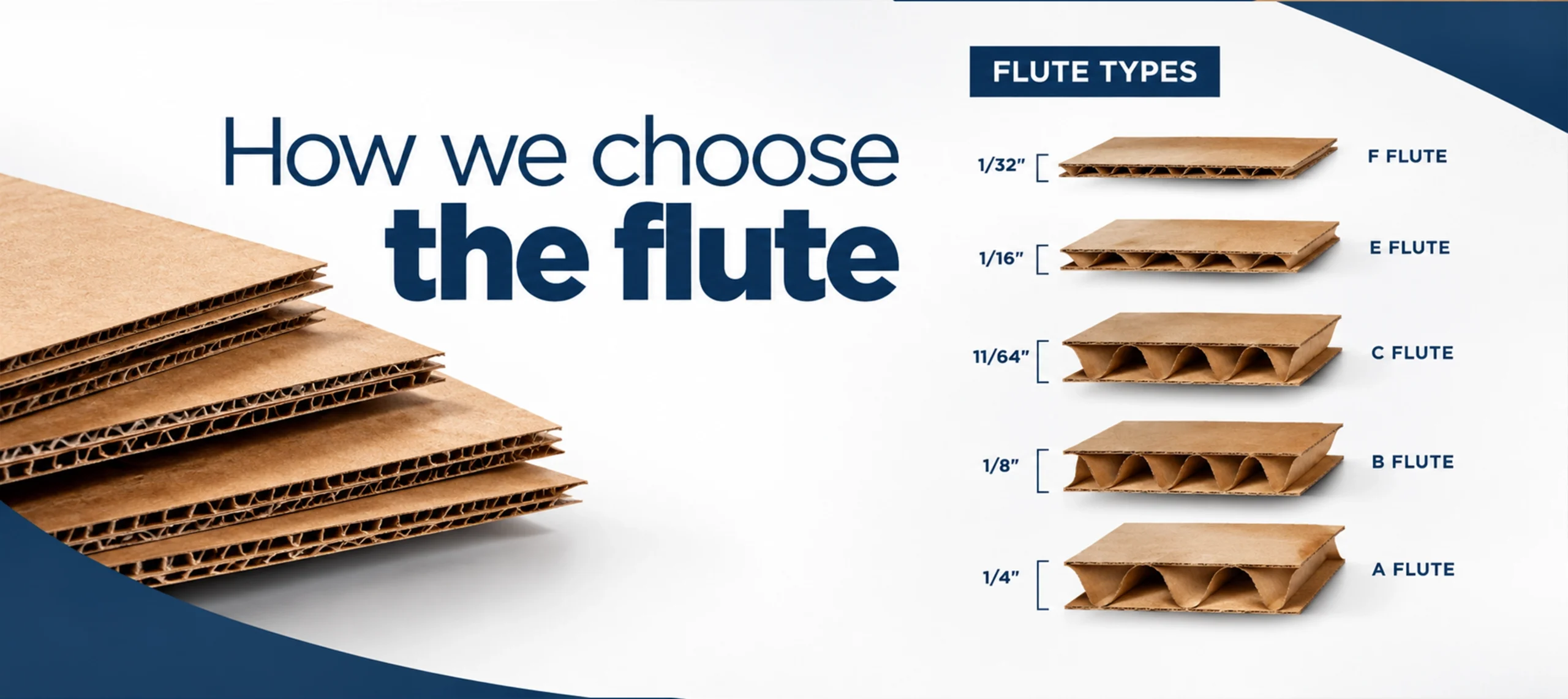
We make custom mailer boxes to your dimensions, and flute grades are chosen to suit the product, its weight and how it will travel. If print is a priority, say so in the brief, along with how the artwork will be printed.
- Orders start from 100 units.
- Design support is free.
- A digital 3D mock-up is free.
E-flute and B-flute questions
How do E-flute and B-flute differ?
Thickness and what follows from it. E-flute is about 1.5 mm, with a smoother print surface and crisper folds. B-flute is about 3 mm, with more cushioning and robustness. Both are single-wall corrugated board.
Is E-flute strong enough for mailer boxes?
For small and light products, usually yes, especially with a snug fit or an insert. For heavy or large mailers, or boxes that travel alone through rough handling, B-flute gives more margin.
Which flute prints better?
E-flute, when printing directly onto the board, because its finer flute gives a flatter surface. When a printed sheet is laminated to the board, the difference is much smaller.
Does flute choice affect postage?
It can. Board thickness adds to the outside size. For a mailer designed to pass as a 25 mm Large Letter, the thinner E-flute leaves more room for the product.
Can I switch from B-flute to E-flute without redesigning?
Not quite. If the inside size stays the same, the outside size shrinks by a few millimetres on each side. Re-check postage, the insert fit and carton counts before switching.
What is EB flute?
A double-wall board with an E-flute layer on the outside for print and a B-flute layer behind it for strength. It is a step up in rigidity when single wall is not enough.
Not sure which flute your mailer needs? Send us the product, its weight, how it ships and how the box will be printed, and we will recommend a board.