
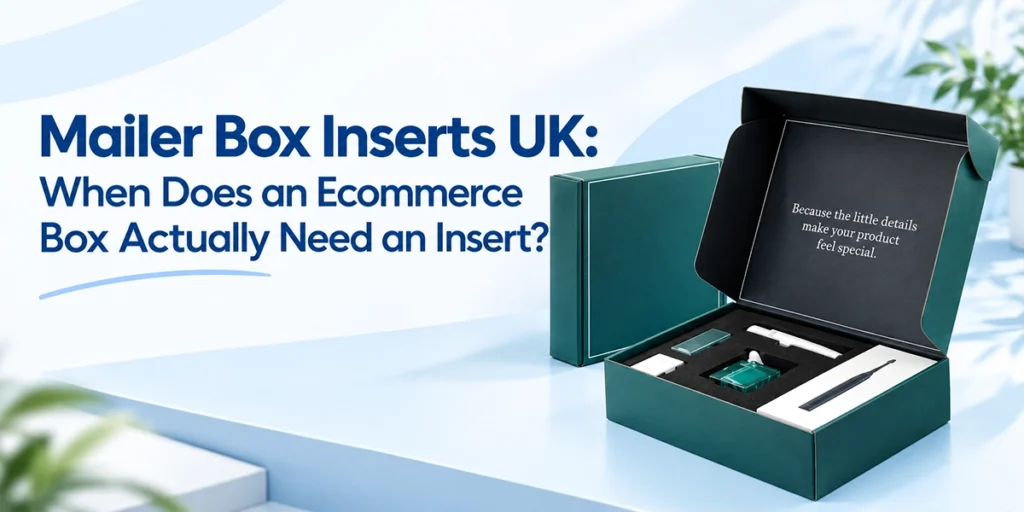
Mailer Box Inserts UK: When Does an Ecommerce Box Actually Need an Insert?
Quick answer: a mailer box needs an insert when the product is fragile, heavy for its size, awkwardly shaped or part of a set that must arrive in order, and when every order packs the same items. If the product is sturdy and fits the box closely, a wrap or a little void fill is usually enough. If orders vary from basket to basket, a fixed insert rarely fits them all, and flexible fill does the job better.
Most pages selling mailer box inserts assume you need one. Plenty of orders do not. This guide helps you decide, then shows what to check before you commit.
“Insert” is used for two different things. Here it means a structure that holds the product: a die-cut cradle, a platform, a divider or a folded wrap. A printed card that goes in with the order is a different thing, covered in our guide to unboxing on a small-business budget.
The four options inside a mailer
| Option | What it does well | What it does badly |
|---|---|---|
| Nothing (product fits closely) | Fastest to pack, cheapest | Only works for sturdy products in a well-sized box |
| Wrap (tissue, paper or a scored card wrap) | Stops scuffing, tidy presentation | Little protection against knocks or movement |
| Void fill (paper, crinkle, cushions) | Adapts to any order, no design needed | Slower to pack, looks less deliberate, varies by packer |
| Insert (cradle, platform, divider) | Holds each item in the same place every time, strong presentation | Needs designing, suits a fixed set of items, adds a part to stock |
Five questions that decide it
- Is the product fragile? Glass, ceramics and anything with a pump or dropper usually needs to be held away from the box walls.
- Is it heavy for its size, or top-heavy? A dense or tall item builds up force in a knock and needs holding in place.
- Is it an awkward shape? Round, tapered or irregular items roll or tip without something to locate them.
- Does every order contain the same items? This is the question most guides skip, and it is often the one that decides it.
- Does the presentation matter? For a gift set, a subscription box or a PR mailer, the insert is part of the product.
The question most guides skip: do your orders vary?
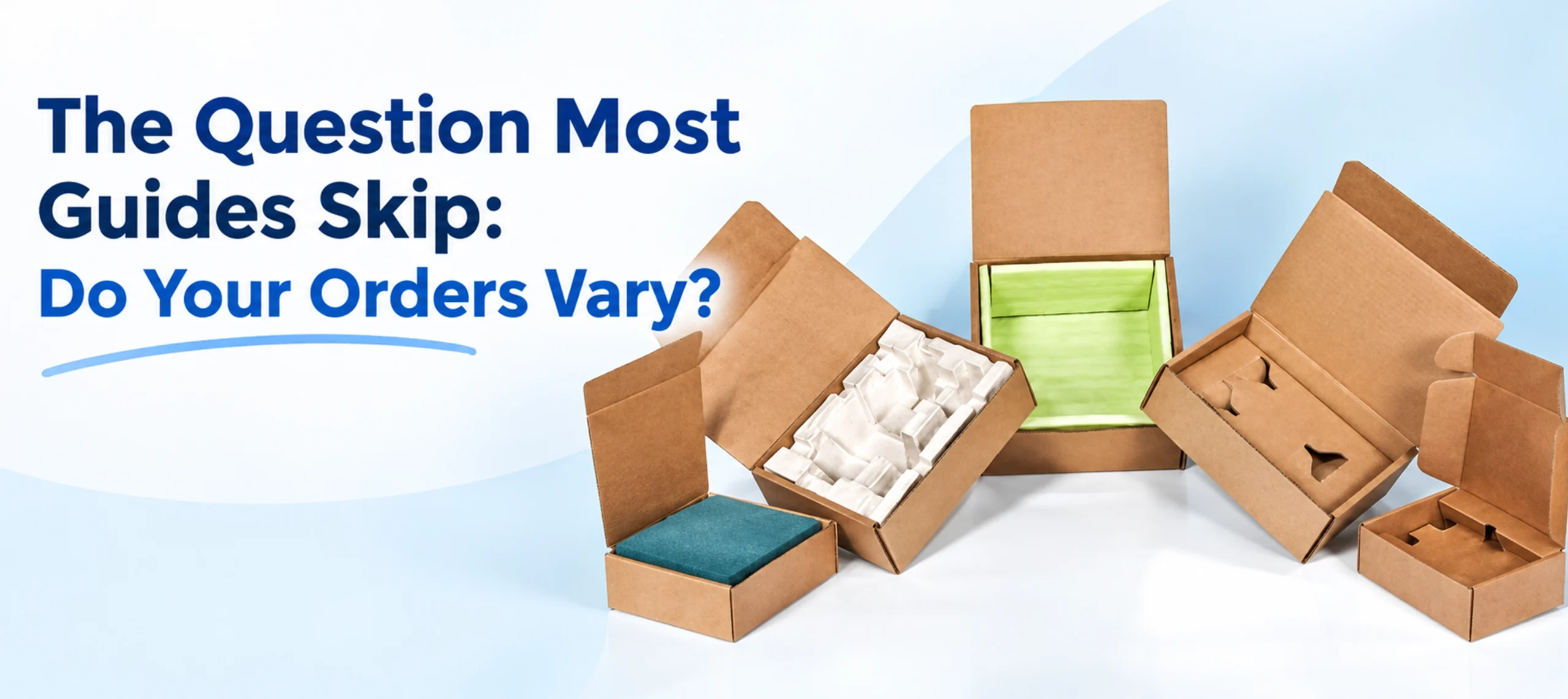
A fixed insert is built for one combination of items. It works perfectly for a kit, a gift set or a single product that always ships alone. It works badly when one customer orders one item, the next orders three, and the next adds a different product.
For variable baskets, the options are:
- Flexible fill around a wrapped product, which adapts to any combination.
- A small set of standard inserts for the most common combinations, with fill for the rest.
- A universal platform that lifts and centres whatever sits on it, rather than a cavity for one product.
If your best-selling combination is a fixed set, give that set an insert and let the long tail use fill.
Decision table
| Your orders look like | Usually the right choice |
|---|---|
| Sturdy single product, box sized closely | Nothing, or a light wrap |
| Sturdy product, box a size too big | Right-size the box first; otherwise void fill |
| Fragile or heavy single product | Insert that holds it away from the walls |
| Fixed kit, gift set or subscription box | Insert with a place for each item |
| Variable baskets of mixed products | Wrap each item plus void fill, or standard inserts for top combinations |
| Premium or PR mailer where the opening matters | Insert, printed or plain |
What an insert can change about postage
An insert takes up space, so it can change the box, and the box decides the postage.
Royal Mail prices by size format first. The Large Letter format stops at 25 mm thick, 353 mm long, 250 mm wide and 750 g. Beyond that the item is at least a Small Parcel, with a 160 mm depth limit and a 2 kg weight limit. A slim mailer that passes as a Large Letter can tip into Small Parcel once a raised platform or a deeper cavity adds a few millimetres of depth. Check the packed size with the insert in place before you order a run of boxes.
The same applies to weight. A foam or double-layer insert adds grams that count toward the limit for each band.
UK carrier conditions worth knowing
Royal Mail’s advice for packing fragile items is to give each fragile item at least 5 cm of cushioning all round. It also warns against a box so tight there is no room for protection, or so loose the item can move. Its compensation policy for damage excludes breakable items that were not sent in a strong container with enough packing material to guard against pressure and knocks. For fragile products, an insert or proper cushioning is part of what makes a damage claim possible, not just good practice.
The wider fragile-packing method, from box strength to taping, is in our guide to stopping damaged parcels.
Insert types that suit mailer boxes
- Die-cut cradle. A card or foam layer with a cavity the shape of the product. Holds it firmly and presents it well.
- Raised platform. A folded card base that lifts the product to the top of the box and keeps it centred.
- Divider or partition. Separates several items so they cannot knock together.
- Folded wrap. A scored card that wraps around one product. Light and quick to pack.
Custom mailer boxes with inserts combine the box and the insert in one design, and PR mailer boxes with inserts are built around presentation. Which insert material suits which product is a separate choice, made once you know an insert is needed.
The cost question, without guessing numbers

An insert has a unit cost. Void fill looks cheaper, but it has costs of its own. Compare them on the whole order, not the part:
- Insert: the insert’s price, plus storing it, plus assembly if it has more than one part.
- Void fill: the fill, plus the extra packing time for each order, plus the variation between packers.
- Both: the cost of damaged orders, replacements and returns, which is where the right choice pays back.
If damaged orders are rare and orders vary, fill usually wins. If damage is costing you replacements, or the unboxing is part of the product, the insert usually earns its place.
Test before you commit
Pack a real sample exactly as it will ship.
- Shake it. If anything moves, the insert or fill is not doing its job.
- Drop it onto a hard floor on a corner and a flat side, then check the product.
- Measure and weigh it packed to confirm the postage band.
- Time the pack. If an insert slows packing badly, that cost is real.
When to re-check the decision
An insert that is right today can be wrong in six months. Re-check it in these cases:
- a product changes size, shape or closure
- you launch a new bundle or subscription box
- your order mix shifts, for example more multi-item baskets
- you change carrier or service
- damage or returns start to rise on one product
How we make mailer boxes with inserts
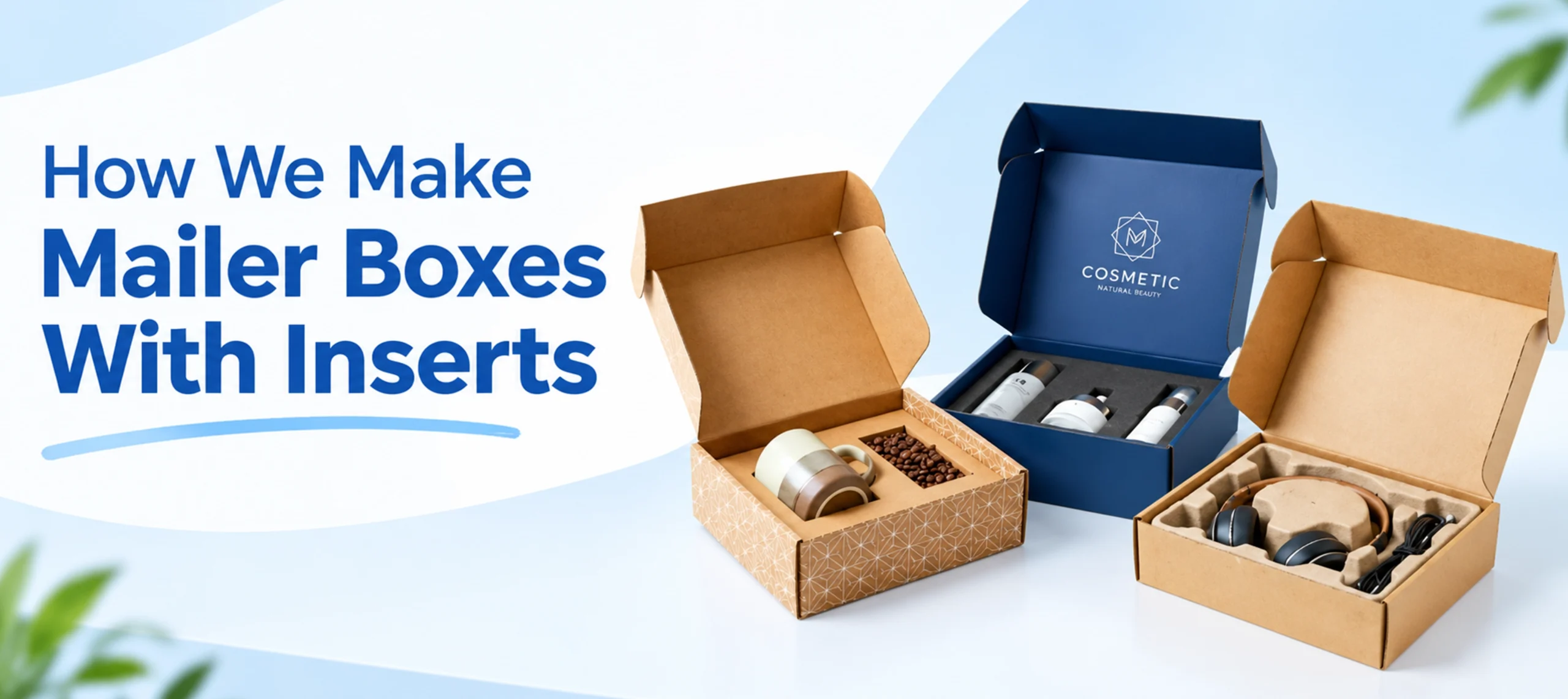
We make mailer boxes and their inserts to your products. Each insert is made to the size of your product, in card, paperboard or foam, and a custom insert box can be designed as one piece with the mailer.
- Orders start from 100 units.
- Design support is free.
- A digital 3D mock-up is free, so the insert layout can be seen before production.
Frequently asked questions
Do mailer boxes need inserts?
Not always. A sturdy product in a closely sized mailer often needs nothing more than a wrap. Fragile, heavy or awkwardly shaped products, and fixed kits or gift sets, usually need an insert to hold each item in place.
Is void fill or an insert better?
An insert is better for fixed kits and fragile items, because it holds each item in the same place every time. Void fill is better for orders that vary, because it adapts to any combination of products.
Can one insert work for different products?
Only if they share a size and shape. For mixed baskets, a universal platform, a few standard inserts for the most common combinations, or flexible fill usually works better.
Will an insert change my postage?
It can. An insert adds depth and weight, which can push a Large Letter over 25 mm into Small Parcel, or change the parcel size band. Measure and weigh a packed sample with the insert in place.
Does packaging affect Royal Mail damage claims?
Yes. Royal Mail’s compensation policy excludes breakable items that were not packed in a strong container with enough material to protect them from pressure and knocks.
Not sure whether your orders need an insert? Tell us the products, whether orders are fixed kits or mixed baskets, and how you ship. We will suggest an insert, a platform or a simpler option.