
When to Order Christmas Packaging: The UK Small Business Countdown for 2026
Order bespoke rigid and gift packaging by the end of August 2026, custom printed boxes by early October, and stock packaging with festive labels by mid November. Bespoke seasonal packaging can take 16–24 weeks to manufacture, and UK suppliers advise starting 3–6 months before your shelf date. It’s July now. That makes this the ideal week to start, not the early one.
If you want custom Christmas packaging delivered before your first festive dispatch, place your order by early October 2026 at the latest — and by the end of August if it’s bespoke rigid or gift boxes. Reading this in July? Good. You’re in exactly the right window, and this guide gives you a month-by-month plan so nothing gets left to a panicked November.
We supply printed boxes to hundreds of UK small brands, and every year the pattern repeats. The brands that brief us in July sail through December. The ones that call in mid-November are choosing between plain stock boxes and paying courier premiums. This countdown exists so you’re in the first group.
Why July is the right time (not the early time)
Seasonal packaging runs on longer clocks than most first-time buyers expect. UK packaging manufacturer Blackmore advises starting seasonal packaging projects 3–6 months before products need to be on shelves, because concept, structural design, sampling, proofing and production all queue up in sequence.
The wider supply chain starts even earlier. UK fulfilment providers report that the best 3PLs begin peak-season planning as early as April, locking forecasts and packaging pre-buys by September at the latest. And retail supplier Go2 Products reports that 62% of UK online businesses start Christmas prep as early as August.
One more reason 2026 is not the year to drift: US public radio’s Marketplace reported in early July that businesses are stocking up for the holidays earlier than usual amid economic uncertainty. Earlier orders across the board mean supplier queues fill sooner.
Worth knowing: none of this means you needed to act in March. It means July and August are when the comfortable options are still all on the table.
Christmas packaging lead times by type
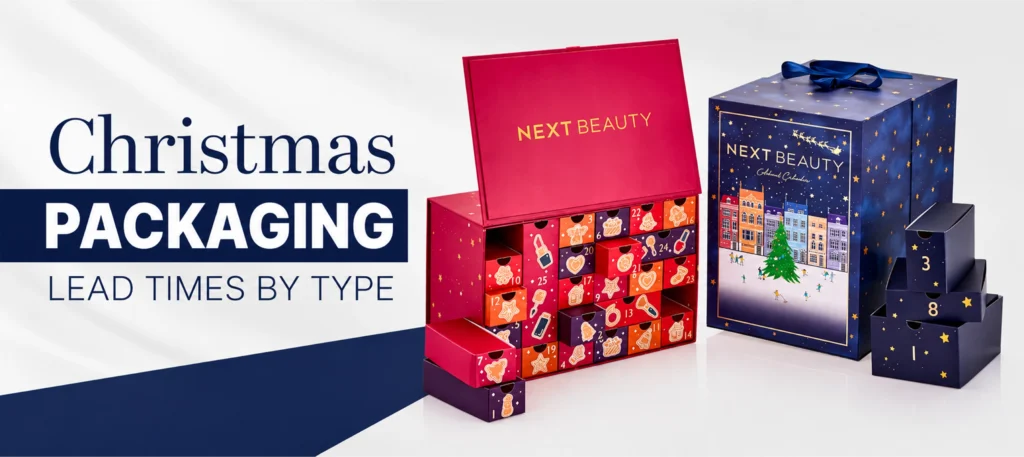
Different packaging types run on very different clocks. “Lead time” simply means the gap between placing your order and holding the finished boxes.
| Packaging type | Typical lead time | Order by (for early-December dispatch) |
|---|---|---|
| Plain stock boxes, tissue, stickers | Days (off the shelf) | Mid November 2026 |
| Custom printed boxes (digital, low MOQ) | 1–3 weeks after design approval | Early October 2026 (with design time built in) |
| Custom printed boxes (litho/flexo, high volume) | 3–6 weeks after approval | Early September 2026 |
| Bespoke rigid boxes, gift sets, tins | 8–24 weeks including sampling | End of August 2026 — and July is safer |
Two figures anchor the extremes. Wholesale gift packaging supplier Inca warns that bespoke products can take 16–24 weeks to manufacture and ship. At the other end, Blackmore quotes around 3 working weeks for simple reprints of existing designs — in a normal month.
Q4 is not a normal month. In our experience at All Custom Packaging, September and October orders queue behind larger seasonal runs across the industry, so even straightforward reprints deserve a 3–4 week allowance at many suppliers. Our own turnaround is 6–8 business days after design approval, but we still tell customers to add buffer for design rounds and delivery. Honest suppliers always will.
The month-by-month countdown: July to December 2026
This is the plan. Each month has one job. Do that job and the next month stays calm.
| Month | Your job | Stock packaging | Custom printed boxes | Bespoke rigid / gift |
|---|---|---|---|---|
| July | Forecast quantities, set budget, brief suppliers | Note reorder points | Shortlist suppliers, request quotes and dielines | Start design NOW — sampling eats weeks |
| August | Lock designs and artwork | Order festive tissue, stickers, ribbon | Approve artwork, order test runs (100 units) | Final safe window to place bespoke orders |
| September | Approve samples, place main orders | Top up basics before prices firm up | Place main print orders | Chase production updates, approve pre-production samples |
| October | Receive and check stock | Last comfortable reorders | Early October: last guaranteed window — after this you need a short-run specialist | Too late for new bespoke; switch to Plan B |
| November | Rescue mode plus fulfilment prep | Order by mid-month | Only fast digital short runs (6–8 day turnaround, ordered by mid-November) | Stock boxes + festive finishing touches |
| December | Dispatch, reorder buffer, note lessons | Emergency stock only | Realistically for January now | Brief your 2027 project in the quiet week |
Order windows at a glance
| Packaging type | Safe window | Tight — act fast | Risky / plan B |
|---|---|---|---|
| Bespoke rigid / gift | July – August | September | October – December |
| Custom printed boxes | July – early October | Mid October – mid November | Late November – December |
| Stock + festive labels | July – mid November | Mid – end November | December |
A visual timeline chart of this same data is provided as ready-to-paste SVG code in Section 6, for whoever builds this page in the CMS. Google Docs cannot render inline SVG, so the code lives there as copy-paste-ready markup rather than as broken raw code in this body text. Source for the underlying dates: UK supplier lead-time data compiled July 2026 (Blackmore, Inca, LD Packaging) plus All Custom Packaging production experience.
July: forecast quantities and brief suppliers
Start with numbers, not designs. Pull last year’s October–December unit sales per product. No trading history yet? Use your best month this year and assume Q4 runs 1.5–2 times higher for giftable products. Then add a 10–15% buffer for reprints, damages and the January sale period.
Brief your supplier this month with rough quantities, box sizes and a budget per unit. You’re not committing yet. You’re getting a slot in their design queue and real prices instead of guesses. The most common mistake we see in July briefs is guessing box dimensions — measure your product with its protective wrap, then let the supplier’s design team confirm the dieline (the flat cutting template a box is made from).
August: lock designs and place bespoke orders
August is the last comfortable month for anything bespoke. LD Packaging’s Christmas guidance is blunt about this: August–September is the comfortable window for custom branding, and from November bespoke production becomes very difficult to guarantee. For manufactured-from-scratch tins and rigid gift sets, Inca’s 16–24 week window means a late-August order is already cutting it fine for early December.
So this month: approve final artwork, order physical or video samples, and sign off bespoke production. If you’re testing a new festive design, a 100-unit run is a cheap way to validate it before committing to thousands.
September: approve samples and place main print orders
September is main-order month for custom printed boxes. Sample approved, quantities locked, purchase order in. Ask every supplier one question in writing: “What is your last order date for guaranteed pre-Christmas delivery?” Their answer, not a blog’s, is your real deadline.
We see supplier queues lengthen visibly from mid-September. Materials also get allocated to big retail runs, which is why even simple jobs deserve extra margin from here on.
October: your last guaranteed window
Early October is the final window where custom printed Christmas packaging is a routine order rather than a rescue job. Order in the first half of the month and a competent supplier will still deliver comfortably. From late October you’re relying on short-run digital printers with fast turnarounds — they exist (we’re one), but design rounds and delivery still take real days.
Use October to receive, count and check everything you ordered in September. Print errors found in October are fixable. The same errors found on 1 December are not.
November: rescue mode
New bespoke packaging is now off the table for pre-Christmas delivery. Custom printed is still possible via fast digital runs if you move in the first two weeks (more on that below). Otherwise, buy plain stock boxes and make them festive with printed stickers, ribbon and tissue — it looks deliberate, not desperate, when done consistently.
Also lock your dispatch calendar around Royal Mail’s last posting dates, which are published on royalmail.com each autumn. Your final order deadline for customers depends on them.
December: dispatch, then debrief
Keep 10% of your packaging as emergency buffer until your final posting date. Then, in the quiet week between Christmas and New Year, write down three numbers: units used, units short or spare, and the date you wish you’d ordered. That note is your 2027 head start. Bespoke suppliers quote 20–24 week lead times for orders placed after mid-December, so brands doing manufactured-from-scratch packaging for 2027 genuinely start now.
What if it’s already October (or November)?
Missed the comfortable windows? Here’s the honest version of your options.
A short-run digital supplier changes the maths. At All Custom Packaging we print custom boxes in 6–8 business days after design approval, from just 100 units, with free design support and no setup fees. That makes a genuine custom Christmas box possible from an order placed as late as mid-November.
But — one caveat here — 6–8 days is production time, not total time. Add 2–5 days for design and artwork rounds, a day or two for our free 3D mockup or video approval, and delivery. Realistic total: two to three weeks door to door. So even with a fast supplier, don’t leave it past mid-November, and earlier is always cheaper on nerves.
If you’re past that point: plain kraft boxes with custom stickers and labels (which print far faster than boxes), festive tissue paper and ribbon will carry you through December respectably. Save the full custom build for Valentine’s or Mother’s Day, when you’ll have the run-up you didn’t have this time.
How much Christmas packaging should you order?
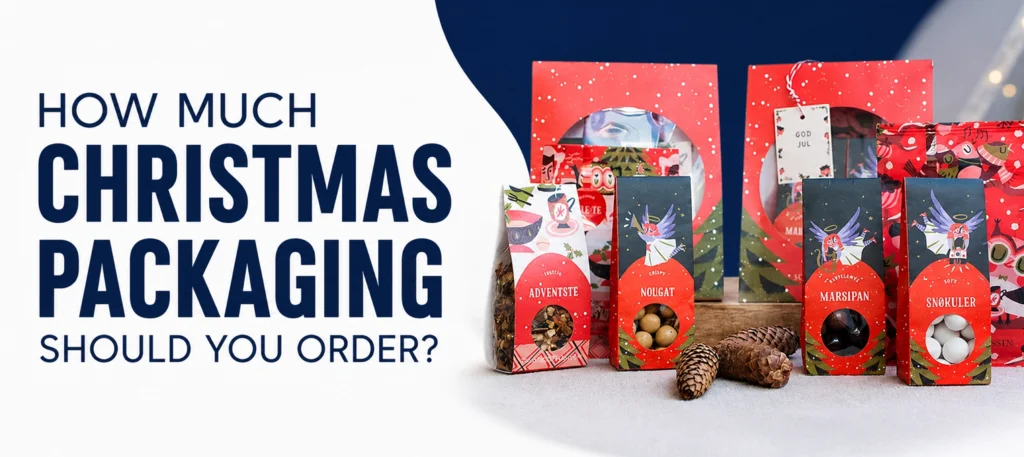
Quantity forecasting scares people more than it should. A simple method:
- Baseline: last year’s Q4 units per product (or best month × 1.5–2 for giftable lines).
- Growth: multiply by this year’s trend. Up 30% year to date? Apply it.
- Buffer: add 10–15% for damages, reshoots, influencer mailers and January orders.
- Round up to MOQ bands: suppliers price in quantity breaks, and the next band up often costs little more per unit. Prices vary by size, material and print method, so get the bands quoted rather than assuming.
Low minimums make the buffer decision easier. With a 100-unit minimum you can order your realistic forecast now and reprint in 6–8 days if December surprises you — rather than gambling on one 1,000-unit bet in September. A word of caution from our production floor: reprints in the first two weeks of December are usually fine; reprints requested after mid-December mostly become January stock.
Do you even need Christmas-specific boxes?
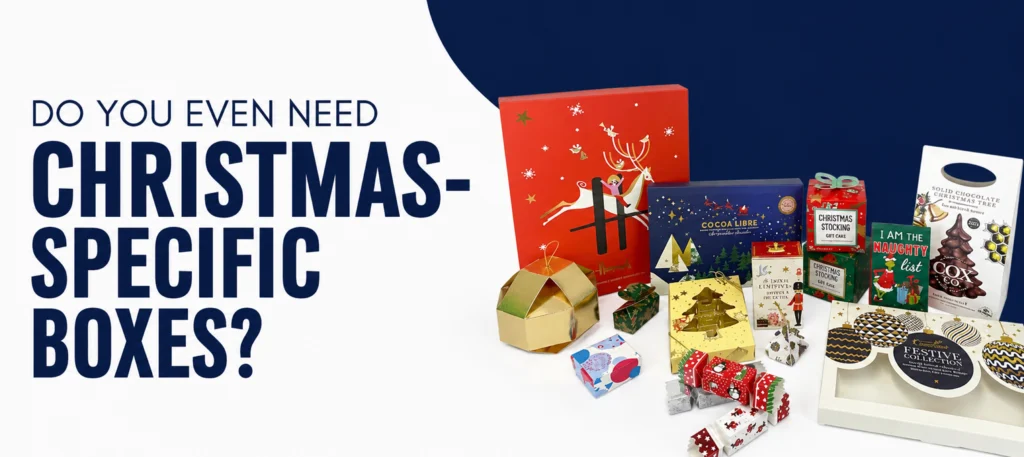
Not always, and it’s worth deciding in July rather than paying for the wrong thing in October. Fully festive printed boxes make sense for gift sets, advent products and hamper-style bundles — anything customers buy as a present. For everything else, a smarter pattern is a year-round box plus seasonal accents: festive sleeve, sticker seal, red tissue. Your custom mailer boxes stay usable in January; only the cheap accents expire.
Where the gift experience is the product — jewellery, candles, premium food — festive gift boxes or rigid boxes earn their keep in unboxing photos and repeat orders. Those are also the types with the longest lead times, which is why they top the countdown table.
Frequently Asked Questions : Christmas packaging deadlines, answered
How early should a small business order Christmas packaging?
Start supplier conversations 3–6 months before your products need to ship — July or August for a UK Christmas. Bespoke rigid boxes and tins need orders by late August 2026; custom printed boxes by early October; stock packaging with festive labels by mid November.
Can I still get custom packaging before Christmas if I order in November?
Bespoke manufactured packaging, realistically no. Short-run digital printing, yes — a supplier with a 6–8 day turnaround and a 100-unit minimum can deliver custom boxes from a mid-November order, provided your artwork is approved quickly. After mid-November, use stock boxes with printed stickers and festive tissue.
How much extra packaging should I order for Christmas?
Add 10–15% on top of your forecast for damages, reprints, PR mailers and January sales. If your supplier’s minimum is low, order your realistic forecast and rely on a fast reprint instead of over-ordering by 40% “to be safe”.
Why do packaging lead times get longer before Christmas?
Supplier capacity is finite and the whole retail industry orders in the same three-month window. Summer production slots go to Christmas packaging first, and by autumn even simple reprints queue behind large seasonal runs. Freight and courier networks slow at the same time.
Do lead times include design and delivery?
Usually not. Quoted lead times typically start after design approval. Add time for artwork rounds, sample or mockup sign-off, and delivery — often one to two extra weeks in total. Always ask the supplier what their quoted figure includes.
When are the Royal Mail last posting dates for Christmas 2026?
Royal Mail publishes them each autumn at royalmail.com — typically mid-to-late December for UK services, earlier for international. Set your customer order deadline, and your final packaging reorder date, backwards from those.
Key takeaways
- Bespoke seasonal packaging takes 16–24 weeks; suppliers advise a 3–6 month head start. July is the right month, not the keen month.
- Order bespoke rigid/gift packaging by end of August 2026, custom printed boxes by early October, stock plus festive accents by mid November.
- Ask every supplier for their last guaranteed pre-Christmas order date in writing.
- Forecast: last Q4 × growth + 10–15% buffer, rounded to the next quantity break. Low minimums beat over-ordering.
- Late start? Short-run digital printing (6–8 days after approval, from 100 units) is the realistic rescue — but only until roughly mid-November.
Planning your first festive run and want real numbers instead of estimates? Send us your product dimensions and rough quantities through our contact page — design support, 3D mockups and quotes are free, and a July conversation costs you nothing but ten minutes.