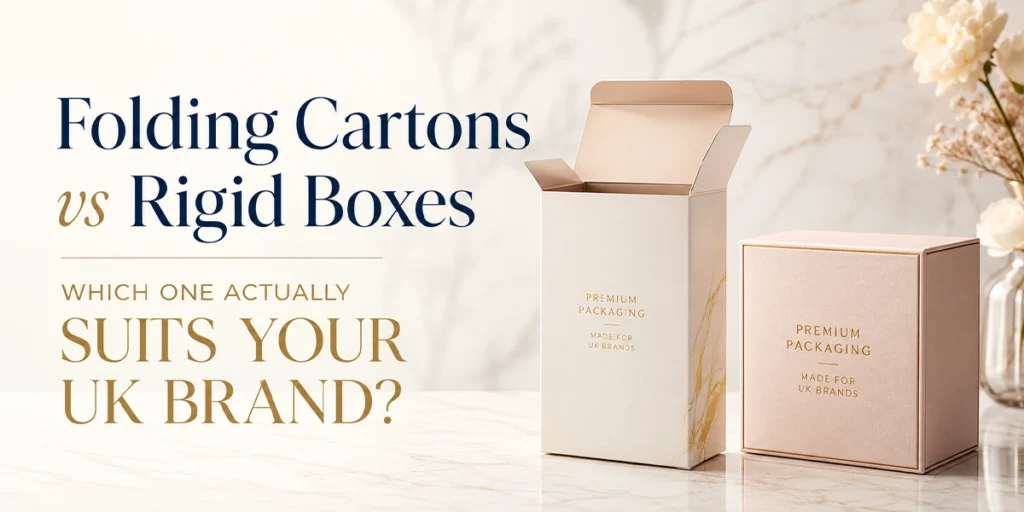
Folding Cartons vs Rigid Boxes: Which One Actually Suits Your UK Brand?
QUICK ANSWER: Folding cartons cost roughly £0.38-£0.95 per unit and suit everyday products under about £20. Rigid boxes cost roughly £2.40-£8.50 per unit and suit gift sets, cosmetics and anything you want to feel premium. Most small UK brands end up using both, one for core stock and one for hero products.
Most people asking “folding cartons vs rigid boxes” aren’t confused about what the boxes look like. They’re trying to work out which one won’t wreck their unit economics or make their product look cheap next to a competitor’s. That’s the question this guide actually answers, with real UK pricing rather than vague “budget-friendly vs premium” labels.
We see this question constantly from candle makers, cosmetics brands and small food producers who’ve outgrown generic packaging but can’t justify a 1,000-unit minimum order. The honest answer depends on your retail price, how fragile your product is, and how much of your brand story the box has to carry on its own.
What’s the real difference between folding cartons and rigid boxes?
A folding carton is made from paperboard, a thinner, foldable board typically measured in GSM (grams per square metre, basically how heavy and stiff the sheet is). It ships flat and gets folded into shape either by the customer or an assembly machine. Think cereal boxes, most cosmetics cartons, and takeaway food packaging.
A rigid box is built from chipboard, a much thicker, non-folding board, then wrapped in printed paper or fabric. It arrives pre-assembled because the whole point is that it doesn’t collapse. That rigidity is what gives premium candle brands and phone manufacturers that reassuring “weighty” unboxing moment.
The trade-off is simple. Folding cartons win on cost and shipping efficiency. Rigid boxes win on perceived value and protection. Neither is objectively “better,” and any guide that tells you otherwise is selling something.
What does each one actually cost in the UK?
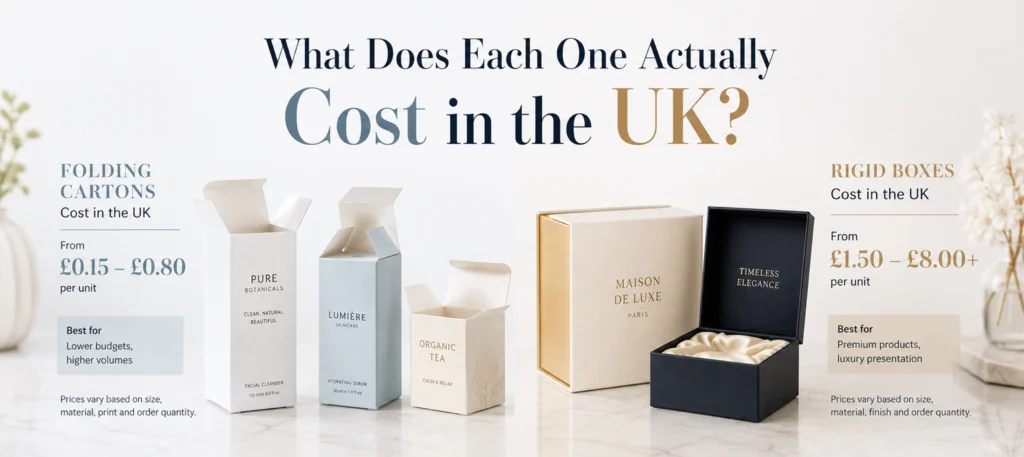
Rigid boxes typically run £2.40 to £8.50 per unit, while folding cartons sit around £0.38 to £0.95 per unit for something like a standard candle box. These are ballpark ranges. Your actual price depends on size, board thickness, finish (foil, spot UV, matte lamination) and order quantity, so always get a like-for-like quote before comparing suppliers.
| Factor | Folding Cartons | Rigid Boxes |
|---|---|---|
| Material | Paperboard (GSM-rated) | Thick chipboard wrapped with decorative paper |
| Typical Cost per Unit | £0.38 – £0.95 | £2.40 – £8.50 |
| Typical MOQ (Trade Suppliers) | 500–1,000 units | 500–1,000 units |
| MOQ at All Custom Packaging | From 100 units | From 100 units |
| Shipping & Storage | Flat-packed, space-efficient, and lower shipping costs | Pre-assembled, requires more storage space and higher shipping costs |
| Lead Time | Faster production with fewer manufacturing steps | Slightly longer production due to additional assembly and wrapping |
| Best Suited For | Everyday retail products, food packaging, pharmaceuticals, and cosmetics | Premium gift sets, luxury cosmetics, electronics, and flagship product packaging |
Worth knowing: most trade printers demand 500 to 1,000 units minimum on either format, which prices out a lot of small brands testing a new product line. All Custom Packaging runs both folding cartons and rigid boxes from 100 units, with free in-house design support and proofing, and a 6-8 business day turnaround once you approve the design. That’s not a universal industry standard, so check MOQ terms with whoever you’re quoting.
Because folding cartons ship flat, brands switching from rigid to folding format often report meaningfully lower freight and warehousing costs, since a pallet can carry far more flat blanks than pre-built boxes. Treat that as a directional saving rather than a fixed percentage. It depends heavily on box size and your shipping lane.
Which one should you choose for your product?
Start with your retail price. Products under about £20 rarely earn back the cost of a rigid box, since the packaging can end up costing more than the profit margin allows. Products over about £50 can look under-presented in a bare-bones folding carton, especially if a competitor on the same shelf is using rigid.
Fragility matters too. Rigid boxes give better physical protection for delicate items like glassware, ceramics or multi-piece gift sets, though a folding carton with a snug insert or foam padding handles most lightweight products fine. If you’re shipping candles or cosmetics direct to customers, check our cosmetic packaging range for formats built around exactly this trade-off.
Brand positioning is the final factor. A rigid box signals “this is special” before the customer even opens it, which is why you’ll find it used heavily across gift boxes and premium cosmetics. Folding cartons can still look sharp with the right finish, foil stamping and spot UV go a long way, but they won’t carry the same weight (literally) in your hand.
For food brands specifically, folding cartons dominate because they’re food-safe, cost-effective at volume, and fast to produce for short shelf-life products. Our food packaging range is built around that reality. Apparel brands tend to sit in the middle, using sturdy folding cartons or mailer-style boxes for core ranges and rigid boxes for capsule collections. Our apparel boxes and mailer boxes categories cover both approaches.
Are folding cartons or rigid boxes more sustainable?
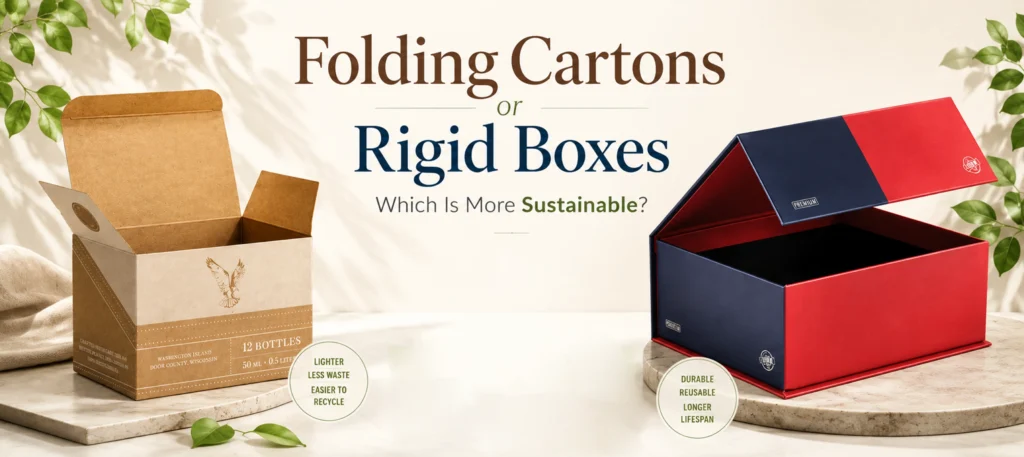
Neither format is automatically the “eco” choice, and it depends far more on the specific board, inks and finish than on whether the box folds flat. Around 69-70% of paper and cardboard packaging gets recycled in the UK, but contamination from food or liquid residue is a genuine problem that keeps otherwise-recyclable board out of the recycling stream.
Both folding cartons and rigid boxes can be made from recycled or FSC-certified board and printed with water-based, low-migration inks. What actually breaks recyclability isn’t the format, it’s laminates, foil finishes and certain adhesives that are harder for UK recycling facilities to process. If sustainability is the deciding factor for your brand, our guide to different types of biodegradable packaging breaks down which materials and disposal routes genuinely qualify.
One thing we get asked about a lot: Extended Producer Responsibility (EPR) fees. Most small businesses ordering custom packaging won’t be liable for the full amount. “Small producer” status generally applies once a business has turnover over £1 million and supplies more than 25 tonnes of packaging a year, well above what most brands reading this handle. Rules change, so check GOV.UK for current EPR guidance rather than assuming either way.
One genuinely new development for 2026: WRAP’s UK Packaging Pact launches in April, replacing the UK Plastics Pact with a broader push toward circular packaging systems across the whole supply chain, not just plastics. It’s early days, but it’s worth watching if recyclability claims matter to your customers.
Can you use both?
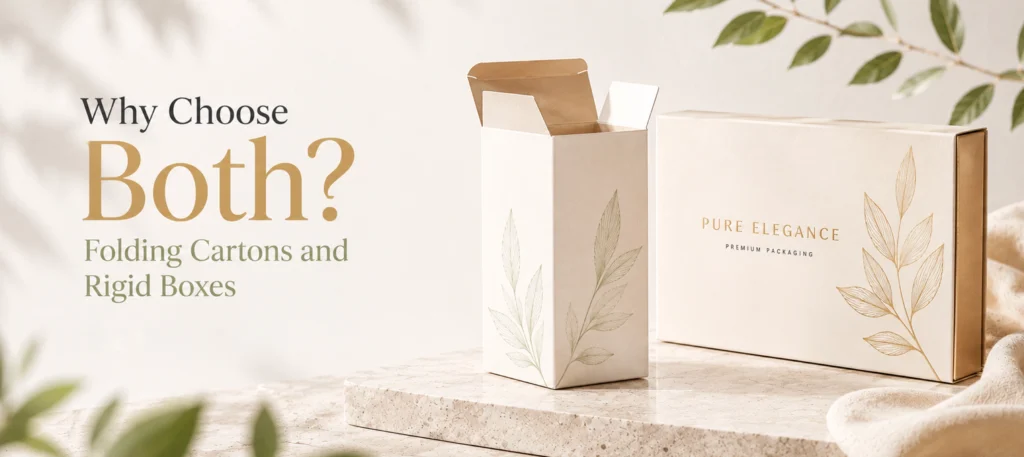
Yes, and plenty of brands do exactly that rather than picking one format for everything. A common pattern is rigid boxes for gift sets, limited editions or flagship products, paired with folding cartons for the everyday range that ships in higher volume. It lets you control cost where it matters most while still giving your hero product the premium unboxing moment.
This hybrid approach works particularly well for cosmetics and candle brands launching a signature scent or shade alongside a wider core range. The flagship item earns the rigid box treatment. The rest of the catalogue stays profitable in folding cartons.
Frequently asked questions

Do rigid boxes cost more to ship than folding cartons?
Generally yes. Rigid boxes arrive pre-assembled and take up significantly more room per unit than flat-packed folding cartons, which increases freight and warehousing costs, especially over long shipping lanes.
What’s the minimum order quantity for custom rigid boxes in the UK?
Most trade suppliers set MOQs of 500 to 1,000 units. All Custom Packaging offers custom rigid boxes from 100 units, which suits brands testing a new product before committing to a bigger run.
Can folding cartons look premium?
Yes, with the right finish. Foil stamping, spot UV, and matte or soft-touch lamination can lift a folding carton well beyond “basic,” though it still won’t match the weight and rigidity of a true rigid box.
Are folding cartons recyclable if they have foil or laminate?
It depends on the finish. Plain paperboard folding cartons recycle easily through standard UK kerbside collection, but heavy foil, plastic lamination or certain adhesives can make a carton harder to process. Ask your supplier exactly what finish is being used before assuming it’s recyclable.
Do I need to worry about EPR packaging fees as a small business?
Most small brands won’t meet the “small producer” thresholds (turnover over £1 million and 25+ tonnes of packaging supplied annually), so they’re unlikely to owe full EPR fees. Check GOV.UK for current rules, since this isn’t legal advice and thresholds can change.
Key takeaways
- Folding cartons cost roughly £0.38-£0.95 per unit; rigid boxes cost roughly £2.40-£8.50 per unit, both varying by size, finish and quantity.
- Products under about £20 rarely justify a rigid box; products over about £50 can look under-presented in a basic folding carton.
- Most trade suppliers need 500-1,000 units minimum; All Custom Packaging starts both formats from 100 units.
- Neither format is automatically more sustainable. What matters is the board, inks and finish, not whether it folds flat.
- Many brands run a hybrid strategy: rigid boxes for flagship products, folding cartons for the core range.
If you’re weighing up folding cartons against rigid boxes for your own product line, it helps to see and hold samples of both before committing to a print run. Get in touch for a free quote and design proof, or browse our rigid boxes range to see what’s possible from a 100-unit minimum order.