
The Characteristics of Corrugated Cardboard: Structure, Strength and Testing Explained
Quick answer: Corrugated cardboard is not one material but a three layer sandwich: two flat sheets of linerboard glued to a wavy fluting medium in between. That fluted middle layer, not the liners, is what gives the board its crush resistance and cushioning. Strength is not something you can judge by feel or by GSM alone.
The industry actually measures it with three different tests: the edge crush test (ECT), the Mullen burst test and the box compression test (BCT). They exist because “strong” means different things, depending on whether a box needs to survive stacking, a sharp knock, or a rough journey.
Moisture is the material’s real weak point: a board that tests well bone dry can lose a large share of its stacking strength once it picks up humidity. And while corrugated cardboard is one of the most recycled materials in the UK, coatings and laminates can take a specific box out of standard recycling streams even though the base material is paper.
If you already know you need corrugated packaging and just want help choosing the right flute or wall thickness for your own box, ACP’s Cardboard Grades, GSM and Flutes Explained guide covers that buying decision directly, letter by letter. This piece sits underneath that one. It looks at what the material actually is, how it is made, how its strength is actually tested, and what changes that strength once a box leaves a lab and goes into the real world.
What is corrugated cardboard, structurally?
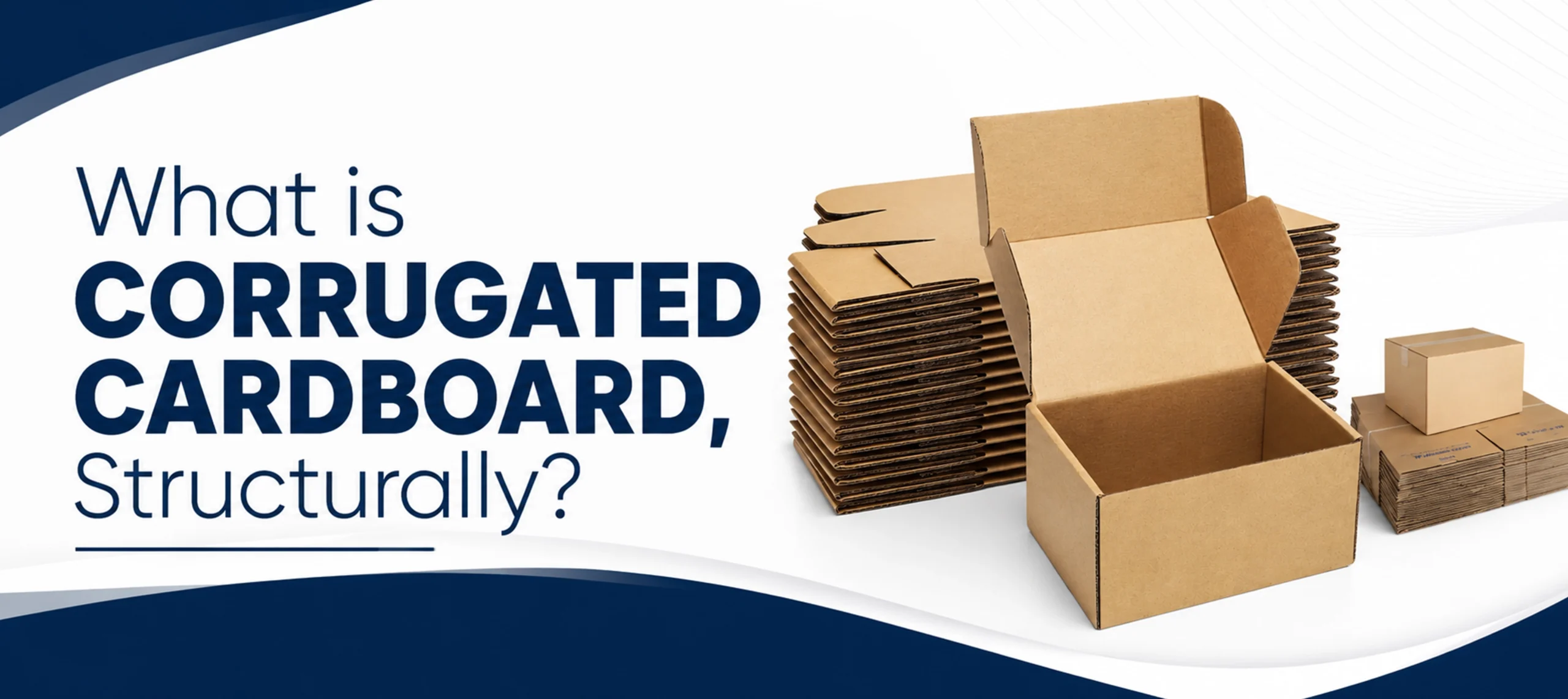
Corrugated cardboard is not thick paper. It is a composite, built from three separate sheets that only become strong once they are joined together.
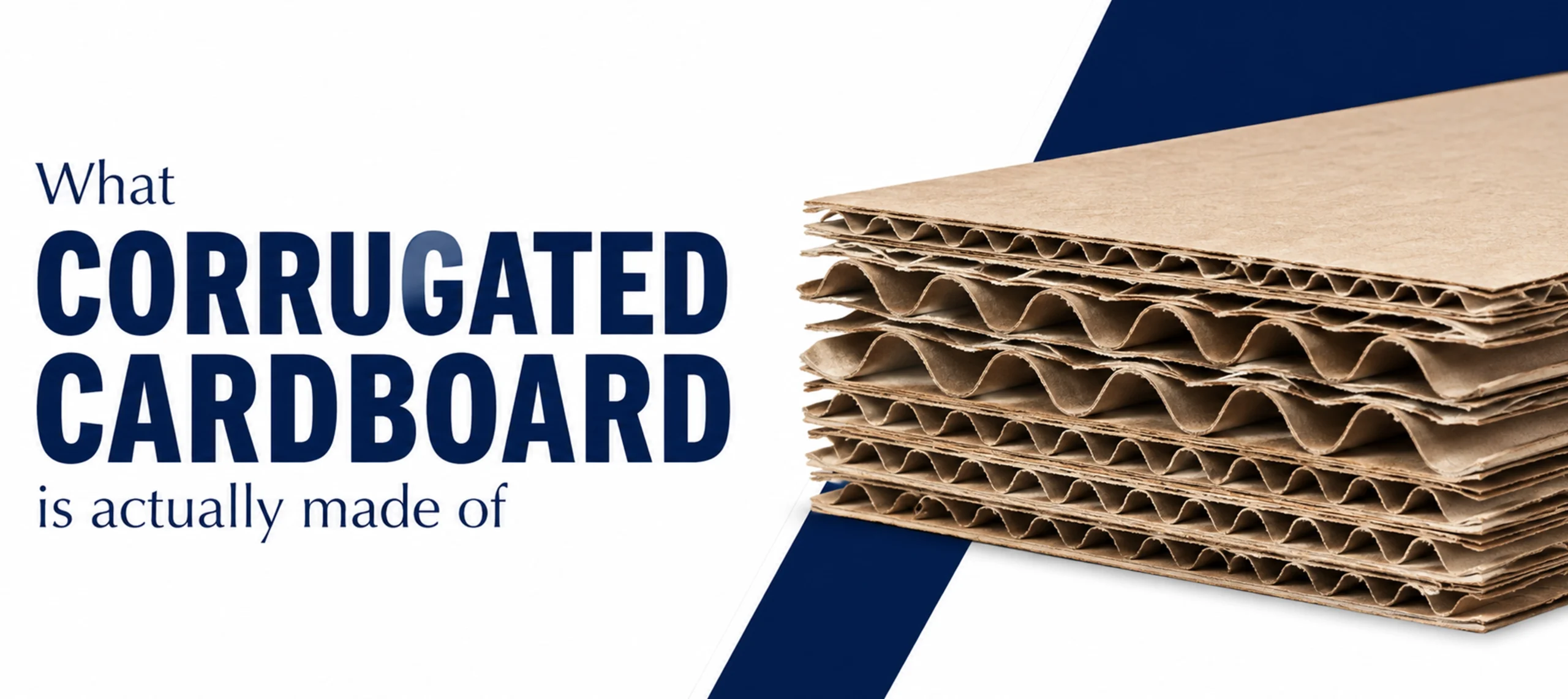
The two outer sheets are called linerboard, and they are flat, smooth and fairly plain on their own. Between them sits the fluting medium: a sheet of paper that has been formed into a continuous series of arches, then glued to both liners along the tips of every arch. That gluing step matters as much as the material itself.
A loose fluted sheet folds flat under almost no pressure at all. Bonded to two liners, the same sheet resists crushing from above, because the arches act like a row of tiny columns sharing the load instead of one flat sheet taking it alone.
This structure is also directional, which is a detail most buying guides skip entirely. Corrugated board resists a downward crushing force, the kind a stack of boxes puts on the one underneath, far better than it resists a sideways force pushed along the length of the flutes. That is not an accident.
It is the entire point of the arch shape, and it is also why the standard strength test squeezes a sample in one specific direction rather than any direction at random. A number on a spec sheet only means anything once you know which way the board was tested.
Single wall board (one fluting layer between two liners) is what most people picture. Double and triple wall board simply repeat the same liner and flute pairing two or three times for extra strength. That part, wall count and which flute size to pick for a given weight, is exactly what our flutes and grades guide already walks through, so it is not repeated here.
What corrugated cardboard is actually made of
Both the liner and the fluting medium start life as paper, but they are not the same grade of paper, and the fibres inside them are not interchangeable.
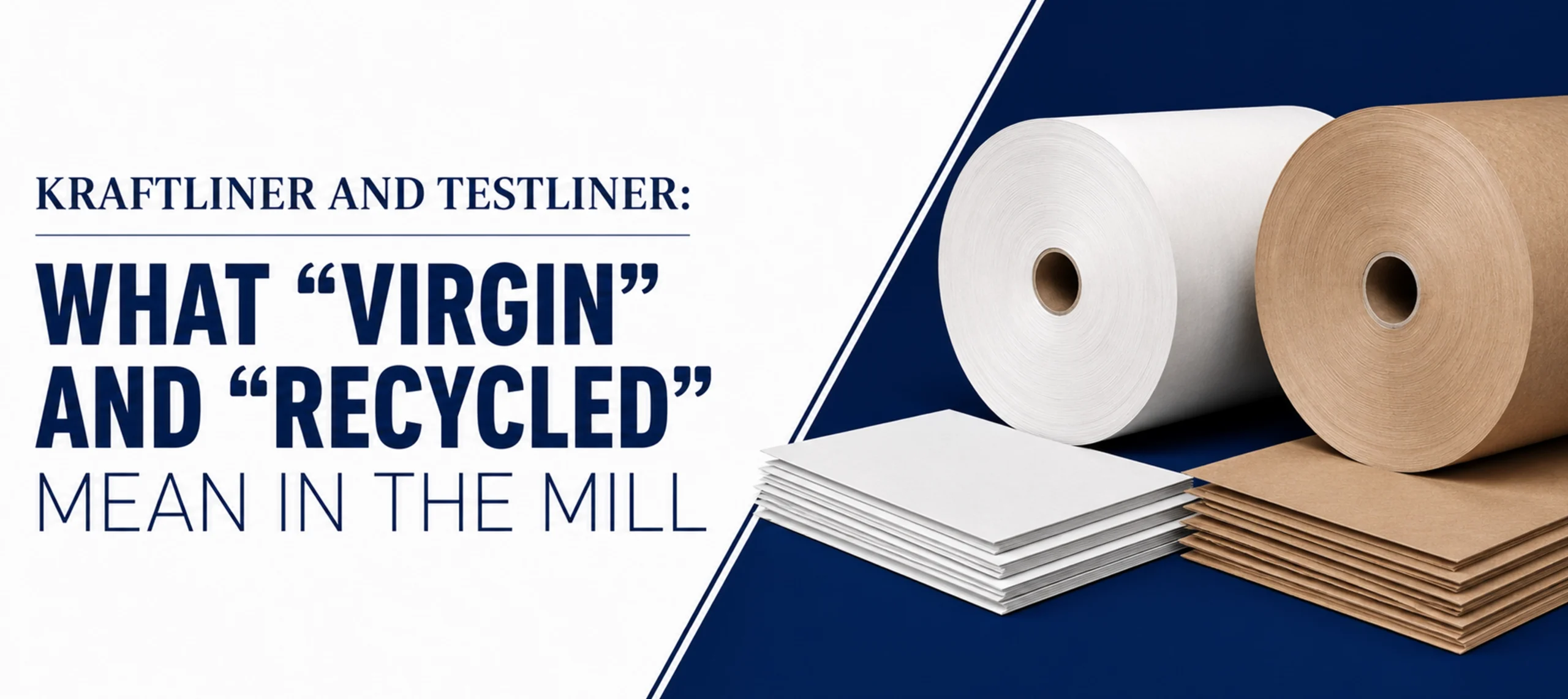
Linerboard comes in two broad types. Kraftliner is made mainly from virgin wood pulp, fibre that has never been through a paper mill before. Testliner is made mainly from recovered fibre, paper and card that has already been used once (often old corrugated boxes themselves) and reprocessed. The fluting medium has a similar split. Semi-chemical fluting is made from a high proportion of virgin hardwood fibre, chemically softened just enough to fold into the arch shape without cracking. Recycled fluting is made from recovered waste paper instead.
The fibre source is not a minor detail. Every time a cellulose fibre goes through a pulping and drying cycle, it comes out slightly shorter and stiffer than it went in. Virgin fibres are at their longest and most flexible the first time they are used, which is exactly what makes them bond together most strongly and resist crushing best.
Recycled fibres have already been shortened by at least one previous cycle, so a board built entirely from recycled liner and fluting will generally need to be heavier to match the strength of a lighter board built from virgin fibre. That trade off, strength per gram versus environmental positioning and cost, is the real reason “recycled” and “premium strength” rarely sit on the same spec sheet, not because recycled board is a lesser material in some vague sense.
Kraftliner and testliner: what “virgin” and “recycled” mean in the mill
It helps to know what actually happens before either paper reaches a corrugator.
Kraftliner takes its name from the kraft pulping process, a chemical method that dissolves the lignin binding wood fibres together while leaving the cellulose fibres themselves largely intact and unusually long. That is a deliberate trade: kraft pulping produces a lower yield of paper from a given amount of wood than gentler methods, but the fibres that come out are strong enough that “kraft” has become industry shorthand for strength generally, well beyond papermaking.
Unbleached kraftliner keeps its natural brown colour because it skips the bleaching stage entirely, which is also why brown kraft board tends to be marketed as the more natural, more sustainably positioned option.
Testliner works from the opposite direction. It starts as recovered fibre, most commonly old corrugated containers collected, pulped back down into a slurry and reformed into new paper. Because it is rebuilding paper from fibres that have already been through at least one full cycle, testliner is often constructed in layers rather than as one uniform sheet. A cleaner recycled ply typically faces outward for a better print surface, with a coarser recycled ply behind it.
Semi-chemical fluting sits in between the two liner types: it uses mostly virgin hardwood fibre, but a less intensive chemical process than full kraft pulping, which keeps cost down while still producing a medium stiff enough to hold its arched shape under load.
A quick word on flutes
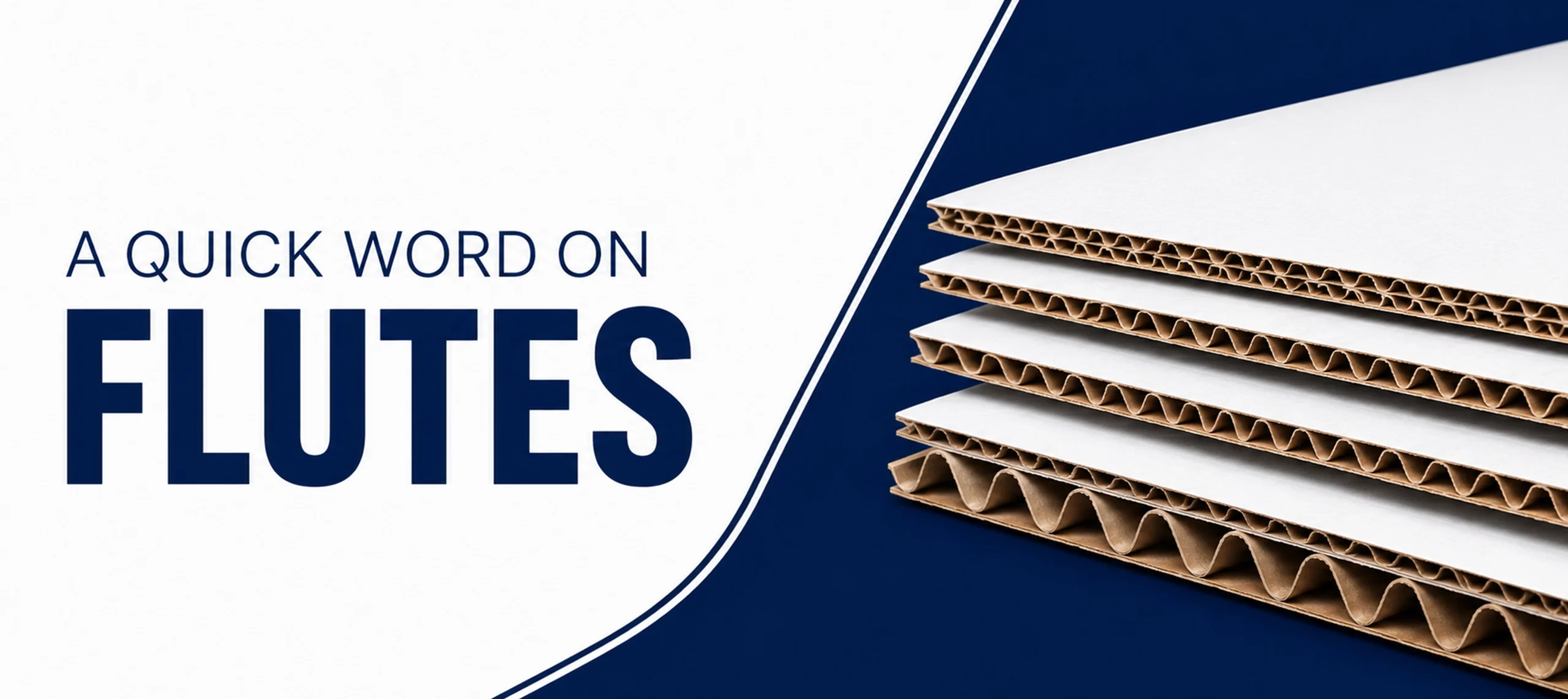
The arches themselves come in a handful of standard sizes, referred to by letter (A, B, C, E and F are the common ones), and the letter mostly describes how tall each arch is and how many arches fit into a given length of board. Taller arches generally cushion and absorb shock better. Shorter, tighter arches generally crease more cleanly and print better, because there is less of a wave pattern showing through the liner.
Picking the right one for a specific product is a genuinely separate question from anything in this guide, and it is one our Cardboard Grades, GSM and Flutes Explained post answers directly, flute by flute, with the weight ranges and product types each one typically suits. Come back to that guide once you know what this piece is about: what the board actually is and how its performance is actually checked.
How corrugated board strength is actually tested: ECT, Mullen and BCT
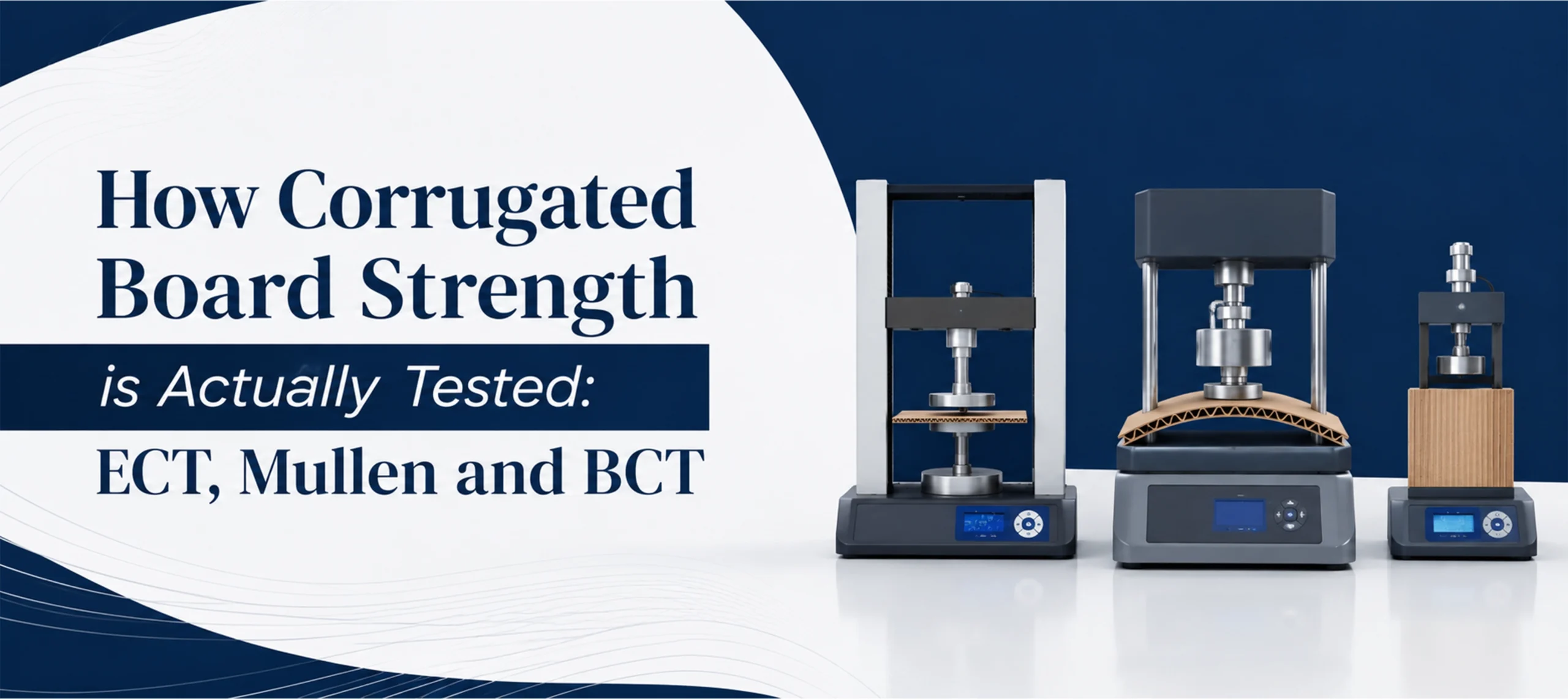
None of the three standard strength tests measure the same thing, and a board can look comfortable on one test while being borderline on another.
Edge crush test (ECT) compresses a small sample of the board on its edge, in the direction a stack of boxes actually loads it, until the board buckles. The result is reported as a force per unit width, in kilonewtons per metre (kN/m) under the ISO 3037 method, or sometimes in pounds per inch on older or US specified board. ECT is the figure most closely tied to how well a box will hold up under a stack of other boxes on a pallet.
Mullen burst test, often just called the burst test, is older and works completely differently. It clamps a sample flat and pushes a rubber diaphragm against the underside until it bursts straight through the face of the board, measuring resistance to a sharp poke or a puncture rather than a crushing force. A board can have a perfectly respectable burst rating and still buckle under a stacking load that a lower burst, higher ECT board would shrug off, because the two tests are checking for different failure modes.
Box compression test (BCT) is the only one of the three that tests a complete, assembled, empty box rather than a flat sample of board. The finished box is compressed from top to bottom until it collapses, and the result is reported as an actual force, commonly in kilograms force or pounds force. It is the closest of the three to a real pallet, because it accounts for the box’s shape and size, not just the board it is made from.
| Test | What it actually measures | Typical unit | Tests the board or the finished box? | When it matters most |
| ECT (edge crush test) | Resistance to crushing force along the board’s edge, the same direction a stack of boxes pushes down | kN/m (also lb/in on some US specified board) | Board sample | Predicting how a box will perform stacked on a pallet |
| Mullen burst test | Force needed to push a diaphragm straight through the face of the board | psi, or “Mullen points” | Board sample | Resistance to a sharp knock or puncture through the face; less relevant to stacking |
| BCT (box compression test) | Peak force a complete, empty, assembled box withstands before it collapses top to bottom | kgf or lbf (force) | Finished box | The real world figure a warehouse or pallet stacking plan actually needs |
The three are connected, but not interchangeable. In 1963, researchers McKee, Gander and Wachuta published a formula, still referred to simply as the McKee formula, that estimates a box’s BCT from its board’s ECT, the board’s thickness and the box’s own perimeter. It exists because crushing a finished box on a lab press for every single specification is slow and expensive, while testing a flat sample of board is quick.
As a rough guide, a higher ECT board generally produces a higher BCT box once it is made up. To put ECT numbers in perspective: a board rated at roughly 32 lb/in (about 5.6 kN/m, converting the imperial rating still used to describe some US specified board) is generally treated in the trade as enough for general parcels of moderate weight. Taller stacks or heavier loads call for board closer to 44 lb/in (about 7.7 kN/m) or higher.
Treat figures like that as a starting point for a conversation, not a guarantee. The McKee formula was built around single wall boxes of a fairly standard shape, and it explicitly does not account for humidity, how long a box sits under load, or rough handling, all of which move the real number.
Why a box can test perfectly and still fail: moisture and temperature
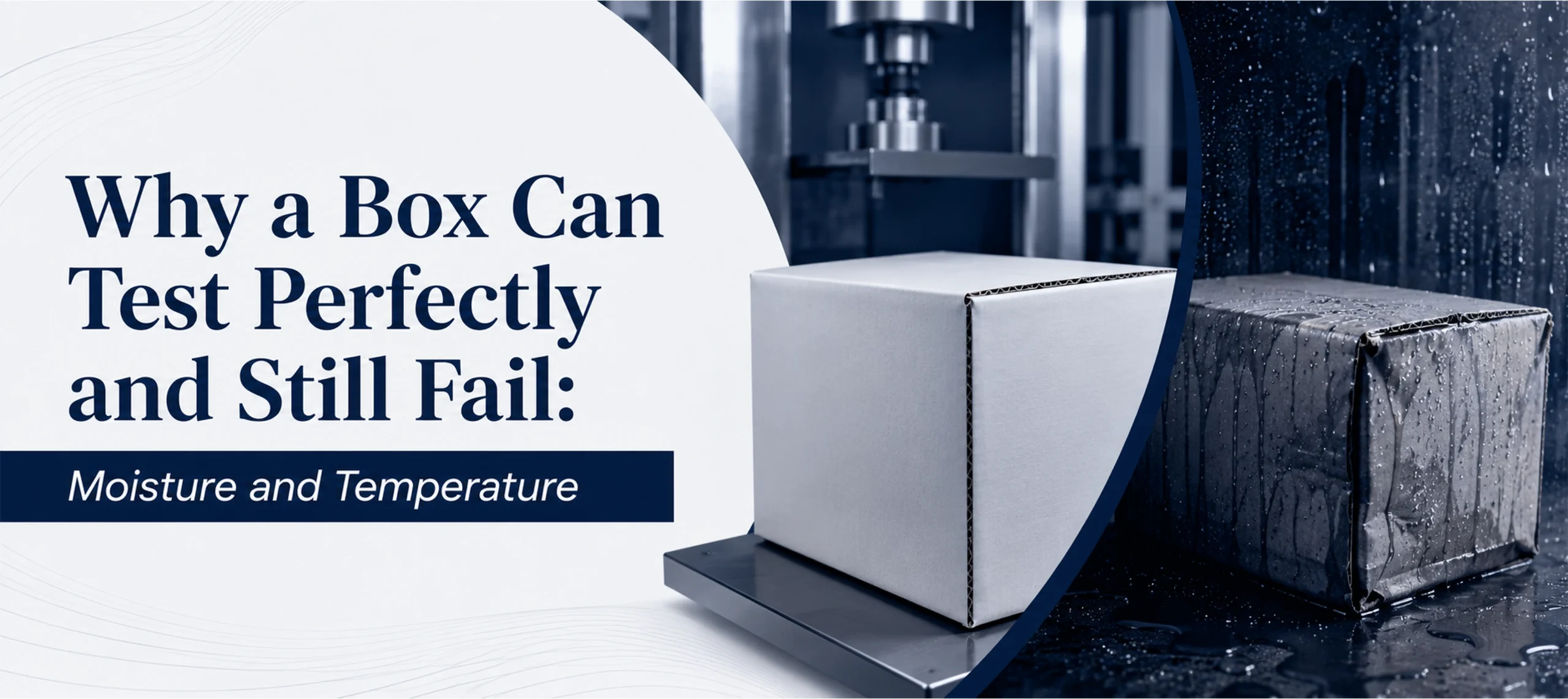
A board’s ECT and BCT figures are measured in stable, dry laboratory conditions, and every one of those figures drops once the board picks up moisture, whether from rain, condensation, a damp warehouse or simply humid air.
Paper fibres bond to each other partly through hydrogen bonds that form between adjacent cellulose fibres as the sheet dries during manufacture. Water molecules interfere with exactly those bonds, so as a board absorbs moisture, from wet weather or just ambient humidity, the fibre network genuinely softens rather than merely feeling damp on the surface.
Corrugated board is hygroscopic: it will pull moisture out of humid air over time even if it is never directly rained on, which is why a box stored in a damp unit over a UK winter can weaken without ever looking wet.
Packaging research into this effect consistently finds the drop is not small. Once relative humidity climbs above roughly 30%, fibres begin to soften measurably, and ECT is generally the most sensitive of the standard strength measures to both humidity and temperature change.
As an illustration of scale rather than a precise universal figure, studies in this area have found board that performs at its full rated strength at a dry moisture content of around 7 to 8% can drop to somewhere around 85 to 90% of that rating once moisture content reaches 12 to 13%. Strength can fall by over half once moisture content passes about 16%.
That matters well beyond boxes left out in the rain. Chilled and frozen goods, produce, anything shipped through a humid climate, or stock stored in an uninsulated unit through a damp UK winter can all quietly lose stacking strength long before a box looks visibly wet.
Where that risk is real, the trade addresses it with water resistant treatments rather than simply specifying a heavier board. Options include wax coatings or full wax dips, which are highly effective but take the board out of standard paper recycling streams, and water resistant chemical treatments applied to the liner itself during manufacture.
Lighter protective coatings, like the aqueous coating ACP offers as a published finish option, add a protective surface layer rather than genuine water resistance. It’s worth being specific with a supplier about what “protected from moisture” actually needs to mean for your product and its journey, rather than assuming any coating does the same job.
Is corrugated cardboard recyclable? The real UK picture
Corrugated cardboard, as a base material, recycles well, and the UK figures back that up, but the honest answer depends on the full construction, not just the word “cardboard” on its own.
Defra’s provisional figures for 2024 put the UK recycling rate for paper and cardboard packaging at 86.4% under one of the two methodologies used in the official release (74.3% under the alternative method). The gap is explained by which packaging-arising dataset each method uses as its denominator, not by different amounts actually being recycled. Either way, paper and cardboard was the best performing packaging material category that year, ahead of both glass and metal.
Separately, OPRL (On Pack Recycling Label), the scheme most UK packaging carries its recycling label from, classifies plain corrugated cardboard as “Widely Recycled,” its top tier. That means it is collected for recycling by at least 75% of UK local authorities through standard kerbside or local collection. Those are two different measurements, a national recycling rate and a household collection coverage threshold, not the same statistic phrased two ways, and it is worth keeping them separate rather than blending them into one bigger sounding number.
Both figures describe plain, uncoated corrugated board. They do not automatically apply to every box that uses corrugated as its base material. Wax coated or wax dipped board, heavy plastic lamination, foil, and plastic film windows all change what happens to a box at a recycling facility. Sometimes that rules it out of standard paper recycling streams entirely, even though the board underneath is the same material described above.
Tape and heavy contamination, food grease being the common example, cause the same problem in smaller ways. None of that makes corrugated cardboard a bad recycling choice. It makes “is this recyclable” a question about the finished, specified box, coating, lamination, adhesive and all, rather than a question with one answer that applies to every box built from it.
If you’re specifying a box and recyclability genuinely matters for your product, the honest approach is to confirm it against the finished specification, not the base material alone, and against the collection reality in the areas your customers actually live.
Getting the specification right for your own box
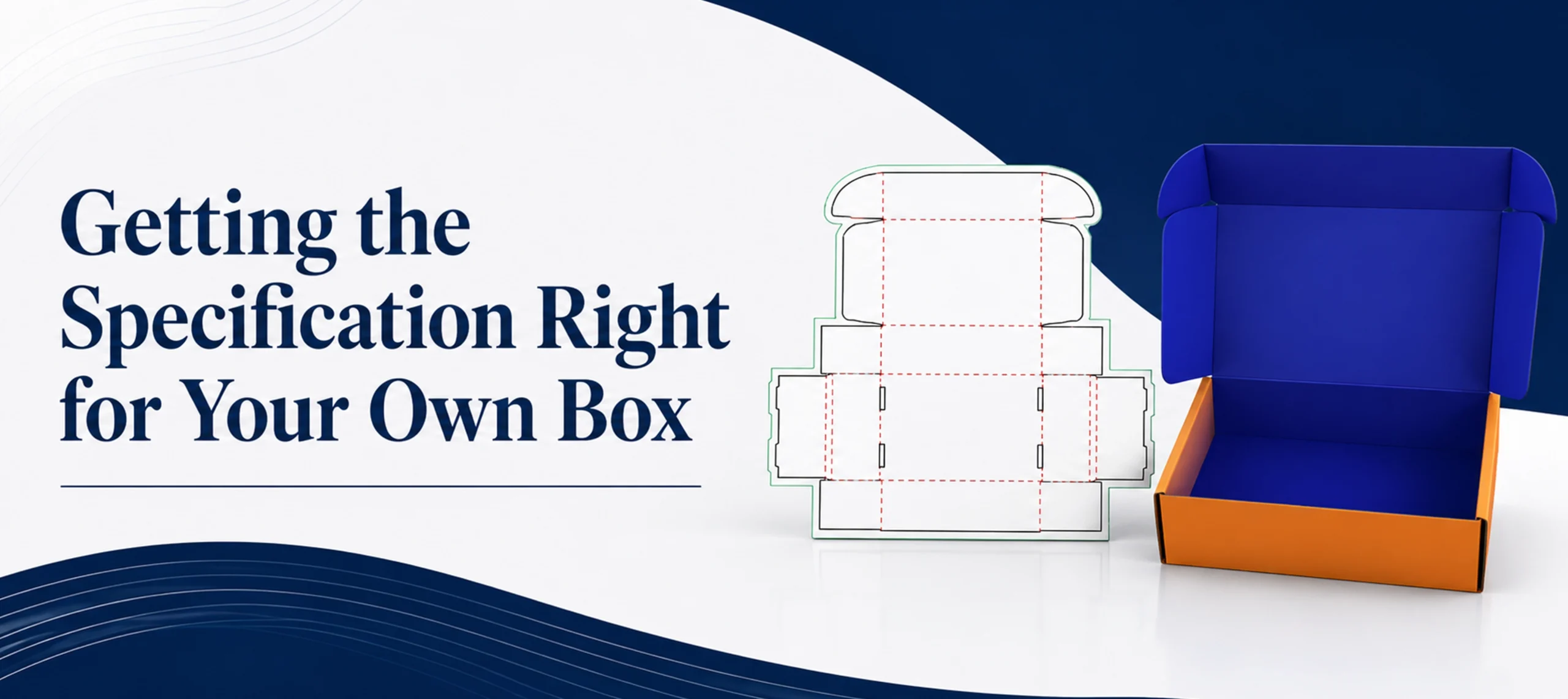
Everything above explains what corrugated cardboard is and how its performance is actually measured. It is not, on its own, enough to tell you which board, flute or wall count a specific product needs, because that depends on the product’s weight, shape, how it travels and how long it sits in storage, not on any single figure in isolation.
That is exactly the conversation ACP’s design and quote process exists for. Browse our Corrugated Shipping Boxes range to see the finished product, or simply get in touch with your product’s weight, dimensions and how it will be shipped, and the specification gets confirmed against that rather than a generic chart.
Frequently asked questions

What is corrugated cardboard actually made of? Two flat sheets of linerboard glued to a wavy fluting medium in between. The liners can be kraftliner (mainly virgin fibre) or testliner (mainly recycled fibre), and the fluting medium is either semi-chemical (mostly virgin hardwood fibre) or recycled.
What is the difference between ECT, Mullen and BCT tests? ECT (edge crush test) measures how well a flat sample of board resists a crushing force, in kN/m, and relates closely to stacking strength. The Mullen burst test measures how much force is needed to push straight through the face of the board, a puncture test rather than a crushing one. BCT (box compression test) is the only test run on a complete, assembled box rather than a flat sample, measuring the peak force the finished box withstands before it collapses.
Does humidity really affect how strong a cardboard box is? Yes, measurably. Corrugated board is hygroscopic and absorbs moisture from humid air even without being rained on. As moisture content rises, the hydrogen bonds holding cellulose fibres together weaken, and research into the effect has found strength can drop to roughly 85 to 90% of its dry rating at moderate moisture levels, and by over half at higher moisture levels. ECT is generally the most humidity sensitive of the standard tests.
Is corrugated cardboard recyclable in the UK? Plain corrugated cardboard is. Defra’s provisional 2024 figures put the UK recycling rate for paper and cardboard packaging at 86.4% (74.3% under an alternative measurement method), the best performing packaging material category that year, and OPRL classifies plain corrugated board as “Widely Recycled,” collected by at least 75% of UK local authorities. Coated, laminated or heavily contaminated boxes do not automatically share that outcome, since recyclability depends on the full construction, not the base material alone.
What is the difference between kraftliner and testliner? Kraftliner is made mainly from virgin wood pulp using the kraft chemical pulping process, which keeps fibres long and produces a stronger, often naturally brown board. Testliner is made mainly from recovered fibre, commonly old corrugated containers reprocessed into new paper, and is generally somewhat weaker gram for gram because recycled fibres shorten with each processing cycle, though it costs less and supports a lower virgin material footprint.
Why does corrugated board behave differently depending on which direction you press it? The fluting medium’s arches are built to resist a downward crushing force, the same direction a stack of boxes loads the one underneath, far better than a sideways force pushed along the length of the flutes. This is why the standard strength tests apply force in one specific, defined direction rather than any direction, and why a board’s rated strength assumes it is being loaded the way it was actually tested.
Key takeaways
- Corrugated cardboard is a three layer composite: two linerboard sheets glued to a fluted medium, not a single uniform material.
- The board is directional. It resists a downward crushing force far better than a sideways one, which is why standard tests apply force in one specific direction.
- Three different tests exist because “strong” means different things: ECT (kN/m) predicts stacking strength, the Mullen burst test measures puncture resistance, and BCT tests a complete finished box.
- The McKee formula, published in 1963, estimates a box’s BCT from its board’s ECT, thickness and perimeter, but it does not account for humidity or rough handling.
- Moisture is the material’s real weak point. Research indicates strength can fall to roughly 85 to 90% of its dry rating at moderate moisture content, and by over half at higher moisture content, well before a box looks visibly wet.
- Corrugated cardboard recycles well in the UK (Defra: 86.4% of paper and cardboard packaging recycled in 2024 under one methodology; OPRL: plain board is “Widely Recycled”), but coatings, lamination and heavy contamination can take a specific box out of standard recycling streams.