

M, MM, ML and MIL: What These Packaging Measurements Really Mean
M, MM, ML and MIL look almost identical on a page, yet they measure four different things, and case matters more than most people expect. Lower case mm is a length, the millimetre. Capital MM is trade and finance shorthand for a million. ML is a volume, the millilitre. MIL is a thickness, one thousandth of an inch, and it is the one a packaging buyer meets most often. M on its own is the slippery letter, because it means the metre in everyday metric, the prefix mega (a million) in science, and one thousand in the print and packaging trade, where a price quoted “per M” is a price per thousand units. The figure that matters most in the UK is the thickness one. One mil equals 25.4 microns, and British film is specified in microns and gauge rather than mils, so getting that single conversion right is what stops an American spec sheet being a guessing game.
Search this question and you will find a row of confident pages that quietly disagree with each other. One says M means mega. Another says M means metre. A third prints a thickness figure that is simply wrong. The honest answer is that M is genuinely context dependent, so a good guide tells you which meaning applies where instead of picking one and hoping. This guide does that, gives you one clean conversion table you can keep, and then spends its energy on the part no UK buyer is served on anywhere: turning mils into the microns and gauge that British suppliers and spec sheets actually use.
Why these four get muddled in the first place

They get muddled because they share letters, they sit next to each other on quotes and spec sheets, and they come from two different measuring systems that were never meant to mix.
M, MM and ML are metric shorthand. MIL is imperial, an American unit that almost never appears in British metric documents but turns up the moment you read a US supplier’s spec, an imported film reel, or a datasheet written for the American market. So a UK buyer often meets all four on the same desk on the same day, one from a local quote and one from an overseas datasheet. The eye then slides over the difference between a millimetre and a mil at exactly the point where that difference decides whether a bag is fit for the job.
Case is the other trap. In metric, capitals and lower case are not decorative, they change the meaning. Lower case m is the metre. Capital M is the prefix mega. Lower case mm is the millimetre. Capital MM, in trade and finance, is a million. Treating MM and mm as the same word is how a quote for materials “per MM” gets read as millimetres when it means per million, and the numbers stop making sense.
What each one actually measures
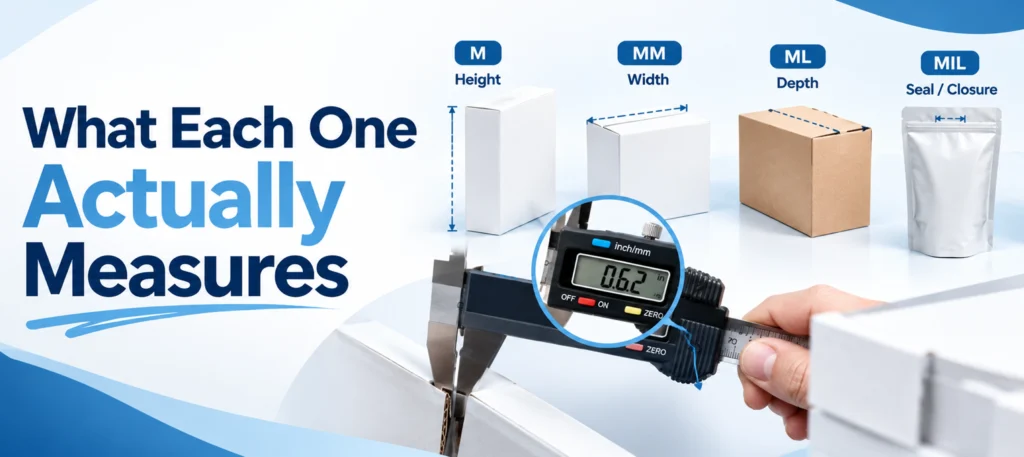
Here is each abbreviation on its own, with the meaning a packaging buyer needs and the trap that sits behind it.
M measures nothing by itself. It is a multiplier or a symbol whose value depends entirely on context. As a metric unit symbol, lower case m is the metre, the base unit of length. As a metric prefix, capital M is mega, meaning one million, as in MB for a megabyte. In the print and packaging trade it carries a third, older meaning: one thousand, from the Latin mille, the same root as the Roman numeral M. That is why a printer or box supplier quoting “per M” or “price/M” means a price for every thousand units, not a price per metre or per million. The UK printer B and B Press lists exactly this usage in its glossary of printing terms. If a quantity-based price on a quote looks strangely low, check whether it is a per M figure before you celebrate.
MM in strict metric is not a unit at all, because the millimetre is written in lower case as mm. Capital MM is a separate convention borrowed from Roman numerals, where M is a thousand and MM is a thousand thousand, so MM has come to mean a million in finance, accounting and some materials pricing. AccountingCoach explains the same origin. Worth knowing: strictly, the Roman numeral MM is 2,000, so this usage is a convention rather than pure maths, and that is precisely why plenty of people now write K for thousand and M for million to avoid the clash. For packaging, the practical rule is simple. Lower case mm on a box drawing is millimetres. Capital MM on an invoice or a volume-pricing line is almost always a million.
mm, the millimetre, is the one you will use most and the one that is not ambiguous. It is one thousandth of a metre, ten of them make a centimetre, and it is the standard unit for every box dimension a UK supplier will quote. Length, width, height, board thickness in some contexts, bleed and safety margins on artwork are all in millimetres. If you want the practical side of using it, our guide to measuring box dimensions correctly covers which figure is which and why the order matters.
ML, the millilitre, is the odd one out, because it measures volume rather than length or thickness. One millilitre is one thousandth of a litre, and it is exactly one cubic centimetre. In packaging it appears on the product going inside, a 250ml bottle, a 30ml sample, a 500ml jar, rather than on the box itself. It matters to a packaging buyer only in that the fill volume drives the size of the container, which drives the size of the box and the void fill around it. It is never a thickness and never a length.
MIL is the one worth slowing down for. A mil is one thousandth of an inch, written 0.001 in, and it measures thickness. It is the standard American way to describe the thickness of plastic film, poly mailers, sheeting, laminate and mylar. A mil is not a millimetre and not a millilitre, and it is roughly forty times thicker than the sound of the word suggests, because a mil is 0.0254 mm. This is the abbreviation that the weaker guides get wrong, and getting it wrong on a film order is expensive, so it gets its own section below.
One correct conversion table
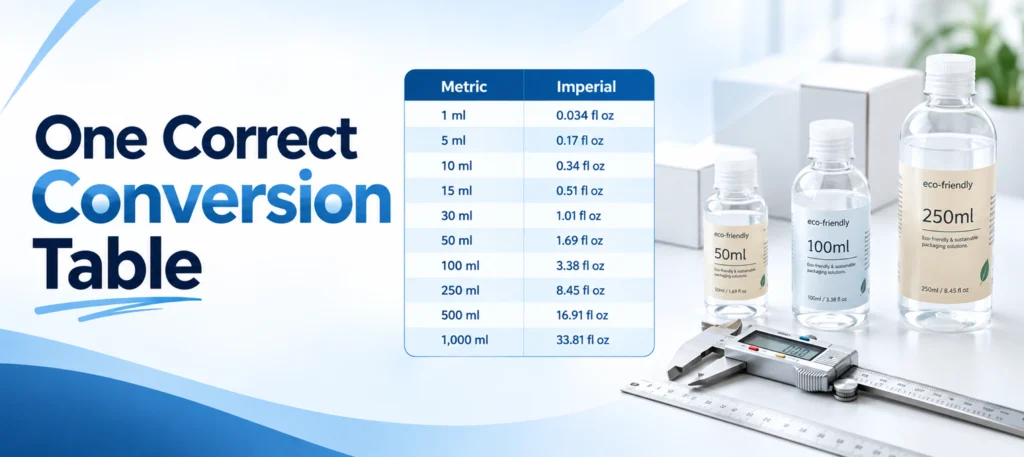
Most of the confusion disappears once the numbers sit in one place. This is the table no competitor on this topic has printed correctly and completely, so it is worth keeping.
| Abbreviation | Case | What it means | What it measures | Metric value |
|---|---|---|---|---|
| m | lower case | metre | length | base unit of length |
| M | capital | mega (a million) in science; one thousand in the print trade | a multiplier | 1,000,000 or 1,000 by context |
| mm | lower case | millimetre | length | 0.001 metre |
| MM | capital | a million (finance and trade) | a multiplier | 1,000,000 |
| ml or mL | lower case | millilitre | volume | 0.001 litre, or 1 cubic centimetre |
| mil | not case sensitive | one thousandth of an inch | thickness | 0.001 inch, which is 0.0254 mm |
Every value in that table is either a definition or fixed arithmetic. The only two lines that are conventions rather than pure maths are the trade meanings of M and MM, and both are flagged as such so you know when to double check the intent behind a quote.
Mil, micron and gauge: the conversion that actually matters in the UK
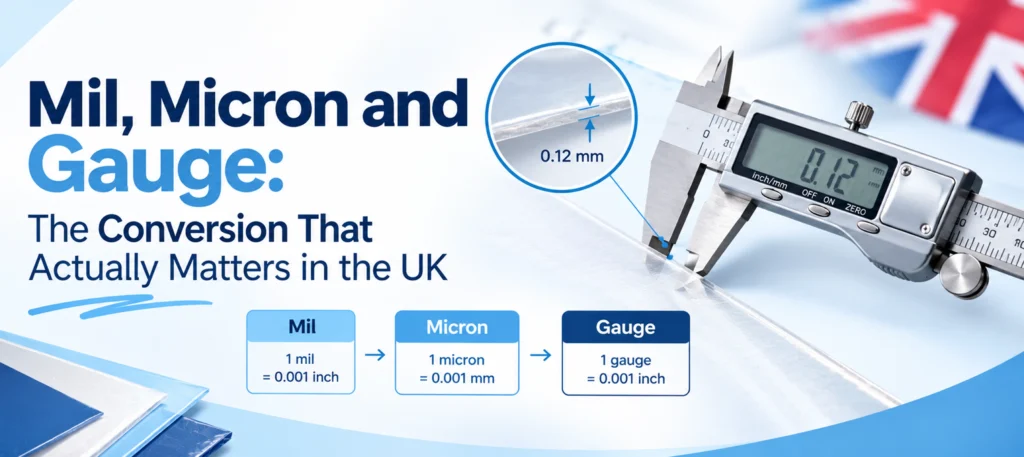
Here is the practical payoff, and it is the one thing a UK buyer genuinely cannot find done properly elsewhere. The UK does not usually spec film thickness in mils. It uses microns, and sometimes the older unit gauge. So when a US datasheet or an imported reel gives you a thickness in mils, you need to translate it before you can compare it to anything a British supplier quotes.
The relationships are fixed. One mil is 0.001 of an inch. An inch is exactly 25.4 mm, so one mil is 0.0254 mm, which is 25.4 microns, because a micron is one thousandth of a millimetre. Gauge is the older film unit, and the standard plastic film convention sets 100 gauge to one mil, so gauge is simply mil multiplied by 100. A film conversion reference such as Carepac’s gauge, mil and micron chart sets out the same relationships. Put together, one mil equals 100 gauge equals 25.4 microns equals 0.0254 mm, and every other value scales straight off that.
This table turns a US mil figure into the microns a UK supplier will recognise.
| Thickness in mil | Gauge | Microns | Millimetres |
|---|---|---|---|
| 1 mil | 100 | 25.4 | 0.0254 |
| 1.5 mil | 150 | 38.1 | 0.0381 |
| 2 mil | 200 | 50.8 | 0.0508 |
| 3 mil | 300 | 76.2 | 0.0762 |
| 4 mil | 400 | 101.6 | 0.1016 |
And because UK quotes usually start from microns, here is the same relationship the other way round, for the gauges British buyers see most.
| Thickness in microns | Mil | Gauge |
|---|---|---|
| 50 microns | 1.97 mil | 197 |
| 100 microns | 3.94 mil | 394 |
| 200 microns | 7.87 mil | 787 |
To convert quickly in your head: microns to mil, divide by 25.4; mil to microns, multiply by 25.4; microns to gauge, multiply by about 3.94; gauge to microns, multiply by 0.254. A common real example makes it concrete. A 2 mil poly mailer on a US spec is a 50 micron mailer in UK terms, which is a fairly light mailing bag. If a supplier abroad offers you “4 mil” heavy duty film and your British quote is written in microns, you are comparing it against roughly 100 microns, and now the two numbers are actually talking to each other.
How to read these on a real quote or spec sheet
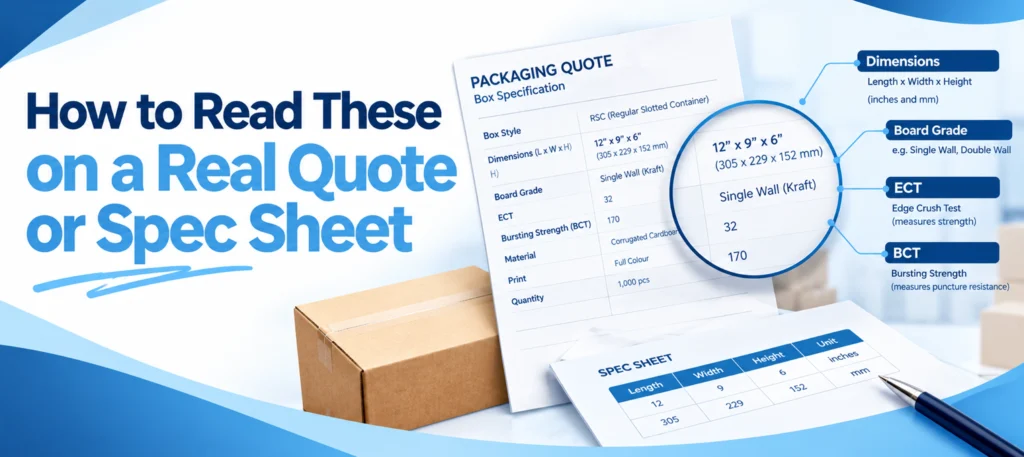
When one of these turns up on a document, read it in this order and the ambiguity usually resolves itself.
First, look at the case and the context. Lower case mm next to a box drawing is millimetres. Capital M or MM next to a price or a quantity is a trade multiplier, meaning per thousand or a million, not a measurement. Second, ask what is being measured. A length or a box dimension is millimetres. A liquid or a fill size is millilitres. A film, bag, sheet or laminate thickness written in mils is imperial, and you should convert it to microns before comparing. Third, if a thickness is quoted in mils and you work in microns, run the conversion above rather than assuming the numbers are close, because a mil and a millimetre look similar and are nearly forty times apart.
The same discipline applies to the other spec abbreviations a UK buyer meets, such as the board weights and flute grades on a corrugated quote. If those are the ones tripping you up, our guide to cardboard grades, GSM and flutes unpacks them in the same plain way.
If you are ever unsure which unit a supplier means on a quote, ask before you order rather than after. At All Custom Packaging our team is happy to translate a spec sheet into plain millimetres and microns for you, so talk to us about your packaging and we will confirm the numbers before anything goes to production.
Frequently asked questions

Is a mil the same as a millimetre? No, and this is the single most expensive mix up in the group. A mil is one thousandth of an inch, which is 0.0254 mm, so a millimetre is nearly forty times thicker than a mil. If a spec says 2 mil and you read it as 2 mm, you are out by a factor of about forty.
What does M mean in packaging and printing? On a price or quantity line, M usually means one thousand, from the Latin mille, so “price per M” is the price per thousand units. In science, capital M is the prefix mega, meaning a million. Lower case m is the metre. Which one applies depends on where it sits, so read it in context.
Is ml the same as mil? No. ML, the millilitre, is a volume, one thousandth of a litre. MIL is a thickness, one thousandth of an inch. They sound almost identical when spoken, which is exactly why they get confused, but one measures liquid and the other measures how thick a film is.
How many microns are in a mil? There are 25.4 microns in one mil, because a mil is 0.0254 mm and a micron is one thousandth of a millimetre. To go the other way, divide microns by 25.4 to get mils.
What is gauge in plastic film thickness? Gauge is an older unit for film thickness where 100 gauge equals one mil. So gauge is mil multiplied by 100, and one mil, 100 gauge and 25.4 microns all describe the same thickness. UK suppliers mostly quote microns now, but gauge still appears on some film products.
Why do MM and mm mean different things? Because they come from different systems. Lower case mm is metric, the millimetre. Capital MM is a Roman numeral convention, where M is a thousand and MM reads as a thousand thousand, so it means a million in finance and some trade pricing. Case is doing real work, so it is worth checking which one a document uses.
Key takeaways
- mm is a length (millimetre), ML is a volume (millilitre), and MIL is a thickness (one thousandth of an inch). They are three different measurements that happen to look alike.
- M is context dependent: the metre in metric, mega (a million) in science, and one thousand in the print and packaging trade, where “per M” means per thousand.
- Case matters. Lower case mm is millimetres; capital MM is a million.
- The UK conversion that counts: one mil equals 25.4 microns equals 100 gauge equals 0.0254 mm. Convert US mil figures into microns before comparing them with a British quote.