
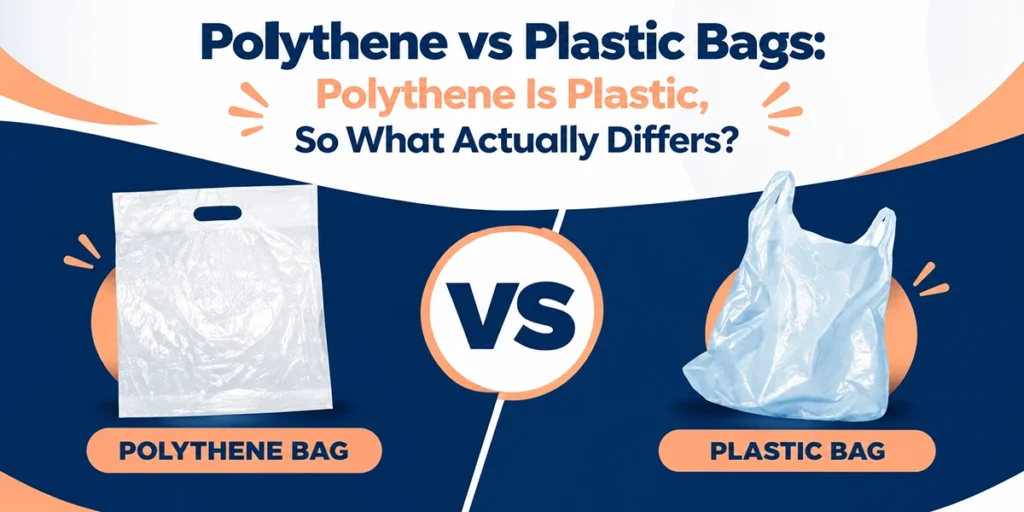
Polythene vs Plastic Bags: Polythene Is Plastic, So What Actually Differs?
Polythene is plastic. Polythene and polyethylene are two names for the same polymer, so a poly bag is a plastic bag, and asking which is better is a bit like asking whether a terrier is better than a dog. What genuinely changes how a bag behaves is the polymer grade it was blown from, the film thickness in microns, and the job it was built for. Get those three right and you have chosen well. Two UK polythene manufacturers, NPF Packaging and Abbey Polythene, both describe polythene as polyethylene made from ethylene gas, and both list LDPE, LLDPE and HDPE as densities of the same material rather than as separate plastics.
That correction matters more than it sounds, because a lot of packaging content sold as a buying guide is built on the opposite idea. Search this question and you will find pages telling you that poly bags are made from HDPE while plastic bags are made from LDPE, as though those were two different substances that happened to end up in the same shop. They are not. This guide answers the question honestly, explains what people are usually asking when they ask it, and then gives you the grade and gauge framework that actually decides which bag you order.
Is polythene the same as plastic?
Yes. Polythene is one specific plastic out of thousands, and it happens to be the most common one on earth.
Plastic is the umbrella word. It covers polypropylene, PVC, polystyrene, PET and dozens more, and polythene sits inside that family. NPF Packaging, a UK polythene manufacturer, puts the chemistry plainly: polythene “is made from a gas called ethylene, by putting it under intense heat and pressure,” and the resulting polymer “came to be called polythene (polyethylene).” Macfarlane Packaging describes the same material as “part of the polyolefin family of plastic resins” and uses “polythene plastic” and “low density polyethylene (LDPE)” in the same breath.
The two words split on geography, not chemistry. Polythene is the ordinary British trade word. Polyethylene is the international and scientific one. A UK supplier quoting you for polythene mailing bags and a spec sheet listing PE film are talking about the same thing.
Worth knowing: nothing in this changes the recycling answer either. A polythene bag carries the same resin identification code as any other polyethylene item, which is 4 for low density and 2 for high density.
So why does everyone talk about poly bags versus plastic bags?
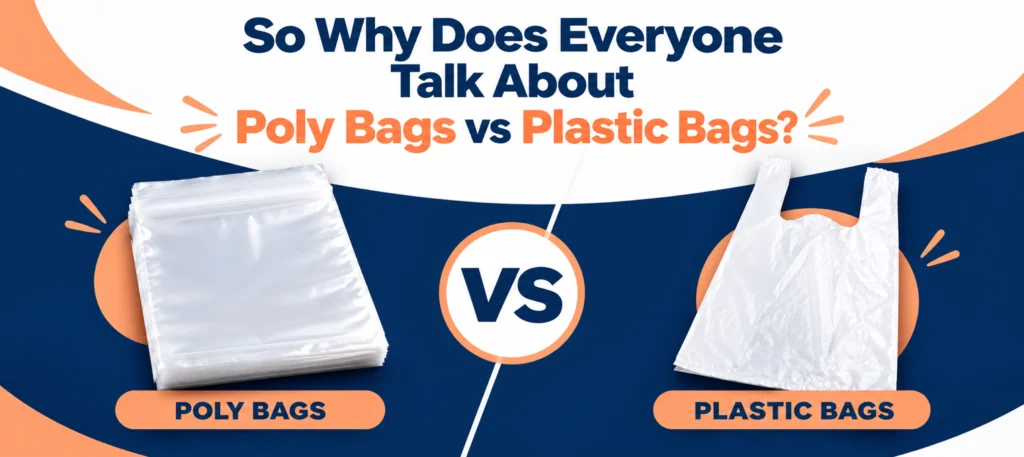
Because the phrase is real trade shorthand, even though it is not a material distinction. It describes a difference in format and expectation, and it survives because it is useful in a warehouse.
In UK and US packaging usage, “poly bag” almost always means a purpose made packaging bag: a clear or coloured flat bag, a garment bag, a mailing bag, a liner. “Plastic bag” in ordinary conversation usually means the thing you get at a till. One US supplier, Polybags, lands on the accurate version of the distinction: “All poly bags are plastic bags, but not all plastic bags are poly bags.” That is the honest framing, and it is a category relationship rather than a chemical one.
The confusion starts when suppliers turn that shorthand into a materials claim. Saying poly bags are HDPE and plastic bags are LDPE is not a description of two products, it is a description of two grades of one product, and either grade can be used for either format. Carrier bags are commonly HDPE. Mailing bags are commonly LDPE. Both are polythene. Both are plastic.
So when a buyer asks for “polythene rather than plastic”, what they usually want is a thicker, tougher, printable, purpose made bag rather than a thin till bag. That is a legitimate thing to want. It is just not what the words mean.
What do LDPE, LLDPE and HDPE actually change?
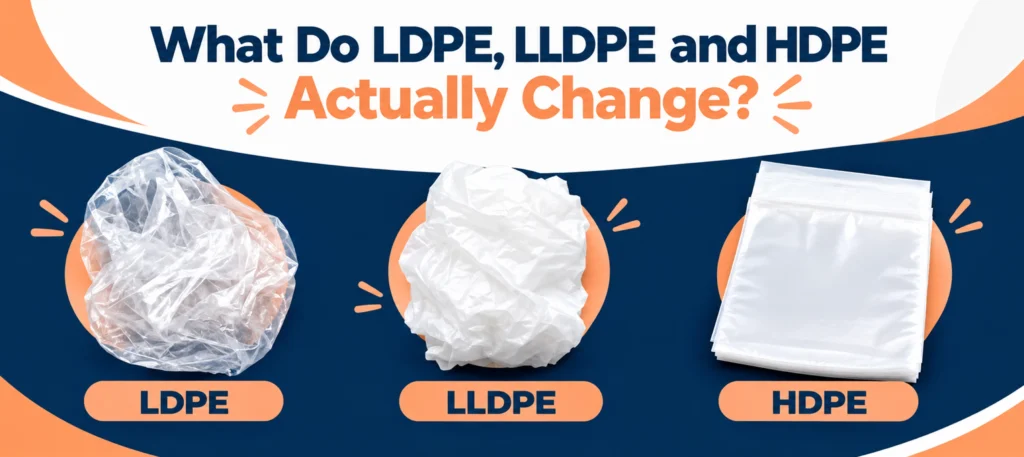
They change flexibility, stiffness, tear behaviour and how the bag looks, and those four things are what you feel in your hand.
All three are polyethylene. What differs is how the polymer chains are arranged, which changes density, which changes everything downstream. Abbey Polythene, a UK polythene manufacturer, describes LDPE as “the least dense” and suited to “applications where flexibility and durability are important”, HDPE as “more dense than LDPE, making it stronger and more resistant to wear and tear”, and LLDPE as falling “somewhere in between” with “better resistance to tearing”.
LDPE is soft, quiet, glossy and forgiving. It seals well, it prints well, and it stretches a little before it gives. This is the standard grade for mailing bags, garment covers and general packing bags, and it is the film our own poly mailers are made from.
LLDPE is the toughness upgrade. Blended into or used in place of LDPE, it resists tearing and puncturing better at the same thickness, which is why it turns up in heavy duty sacks and in stretch and shrink film. If you want a thinner bag that still survives a courier network, this is usually the lever a supplier reaches for rather than simply adding microns.
HDPE is stiffer, crisper and noisier. It has a slight milky haze rather than gloss, it crackles, and it carries more weight per micron than LDPE does. That is exactly why supermarket vest carriers and fresh produce bags are HDPE: you get strength out of a very thin film. The trade off is that it creases badly and prints less smoothly, which is why you rarely see a premium branded mailer in HDPE.
One caveat here. Suppliers blend these grades constantly, and most real world bags are not a single pure resin. Co-extruded mailing bags in particular are built in layers, and Elite Plastics, a UK mailing bag manufacturer, describes “a white outer layer with a black inner layer” as a common structure. So treat grade as a description of behaviour rather than a guarantee of composition, and ask your supplier what is actually in the film if opacity or strength is critical.
What do gauge and microns mean on a UK polythene spec?
They are the same measurement written two ways, and the conversion is simple: divide gauge by four to get microns.
A micron is one thousandth of a millimetre. Gauge is the older imperial measure, where 100 gauge is one thousandth of an inch. ITP Packaging states the rule directly: “the gauge of polythene can be converted to micron by dividing by 4”, and gives worked examples including “50mu = 200 gauge = 0.05mm” and “200mu = 800 gauge = 0.20mm”. Polybags UK confirms the same ratio from the other direction, noting that “a 4 inch by 6 inch by 150 gauge bag is the same as a 102mm x 152mm x 37.5 micron bag.”
Most UK quotes now use microns. Older price lists and bin liner packaging still use gauge. If a supplier gives you one and your spec is written in the other, the divide by four rule settles it in a second.
Here is the thickness ladder, using the reference table published by UK supplier Plastic Bag Suppliers for low density polythene.
| Gauge | Microns | Millimetres | What that thickness is typically used for |
|---|---|---|---|
| 100 | 25 | 0.025 | Very lightweight, economy black bin liner |
| 120 | 30 | 0.03 | Standard bin liner |
| 160 | 40 | 0.04 | General purpose quality black bin liner, domestic kitchen waste |
| 200 | 50 | 0.05 | Heavy duty black bin liner, commercial kitchen waste |
| 300 | 75 | 0.075 | Heavy duty garden waste bag |
| 400 | 100 | 0.1 | Typical rubble sack when gauge is not specified |
| 500 | 125 | 0.125 | Tough rubble sack, suitable for up to a 40kg load |
Two honest warnings about that ladder.
First, the duty words are not standardised, and this catches people out. Plastic Bag Suppliers calls 100 gauge, which is 25 microns, “very lightweight”. Polybags UK calls 120 gauge, or 30 microns, “light duty”. ITP Packaging says light duty is “around 50mu”. Those three UK suppliers are describing three different thicknesses with overlapping words. Always specify the micron figure on your purchase order and never rely on the phrase “heavy duty” to carry a specification.
Second, thickness is not the same as puncture resistance. Plastic Bag Suppliers is blunt about it: “sharp objects will puncture polythene” whatever the gauge, and what a thicker film buys you is resistance to the tear spreading afterwards. If your product has corners, the fix is a board box or an insert, not more microns.
The full commercial range is wider than the table suggests. Packaging Knowledge, a UK packaging reference site, lists mailing bags as available from “80 gauge (20 micron) to 1000 gauge (250 micron)”, which spans everything from a thin protective sleeve to a builder’s sack.
Which grade and gauge suits which job?
Match the grade to how the bag needs to behave, then set the micron figure by what is going inside it and how far it travels.
The table below is our own selection framework rather than a published standard. The grade behaviours and the recycling routes are sourced, and the thickness bands are ranges drawn from the published UK supplier data above, so treat the microns as a starting point for your own sample testing rather than a specification.
| Job | Grade usually specified | Thickness band to discuss | Why that combination | What the recycling route usually is |
|---|---|---|---|---|
| Branded mailing bag for apparel and soft goods | LDPE, often with LLDPE blended in, frequently co-extruded | Light to mid range of the mailer scale | Prints well, seals reliably, stays quiet and glossy in the hand, opaque layer hides the contents | Polythene film, so a supermarket collection point rather than a kerbside bin |
| Garment cover or protective sleeve | LDPE | Thinnest practical band | Only has to keep dust and moisture off a hanging item, so strength is not the constraint | Polythene film, supermarket collection point |
| Retail carrier bag | HDPE | Very thin, strength comes from the grade | HDPE carries weight per micron better than LDPE, which is why till bags are so thin | Polythene film, supermarket collection point, and the bag itself is chargeable |
| Waste sack or liner | LDPE, or LLDPE where tear resistance matters | Mid to heavy bands on the table above | Load bearing with give, so it stretches rather than splitting under an uneven load | Usually contaminated in use, so realistically general waste |
| Rubble or aggregate sack | LDPE with LLDPE for tear resistance | Heaviest bands, 100 microns and up | Needs to survive being dragged, dropped and loaded past 40kg | Usually contaminated, so general waste |
| Pallet and transit wrap | LLDPE | Stretch film, specified separately from bag gauge | Cling and stretch without tearing is the whole point of the grade | Clean back of house film, so a commercial film recycling stream |
A quick reality check on all of that. If your product is rigid, has corners, or needs to arrive presentable, a bag is the wrong format regardless of grade and gauge, and you want a board box. Our guide to choosing between mailer, shipping and product boxes covers that decision, and the protective packaging guide covers what to do when the item is fragile.
What does UK law charge for a carrier bag?
The charge exists in all four UK nations, but the amount, the start date and the rules differ in each one, so a single UK figure does not exist.
In England, GOV.UK guidance states that “retailers of any size (large, medium, small, micro and airport retailers) must charge a minimum of 10 pence for single-use carrier bags in England.” The 10p level and the extension to businesses of every size both took effect on 21 May 2021, having started at 5p for large retailers in 2015.
Scotland raised its minimum to 10p on 1 April 2021, having introduced the charge at 5p in October 2014. Wales was first in the UK, with a minimum of 5p from 1 October 2011, and that 5p minimum still stands. Northern Ireland runs the highest levy of the four: nidirect confirms that “since 1 April 2022, the levy is 25p”, and unusually it applies to “all new carrier bags with a retail price of £5 or less” whatever they are made from, including paper.
The effect has been large and it is measured. Defra’s carrier bag data for England 2025 to 2026, published 30 July 2026, reports that the main retailers sold 126 million single use plastic carrier bags in the year. That is down from 164 million the year before. Against a 2014 baseline of 7.64 billion bags, Defra describes “a reduction of 98% on the annual number of single-use carrier bags sold since the charge was introduced”.
One thing not to assume. Wales legislated for an outright ban on single use plastic carrier bags under the Environmental Protection (Single-use Plastic Products) (Wales) Act 2023, and it was widely expected in spring 2026. It has not happened. A Welsh Government written statement of 11 February 2026 said it is “no longer viable” to implement the remaining phase 2 bans this Senedd term, while confirming Wales remains committed to banning “plastic single-use carrier bags” as soon as possible. No new date has been given.
A mailing bag posted to a customer is not a carrier bag supplied at the point of sale, so the charge does not apply to it. Check the guidance for your own nation before assuming that holds for an unusual case, because the exemption lists differ.
Which UK rules apply to a business buying polythene bags?
Two, and neither is the carrier bag charge. They are the Plastic Packaging Tax and extended producer responsibility, and both are weight based rather than item based.
Plastic Packaging Tax applies to finished plastic packaging manufactured in or imported into the UK that contains less than 30% recycled plastic by weight. HMRC guidance sets the registration point at “10 tonnes or more of finished plastic packaging components” in a twelve month period, and the rate has risen every April since the tax began on 1 April 2022, reaching £228.82 per tonne from 1 April 2026. Polythene bags are squarely inside scope. If you order a lot of them, ask your supplier for the recycled content by weight in writing, because 30% is the line between paying and not paying.
Extended producer responsibility is the bigger administrative burden. GOV.UK guidance sets the entry thresholds at more than 25 tonnes of packaging supplied or imported in the previous year and an annual worldwide turnover of £1 million or more. Below both, you have no obligation. Above them you are a small producer, and above 50 tonnes with turnover over £2 million you are a large producer, which means registering annually, reporting packaging data every six months and paying disposal fees for household packaging.
Most small UK brands ordering a few thousand mailing bags a year sit well under 25 tonnes and both regimes pass them by. The point at which it stops being theoretical is usually growth, not a change in the rules, so it is worth knowing where the lines sit before you cross one. Both thresholds and rates change, so check GOV.UK for the current position rather than relying on any guide, including this one.
Can polythene bags actually be recycled in the UK?
Technically yes, practically it depends entirely on where the bag ends up, and for a household in England the honest answer today is a supermarket collection point rather than the kerbside bin.
Polythene film is recyclable as a material. The obstacle has always been collection and sorting rather than chemistry. North London Waste Authority, a statutory waste authority, is direct about it: LDPE thin plastic film “cannot be recycled at home”, and residents should “put it in your general waste, or take it to a collection point at the larger stores of most major supermarkets”, naming Tesco, Asda, Morrisons, Sainsbury’s, The Co-op and Waitrose.
Those front of store schemes are the working route right now. Recycle Now’s Repeat the Cycle campaign points householders to in store collection points for bags and wrapping, and its locator tool finds the nearest one.
Kerbside film collection was supposed to arrive very soon. Under Simpler Recycling, every local authority in England was required to collect plastic film from households by 31 March 2027. That deadline has moved. On 16 July 2026, Defra confirmed a deferral to 1 April 2030, as reported by letsrecycle.com and Circular Online, citing insufficient domestic sorting and reprocessing capacity and a lack of established end markets. The decision was not popular. The Flexible Plastic Fund warned that it “risks destroying investor confidence” in UK recycling infrastructure.
Be careful reading older sources on this, including some government pages that have not yet been updated. The 31 March 2027 date is still published in places and it is out of date for film. Whether Scotland and Wales follow the English deferral has not been settled, so do not assume a UK wide 2030 date.
What this means for a brand shipping in poly mailers is unglamorous but clear. Your customer cannot put the bag in their kerbside recycling in most of England today, and will not be able to until the end of the decade at the earliest, so if you want the bag recycled you have to tell them where to take it.
What can you honestly claim on a polythene bag?
Name the material, name the evidence, name the disposal route. If you cannot do all three, do not make the claim.
This is where a lot of packaging marketing falls over, and the polythene category is one of the worst offenders. The competitor page that prompted this guide claims poly bags are “environmentally friendly since they do not leach harmful chemicals”, which is a claim with no material named, no evidence attached and no disposal route given. Under the CMA’s Green Claims Code that framing is exactly what businesses are told not to do.
Three specific traps in this category.
Recyclable is not the same as recycled. A bag can be technically recyclable and still have no realistic collection route for your customer, which is precisely the English kerbside situation described above. If you print “recyclable”, print where.
Recycled content is a percentage, not a badge. Thirty per cent recycled content is a real and meaningful figure because it is the Plastic Packaging Tax threshold. “Made with recycled materials” without a percentage is not.
Biodegradable, compostable and recyclable are three different legal and practical states, and they are not interchangeable. Our guide to biodegradable, compostable and recyclable packaging works through the terminology and the certification standards behind each one, which is the companion piece to this article: that guide covers what the eco words mean, this one covers what the material actually is.
Frequently asked questions

Is polythene the same as plastic?
Polythene is a plastic, but not all plastics are polythene. Polythene and polyethylene are two names for the same polymer, so any bag described as polythene, poly or PE is a plastic bag. Plastic is the wider family that also includes polypropylene, PVC, PET and polystyrene.
What is polythene made from?
Ethylene gas, which is derived from oil and gas feedstocks. UK manufacturer NPF Packaging describes the process as taking ethylene and “putting it under intense heat and pressure” to form a polymer. Some polythene is now made from bio based ethylene instead, most commonly from sugarcane, and it is chemically identical and recycles in the same stream.
Are polythene bags recyclable in the UK?
The material is recyclable, but most households in England cannot put film in their kerbside bin. North London Waste Authority states that LDPE thin film “cannot be recycled at home” and directs residents to collection points at larger branches of the major supermarkets. Mandatory kerbside film collection in England was deferred by Defra on 16 July 2026 from 31 March 2027 to 1 April 2030.
What does gauge mean on a polythene bag?
Gauge is an imperial thickness measure where 100 gauge equals one thousandth of an inch. Divide gauge by four to get microns, so 100 gauge is 25 microns and 400 gauge is 100 microns. UK suppliers increasingly quote microns instead, and if a spec mixes the two the divide by four rule reconciles them.
Which is stronger, LDPE or HDPE?
HDPE carries more weight for a given thickness, which is why supermarket vest carriers can be so thin. LDPE is more flexible and seals and prints better, so it wins for mailing bags. LLDPE resists tearing and puncturing better than either at the same gauge, which is why it goes into heavy duty sacks and stretch film. Stronger depends on which failure you are trying to avoid.
Do I have to charge a customer for a poly mailer?
No. The single use carrier bag charge applies to bags supplied at the point of sale so goods can be taken away, not to packaging you post out. The exemptions differ between England, Wales, Scotland and Northern Ireland, so check the guidance for your own nation on any unusual case.
Does the Plastic Packaging Tax apply to my mailing bags?
Only if you manufacture or import 10 tonnes or more of finished plastic packaging in a twelve month period, and even then only on components containing less than 30% recycled plastic by weight. Most small brands are well below the threshold, but the recycled content figure is still worth asking your supplier for in writing.
What is a mylar bag, and is it polythene?
Not the same thing. Mylar is a trade name for BOPET, a polyester film, and barrier pouches sold as mylar bags are usually multi layer structures built from PET, metallised PET or aluminium foil. They are chosen for barrier performance rather than for the properties described in this guide, and because they are multi material they do not go into the polythene film stream.
Key takeaways
- Polythene and polyethylene are the same material, so a poly bag is a plastic bag. Any guide that treats them as two different substances has the premise wrong.
- What actually differs between bags is grade, gauge and intended job. LDPE prints and seals well, HDPE gives strength at very low thickness, LLDPE resists tearing.
- Gauge divided by four gives microns. Specify the micron figure on your order, because “light duty” and “heavy duty” mean different thicknesses at different UK suppliers.
- The carrier bag charge is 10p in England and Scotland, 5p in Wales and 25p in Northern Ireland, and it does not apply to mailing bags you post out.
- Plastic Packaging Tax bites at 10 tonnes and less than 30% recycled content, at £228.82 per tonne from 1 April 2026. EPR bites at 25 tonnes and £1 million turnover.
- English kerbside film collection was deferred on 16 July 2026 from 31 March 2027 to 1 April 2030, so tell customers to use supermarket collection points in the meantime.
If you are working out which format your product actually needs, that conversation is worth having before you commit to artwork. All Custom Packaging prints custom poly mailers and mylar barrier pouches alongside its board packaging. Orders start from 100 units, design support is free, and UK delivery is free. Tell us what you are shipping and we will tell you honestly whether a bag or a box is the right answer.