
Greeting Card Sizes UK: The Standard A6, A5, DL and Square Dimensions
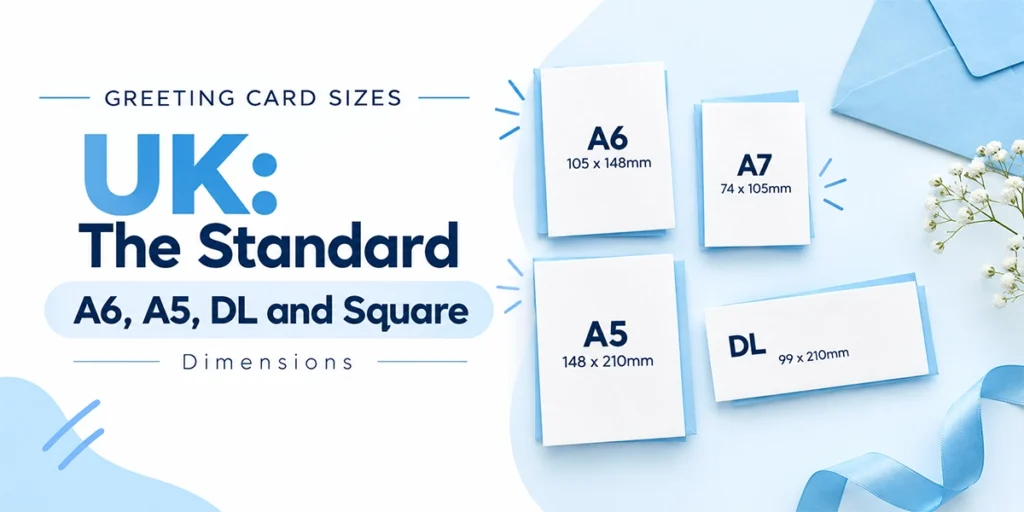
Quick answer: The standard UK greeting card is A6, which is 105mm by 148mm, and it is simply an A5 sheet (148mm by 210mm) folded once. UK cards are cut and folded from the ISO A series of paper, so the sizes that apply here are A6, A5, DL and square, not the US “A” envelope sizes measured in inches that fill most of the guides online. Those two systems share letters and numbers but describe different cards, which is why an American guide can list “A6” as both 4.5 by 6.25 inches and 10.5 by 14.8cm on the same page, even though those are two different sizes. The size that decides your postage is the one you probably have not thought about. To post at the cheapest rate, the finished card plus its envelope has to stay inside Royal Mail’s Letter limit of 240mm by 165mm by 5mm and 100g. An A6 card in a C6 envelope does exactly that.
Search “greeting card dimensions” and almost every result is a US packaging supplier listing sizes in inches, built around the American 5 by 7 inch card, then converting to centimetres by machine. None of that is how a UK printer, a UK buyer or Royal Mail actually works. This guide gives the finished sizes UK cards really come in, shows the flat sheet each one folds from, and pairs each card with the envelope that fits it. Then it answers the question no competitor gets right for Britain: which Royal Mail format your card lands in, and how to design it so it posts cheaply.
Why most greeting card size guides get this wrong for the UK
There are two completely separate sizing systems that both use the letter A, and the guides that dominate the search results quietly mix them together.
The first is the ISO 216 international paper standard, the metric A series used in the UK, Europe and most of the world. In that system A6 is 105mm by 148mm, A5 is 148mm by 210mm, A4 is 210mm by 297mm, and each size is exactly half of the one above it. This is what a British printer cuts card from, so it is the system that applies to a UK greeting card. You can see the full ISO A series set out in the ISO 216 paper size standard.
The second is a US stationery convention, also written with an A, but measured in inches and unrelated to the metric standard. In that American system an A2 card is about 4.25 by 5.5 inches, an A6 is about 4.5 by 6.25 inches, an A7 is about 5 by 7 inches, and an A9 is about 5.5 by 8.5 inches. These are card and envelope trade sizes used in the United States, and they do not match the ISO sizes at all.
Here is where the popular guides fall apart. Take one widely shared US guide to greeting card dimensions. It lists A6 as 4.5 by 6.25 inches, which works out to roughly 114mm by 159mm, and then in a different table lists A6 as 10.5 by 14.8cm, which is the ISO 105mm by 148mm. Those are two different cards wearing the same name. The same guide lists A7 three ways at once: as 5 by 7 inches, as 127 by 178mm, and as 7.4 by 10.5cm. That last figure is the ISO A7 of 74 by 105mm, a card less than half the size of the first two. A buyer who trusts that table has no way of knowing which A7 they are ordering. For a UK reader the fix is simple: ignore the inch “A” sizes entirely and use the ISO figures below.
The standard UK greeting card sizes
Here are the finished sizes a UK greeting card actually comes in, with the flat sheet each one folds from and the envelope that fits it. Every inch figure is converted straight from the millimetre figure, so nothing here contradicts itself. This is the table the US guides do not print, because they are not built around the ISO sizes that apply here.
| Card size | Finished (folded) size | In inches (approx) | Flat sheet it folds from | Matching envelope |
| A6 (the UK standard) | 105 x 148mm | 4.1 x 5.8in | A5 sheet, 148 x 210mm, folded once | C6, 114 x 162mm |
| A5 | 148 x 210mm | 5.8 x 8.3in | A4 sheet, 210 x 297mm, folded once | C5, 162 x 229mm |
| DL (slim) | 99 x 210mm | 3.9 x 8.3in | 198 x 210mm sheet, folded once | DL, 110 x 220mm |
| Square | 148 x 148mm (140 to 150mm all common) | 5.8 x 5.8in | 296 x 148mm sheet, folded once | Square envelope, a few mm larger |
| 7 x 5in (photo card) | 178 x 127mm | 7 x 5in | flat or folded card | around 133 x 184mm |
A6 is the one to remember. It is the most common UK greeting card by a wide margin, it fits the C6 envelope that newsagents and stationers stock everywhere, and as the next section explains, it is the only size in the table that posts at Royal Mail’s cheapest Letter rate. The square row is worth a word of caution: unlike the A series, there is no single square standard, and UK printers commonly offer 140mm, 148mm and 150mm squares, so always confirm the exact square size with your printer rather than assuming. These finished sizes and the fold relationships behind them are set out by UK printers such as Printways in their UK greeting card size guide.
Flat size versus folded size, and why it trips people up
The single biggest cause of a mis-ordered card is confusing the flat size with the folded size, and it is the thing the popular guides never explain.
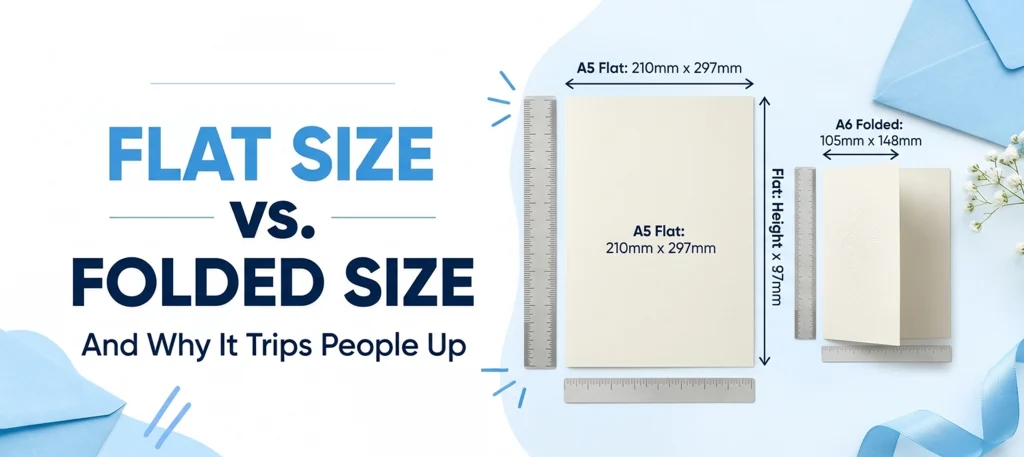
A greeting card has two sizes, not one. The finished or folded size is the card as it sits on a mantelpiece, so an A6 card is 105mm by 148mm closed. The flat or open size is the sheet before it is creased and folded, which for that same A6 card is 148mm by 210mm, an A5 sheet. Fold that A5 sheet once and the 210mm side halves to 105mm, giving you the 105mm by 148mm A6 card. The maths is exact: A5 is 148 by 210, and folded it becomes 105 by 148.
The pattern runs all the way up the A series, and it is genuinely useful to hold in your head. An A6 card folds from an A5 sheet. An A5 card folds from an A4 sheet, because A4 at 210 by 297 folded once gives 210 by 148.5, which is A5. So when a printer asks whether you want your artwork set up as A5 folded or A6 folded, they are asking which of these you mean, and getting it wrong means your design prints at half or double the size you expected. Worth knowing: your printer will also ask you to add a few millimetres of bleed on every edge, which is extra artwork beyond the trim line so there is no white edge if the cut drifts slightly.
Which envelope fits which greeting card
Envelopes follow their own ISO family, the C series, and the rule is easy: the C number matches the A number of the card that fits inside it.
A C6 envelope, 114mm by 162mm, is built for an A6 card. A C5 envelope, 162mm by 229mm, takes an A5 card. A DL envelope, 110mm by 220mm, was designed for a sheet of A4 folded into three, which is the classic business letter fold, and it also suits a slim DL card. In each case the envelope is a few millimetres larger than the card on every side, which is the clearance you need to actually get the card in and out without a fight.
Square cards are the exception that catches people out, because a square card needs a square envelope, and a standard rectangular C6 or C5 will not do. A 148mm square card wants a square envelope of around 155mm, again a few millimetres of headroom on each side. This matters more than it sounds, because as the postage section explains next, the envelope is what Royal Mail actually measures.
Royal Mail postage: the dimension that quietly decides your cost
This is the part every US guide gets wrong for Britain, because US postage and UK postage price cards in completely different ways.
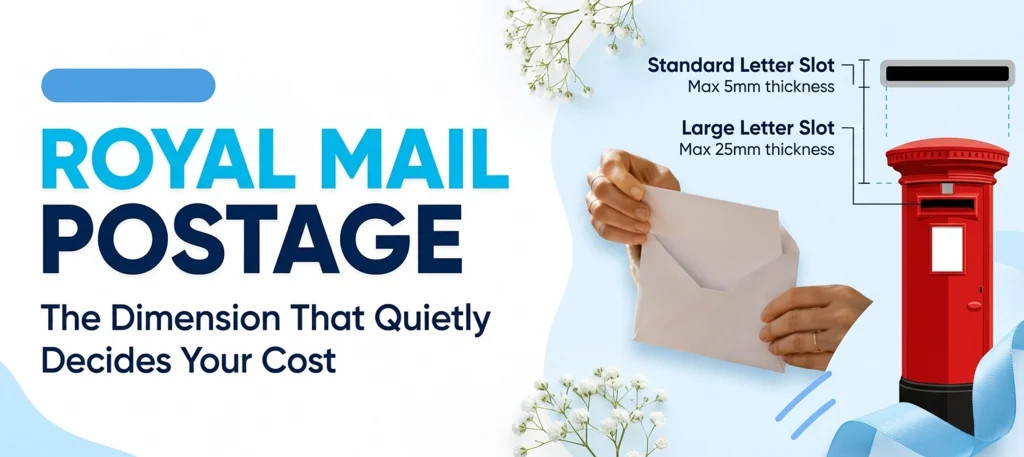
Royal Mail prices by format, and the two that matter for cards are Letter and Large Letter. A Letter has to stay within 240mm by 165mm by 5mm and weigh no more than 100g. A Large Letter goes up to 353mm by 250mm by 25mm and 750g. Crucially, Royal Mail measures the item you actually post, which for a greeting card means the card inside its envelope, so the envelope size is what sets your rate. You can see the full band by band breakdown, including how a fat envelope tips into the next price up, in our own guide to Royal Mail and Parcelforce parcel sizes. These format limits are also set out by UK suppliers such as Priory Direct’s Royal Mail size guide.
Now put the cards in their envelopes. An A6 card in a C6 envelope is 114mm by 162mm, which sits inside the Letter limit on every measurement, so it posts at the cheapest Letter rate. An A5 card in a C5 envelope is 162mm by 229mm, and that 229mm length is over the 165mm Letter limit, so it becomes a Large Letter and costs more. A DL card in a DL envelope is 110mm by 220mm, again over 165mm, so it is a Large Letter too. That is the hidden cost the US inch guides never mention: your choice of card size is also a choice of postage rate.
A word on square cards, because this is where American advice actively misleads a UK buyer. In the United States, square envelopes attract a fixed non machineable surcharge because they cannot run through automated sorting, and US guides repeat that as though it were a universal rule. Royal Mail does not price that way. It has no published flat square surcharge. It prices by format, so a square card that stays within the Letter size and weight limits can still qualify as a Letter, while a bigger or heavier square moves up to Large Letter like any other card. Because square and rigid items can still be handled differently in practice, the honest advice is to check the exact price for your finished card and envelope on Royal Mail’s price finder rather than assuming either the cheap rate or an American style surcharge. If a figure ever cannot be confirmed, royalmail.com is the source of record.
Designing your card so it posts cheaply
If postage cost matters to you, and for anyone selling cards it should, you can design for it from the start rather than discovering the price at the counter.
The cheapest outcome is to stay inside the Letter format, which in practice means an A6 card in a C6 envelope, kept under 5mm thick and under 100g. That covers the great majority of single greeting cards on normal card stock. Go up to A5 in a C5 envelope, or choose a DL card, and you have chosen the Large Letter rate, which is a fine trade for a bigger card but worth making on purpose. Two things push even a small card up into Large Letter without changing its length or width. The first is thickness: a chunky badge, a gem, a pop up mechanism or a very heavy board can take the packed envelope past the 5mm Letter limit. The second is weight: a thick uncoated board plus a lined envelope can drift over 100g. If you are printing a run of cards to sell, weigh and measure one finished card in its sealed envelope before you commit, because a few millimetres or a few grams decides the rate on every unit you post.
How this differs from business card and box sizing
Greeting card sizing gets muddled with two neighbouring questions, so it is worth drawing the lines clearly.
A business card is not a small greeting card. It is a single flat card at a fixed trade standard, and in the UK that is 85mm by 55mm, as covered in our guide to business card size in the UK. It does not fold, it does not come from the A series, and it has no envelope or postage dimension, so none of the A6 and C6 logic here applies to it. A greeting card, by contrast, is ISO folded stock with a matching envelope and a Royal Mail format to think about. The other easy mix up is with boxes: a card box or a boxed set of cards is packaging measured by length, width and depth, which is a different job from the flat sheet sizing in this guide.
Getting a custom card or card packaging printed in the UK
If you are a UK brand or maker producing cards to sell, the sizes above are your starting point, and the print decisions sit on top of them. All Custom Packaging is a UK based custom packaging and print supplier, so the natural fit here is custom printed card, boxed card sets and the gift packaging around them rather than mass produced off the shelf greeting cards. We can print to your chosen A6, A5, DL or square size and artwork, set up the fold and the bleed correctly, and produce the retail box or presentation packaging a card range needs. Orders start from 100 units and design support is free, so you can prototype a size and finish without committing to a huge run. If you want a hand matching a UK card size to the right envelope and postage format, or packaging a set, take a look at our gift boxes and boxed stationery packaging or talk to our team. We will confirm the specification with you before production.
Frequently asked questions
What is the standard greeting card size in the UK?
The standard UK greeting card is A6, which is 105mm by 148mm when folded, or about 4.1 by 5.8 inches. It is an A5 sheet folded once, and it fits a C6 envelope, which is 114mm by 162mm. A5 cards, at 148mm by 210mm, are the next size up.
Is a greeting card A5 or A6?
Most single greeting cards are A6 when folded, which comes from an A5 flat sheet. This is the source of a common mix up: the same card is an A5 sheet flat and an A6 card folded. If a printer says A5 folded, they mean a larger card that folds down to A5 from an A4 sheet.
Why do US guides list A6 and A7 cards in inches?
Because the United States uses a separate “A” stationery system measured in inches, where A6 is about 4.5 by 6.25 inches and A7 is about 5 by 7 inches. These are unrelated to the ISO metric A series used in the UK, where A6 is 105 by 148mm and A7 is 74 by 105mm. UK buyers should use the ISO figures.
What envelope fits an A6 card?
A C6 envelope, 114mm by 162mm, is made for an A6 card, leaving a few millimetres of clearance on each side. For an A5 card you need a C5 envelope, 162mm by 229mm, and for a slim DL card a DL envelope, 110mm by 220mm.
Can I post a greeting card at the Letter rate or is it a Large Letter?
An A6 card in a C6 envelope stays within Royal Mail’s Letter limit of 240mm by 165mm by 5mm and 100g, so it posts at the cheapest Letter rate. An A5 card in a C5 envelope, or a DL card, is longer than 165mm, so it becomes a Large Letter and costs more. Thick or heavy cards can also move up to Large Letter.
Do square cards cost more to post in the UK?
Not automatically. Unlike the US, where square envelopes carry a fixed non machineable surcharge, Royal Mail prices by format, so a square card within the Letter size and weight limits can still post as a Letter. Because square and rigid items can be handled differently, check the exact price for your card and envelope on Royal Mail’s price finder before printing a run.