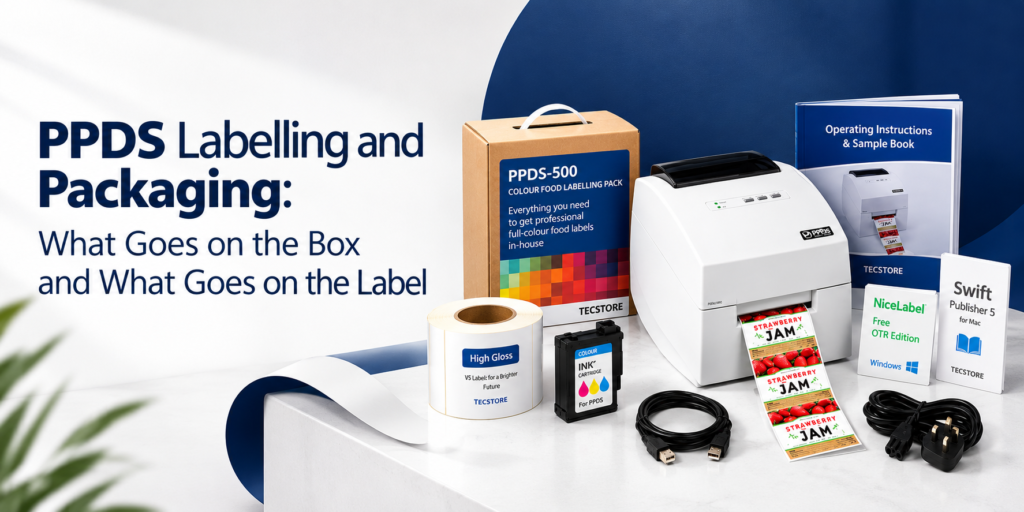
PPDS Labelling and Packaging: What Goes on the Box and What Goes on the Label
PPDS food, packed by the business that sells it before anyone orders it, must carry its name and a full ingredients list with the 14 allergens emphasised, on the pack or on a label attached to it. For packaging, that means a label on the outside, readable without opening the box, clear of flaps and folds, with text at an x-height of at least 1.2 mm, or 0.9 mm on small packs.
This is Natasha’s Law, which has applied across the UK since 1 October 2021. The packaging can decide whether a food is PPDS in the first place. So the choices start before the label: whether the box closes, where the label goes, whether to print the information or apply it, and how much space it needs. This guide covers PPDS labelling as a packaging decision, using FSA and Trading Standards guidance. It is not legal advice, so contact your local authority’s food team if you are unsure how the rules apply to a product.
Is your food PPDS?
The FSA’s introduction to PPDS labelling defines PPDS food as food packaged at the same place it is offered or sold, and in that packaging before it is ordered or selected. Its guidance for bakers adds the packaging test. The food must be fully or partly enclosed, it must not be possible to alter it without opening or changing the packaging, and it must be ready for sale.
| How the food is packed | PPDS? |
|---|---|
| A cake wrapped completely in cling film | Yes |
| Bread in a paper bag folded or twisted shut | Yes |
| A filled baguette in a box with the lid closed | Yes, it is prepacked |
| The same baguette in the box with the lid open | No |
| A cake on an open cardboard tray | No |
| A baguette in a band that slips on and off | No |
| A small cake presented to the customer under a dome | Yes |
| A large cake under a dome, sliced to order | No |
| Cake slices boxed at the customer’s request | No |
| Leftover cupcakes boxed before anyone orders them | Yes |
| Food packed by another business | Prepacked food, with full labelling |
The closed and open lid rows come from Trading Standards’ guide to labelling PPDS foods, which notes that changing how packaging is presented can change the category. For a bakery, a closed cake box packed before sale is a typical PPDS case. Food that is not PPDS still needs allergen information, but that can be given in other ways, including orally.
What the PPDS label must say
The FSA’s labelling guidance for PPDS food and the Trading Standards guide set out the contents.
| On the label | Detail |
|---|---|
| Name of the food | Its legal name, customary name or a descriptive name |
| Ingredients list | Headed with the word “ingredients”, in descending order of weight |
| The 14 allergens | Emphasised every time they appear, in bold, capitals, contrasting colours or underlining |
| Meat content | A quantitative declaration for meat products only, with an exemption for ready-to-eat food sold by mass caterers |
| Net quantity | Needed for many PPDS foods under weights and measures law, with exemptions |
| “May contain” | Recommended where a risk assessment shows a real risk; not a legal requirement |
The 14 allergens are celery, cereals containing gluten, crustaceans, eggs, fish, lupin, milk, molluscs, mustard, peanuts, sesame, soybeans, sulphur dioxide and sulphites above 10 parts per million, and tree nuts. The FSA advises against “may contain” wording where there is no real risk, because it can mislead and limit choice.
Where the label goes on the pack
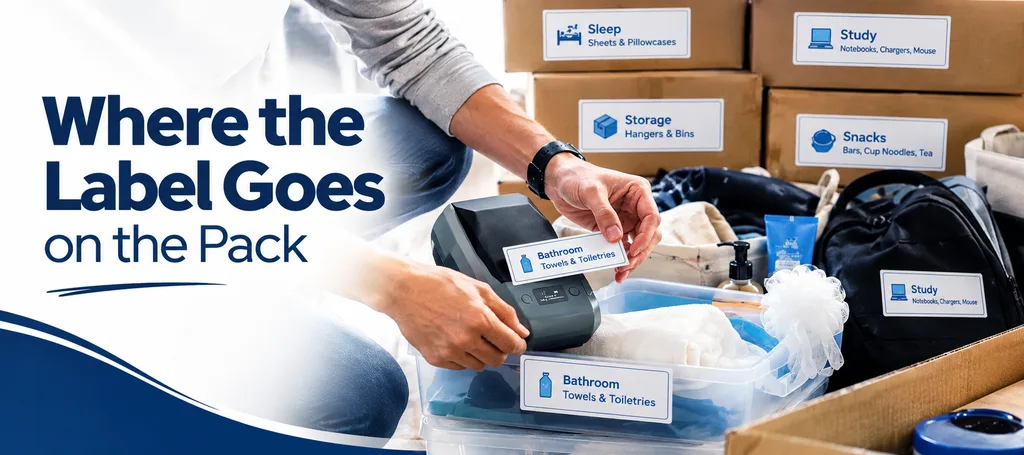
The law puts the information on the pack itself. The FSA’s PPDS guidance points to Articles 12 and 13 of the retained food information regulation. Article 12 places the information directly on the package or on a label attached to it. Article 13 requires it to be conspicuous, easily visible and clearly legible, and not hidden, obscured or interrupted by other words, pictures or intervening material.
The FSA’s technical guidance on allergen labelling gives the examples that matter for boxes: information must not be hidden under a flap or across a fold or crease. Its PPDS guidance adds that the customer should not need to open the packaging to read it. Trading Standards puts it plainly: the information goes on the outside, never inside the packaging.
| Box situation | Risk | Better |
|---|---|---|
| Labelled cling film inside a closed box | The label is inside the packaging | Put the label on the outside of the box |
| Label across the lid edge or a tuck flap | Hidden under a flap or across a fold | A flat panel away from folds |
| A sleeve or band over the box | The label is covered | Keep the label panel clear of the sleeve |
| Artwork running into the label area | Interrupted by other words or pictures | A clear, plain panel kept for the label |
| A QR code in place of the label | Not enough on its own | A QR code only in addition to the label |
The artwork layout can reserve clear panels for the information the product is required to display. Our guide to print-ready artwork covers the safe zone that keeps text clear of cut and fold lines.
How big the text must be
Article 13 of the food information regulation sets a minimum x-height of 1.2 mm for the mandatory information. The x-height is the height of a lower-case letter such as x, measured on the printed text, so check that measurement rather than a point size. Where the largest surface of the packaging is under 80 cm², the minimum drops to 0.9 mm.
The test uses the pack’s largest surface, not the label. A cookie box whose largest face is 8 x 9 cm has 72 cm² and can use 0.9 mm text. A box with a 10 x 10 cm face has 100 cm², so 1.2 mm applies. The FSA also asks businesses to think about readers with sight problems, for example people with colour blindness when contrast is used for emphasis.
A long ingredients list at that size needs a sizeable panel. Size the label panel for the longest recipe that will go in that box, not the shortest.
Printed on the box or a label on the box?
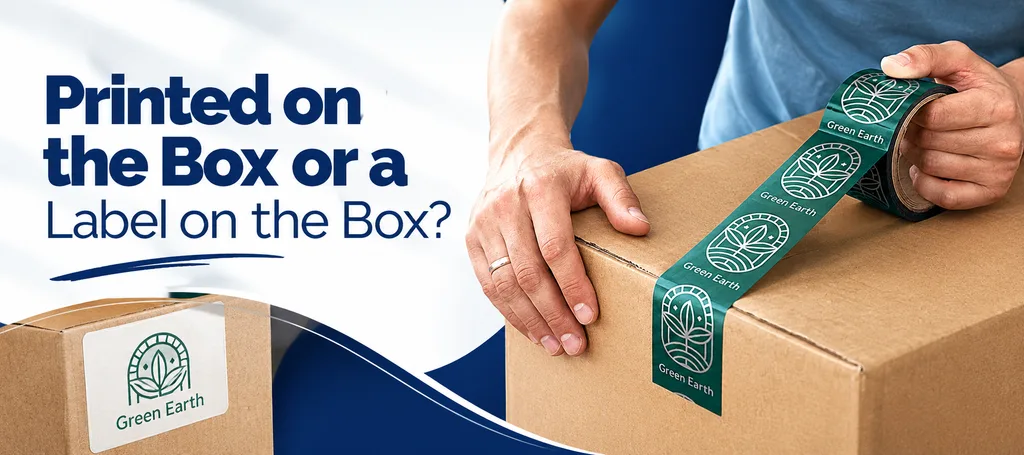
The law allows either: the information can be printed directly on the package, or on a label attached to it. The choice comes down to how often the information changes.
| Printed on the box | Label applied to the box | |
|---|---|---|
| Suits | One product with a fixed recipe and supplier | Several products sharing one box design, or recipes that change |
| Main risk | A recipe or supplier change leaves printed stock wrong | Labels to print and apply, and a plan if the printer fails |
| When something changes | New boxes | A new label file |
The FSA makes the business that packs the food responsible for the label, and expects a process to update it when suppliers or ingredients change. Labels can be printed in-house, pre-printed or handwritten, provided handwritten ones meet the size rules, and the FSA suggests keeping reserve pre-printed labels for printer failures. If several products share one box design, that points to a printed box with a clear label panel and a separate label for each product.
All Custom Packaging can help organise the available print space, but the brand or its regulatory adviser remains responsible for confirming the accuracy and completeness of the required product information.
Selling online, at markets and in Scotland
PPDS labelling does not apply to food sold by distance selling, such as phone and online orders. Allergen information must still be available before the purchase is completed and again at delivery, and some businesses label everything anyway, so one system covers both. Food packed by the same business at another site and sold from its market stall or van is PPDS.
The rule applies in Scotland too. Food Standards Scotland confirms the same requirement since 1 October 2021 and publishes its own guidance. Cosmetics follow a different regime, which our cosmetic labelling requirements guide explains.
Common mistakes
- Labelling the inner wrap, then closing it inside a box.
- Putting the label across the lid edge or under a tuck flap.
- Covering the label with a sleeve, band or another sticker.
- Printing ingredients on boxes for a recipe that changes.
- Relying on a QR code instead of the label.
- Setting text below a 1.2 mm x-height on a pack that does not qualify for 0.9 mm.
- Forgetting that closing the lid can make the food PPDS.
Frequently asked questions
What does PPDS stand for?
Prepacked for direct sale. It means food packed by the business that sells it, before the customer orders or selects it, and sold from the same premises or the business’s own stall or van.
What must a PPDS label include?
The name of the food and a full ingredients list with the 14 allergens emphasised. Meat products also need a meat content declaration, and many foods need a net quantity.
Can PPDS information be printed on the packaging instead of a label?
Yes. The information can go directly on the package or on a label attached to it. Printing suits a single, fixed recipe, because any change to ingredients or suppliers leaves the printed stock out of date.
What text size does a PPDS label need?
An x-height of at least 1.2 mm, or 0.9 mm where the largest surface of the pack is under 80 cm².
Can I use a QR code instead of a PPDS label?
No. Trading Standards guidance allows a QR code or web link only in addition to the information on the label.
Does PPDS labelling apply to food sold online?
Not the labelling rule itself. For phone and online sales, allergen information must be available before the purchase is completed and when the food is delivered.
Does a cake box with the lid closed make the cake PPDS?
It can. If the cake was boxed on the premises before the customer chose it, and it cannot be altered without opening the box, the FSA’s packaging test is met.
Selling food packed on your premises? Our custom food boxes can be printed to your artwork with a clear panel left for the label, and our stickers and labels range covers the labels themselves. Orders start from 100 units. Design support is free. A digital 3D mock-up is free. For the quote, send the artwork, the quantity, the delivery postcode and the date the order is needed by.