
Are Magnetic Gift Boxes Recyclable? A UK Buyer’s Guide
A magnetic gift box is mostly paper and board, so it can usually go in UK card recycling once the parts that are not paper come out. What decides how easily it recycles is often less the magnets than the finish and the extras: a plastic laminate, glitter, a thick foil laminate, a plastic window or a foam insert.
That matters twice over. Your customer needs to know what to do with the box, and a large producer’s packaging fees depend on how the UK’s recyclability assessment rates it.
In this guide
- What a magnetic gift box is made of
- What households are told
- How the UK assessment rates a magnetic box
- Specifying a magnetic box that recycles more easily
- What you can print on the box
- Mistakes to avoid
- Frequently asked questions
What a magnetic gift box is made of
A magnetic gift box is a rigid box: greyboard wrapped in paper and glued, with small magnets hidden under the wrap so the flap closes itself. Around that core sit the choices that change from order to order: a laminate or coating on the wrap, foil, a window, an insert. Our explainer on what a rigid box is covers the construction.
For scale, a neodymium disc magnet 10 mm across and 2 mm thick weighs about 1 g, according to one UK magnet seller’s listing. Two of them in a box that weighs 200 g, for example, come to about 1% of its weight. Weigh your own box and its magnets to know your figure.
What households are told
General UK guidance on recycle.co.uk says a rigid gift box can go in kerbside card recycling once the magnets, foam and plastic windows are removed, with those parts going in general waste. It adds that foil-coated or glitter boxes should be binned whole if the coating will not peel, and that bin colours and collection streams are set by each council.
So the instruction your customer needs is short: take out the magnets and any foam, flatten the box, and put it in the card recycling, checking local rules.
How the UK assessment rates a magnetic box
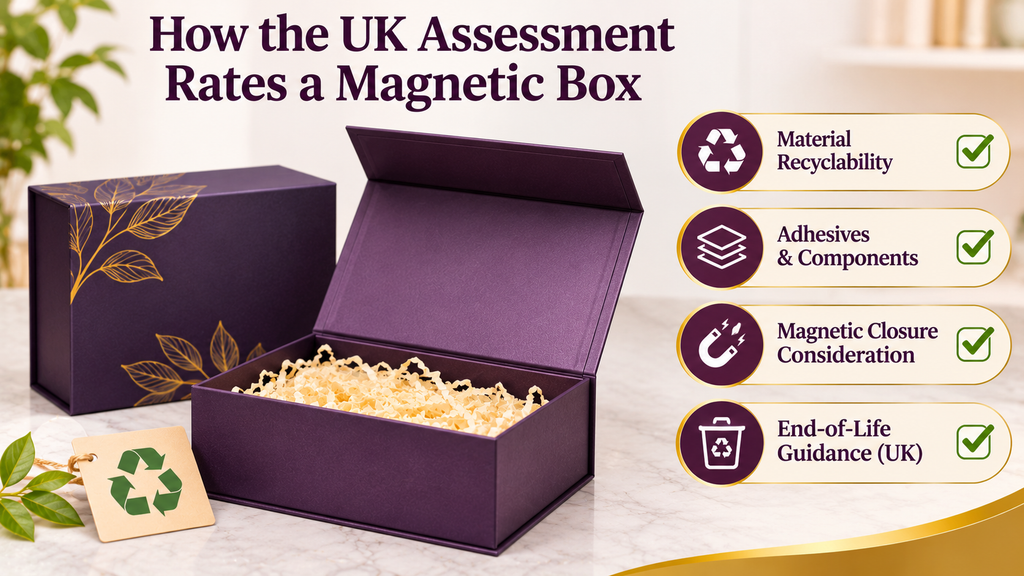
Under packaging EPR, large producers rate the household packaging they supply with the government’s recyclability assessment methodology. For the 2027 reporting year, the RAM 2027 materials guidance treats the parts of a magnetic box as follows.
- Magnets glued in. Parts that are not intended to be removed make the box one item, rated as its predominant material by weight. For a magnetic box that is paper or board, with the magnets counted in its non-paper content.
- Non-paper content. More than 10% by weight rates the box amber at the reprocessing stage, and more than 15% rates it red.
- Plastic. A paper or board pack with more than 5% plastic by mass is assessed as a fibre-based composite instead.
- Glitter stuck to the board rates red at collection.
- Foil and film laminates. Lamination with aluminium foil 6 microns thick or more rates red; an inside lamination of PET or metallised PET rates amber.
- A part distinct from the box, such as a loose insert, can be assessed as a component of its own.
In the example above, two small magnets sit well under the 10% line. A plastic laminate, glitter or a heavy foil laminate is more likely to change the rating. How the UK assessment works in general is set out in our guide to recycled vs recyclable packaging, and who pays, with fees that follow the rating, in our guide to EPR packaging fees.
The paper industry asks for the same thing from the design side. The Confederation of Paper Industries’ design guidelines, as reported by letsrecycle, ask designers to keep non-paper components to 5% of the pack’s weight, and say plastic is a contaminant that is rejected from the process.
Specifying a magnetic box that recycles more easily
| Part | The easier choice | Why |
|---|---|---|
| Closure | A lift-off lid, a hinged lid without magnets or a drawer, where a magnetic flap is not essential | Nothing for the customer to remove |
| Wrap | Paper without a plastic film laminate | A film laminate is usually plastic, which household guidance and the paper industry treat as a contaminant |
| Finish | No glitter; ask how any foil effect is made and how thick it is | Glitter and aluminium foil lamination of 6 microns or more both rate red in the UK assessment |
| Window | A die-cut opening rather than a film patch, if the product can be seen without one | A film patch adds a non-paper material |
| Insert | Card rather than foam | Household guidance sends foam to general waste |
An unlaminated paperboard construction may be easier to process through suitable paper-recycling streams than a heavily laminated alternative. Final recyclability depends on the full material and finishing specification and the facilities available locally. A window needs a film patch or a die-cut aperture, and that choice affects both cost and recyclability.
A lift-off lid stays on by its fit rather than by magnets, which is the build behind Rigid Boxes With Lids. For the insert, our guide to cardboard vs foam inserts weighs holding against cushioning.
If the magnetic flap is the point of the box, keep it, and put the effort into the wrap and the insert instead: those choices are more likely to change how the box is rated. How laminates and finishes differ is covered in our explainer on packaging print finishes.
What you can print on the box
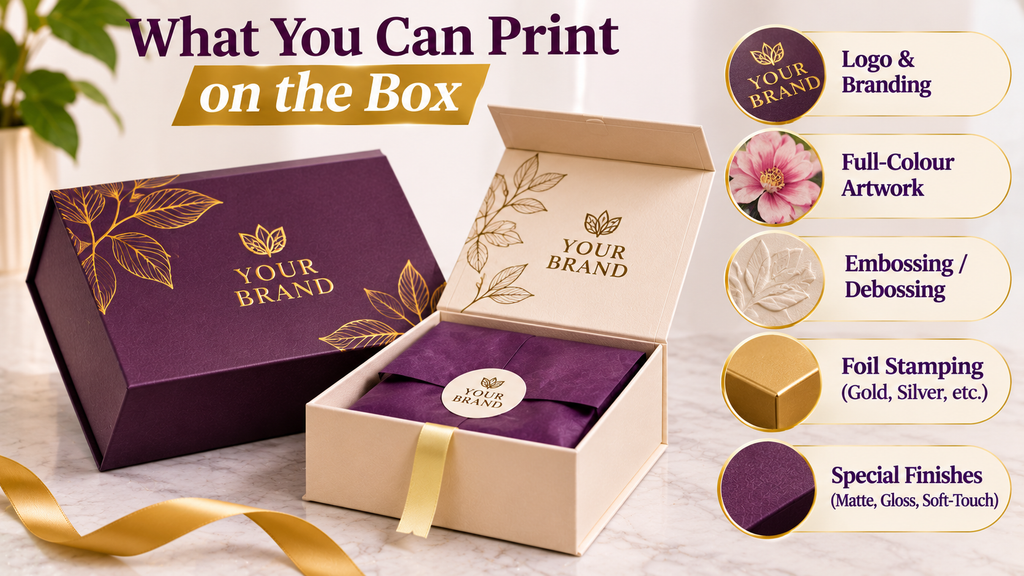
A recycling message has to be true of the box as built. A blanket recyclability claim on a laminated, foiled box with magnets is the kind of message to avoid. For a box without glitter, a foil coating or a film laminate, a plain instruction tells the customer what to do and stays accurate, for example: “Remove the magnets and any foam, then recycle the box with card. Check local recycling.”
The rules on recycling claims are covered in our guide to recycled vs recyclable packaging, and the symbols that can go on a box in our guide to packaging symbols.
Mistakes to avoid
- A glitter finish on a box you want customers to recycle.
- A blanket recyclability claim printed on a laminated box.
- A foam insert with no instruction to take it out.
- No disposal line on the box at all.
- Removing the magnets from the design but keeping a plastic film laminate on the wrap.
Frequently asked questions
Are magnetic gift boxes recyclable?
Usually, as card, once the magnets, foam and any plastic window are taken out, according to general UK household guidance. A glitter or foil-coated box may have to go in general waste.
Do you have to remove the magnets before recycling?
Household guidance says to take them out and put them in general waste. In the UK assessment used for EPR, magnets glued into the box are counted as part of it rather than as a separate piece.
Are the magnets themselves recyclable?
General household guidance puts them in general waste. Collection rules are set by each council, so check locally.
Does a laminated magnetic box recycle?
Plastic film lamination is what household guidance and the paper industry both treat as a contaminant, and above 5% plastic by mass the UK assessment treats the box as a fibre-based composite. A wrap without a film laminate is the easier route.
Can I call my magnetic box recyclable?
Only if it is true of the box as built and for where it will be thrown away. A disposal instruction is safer than a blanket claim.
Choosing a magnetic box and want it to recycle more easily? Tell us the closure, wrap, finish and insert you have in mind. We can explain the general recyclability considerations of the selected material and finishing options, so you can make accurate claims on your own packaging. Orders start from 100 units. Design support is free. A digital 3D mock-up is free. For the quote, send the artwork, the quantity, the delivery postcode and the date the order is needed by. Our Magnetic Closure Rigid Boxes are made to your product’s size.