
QR Codes and Barcodes on Packaging: A UK Small Business Guide
Quick answer: You only need a GS1 barcode (EAN-13, with a GTIN) if you’re selling through a retailer, supermarket or a marketplace that requires one, such as Amazon UK without GTIN exemption. If you sell only on your own website, Etsy or at markets, you don’t legally need one. A QR code is a different thing entirely it’s free to generate, carries far more information than a barcode, and is best used for instructions, provenance, loyalty schemes or reviews. From 2027, GS1’s “Sunrise 2027” initiative means many UK retailers will start scanning 2D barcodes (a QR-style code carrying the same GTIN) alongside the traditional black-and-white barcode, not instead of it.
If you’ve ever stared at a barcode on a sample box and wondered whether you actually need one, you’re not alone. We get this question from candle brands, cosmetics sellers and food businesses most weeks at ACP. The honest answer depends entirely on where you’re selling, not on what looks “proper” on a shelf.
Do I Need a Barcode? Decision Table by Sales Channel
| Sales channel | Barcode required? | What you need |
|---|---|---|
| Your own website (Shopify, WooCommerce, etc.) | No | Nothing – Internal SKUs are enough |
| Etsy / Not On The High Street / markets | No | Nothing, though some buyers like seeing one |
| Amazon UK (Brand Registry, private label) | No, if GTIN-exempt | Apply for GTIN exemption in Seller Central under your brand |
| Amazon UK (non-Brand-Registry or bundled items) | Usually yes | A GS1 GTIN/EAN-13 barcode |
| Independent UK retailers / farm shops | Sometimes | Ask the retailer many small shops use their own till codes |
| Supermarkets (Tesco, Sainsbury’s, etc.) | Yes, always | A GS1 GTIN/EAN-13 barcode, plus their supplier onboarding process |
| Wholesale to other UK businesses | Usually yes | A GS1 GTIN, so the buyer can stock and reorder easily |
| Export to EU/US retailers | Yes | A GS1 GTIN the same one works internationally |
Amazon’s GTIN exemption route means many small brands never need to buy a barcode at all. If you’re not on Amazon and only sell direct or through Etsy, save your money you don’t need one. The moment a supermarket buyer, wholesaler or major marketplace asks for a product identifier, that’s your signal to get a proper GS1 GTIN, not a free online barcode generator (retailers can and do reject those, because the numbers aren’t guaranteed unique).
What a Barcode Actually is, and Why GS1 Matters
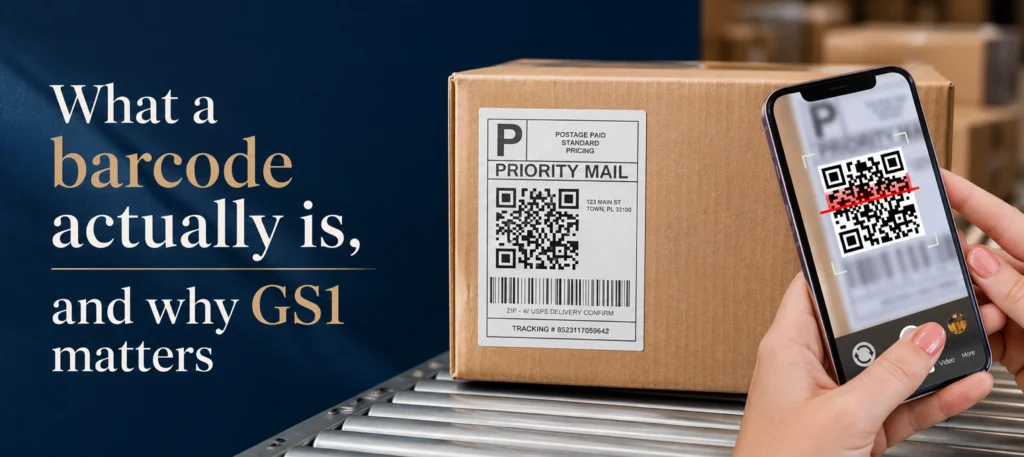
A barcode you see on a shelf is almost always an EAN-13: thirteen digits encoded as black bars, built around a GTIN (Global Trade Item Number). The GTIN is the important part – it’s a unique ID for your product that only GS1 can issue and guarantee isn’t already in use by someone else’s product anywhere in the world. Free “barcode generator” websites will make you a scannable-looking image, but the number underneath isn’t guaranteed unique, which is exactly why big retailers won’t accept them.
GS1 UK membership costs (verified July 2026)
GS1 UK membership is priced by your company’s annual turnover, and it’s an annual renewal, not a one-off fee. Numbers below are GS1 UK’s own published rates, excluding VAT.
| Annual turnover | Annual fee (ex VAT) | GTINs included |
|---|---|---|
| Up to £99,999 | £50 | 10 |
| £100,000–£499,999 | £100 | 100 |
| £500,000–£999,999 | £130 | 1,000 |
| £1,000,000–£9,999,999 | £200 | 1,000 |
| £10,000,000–£49,999,999 | £450 | 10,000 |
| £50,000,000–£249,999,999 | £1,750 | 10,000 |
| £250,000,000–£999,999,999 | £3,250 | 100,000 |
| Over £1,000,000,000 | £4,250 | 100,000 |
For most brands reading this, that’s £50 a year for up to 10 unique product barcodes – less than the cost of a single carton print run’s proofing round. Barcode images themselves are included free once you’re a member. Prices changed for additional (top-up) GTIN batches from 10 May 2026, so if you’re renewing after that date, check the current additional-numbers rate on GS1 UK’s site before budgeting; always confirm the live figure on gs1uk.org, since membership pricing is reviewed periodically.
Worth knowing: the fee is per company, not per product, so a candle brand with six scents pays the same £50 as a brand with just one.
QR Codes: What they’re Actually Good For
A QR code isn’t a barcode replacement in the traditional retail sense (not yet, more on that below) it’s a different tool. Where a GTIN barcode identifies what the product is to a till system, a QR code links to anything you want: a webpage, a video, a form, a loyalty scheme. On packaging, we see UK small brands use QR codes well for:
- Instructions and safety information – care instructions for candles, patch-test guidance for cosmetics, or assembly steps, without cluttering the box copy
- Provenance and traceability – linking a batch code to a “meet the maker” page or ingredient sourcing story
- Reviews and social proof – sending unboxing customers straight to a review page at the moment they’re most likely to leave one
- Loyalty and repeat orders – a scan-to-reorder link that removes friction from repurchase
- Warranty registration and support – particularly useful for higher-value gift or homeware items
Because a QR code is free to generate and print, there’s no membership cost involved the only cost is getting the print quality right, which is where most small-brand QR codes actually go wrong (see the spec checklist below).
GS1 Digital Link and Sunrise 2027: The 2D Barcode Transition
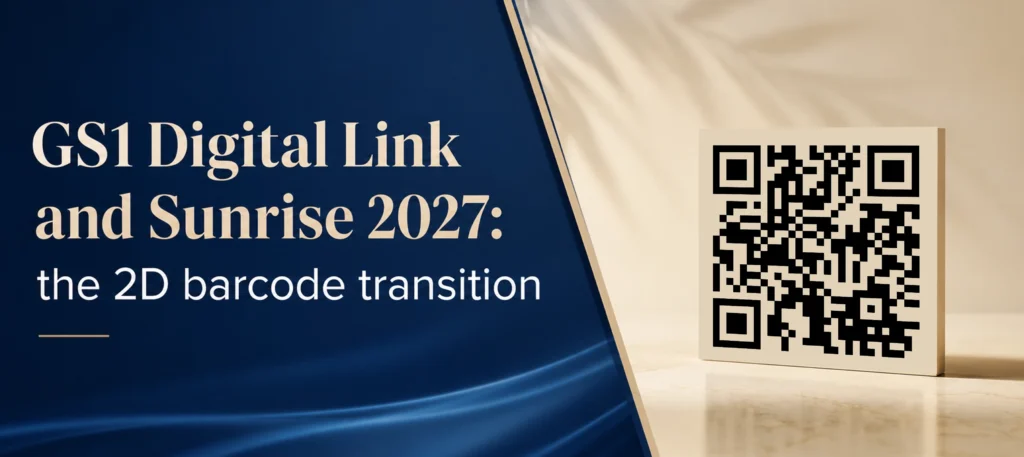
This is the bit worth understanding now, even if it doesn’t affect you immediately. GS1’s global “Sunrise 2027” initiative is a move from today’s linear (1D) barcodes to 2D barcodes QR-style codes built on the GS1 Digital Link standard that carry the same GTIN as a traditional EAN-13, plus optional extras like batch number, expiry date or a link to a product page.
As of mid-2026, here’s the verified state of play:
- 2026 is the final preparation year. Retailers, brand owners and logistics providers across dozens of countries are aligning product data and upgrading point-of-sale scanners.
- By the end of 2027, retailer point-of-sale systems worldwide are expected to be able to scan 2D barcodes at full checkout speed, extracting the GTIN just as they do from a linear barcode today.
- Dual-marking is the safe approach through 2027. GS1’s guidance is to keep printing your existing EAN-13 alongside a 2D barcode where you’re able to, not to switch over early not every till in the UK will be upgraded on the same timetable.
- From 2028 onwards, brands are expected to gain the freedom to choose 1D, 2D, or both, once POS coverage catches up. The classic EAN-13 isn’t being scrapped; it’s gaining a more capable sibling.
For most UK small businesses selling direct-to-consumer or through Etsy, none of this is urgent. If you supply supermarkets or large retail chains, it’s worth asking your retail buyer’s team whether they have a 2D barcode timeline, since some are moving faster than others.
Print-quality Spec Checklist
This is where we spend most of our prepress time at ACP a barcode or QR code that looks fine on screen can fail completely once it’s printed on kraft or under gloss lamination. Run through this list before you approve any print run.
Barcode (EAN-13) Minimums:
- Minimum size at 80% magnification: roughly 29.8mm × 18.3mm including quiet zones (the bars themselves run about 25mm wide, 18mm tall)
- Comfortable working size: 100–120% magnification prints far more reliably than the bare minimum don’t design right at the floor.
- Quiet zone: leave clear space either side of the bars roughly 3.6mm on the left, 2.3mm on the right at standard size with no text, logos or artwork crossing into it.
- Never scale a barcode disproportionately (stretching width only, or height only, breaks the bar ratios a scanner relies on)
QR code minimums:
- Minimum printed size: 10mm × 10mm for a simple, short link.
- For longer URLs or higher error-correction levels, scale up to 20mm × 20mm or more.
- Quiet zone: clear space on all four sides equal to at least four modules (roughly four times the width of one of the small squares) don’t let a border, logo or fold line crowd it.
Contrast, for both barcode types:
- Dark marks on a light background always. Never invert to light-on-dark; most retail laser scanners simply can’t read it, and even camera-based scanners are less reliable with it.
- Avoid red or dark-red printed elements behind or through the code many older scanners use a red light source and can’t distinguish red from the background.
- Aim for strong, even contrast muddy or low-contrast combinations (navy on black, dark green on brown) are a common cause of failed scans.
Kraft and natural-material substrates:
- Kraft’s mid-brown tone reduces contrast against black ink more than you’d expect on screen always print a solid white (or light) knockout panel behind the code rather than printing straight onto bare kraft.
- Ask your printer for a physical proof on the actual substrate, not just a screen mock-up, before a full run.
Lamination and finish:
- Gloss lamination over a barcode or QR code can cause scanner glare severe enough to cause failed scans under shop lighting.
- Matte or soft-touch lamination scans far more reliably if the rest of your box is gloss, consider a spot-matte finish just over the code.
- Foil, metallic or textured stock behind a code is a common cause of scan failure keep the substrate behind any scannable code flat and matte wherever possible.
Dead links (QR only):
- Test the destination URL before the print run, not after a QR code prints permanently, but its destination shouldn’t be a page you’re likely to delete or restructure within the product’s shelf life.
- Use a URL you control (your own domain or a redirect you manage) rather than linking directly to a third-party page that might move.
Placement on the Dieline

Where you put a scannable code on the dieline matters as much as how it’s printed. If you haven’t finalised your box structure yet, it’s worth reading our guide on getting your dieline right before you send artwork to print first the placement rules below assume you already know which panels are flat, which fold, and which get trimmed.
- Keep barcodes and QR codes off fold lines, glue flaps, and any panel that curves around a corner a code that wraps around an edge distorts and often fails to scan.
- For retail barcodes, follow the retailer’s placement brief if they’ve given you one most want it on a specific panel (commonly the back or base) within a set distance from the edge.
- If you’re using a QR code for both POS scanning and consumer engagement, GS1 UK’s guidance is to place a scannable 2D code within 50mm of the linear barcode’s centre for point-of-sale speed, and add a second, separate QR code elsewhere on the pack for consumer-facing content like reviews or instructions.
- Leave a safety margin between any code and the box edge trimming tolerances of even 1–2mm can clip a quiet zone if the code sits too close to a cut line.
- Flag the code’s exact position to your printer on the dieline file itself, not just in an email it’s the file that goes to press.
Testing before your print run
Before committing to a full print run, we always recommend:
- Order a physical proof, not just a digital PDF screen previews don’t show you how ink sits on your actual substrate.
- Scan the proof with three or four different phones and, if possible, a retail-style laser scanner apps and scanners read contrast differently.
- Test under shop-style lighting, not just your desk lamp glare from gloss lamination often only shows up under stronger, angled light.
- Check the QR destination loads correctly on mobile data, not just office wifi.
- Get a second person to scan it cold, without knowing where the code is this catches placement and quiet-zone issues your own eye has gotten used to.
Common mistakes we see on artwork files
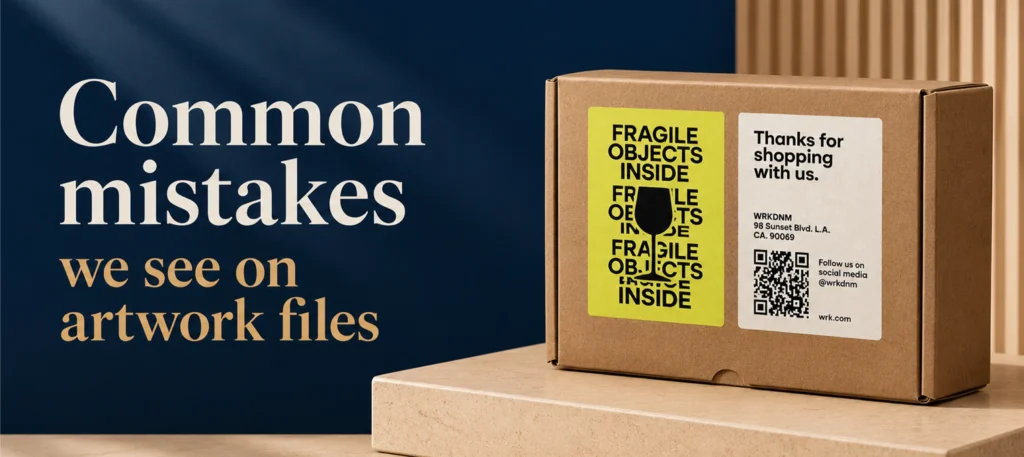
- Too small. Codes shrunk to “fit the design” rather than to the printable minimum are the single most common failure we see in prepress
- Low contrast. Pastel or metallic inks behind a code that looked fine as a screen mock-up
- Glossy lamination glare. A code that scanned perfectly on the proof, then failed once the full-gloss lamination went on
- Printing straight onto kraft with no knockout panel. Contrast drops far more than expected against a natural brown substrate
- Dead or soon-to-move links. QR codes pointing to a seasonal landing page that gets taken down months into the product’s shelf life
- Ignoring the quiet zone. Logos, taglines or decorative borders creeping into the clear space around the code
Frequently asked questions
Do I need a barcode to sell on my own website?
No. Barcodes exist for retail and marketplace stock systems. If you’re selling direct-to-consumer through your own site, you don’t need one.
Can I use a free online barcode generator instead of buying one from GS1?
You can generate an image, but the number behind it isn’t guaranteed unique. Supermarkets and most marketplaces require a genuine GS1 GTIN precisely because free generators can produce duplicate numbers.
What’s the difference between a barcode and a QR code on packaging?
A barcode (EAN-13) identifies a product to a retail till system via a GTIN. A QR code links to a web address and can carry far more information instructions, provenance, reviews but by itself doesn’t identify the product to a till unless it’s a GS1 Digital Link 2D barcode built for that purpose.
Do I need to worry about Sunrise 2027 right now?
Only if you supply supermarkets or large retail chains. If you sell direct or through Etsy, it has no effect on you at present. Keep printing your existing EAN-13 if you have one.
Why did my QR code fail to scan after printing, when it worked fine on screen?
The three most common causes we see are low contrast against the substrate (especially on kraft), glare from gloss lamination, and the code being printed below the practical minimum size.
How much does a UK barcode cost?
GS1 UK membership starts at £50 a year (ex VAT) for businesses turning over under £100,000, which includes 10 GTINs. Larger turnover bands pay more but also get more numbers included. Confirm current pricing at gs1uk.org before budgeting, as GS1 reviews rates periodically.
Key takeaways
- You only need a GS1 barcode for retail, wholesale or marketplace selling that requires a GTIN not for direct-to-consumer sales.
- GS1 UK membership starts at £50 a year (ex VAT) for smaller businesses, including 10 GTINs
- QR codes are free to generate and best used for instructions, provenance, reviews and loyalty not as a barcode substitute, yet
- Sunrise 2027 means 2D (QR-style) barcodes carrying a GTIN are coming to UK tills, with dual-marking the safe approach through 2027
- Print quality size, quiet zone, contrast, and lamination finish causes more real-world scan failures than any design choice
- Always test a physical proof on your actual substrate before committing to a full print run.
If you’re finalising artwork and want a second pair of eyes on barcode or QR placement before it goes to press, our design team checks this as standard as part of free proofing on every custom box order. Get a free quote and we’ll flag anything that needs adjusting before the file goes anywhere near the press.