
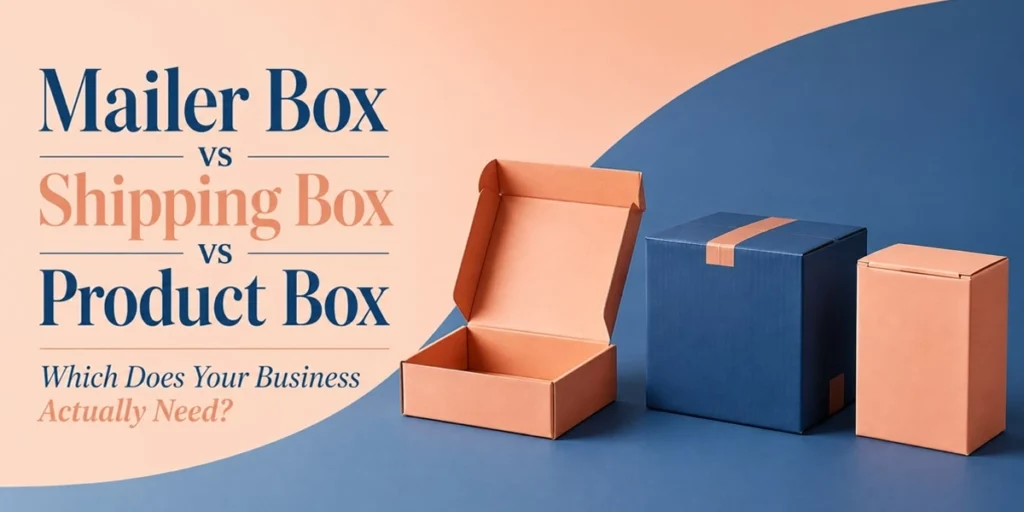
Mailer Box vs Shipping Box vs Product Box: Which Does Your Business Actually Need?
Quick answer: A product box presents your item on a shelf or in the customer’s hands. A mailer box is a self-locking corrugated box that ships on its own and doubles as the unboxing experience. A shipping box is a plain corrugated outer that exists purely to protect whatever sits inside it. Sell online only? A printed mailer usually does the whole job in one layer. Sell in shops? You need a product box, plus a shipping outer to move stock. Sell through both? That’s when brands run two or three layers, and when costs need watching.
Every week we quote a new brand that asks for “a box” and then, three emails later, realises they were actually asking about three different boxes. It’s the most common confusion in packaging, and suppliers make it worse by using the names interchangeably.
So here’s the plain-English version: what each box is, who actually sees it, what each one costs, and how to work out whether you need one layer, two, or all three. Prices below are in pounds, based on our own 2026 quoting, and they shift with size, board grade, print and quantity. Treat them as ballparks, not a price list.
The Three Boxes, in one Minute

A product box is the “pretty” layer. It’s the retail carton a customer picks up off a shelf, made from folding carton board (thin, printable cardboard, like a cereal box) or rigid board (the stiff, non-collapsible box your phone came in). It’s built for presentation, not for surviving a courier network on its own.
A mailer box is a self-locking corrugated box. Corrugated means it has a fluted (wavy) middle layer glued between flat sheets, which is what gives it crush strength. Mailers fold together without tape, close with a tuck-front lid, and are sturdy enough to ship as-is. Print the inside of the lid and the box becomes the unboxing moment itself.
A shipping box is the workhorse. Usually an RSC, short for regular slotted container: the classic four-flap box you seal with tape. It’s plain or lightly branded, cheap per unit, and exists to absorb the bumps so the layers inside don’t have to.
One box, three very different jobs. The question isn’t “which is best”. It’s “which of these jobs does my order actually need done?”
What Each Box Actually is
Product Box: The Retail Layer
A product box touches the customer’s hands, not the courier’s van floor. Folding cartons suit lightweight items such as cosmetics, teas, candles and soaps. Rigid boxes suit jewellery, tech, perfume and gifting, where the box itself signals value.
Worth knowing: a standard folding carton has almost no transit protection. Post one on its own and it will arrive creased. If your product box is cartonboard and you sell online, something protective has to go around it.
We covered the presentation side of this in more depth in our guide to choosing the right custom box style, so this post stays on the question of which layers you need, not which style looks best.
Mailer Box: The Hybrid Layer
The mailer is the reason e-commerce brands can skip a layer. It’s corrugated, so it protects. It’s printable inside and out, so it presents. And because it self-locks, packing is quicker than taping up an RSC.
Typical UK mailer sizes sit comfortably inside Royal Mail’s small parcel limit of 45cm x 35cm x 16cm and 2kg, which keeps postage in the cheapest parcel band. That’s not an accident. Mailer dielines (the flat cutting templates) are usually designed around carrier bands.
One caveat: mailers suit light to medium loads. A 12kg order of bottled goods needs a double-wall shipping box, not a mailer.
Shipping Box: The Protection Layer
Nobody unboxes an RSC on camera. That’s fine, because it isn’t there to be seen. It’s there so the boxes inside arrive without scuffs, crush marks or courier stickers on them.
Most brands leave shipping boxes plain or add a one-colour logo at most. Heavy branding on an outer box is usually wasted money, and for high-value goods it can even advertise what’s worth stealing. Plain outside, premium inside is the pattern most established brands settle on.
Comparison Matrix: Role, Material, Print, Cost
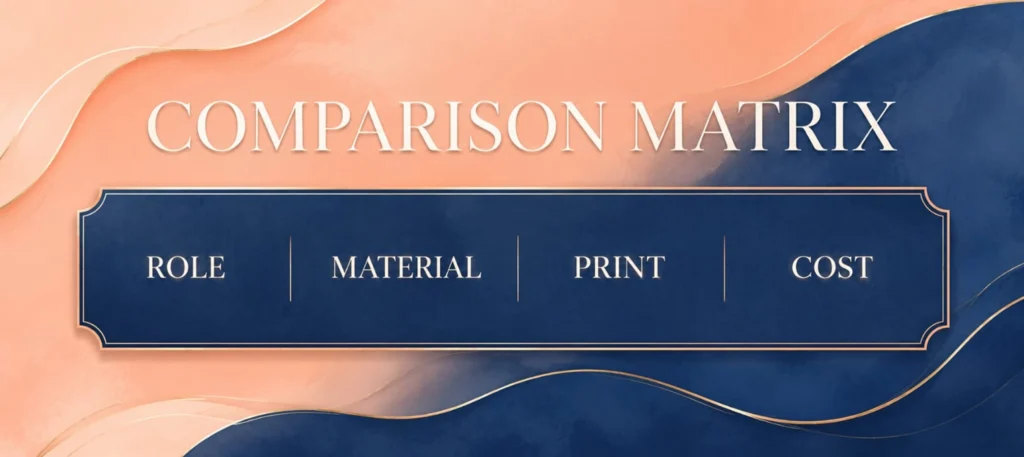
| Details | Product box | Mailer box | Shipping box |
|---|---|---|---|
| Job | Present the product | Protect and present in one | Protect everything inside |
| Who sees it | Retail customer | Online customer | Courier, warehouse |
| Material | Folding carton or rigid board | Corrugated (usually E or B flute) | Corrugated, single or double wall |
| Ships on its own? | No | Yes | Yes |
| Print approach | High-quality full colour, finishes | Outside and/or inside print | Plain, or one colour |
| Illustrative unit cost (100 to 500 units, 2026) | Cartons roughly £0.40 to £1.20; rigid roughly £2 to £6 | Roughly £0.70 to £2.50 | Roughly £0.20 to £0.60 (stock, unprinted) |
| You need it when | Product sits on a shelf or is a gift | You sell online and the box is the experience | Anything fragile, heavy, or boxed in cartonboard travels by courier |
Costs are from our own quoting and vary by size, board grade, print method and quantity. Unit prices fall sharply as quantities rise.
Which Layers Do You Actually Need?

Run your business through this. It’s the same flow we walk clients through on quote calls.
1. Do strangers see your product on a shelf?
Shops, markets, gift fairs, wholesale. If yes, you need a product box. If your only shelf is a website, you don’t, and plenty of successful online brands never buy one.
2. Do you post orders directly to customers?
If yes, and your product either has no box or sits in a folding carton, you need a corrugated layer around it. That’s either a printed mailer (if unboxing matters) or a plain shipping box (if it doesn’t).
3. Is the product heavy, fragile or high-value?
Glass, ceramics, liquids and anything over about 2kg per order usually wants a proper shipping box, often with an insert. A rigid product box also tends to travel inside an outer, because scuffed rigid boxes undo the point of buying them.
4. Do you ship in bulk to stockists?
Wholesale orders go out as product boxes packed into large plain outers. No mailer needed for that channel.
That produces four common setups:
- Online-only, light products: one layer. A printed mailer does protection and presentation together. This is the cheapest route to a branded unboxing and the setup we recommend most often to new e-commerce brands.
- Retail-only: two layers. Product box for the shelf, plain transit outers for moving stock. The outer is a consumable; spend as little on it as protection allows.
- Online and retail: two layers, used flexibly. A retail-ready product box, shipped inside either a plain outer or a lightly branded mailer. Your carton works in both channels and you avoid designing twice.
- Premium or fragile online orders: two to three layers. Rigid or cartonboard product box, protective insert, corrugated outer. Perfume, jewellery and glassware live here. More on protecting the inside in our post on reducing product movement inside shipping boxes.
What Layering Does to your costs
Layers multiply. That’s the bit that catches new brands out, because each extra layer adds unit cost, pack time and postage weight.
Take a candle brand posting 300 orders a month. Illustrative 2026 figures from our quoting:
- Single layer: printed mailer with a die-cut insert, about £1.40 per order.
- Two layers: folding carton (£0.70) inside a plain shipping box (£0.40) with void fill (£0.10), about £1.20 per order, but slower to pack and no branded unboxing.
- Three layers: rigid box (£3.20) plus outer (£0.40), about £3.60 per order, justified only if the price point carries it.
The sneakier cost is dimensional weight. Most UK couriers charge on volumetric weight where it exceeds actual weight. Evri, for example, calculates it as length x width x height in centimetres divided by 5,000. A 35 x 30 x 20cm two-layer setup around a 900g candle has a volumetric weight of 4.2kg, so you pay as if it weighed 4.2kg. Right-sized single-layer packaging that stays inside Royal Mail’s 45 x 35 x 16cm small parcel limit avoids that entirely.
Two more quiet savings from fewer layers: less pack time per order, and less packaging weight to report if your business falls under the UK’s extended producer responsibility (EPR) rules for packaging. Check GOV.UK for the current thresholds, as we inform rather than give legal advice.
And if sustainability messaging matters to your brand, one recyclable corrugated layer is an easier story to tell than three mixed-material ones. Our guide to biodegradable packaging types covers the material side.
How Each Box Prints Differently
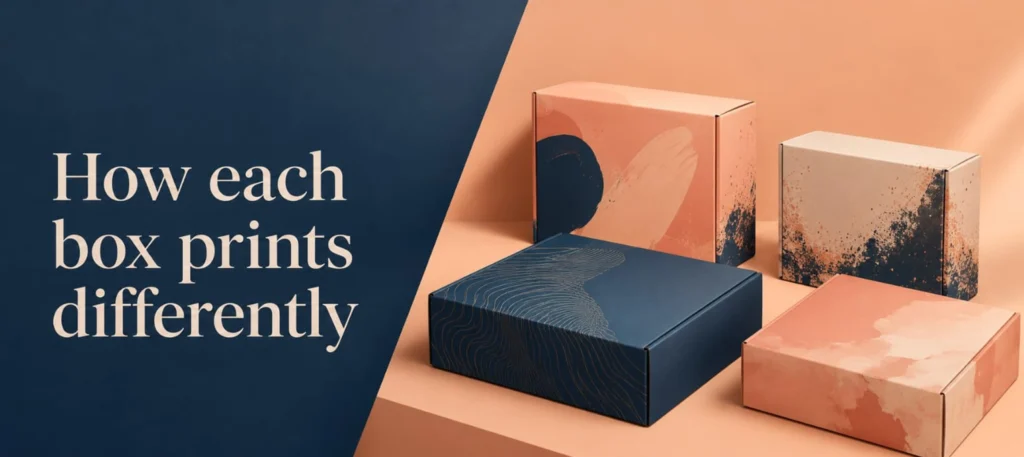
The three boxes don’t just differ in structure. They print differently, and that changes both cost and design choices.
Product boxes carry the premium print. Folding cartons are usually litho printed (a high-detail press process) with finishes such as matt lamination, spot UV or foil. Rigid boxes are wrapped in printed paper over thick greyboard. This is where photography, gradients and fine detail belong.
Mailer boxes print well on the outside, but the inside lid is the high-value surface. The customer stares at it for the whole unboxing. A message, a pattern or care instructions printed inside the lid costs relatively little and does more work than any outer graphic. Kraft brown with one or two ink colours keeps costs down; full-colour white mailers cost more but pop on camera.
Shipping boxes barely print at all, and shouldn’t. A one-colour logo and a “fragile” mark is plenty. Detailed artwork on an outer box gets taped over, labelled over and scuffed within one courier depot.
First-hand observation, for what it’s worth: the most common artwork mistake we see on mailers is designing the outside like a retail carton and leaving the inside lid blank. It’s backwards. Online, the inside is the shelf.
Mistakes We See on Real Orders
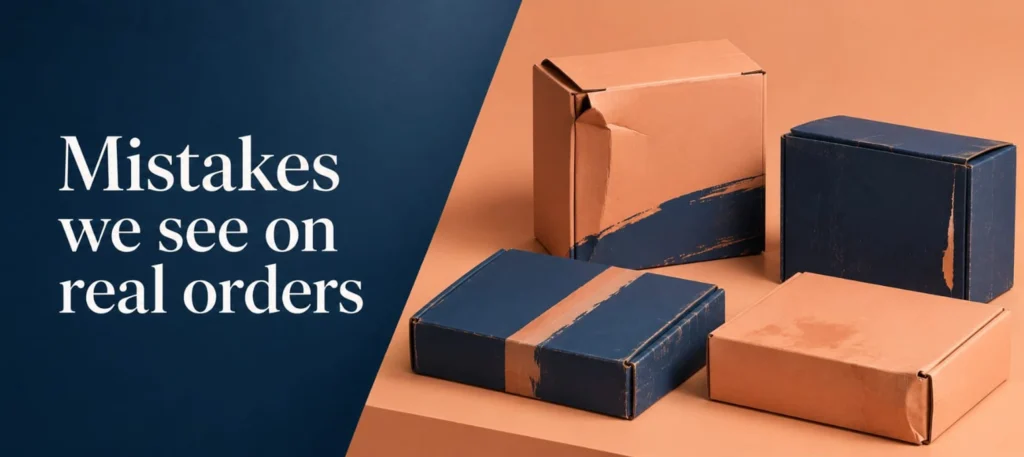
These come up on client jobs at All Custom Packaging often enough to list. All examples are from our own order files, anonymised.
Buying the pretty box first. A skincare startup ordered 500 lovely folding cartons, then discovered each one needed a shipping box and void fill to survive the post. Their real per-order packaging cost nearly doubled. Had they mapped channels first, they’d have started with a printed mailer and added retail cartons when a stockist actually asked.
Shipping rigid boxes naked. A jewellery client posted rigid gift boxes in paper mailing bags to save money. Around one in ten arrived with crushed corners, and every crushed corner became a refund conversation. Rigid boxes travel inside a corrugated outer. That outer is cheap insurance.
Over-boxing small items. A subscription snack brand used a carton inside a mailer inside an outer. Three layers for crisps. We rebuilt it as one inside-printed mailer, which cut their pack time roughly in half and dropped them into a cheaper postage band.
Frequently Asked Questions
What is the difference between a mailer box and a shipping box?
Both are corrugated, but a mailer box self-locks without tape and is designed to be seen, with print inside and out. A shipping box is a plain taped RSC built purely for protection. Mailers ship on their own; shipping boxes usually carry other packaging inside them.
Can a mailer box be shipped without an outer box?
Yes. That’s the point of a mailer. It’s corrugated and self-locking, so it goes straight into the postal network with a label on it. Only very fragile or heavy contents need an additional outer.
Do I need a product box and a mailer box?
Only if you sell in shops as well as online. Online-only brands can use a printed mailer as the sole box. Retail products need a shelf-ready product box, which then ships inside a mailer or plain outer.
Are mailer boxes cheaper than shipping boxes?
Per unit, no. A printed mailer typically costs more than a plain stock shipping box. Per order, often yes, because one mailer can replace a product box, void fill and an outer, and its smaller footprint can lower postage under volumetric pricing.
What kind of box do subscription boxes use?
Almost all use self-locking corrugated mailer boxes, usually printed inside the lid. Mailers survive monthly postal handling, open cleanly on camera, and don’t need tape, which matters at high monthly volumes.
Does a product box need protective packaging for shipping?
If it’s folding carton or rigid board, yes. Neither is built for loose courier transit. Use a corrugated mailer or shipping box around it, with an insert or paper void fill if the product is fragile.
Key takeaways
- Product box = presentation, mailer = protection plus presentation, shipping box = protection only.
- Online-only brands usually need just one layer: a printed corrugated mailer.
- Retail demands a product box; wholesale moves it in plain outers.
- Every extra layer adds unit cost, pack time, postage volume and EPR-reportable weight.
- Couriers charge on volumetric weight, so right-sizing beats over-boxing.
- Print money goes where eyes go: carton faces, mailer lids, and barely anything on outers.
Still unsure which layers your product needs? Send us the product and your channels and we’ll map it with you. At All Custom Packaging we make custom mailer boxes, retail cartons and rigid boxes from just 100 units, with free design support and proofing before anything prints. Get a quote and we’ll talk you through it.