

How Much Clearance Should a Custom Box Have? Packaging Fit and Tolerance Guide
Quick answer: how much clearance should a custom box have? It depends on what has to fit in the gap. For a product that goes straight into a close-fitting carton, the clearance only needs to cover the product’s own size variation, the box’s manufacturing tolerance and enough room to get it in and out. For a fragile item that ships with cushioning, the gap has to hold the cushioning, and Royal Mail advises at least 5 cm of it all round. Check the fit with the largest product in the smallest box the tolerance allows, and the smallest product in the largest.
Most sizing guides give one number, “add a few millimetres”, and stop. That number is only a guess until you know what goes in the gap and how much the box and product can vary. This guide shows how to work it out.
Clearance and tolerance are different things
Two terms get mixed up in almost every box brief.
- Clearance is the gap you design in on purpose: the difference between the product and the inside of the box.
- Tolerance is how far a real, finished box can be from the number on the drawing, and how far each real product can be from its nominal size.
You choose the clearance. You live with the tolerance. A box drawn with 2 mm of clearance can end up with less than nothing if the product runs large and the box runs small on the same day.
Where the size variation comes from

Neither the box nor the product is exactly the size on paper.
- Board thickness. Box sizes are conventionally given as internal dimensions, length x width x depth, and board thickness sits outside that. Corrugated board also varies in thickness from batch to batch, and it can be crushed slightly at the creases.
- Cutting and folding. Where the crease sits and how the panels fold changes the finished size by a small amount.
- Glue and assembly. A glued flap or a hand-wrapped rigid box adds its own small variation.
- Moisture. Paper and board take up moisture and swell in damp conditions, and shrink as they dry out, so a box stored in a damp unit can fit differently from one stored somewhere dry.
- The product itself. Glass bottles, candle jars, handmade soap and anything poured, moulded or cut by hand vary from piece to piece. A lid or a pump adds its own variation.
There is no single tolerance that applies to every box. Ask your supplier what tolerance it works to for your box style, and whether that figure applies to the internal size.
The worst-case fit check
This is the check that stops the “it matched the drawing but it doesn’t fit” problem. Test two combinations, not one:
- Largest product, smallest box. Take the biggest product you will pack and the tightest the box can come out. It must still go in without forcing, and the lid must close without bulging.
- Smallest product, largest box. Take the smallest product and the loosest box. It must not slide or rattle enough to damage the product or spoil the presentation.
If both pass, the clearance is right. If the first fails, add clearance or tighten the tolerance. If the second fails, you need an insert or some fill to take up the difference, because clearance alone cannot cover both ends.
The same check as two simple sums, worked along each axis (length, width and depth) in turn:
| Check | Sum | What you want |
|---|---|---|
| Tightest fit | Smallest internal box or cavity size minus largest product size | Above zero, with enough left to load the product without forcing |
| Loosest fit | Largest internal box or cavity size minus smallest product size | Small enough that the product cannot slide or rattle |
Loading direction changes the answer. A product dropped in from the top, slid in from the side, pushed into a sleeve or pressed into an insert cavity each needs a different amount of working room, usually most along the direction it travels as it goes in. Plan the clearance for the way it will actually be packed.
Hand packing and machine packing are different. A fit that works by hand can jam on a packing line. If your boxes will be filled by machine, tell the supplier before the dieline is approved, because machine guides and loading speed can need more working clearance than hand packing.
Build the clearance from what goes in the gap

Rather than picking a number, add up what the gap has to hold.
| What sits in the gap | What it adds |
|---|---|
| Nothing (product straight into a close-fitting carton) | Only product variation, box tolerance and room to slide in |
| Tissue or a paper wrap | The thickness of the wrap, on each side it covers |
| A card or foam insert | The insert’s wall thickness, plus the cavity clearance inside it |
| Cushioning for a fragile item | The full cushioning depth on every side |
| Finger room to lift the product out | A notch or a little extra space at one end |
For fragile items that ship on their own, the cushioning dominates. Royal Mail’s advice for packaging fragile items is to surround each one with at least 5 cm of cushioning material. It also says fragile items should not touch each other or the sides of the box, and that the fit should be neither so snug that there is no room for protection nor so roomy that the item slides around. The 5 cm figure is a shipping cushioning recommendation for fragile items, not a general custom-box clearance or manufacturing tolerance.
For the measuring itself, including which way round length, width and height go, see our guide on how to measure box dimensions.
Fit by box type
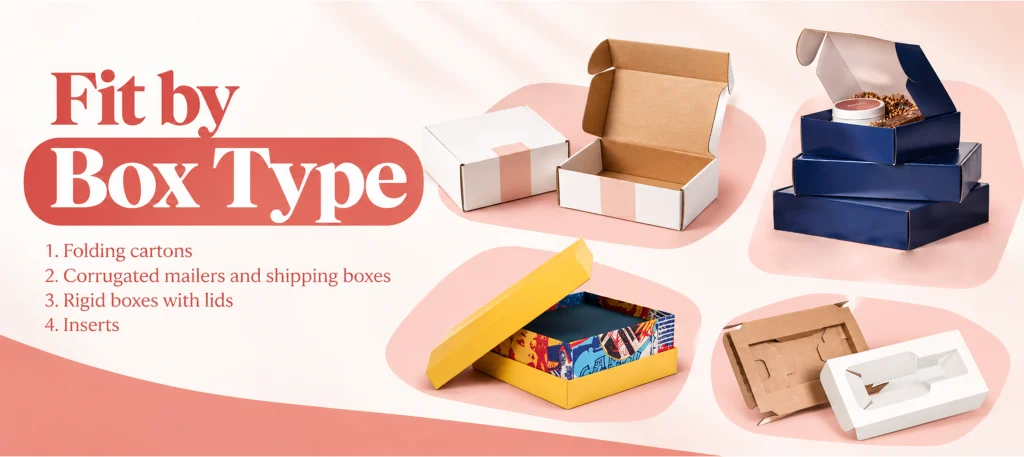
Folding cartons
A folding carton is thin board, so its clearance is mostly about sliding the product in and closing the tuck. Too tight and the tuck flap bulges or the carton splits at a crease; too loose and the product rattles on the shelf. A carton that holds a jar or a bottle often needs a little more room at the top for the closure than at the sides.
Corrugated mailers and shipping boxes
Corrugated board is thicker and softer at the creases, so the difference between internal and external size is bigger and the corners give slightly under load. For a mailer holding a sturdy product with a light wrap, the clearance can be modest. For a shipping box holding cushioning, the internal size has to include the full cushioning depth, which is why a fragile item’s box can be much bigger than the item. Custom mailer boxes are made to your dimensions, so the internal size can be set around the product and its protection rather than the nearest stock size.
Rigid boxes with lids
A two-piece rigid box has two fits to get right: the product in the base, and the lid over the base. The lid’s internal size has to clear the base’s external size, which includes the wrapped board on both sides. Too tight and the lid sticks or scuffs the wrap; too loose and it drops off and looks cheap. This is a fit that needs a physical sample, because the wrap and glue add thickness that a drawing does not show well. Rigid boxes with lids are the usual construction here.
Inserts
An insert moves the clearance question inside the box. The cavity needs a small gap around the product so it lifts out cleanly, and extra room around caps, pumps and necks so the insert holds the body rather than pressing on the closure. Size the cavity to the largest product you will pack. Custom insert boxes have the cavity designed as part of the box.
When it fits but looks wrong
A product can fit physically and still look wrong. A logo sits off-centre behind a window, a bottle neck drifts to one side of the window, or a round product rotates so its label faces the back. If the look matters, treat alignment as its own check: hold the product in position with an insert or a locating tab, and judge the sample by eye as well as by measurement.
Four sizing mistakes that cost a reprint
- Sizing from one sample. The one bottle on your desk may be the smallest in the batch. Measure several and use the largest.
- Forgetting the closure. Pumps, caps and lids are often the tallest or widest point, and the part most likely to be pressed on.
- Mixing internal and external sizes. A box ordered at the product’s size, or an external size read as internal, will be too tight or too loose. The standard sizes and carrier limits in our guide to standard box dimensions use the same distinction.
- Not re-checking after a change. An approved fit only holds for the materials and product it was approved with. Re-check it if the board, lamination, insert material, bottle or jar supplier, cap, pump, label or any other component changes.
Check the fit before the full run
A drawing confirms the numbers. Only a real box with the real product confirms the fit.
Every order is approved before bulk production. Approval may be based on a digital 3D mock-up, a video of the physical sample, or a physical production sample, depending on the order. A mock-up is the right place to check layout and proportions. For a close fit, such as a rigid lid, a tight insert or a carton that must hold a variable product, ask for a physical sample when you request the quote. Then run the worst-case check on it.
How we size custom boxes
We make boxes to your dimensions, so the internal size is set around the product and whatever sits in the gap. The board and construction are chosen for the product’s weight and the journey it makes, and inserts are cut to the customer’s product dimensions.
- Orders start from 100 units.
- Design support is free.
- A digital 3D mock-up is free.
Frequently asked questions
How much space should there be between a product and its box?
It depends on what goes in the gap. A close-fitting carton only needs room for product and box variation and to slide the product in. A box with a wrap, an insert or cushioning needs room for that too. For fragile items with cushioning, Royal Mail advises at least 5 cm all round.
What is the difference between clearance and tolerance?
Clearance is the gap you design between the product and the box. Tolerance is how much the real box and the real product can vary from their stated sizes. The clearance has to be big enough to absorb the tolerance.
Why does my product not fit a box made to the right size?
Usually because the box was sized from one product that was smaller than others in the batch, because the size quoted was external rather than internal, or because the closure was not measured. Board thickness and moisture can also take up a little space.
How tight should a rigid box lid be?
Snug enough to stay on when the box is picked up, loose enough to come off without sticking or scuffing. Because the wrap and glue add thickness, the fit is best judged on a physical sample.
Should a box be bigger for fragile items?
Yes. The internal size has to include the cushioning on every side. Royal Mail’s guidance is at least 5 cm of cushioning around each fragile item, so the box is much larger than the item itself.
What tolerance should I ask my packaging supplier for?
Ask what tolerance the supplier works to for your box style, whether it applies to internal dimensions, and how it is measured. Then check the fit on a sample with your largest and smallest product.
Working out a box size now? Tell us the measurements of the largest product you will pack, what goes around it and how it travels, and we will come back with a suggested internal size.