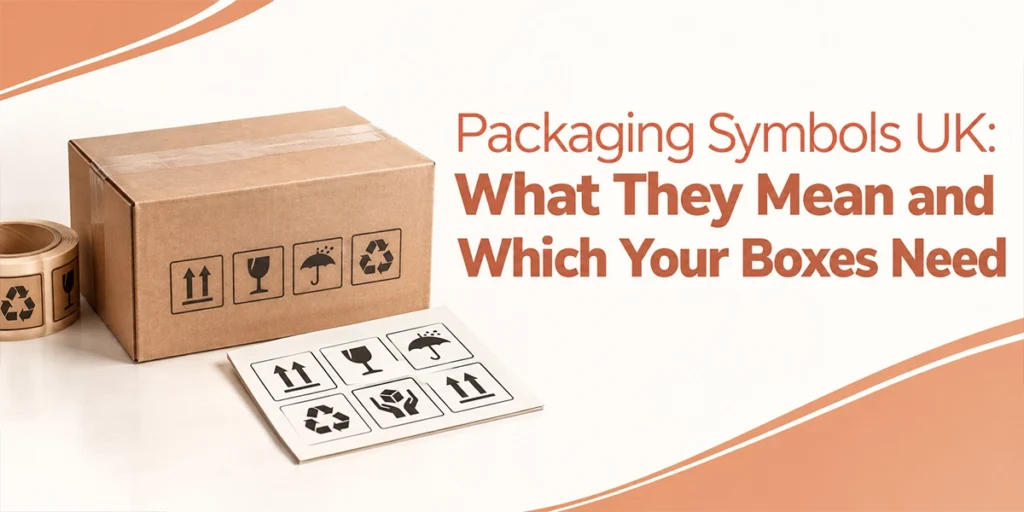
Packaging Symbols UK: What They Mean and Which Your Boxes Need
Quick answer: Packaging symbols fall into three groups. Some are required by law, but only for certain products: hazard pictograms on dangerous chemicals, the crossed-out bin on electrical goods, food contact marking on items sold for food use, and UKCA or CE marking where product rules apply. Some are voluntary but controlled, so you may only use them if you qualify: the ℮ mark, forest certification logos and certified compostable marks. The rest are informational, such as handling icons and most recycling marks. If none of the relevant product, chemical, food-contact or sector-specific rules requires a mark, there may be no compulsory symbol on the box, but any recycling or environmental symbol you add must be true.
Packaging symbols by UK status
| Symbol | What it means | UK status | Who can use it |
|---|---|---|---|
| UKCA or CE mark | The manufacturer declares the product meets the relevant product rules | Required for products covered by those rules | The manufacturer, for a conforming product |
| Crossed-out wheeled bin | Do not put in household waste; electrical item | Required on electrical and electronic equipment itself | Producers of electrical goods |
| GB CLP hazard pictograms | The contents are a hazardous chemical | Required on hazardous chemical products | The supplier of the chemical |
| “For food contact” or glass and fork | The material is suitable for contact with food | Required where food contact materials are sold as such | Makers and sellers of food contact materials |
| ℮ (estimated sign) | Quantity packed under the average system | Voluntary, but only on packs that meet the rules | Packers who comply with the average system |
| Forest certification logo | The fibre comes from certified, responsibly managed forests | Voluntary, trademark controlled | Certificate holders and licence holders of that scheme |
| OPRL “Recycle” or “Don’t recycle” label | How the pack should be disposed of in the UK | Voluntary for now | Members of the OPRL scheme |
| Mobius loop | Commonly used to indicate recyclability | Informational, but must be true | Anyone, if the claim is accurate |
| Numbered triangle (1 to 7) | The type of plastic | Informational only | Anyone |
| Green Dot | A contribution to a packaging recovery scheme was paid | Informational only | Members of schemes that use it |
| Tidyman | Please do not litter | Informational only | Anyone |
| Generic handling symbols | How to move, stack and store the package | Generally informational; transport rules can require other marks | Anyone |
The rest of this guide takes each group in turn.
Recycling symbols, decoded
Recycling marks cause the most confusion, because several look alike and mean very different things. Milton Keynes Council’s guide to recycling logos sums up the main ones:
- OPRL labels (the “Recycling Swoosh”) tell the consumer whether the pack can be recycled or not. These are the clearest UK labels.
- The Mobius loop (three chasing arrows in a circle) is commonly used to indicate recyclability. It says nothing about whether your local collection takes it.
- A numbered triangle does not mean the item can be recycled. It identifies the type of plastic.
- The Green Dot means the producer has paid towards a packaging recovery scheme. It does not mean the pack is recyclable.
The Tidyman, a figure dropping litter in a bin, comes from the charity Keep Britain Tidy. It asks people not to litter. It is not a recycling claim.
For board packaging, the honest message depends on the whole build, not the board alone. An unlaminated paperboard construction may be easier to process through suitable paper-recycling streams than a heavily laminated alternative. Final recyclability depends on the full material and finishing specification and the facilities available locally.
Are recycling labels mandatory in the UK?
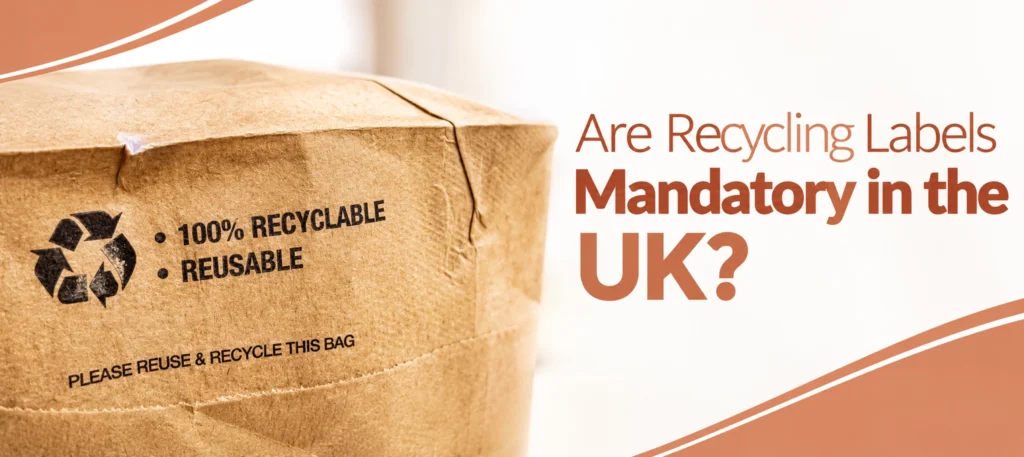
Not yet. Under the UK’s extended producer responsibility for packaging (EPR), mandatory “Recycle” or “Do not recycle” labels were planned for 2027. According to the scheme operator OPRL, the mandatory labelling requirement will not be enforced from 1 April 2027 as previously announced. Defra has said it will consider options for UK labelling once the EU’s approach is clearer.
So, as of September 2026, a recycling label is voluntary for most packaging. That can change, so check the current position before a large print run, especially if you order packaging months ahead.
Environmental claims must be true
A recycling symbol is an environmental claim. Government guidance on making green claims applies to everyone in the supply chain, from brands and retailers to manufacturers and suppliers. Since April 2025, the Competition and Markets Authority can fine a company up to 10% of its global turnover for breaking consumer protection law, which includes misleading claims.
In practice:
- Only print “recyclable” or a recycling mark if the finished pack, with its coating, window and glue, can genuinely go into the stream you name.
- Do not use a symbol to suggest more than it means. A numbered triangle or a Green Dot is not a recycling claim, and should not sit next to wording that implies one.
- Keep the evidence behind the claim, such as the material specification.
Certification marks you need permission to use
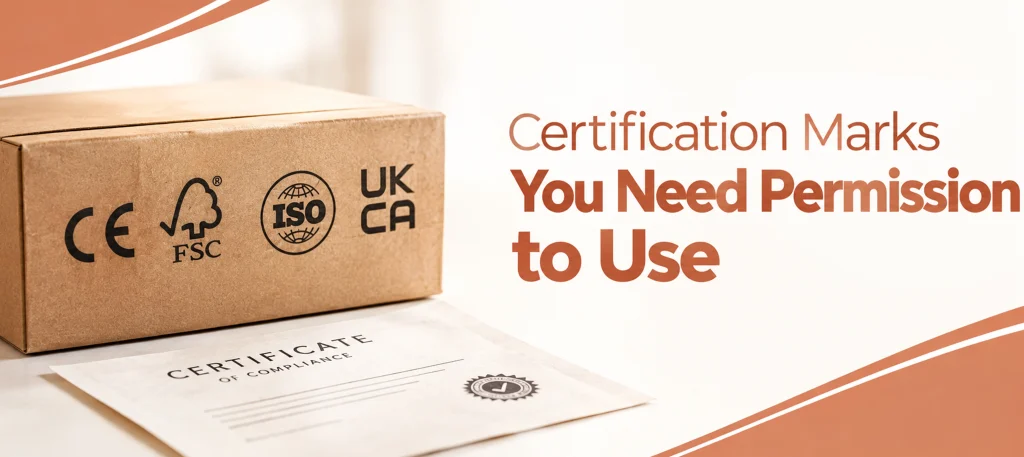
Some logos are trademarks, and printing one without permission can infringe the owner’s rights.
- Forest certification logos. The tree logos of forest certification schemes are trademarks. To put one on products, an organisation needs certification or a licence from that scheme, and each scheme publishes its own trademark rules. Being sent certified board is not enough on its own.
- OPRL. The OPRL labels are used through membership of the scheme, which sets the rules for each label.
- Compostable marks. Home or industrial compostable logos come from certification schemes, and the product must be certified to carry them.
Product and legal marks that can appear on packaging
These belong to the product or its contents rather than the box, but they often end up printed on the pack.
- UKCA and CE. The UK continues to recognise the CE marking alongside, or in place of, the UKCA marking for many products in Great Britain. The marking should be at least 5 mm high unless the rules for that product say otherwise. Where the product is too small, it can go on the packaging, a label or the accompanying documents. The government guide to placing UKCA or CE marked products sets out the details.
- The crossed-out wheeled bin. Producers of electrical and electronic equipment must display it on the product, at a size set by the standard BS EN 50419.
- GB CLP hazard pictograms. Hazardous chemicals carry hazard pictograms: diamonds with a red border and a white background. There are nine.
- Food contact. Suitable food packaging is marked “for food contact” or carries the wine glass and fork symbol, under assimilated Regulation (EC) No 1935/2004.
- The ℮ mark. Placed next to the quantity, it is the packer’s declaration that the contents meet the average system of quantity control. It is not required, and it must not be used on packs that do not meet the criteria.
Cosmetics have their own marks, including the open-jar period-after-opening symbol and the egg timer. These are covered in our guide to cosmetic labelling requirements.
Handling symbols
Handling symbols tell anyone moving the package how to treat it. These generic ISO 780 handling symbols are generally informational rather than a standalone legal requirement; product or transport rules can require separate markings. The common ones:
| Symbol | Meaning |
|---|---|
| Broken glass | Fragile, handle with care |
| Two upward arrows | This way up |
| Umbrella | Keep dry |
| Sun | Keep away from sunlight |
| Thermometer | Temperature limits |
| Stack with a number | Maximum stacking layers |
| Crossed-out stack | Do not stack |
| Crossed-out hook | Do not use hooks |
Two practical points. First, handling symbols matter most on the outer shipping carton, which is what couriers and warehouses handle, not the retail box inside. Second, a symbol does not replace packing. Royal Mail’s compensation policy for damage expects breakable items to be packed in a strong container with enough protection, and marked “FRAGILE HANDLE WITH CARE”.
Putting symbols on your box artwork
Symbols are small, so they are easy to get wrong on a box:
- Size. Keep them legible at print size. Where a rule sets a minimum, such as 5 mm for UKCA or CE, follow it.
- Placement. Keep them off folds, glue flaps, tuck flaps and any panel that is hidden once the box is assembled. Keep them inside the safe zone.
- Contrast. A fine symbol in a pale colour can disappear on kraft board. Use a dark colour or a solid background.
- Files. Use the official artwork from the scheme or regulator, supplied as vector files, and do not redraw or recolour certification marks.
- Barcodes. These have their own rules, covered in our guide to QR codes and barcodes on packaging.
Our guide to print-ready packaging artwork explains bleed, safe zones and file set-up.
When to re-check your symbols
A symbol that is right today can become wrong. Re-check the artwork when:
- you add or change a lamination, foil, window or coating, which can change the recycling message
- you change material, for example from board to a plastic part
- the product changes, for example a new formula that becomes hazardous, or an added electrical part
- you start selling in a new market with its own marks
- the UK labelling rules change
A quick checklist before you approve artwork
- Does the product fall under any rule that needs a mark (electrical, hazardous, food contact, UKCA or CE)?
- Is every recycling or environmental symbol true for the finished pack, and do you have the evidence?
- Do you have permission to use every certification logo on the pack?
- Is every symbol legible, correctly sized and on a visible panel?
- Are handling symbols on the outer carton where couriers will see them?
Symbols on packaging made with us
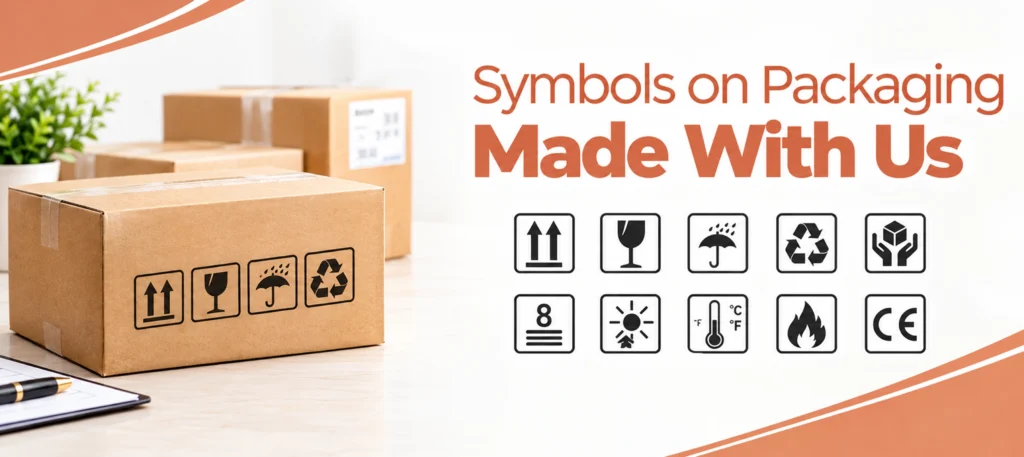
We print your packaging symbols as part of the artwork, on custom product boxes and mailers. The artwork layout can reserve clear panels for the information the product is required to display. All Custom Packaging can help organise the available print space, but the brand or its regulatory adviser remains responsible for confirming the accuracy and completeness of the required product information. We can explain the general recyclability considerations of the selected material and finishing options, so you can make accurate claims on your own packaging.
- Design support is free, including placing symbols on the dieline.
- A digital 3D mock-up is free, so you can check every panel before printing.
- Orders start from 100 units.
Packaging symbol questions
What are the most common packaging symbols?
Recycling marks (the Mobius loop, OPRL labels, numbered plastic triangles, the Green Dot), handling symbols (fragile, this way up, keep dry), and product marks such as UKCA or CE, the ℮ mark and food contact symbols.
Is it a legal requirement to put a recycling symbol on packaging in the UK?
Not at present for most packaging. Mandatory recycling labels under EPR were delayed. Any recycling symbol you do use must be accurate.
Does the Mobius loop mean my packaging is recyclable?
It is commonly used to indicate recyclability. It does not confirm that every local collection accepts it. A Mobius loop with a percentage usually shows recycled content instead.
Does the Green Dot mean packaging is recyclable?
No. It shows the producer paid towards a packaging recovery scheme. It is not a recycling claim.
Can I put a forest certification logo on my boxes?
Only with certification or a licence from the scheme that owns the logo. Buying board from a certified source does not give you the right to use it.
Do I need handling symbols on my product box?
The generic handling symbols are generally not a standalone legal requirement, although product or transport rules can require separate markings. Put handling symbols on the outer shipping carton, where couriers and warehouses see them.
Does food packaging need the glass and fork symbol?
Food contact materials sold as such are marked “for food contact” or with the glass and fork symbol. With us, food-contact material suitability is confirmed for the specific material before production.
Planning your artwork? Send us your design and the symbols you need, and we will place them on the dieline and show them on a free 3D mock-up.