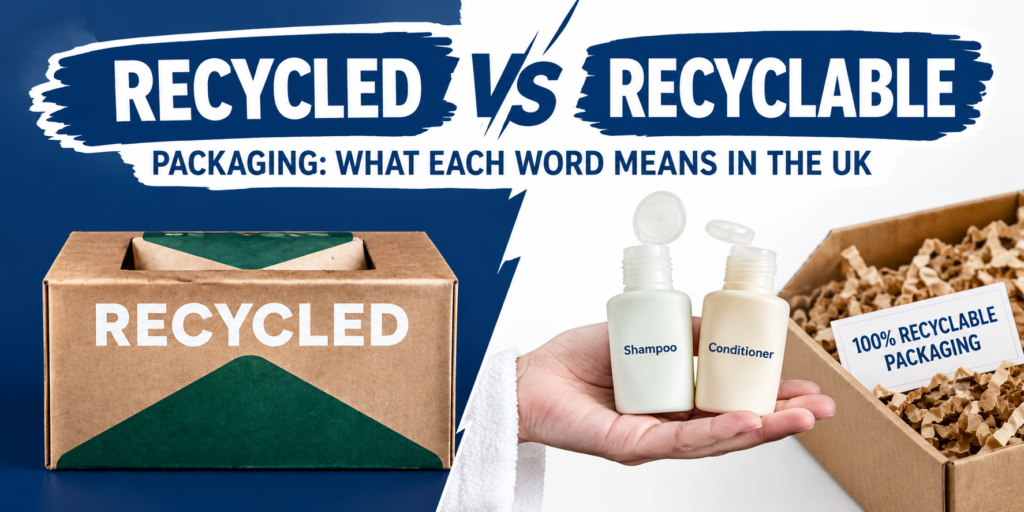
Recycled vs Recyclable Packaging: What Each Word Means in the UK
Recycled packaging is made from material that has already been used and reprocessed. Recyclable packaging can be collected, sorted and reprocessed after use. The first word describes what a pack is made from and the second what can happen to it next, so one pack can be both, either or neither.
In the UK the difference is more than wording, because each word has its own test. The Plastic Packaging Tax looks at recycled content, while the recyclability assessment under extended producer responsibility (EPR) looks at what happens after use. Both words also count as environmental claims under consumer law, so each needs evidence. This guide explains recycled vs recyclable packaging in those terms, with examples and wording that holds up.
Recycled and recyclable at a glance
| Recycled | Recyclable | |
|---|---|---|
| What it describes | What the pack is made from | What can happen to the pack after use |
| How it is measured | The share of the material, by weight, that is recycled | Whether the pack is collected, sorted and reprocessed in practice |
| What decides it | The material bought, and the evidence behind it | The finished build, and the collections it ends up in |
| Main UK rule | Plastic Packaging Tax (plastic only) | EPR recyclability assessment; council collections |
| An accurate claim | “Made with [confirmed %] recycled fibre” | “Recyclable”, with what to do, such as “Remove the window film before recycling” |
One pack can be both, either or neither
Recycled content and recyclability are separate properties, so they combine in four ways. The examples show typical outcomes under the UK assessment rules explained further down.
| Recycled content | Recyclable in UK collections | Example |
|---|---|---|
| Yes | Yes | A plain corrugated box with recycled-fibre liners and no plastic layers |
| Yes | No | A recycled-fibre gift box with glitter stuck to it, which the UK assessment rates red |
| No | Yes | A carton of virgin board with no laminate, foil or wax |
| No | No | A virgin paper mailer lined with plastic bubble padding, also rated red |
Corrugated board shows how the two separate. Its liners can be kraftliner, made mainly from virgin fibre, or testliner, made mainly from recovered fibre, as our guide to corrugated cardboard’s characteristics explains. Either way, corrugated cardboard is on the UK list of packaging commonly collected at kerbside.
What counts as recycled content
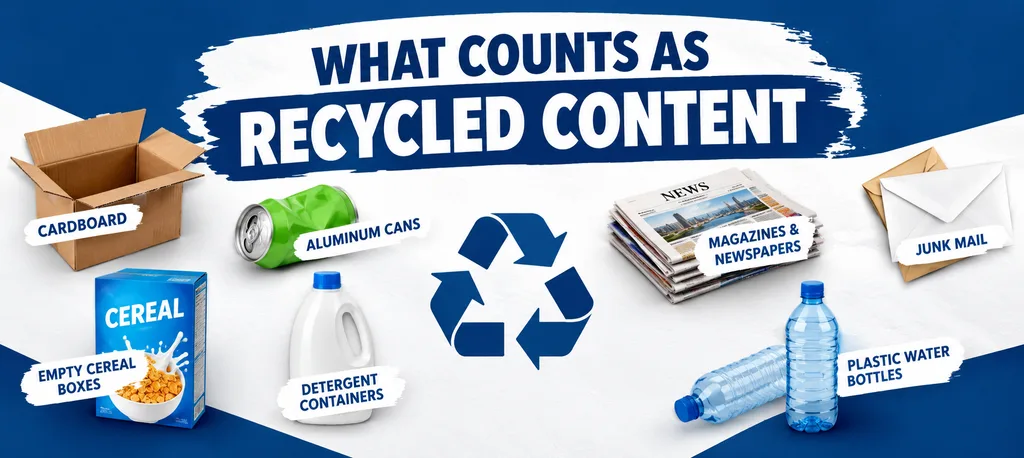
Recycled content is material recovered from waste and reprocessed so it can be used to make something new. It comes from two sources.
| Source | What it is | Example |
|---|---|---|
| Pre-consumer | Waste from a manufacturing process, reprocessed before any customer used it | Plastic trim melted into pellets and moulded into new trays |
| Post-consumer | Material thrown away by an end user, including returns from the distribution chain | Used boxes collected from homes and businesses, then pulped into new board |
For plastic, HMRC’s guide to which packaging is subject to the tax sets a precise test. Scrap or regrind that goes straight back into the same process after shredding or grinding does not count. The tax treats plastic as virgin unless there is evidence that recycled material was used. From 1 April 2027, pre-consumer plastic will no longer count as recycled plastic for the tax at all.
The tax is where a recycled-content figure has a price attached. HMRC’s Plastic Packaging Tax guidance sets the rate at £228.82 a tonne from 1 April 2026, charged on plastic packaging components whose plastic is less than 30% recycled. Registration starts at 10 tonnes of finished plastic packaging components made or imported over 12 months. The share is worked out on the plastic alone, as recycled plastic weight divided by total plastic weight. For mailing bags, our guide to polythene and plastic bags covers what to ask a supplier.
Paper and board are outside the tax, so for board a recycled-content figure is a marketing claim, held to the general rules on environmental claims set out below. Recycled fibre also changes how board performs. Fibres shorten as they are reprocessed, so a recycled-fibre board may need a heavier grade to match the strength of a virgin-fibre board.
Our comparison of kraft and white boxes covers recycled fibre in finished boxes. Our board options include natural brown kraft, made from virgin and recycled pulp, and CCNB, a recycled duplex board with a coated white printing surface, each available depending on the specification.
What makes packaging recyclable in the UK
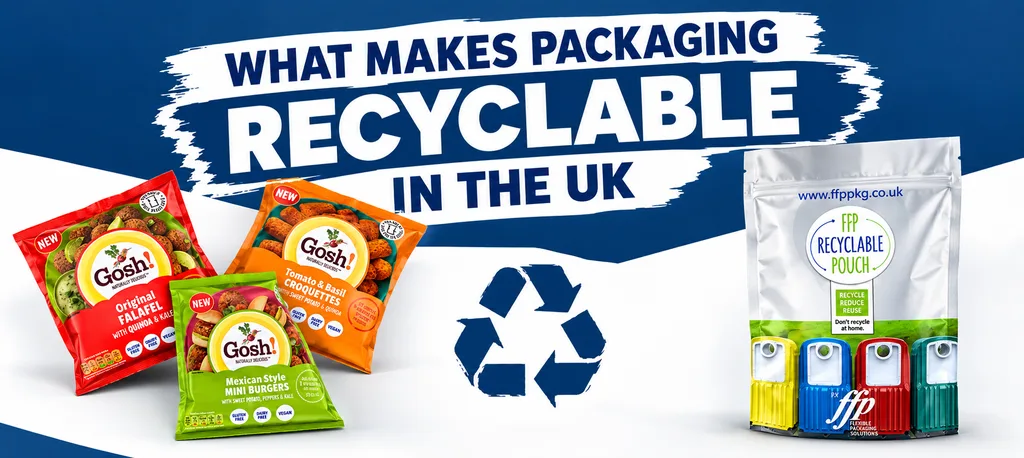
Recyclable means more than a material that could be reprocessed in theory. Under EPR, large producers must rate the household packaging they supply using the recyclability assessment methodology, known as RAM. It follows a pack through four stages: collection, sorting, reprocessing and the use of the recycled material. Each pack is rated red, amber or green, and green means widely recyclable in the current UK infrastructure.
Collection comes first. A green rating at that stage needs kerbside collection by at least 75% of local authorities across the UK. The 2027 list includes corrugated cardboard, cardboard sleeves, cereal boxes and egg boxes, while liquid food and drink cartons have only limited collection.
For paper and board, the RAM 2027 materials guidance then looks at what has been added to the fibre.
| Feature of a paper or board pack | RAM 2027 outcome |
|---|---|
| Glitter stuck to the paper or board | Red |
| Greaseproof, siliconised or waxed paper or board | Red (a wax dispersion coating is rated amber instead) |
| A paper mailer lined with plastic bubble padding | Red |
| More than 10% non-paper content by weight | Amber |
| More than 15% non-paper content by weight | Red |
| Designed for food to be heated in it | Red |
| PET or metallised PET laminated to the inside | Amber |
| Aluminium foil laminate 6 microns thick or more | Red |
| More than 5% plastic by mass | Assessed as a fibre-based composite instead |
These criteria are for the 2027 reporting year. Producers use RAM version 1.1 for 2026, and the method is reviewed every year. An unlaminated paperboard construction may be easier to process through suitable paper-recycling streams than a heavily laminated alternative. Final recyclability depends on the full material and finishing specification and the facilities available locally.
Finishes and windows can change a box’s rating. A window needs a film patch or a die-cut aperture, and that choice affects both cost and recyclability. Our guide to packaging print finishes covers lamination, foil and window film in more detail.
A RAM rating is not related to any recycling label printed on the pack. Our guide to packaging symbols explains those labels and what each one promises.
Collections decide what customers can actually recycle. In England, Defra’s household recycling guidance requires councils to collect paper and card, glass, metal and plastic, including cartons, from every household from 31 March 2026. Councils do not have to collect plastic labelled compostable or biodegradable, polystyrene or PVC packaging, or laminated foil pouches. Workplaces in England have had to separate recycling since 31 March 2025, and firms with fewer than 10 full-time equivalent employees have until 31 March 2027.
How UK rules split the two words
| Rule | Word it tests | What it looks at | Who it applies to |
|---|---|---|---|
| Plastic Packaging Tax (HMRC) | Recycled | At least 30% recycled plastic in each plastic component, with evidence | UK makers and importers who reach the 10 tonne threshold |
| EPR recyclability assessment (RAM) | Recyclable | Collection, sorting, reprocessing and reuse of the material, rated red, amber or green | Large producers, for household packaging |
| Simpler Recycling (England) | Recyclable | What councils and workplaces must collect | Councils and workplaces in England |
| Consumer law and the CMA’s Green Claims Code | Both | Whether a claim is accurate, clear and backed by evidence | Every business that makes or repeats the claim |
A pack can pass one test and fail another. A plastic component that is 30% recycled is not charged the tax but can still be rated red, and the RAM criteria do not include recycled content at all. RAM ratings feed into EPR disposal fees, with red-rated packaging charged more, and our guide to EPR packaging fees covers the amounts.
How to make each claim on your own packaging
The CMA’s Green Claims Code guidance applies to both words. A business must not call a product recyclable if it is not, or if only some parts are. A recyclability claim should make clear whether it covers the whole product or part of it, and should come with recycling instructions. Conditions belong close to the claim, not in small print. Claiming recycled content that is not there is always liable to mislead.
Responsibility runs along the supply chain. The CMA’s supply chain explainer asks manufacturers and suppliers to keep records on composition, testing and provenance, and to avoid casual claims that could be taken as verified. Its own example is a retailer that advertised tents as recycled polyester on the strength of one supplier’s uncertified statement. Since April 2025, the CMA can fine businesses that break consumer law without taking them to court.
| Instead of | Write, if it is true for your pack |
|---|---|
| “Eco-friendly packaging” | “Box made with [confirmed %] recycled fibre” |
| “Recycled” with no figure | “Contains [confirmed %] recycled content” |
| “Made from recycled materials” when only the outer box is | “Outer box made with [confirmed %] recycled fibre” |
| “Recyclable” on a box with a film window | “Remove the window film, then recycle the box with card” |
| A recycling symbol on its own | The symbol, with the instruction printed beside it |
Print a percentage only when it is the confirmed specification for your order, and keep the evidence behind it. The CMA’s checklists name supplier records, written declarations and independent verification as ways to back a claim. If the build changes, check the claim again: a new finish, a window, glitter or a different board can each make a true claim false.
Recycled content in food packaging
Food packaging needs one more check before either claim. HMRC’s guidance says packaging should only contain recycled plastic where other regulations and food safety standards allow it. Recycled fibre raises its own question for food, which our guide to microwaving cardboard touches on. Food-contact material suitability is confirmed for the specific material before production.
Which should you prioritise?
| If your priority is | Look first at | Why |
|---|---|---|
| The Plastic Packaging Tax on plastic you make or import | The recycled plastic share, with evidence | The tax tests recycled content only |
| EPR disposal fees, as a large producer | The RAM rating of the finished pack | Fees follow recyclability, and red costs more |
| Customers recycling the pack at home | Kerbside collection, and a build without glitter, wax or heavy plastic layers | These are among the RAM criteria |
| A recycled-content message | A confirmed percentage by weight | The CMA expects specific, evidenced claims |
| Food | Material suitability, before either claim | Food rules come first |
Packaging can carry both claims, and that is the strongest position when each one is true and evidenced.
Common mistakes
- Treating “recycled” and “recyclable” as the same claim.
- Printing a recycled percentage that is not the confirmed specification for the order.
- Calling a whole pack recyclable when one part, such as a window, a foil laminate or glitter, is not.
- Counting factory regrind as recycled plastic for the tax.
- Assuming pre-consumer plastic will keep counting for the tax after 31 March 2027.
- Assuming compostable plastic can go in with the recycling.
- Reading a recycling symbol as proof that every council collects the pack.
Frequently asked questions
Is recycled packaging always recyclable?
No. A box can be made from recycled fibre and still fail in recycling, for example if glitter is stuck to it or it carries an aluminium foil laminate of 6 microns or more.
What is the difference between recycled and recyclable?
Recycled describes what packaging is made from: material that has already been used and reprocessed. Recyclable describes what can happen after use: the pack can be collected, sorted and reprocessed into new material.
Is recyclable packaging made from recycled material?
Not necessarily. A carton of virgin board with no laminate can be recyclable while containing no recycled fibre at all.
Which is better, recycled or recyclable packaging?
Neither is better in every case, because they measure different things. Recycled content uses material that already exists instead of new raw material, while recyclability decides whether the material can be recovered once the pack is finished with. The two together are the strongest claim, provided each is true.
How do I know if packaging is recyclable?
Check the whole pack: the board, coating, window, glue and any foil or glitter. Then check whether it is collected where your customers live. The council’s recycling list is the practical test, and the UK list of packaging commonly collected at kerbside is a guide.
Which packaging material is recycled most in the UK?
By weight, paper and cardboard. The UK statistics on waste give about 3.9 million tonnes recycled in 2025 (provisional), a rate of 80.3%. By rate, steel was higher at 88.5%, against 57.3% for plastic and 70.5% for packaging overall.
Does recycled plastic avoid the Plastic Packaging Tax?
A plastic packaging component with at least 30% recycled plastic by weight is not charged. It still counts towards the 10 tonne registration threshold, and without evidence its plastic is treated as virgin.
Is compostable packaging recyclable?
Compostable is a different claim. Councils in England do not have to collect plastic labelled compostable or biodegradable with the recycling, and the tax still treats those polymers as plastic. Our guide to biodegradable packaging explains the terms.
Planning a box with recycled content, or one that is easier to recycle? Our sustainable mailer boxes may use recycled-content, lower-plastic or unlaminated constructions depending on the specification, and kraft boxes can be made in natural brown kraft. Recycled-content materials are available depending on the customer’s specification. We can explain the general recyclability considerations of the selected material and finishing options, so you can make accurate claims on your own packaging. Orders start from 100 units. Design support is free. A digital 3D mock-up is free. Tell us whether recycled content, an easier-to-recycle build or both comes first. For the quote, send the artwork, the quantity, the delivery postcode and the date the order is needed by.