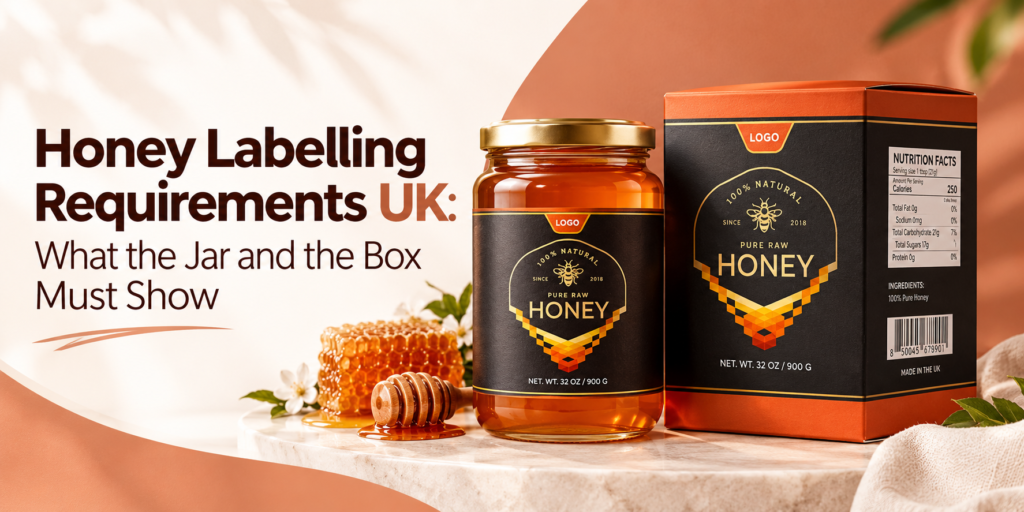
Honey Labelling Requirements UK: What the Jar and the Box Must Show
A jar of honey sold through a shop or online in the UK must show the name “honey”, the country of harvest, the net weight, a best-before date and the responsible business’s name and postal address. On a 227 g, 340 g or 454 g jar, the figures of the weight must be at least 4 mm tall and sit in the same field of vision as the name.
Three things then change the label. Honey you pack and sell yourself at your own stall needs less. A blend needs different origin wording depending on which UK nation it is sold in, and Northern Ireland changed its rule on 14 June 2026. A jar sold inside a closed gift box needs the information readable on the outside of the box.
This guide sets out the honey labelling rules from the regulations and Trading Standards guidance, then turns them into a layout for the jar label and any box it goes in. It is general information, not legal advice. For a view on a specific label, the Trading Standards team at your local council is the place to ask.
What a honey label must show
Business Companion’s guide to labelling honey, the Trading Standards guidance for businesses, sets out what honey sold prepacked must carry. It also recommends a lot mark.
| Item | What to show | Example |
|---|---|---|
| Name | “Honey”, or the reserved description that applies | Honey |
| Country of origin | Where the honey was harvested | Product of the UK |
| Net weight | The honey alone, in g or kg | 340 g |
| Best-before date | “Best before” or “Best before end”, then the date | Best before end 2028 |
| Business name and address | The business responsible, with a postal address | Name, street, town, postcode |
| Storage conditions | Only where the honey’s quality depends on them | Store in a cool, dry place |
| Lot mark (recommended) | A code that identifies the batch | L1409 |
Pure honey needs no ingredients list, because it is a single-ingredient food whose name identifies the ingredient (Article 19 of the retained food information regulation). Unprocessed honey is also exempt from the nutrition declaration under Annex V. Business Companion notes one exception: filtered honey needs a nutrition declaration. Everything mandatory must be in English, though other languages can be added alongside.
Choosing the name
The name has to be “honey” unless one of the reserved descriptions in the Honey (England) Regulations 2015 applies. Plain “honey” can be used for blossom, honeydew, drained, extracted and pressed honey. Four types must carry their own name instead:
- “Comb honey” for honey sold in sealed whole combs or sections of comb.
- “Chunk honey” or “cut comb in honey” when the jar holds one or more pieces of comb.
- “Filtered honey” when fine filtering removes a significant amount of pollen. Business Companion says ordinary filtering to take out small pieces of comb or dead bees does not count.
- “Baker’s honey” for honey suited to industrial use or as an ingredient, with the words “intended for cooking only” close to the name.
A floral name, such as heather honey, is allowed only if the honey comes wholly or mainly from that source and has its characteristics. A place name, such as Sussex honey, needs the honey to come entirely from that place (regulation 17). Filtered honey and baker’s honey may carry neither.
Anything added changes the product. Business Companion is clear that honey with an added ingredient or additive must not be called “honey”, and without the single-ingredient exemption the product needs an ingredients list. Clarifying words such as “clear” and “natural” may be added where they do not mislead. “Raw” is not a reserved description either, so the same test applies to it.
Country of origin and blend wording in each UK nation
Every jar must state the country where the honey was harvested, such as “Product of the UK”. For blends, the four nations now differ.
| Where it is sold | Blend wording if you do not list each country | In force from |
|---|---|---|
| England | “blend of honeys from more than one country” or similar wording | 27 May 2021 |
| Wales | “blend of honeys from more than one country” or English wording with the same meaning | 31 December 2020 |
| Scotland | One of six set forms or similar wording, such as “blends of honeys from more than one country” or a form naming a trading bloc | 31 December 2020 |
| Northern Ireland | No short form: every country, in the principal field of vision, largest share first, each with its percentage | 14 June 2026 |
In Great Britain, listing the countries remains the default, and the phrases above are optional replacements. Some guides still give the older forms, such as “blend of EU and non-EU honeys”. In England and Wales those forms were protected only for honey placed on the market before 1 January 2024 (regulation 22A in England).
GOV.UK’s food standards guidance confirms that in England and Wales, from 1 January 2024, you must use “blend of honeys from more than one country”, or similar wording, if you do not list each country. Scotland’s own regulation 16 still allows trading-bloc forms, provided they are accurate.
Northern Ireland’s rule changed when the Breakfast Foods (Amendment) Regulations (Northern Ireland) 2026 came into operation on 14 June 2026. A blend sold there must list every country of harvest in the principal field of vision, in descending order of share, with the percentage for each. Packs under 30 g may use two-letter ISO country codes, and each share has a 5% tolerance (Northern Ireland’s regulation 17). Stock lawfully placed on the market or labelled before 14 June 2026 may be sold until it runs out.
The GOV.UK page above was last updated on 20 September 2022, so its Northern Ireland section still shows the EU forms. For Northern Ireland, the regulation is the current source.
Honey sent from Great Britain to shops in Northern Ireland under the Northern Ireland Retail Movement Scheme is handled differently. The honey rules of the GB nation where it was produced or imported apply to it, and since 1 July 2025 each jar has needed its own “Not for EU” label.
The weight: what to print and how big
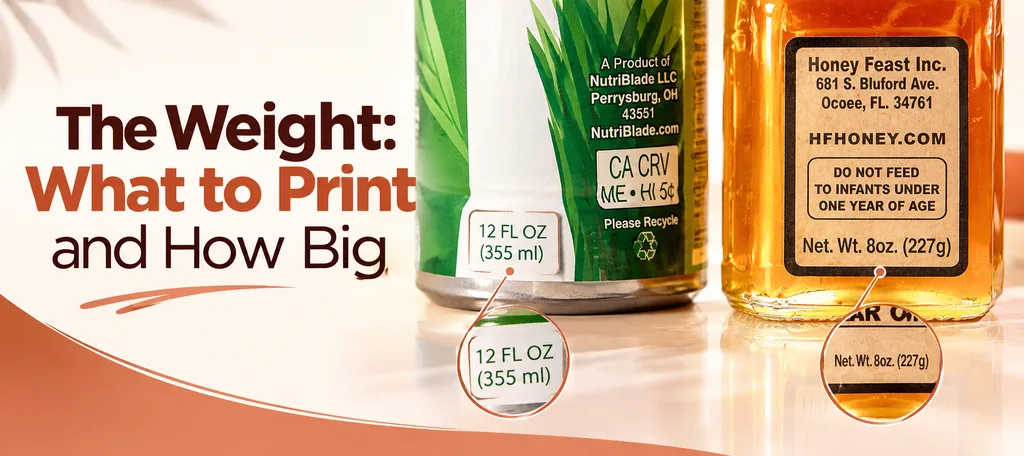
The weight is the net weight of the honey alone, without the jar, lid or label, in grams or kilograms. Under article 3 of the Weights and Measures (Miscellaneous Foods) Order 1988, honey in a container must be marked with its net weight unless it is sold loose or the pack holds less than 5 g. That includes jars sold from your own stall.
The figures have a minimum height that rises with the weight, set by Schedule 1 of the Quantity Marking Regulations 1987.
| Net weight of honey | Minimum height of the figures | Jars in this band |
|---|---|---|
| Up to 50 g | 2 mm | Miniature and favour jars |
| Over 50 g, up to 200 g | 3 mm | 113 g (4 oz) jars |
| Over 200 g, up to 1 kg | 4 mm | 227 g, 340 g and 454 g jars |
| Over 1 kg | 6 mm | Larger jars and tubs |
The 4 mm figure often given as the rule is one band of four. A 113 g jar needs figures at least 3 mm tall, and anything over 1 kg needs 6 mm. The Order requires the weight to be marked, but it does not set a jar size for honey.
Three small details catch labels out:
- Write the unit as a word or as “g” or “kg”. Only the listed symbols may be used for trade, so “gms” and “grm” do not qualify (regulation 11 of the same Regulations).
- If the word “net” is used, it is spelled out in full (regulation 3), so “Net weight 340 g”, never “Nt wt 340 g”.
- Pounds and ounces may be added, but the imperial figure can be no more prominent than the metric one.
The name and the weight must also be in the same field of vision (Article 13, paragraph 5). Business Companion puts the test simply: it must be possible to hold the jar so that both can be seen at the same time.
How big the rest of the text must be
Everything else that is mandatory has its own minimum, measured on the lower-case letters rather than the capitals. Under Article 13, that x-height must reach 1.2 mm. A smaller 0.9 mm applies if the largest surface of the jar or box is below 80 cm².
The x-height rule and the weight’s figure heights are separate tests, and the weight has to pass both. Nothing else on the pack may hide or cover the mandatory text, whether a picture, other wording or a sleeve. Business Companion’s general guide to prepacked food adds that optional wording cannot take the room the mandatory information needs.
Best-before date and lot mark
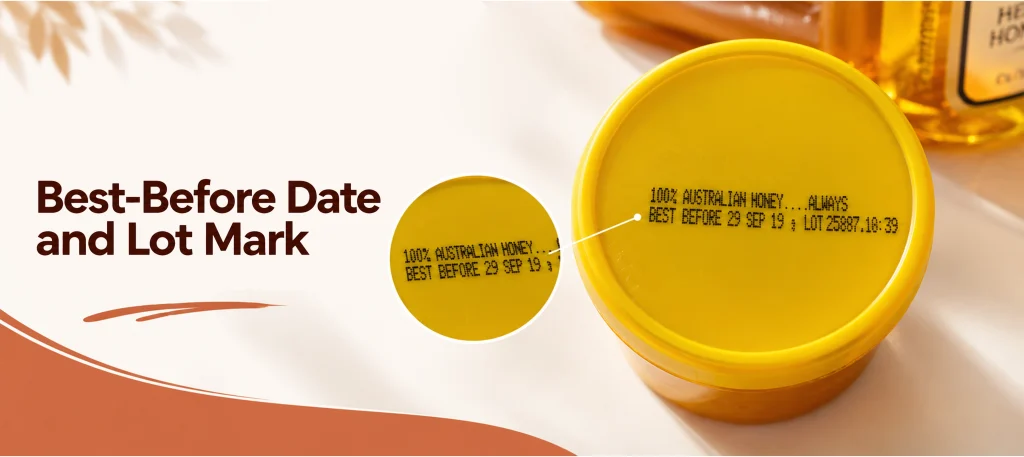
Prepacked honey needs a best-before date. The wording follows how precise the date is (Annex X). Use “Best before” when the date includes the day, and “Best before end” with a month and year. Where the honey will keep for more than 18 months, the year alone is enough.
The business chooses the date itself: it is the date until which the honey keeps its specific properties when properly stored. Business Companion suggests giving the day, month and year, because a date that precise can double as the lot mark.
The lot mark ties each jar to a batch, such as everything jarred on one day. A best-before date works as the lot mark if it includes at least the day and the month. Otherwise use a separate code, and Business Companion suggests starting it with “L” so it reads as a lot mark. If you write the date or the code by hand, use an ink that will not run or rub off, because mandatory information must be indelible.
Name and address
Prepacked honey must carry the name of the business responsible for it and a postal address. For honey sold in Great Britain, Business Companion’s general guide says the address must be in the UK, the Channel Islands or the Isle of Man. An email address, phone number or website can sit alongside it but cannot replace it.
Where you sell changes what the jar needs
| How the honey is sold | What the jar needs | Source |
|---|---|---|
| Through a shop, deli or anyone else (prepacked) | The full list above | Business Companion honey guide |
| Packed by you and sold where you packed it, or from a stall or vehicle you operate (prepacked for direct sale) | Name and country of origin, plus the net weight; no best-before date | Business Companion honey guide; 1988 Order |
| Online or by mail order | The full list on the jar, and the same information on the website before purchase, apart from the best-before date | Business Companion general guide |
The middle row needs care. Trading Standards treats honey you pack yourself and sell from the premises where you packed it, or from a stall or vehicle you operate, as prepacked for direct sale. The food information list then shrinks to the name and the country of origin, but the jar still needs its weight under the 1988 Order. Business Companion still advises a lot mark on these jars, so a batch can be traced. A full label on every jar keeps the same stock ready for a shop or an online order.
For online sales, the general guide says the full prepacked information must appear on the website as well as on the jar, and be available before the customer buys. The best-before date can be left off the website.
Gift boxes, sets and sleeves
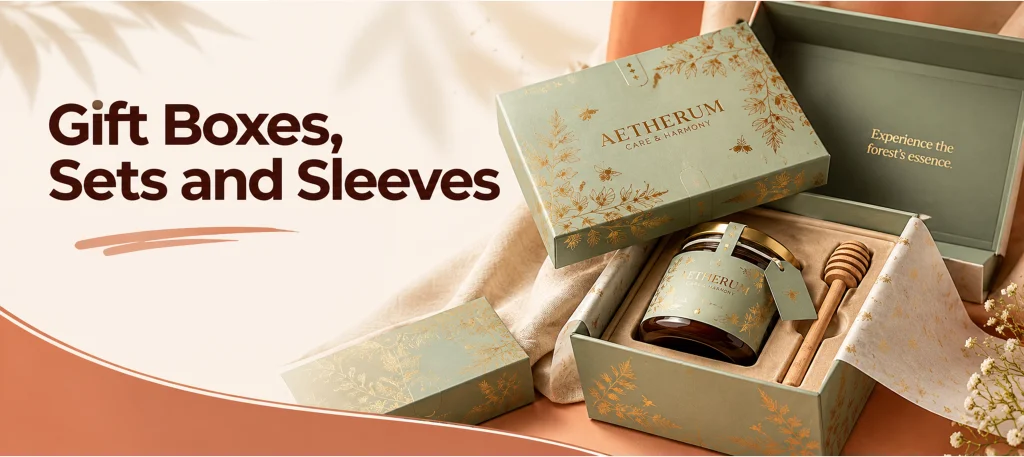
A jar sold sealed inside a gift box is one prepacked item, so the box is part of the packaging the rules look at. Business Companion’s general guide says mandatory information cannot sit where it is only visible once the product is opened. A jar label hidden inside a closed box fails that test, so the information has to be printed on the box, on a label stuck to the box, or readable through a window.
If a window does the job, every mandatory item has to be readable through it, with the name and weight in view together, as on the jar. Our jam jar packaging boxes hold the jar in a fitted insert, and a window can be added over the part of the label that needs to show. Inserts are cut to the product’s own dimensions, so movement inside the box is controlled.
A box of identical jars must show each jar’s weight and how many jars it holds, for example “3 x 227 g”. That is not needed if the jars can be counted from outside and at least one jar’s weight can be read through the packaging (Annex IX, point 3). Our 3 jar gift box packaging is one format for a set like this.
A set of three different honeys is less clear-cut, because Annex IX’s simple rule covers identical items. Plan for each honey’s name, origin and weight to be readable from outside, through windows or on a printed panel. Then ask your Trading Standards service to confirm the layout before you print.
A sleeve or band round a single jar follows the same logic. Article 13 says no intervening material may hide or obscure the mandatory information, so a sleeve that covers the label has to carry that information itself.
The artwork layout can reserve clear panels for the information the product is required to display. All Custom Packaging can help organise the available print space, but the brand or its regulatory adviser remains responsible for confirming the accuracy and completeness of the required product information.
Laying out the jar label
Start with the mandatory text, not the artwork. One way to split it:
- Front panel: the name and the weight together, with the brand. For a blend sold in Northern Ireland, the countries and their percentages belong here too.
- Side or back panel: country of origin, best-before date, lot mark, the business name and address, and any storage line.
- Wrap label: one long label can carry everything in panels. Keeping the name and the weight on one panel makes the field of vision rule easy to meet.
When the information is split across a front and a back label, the simplest way to meet the field of vision rule is to put the name and the weight on the same label. Size the label from the text inward. List the mandatory lines, set them at a 1.2 mm x-height or larger, set the weight figures at the height their band requires, and fit the design into the space left.
Check a printed proof, measuring the x-height and the figure heights on paper rather than on screen. Our print-ready artwork checklist covers the rest of the pre-flight checks. Custom honey jar labels are printed to your own artwork, so the panel sizes are set by your layout.
Optional wording worth considering
- “Unsuitable for children under 12 months” is not a legal requirement. Business Companion says members of the British Honey Importers and Packers Association use it under a voluntary code, and Trading Standards supports it.
- A note that honey may set or crystallise is optional. The compositional standard itself says honey can be fluid, viscous, or partly or entirely crystallised (Schedule 1).
- “Organic” brings its own rules, covered in a separate Trading Standards guide.
- Nutrition and health claims are strictly controlled, so leave health benefits off the label unless a check confirms they are allowed.
If you also sell beeswax lip balm as a cosmetic, it follows cosmetic rules rather than food rules. Our guide to cosmetic labelling requirements UK covers what goes on the container and on any box.
When to re-check the label
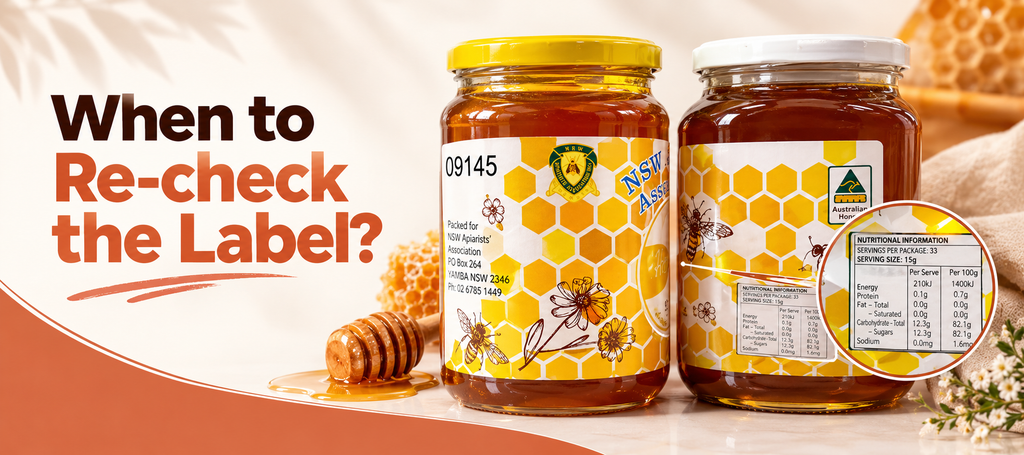
A label that was right for one batch can go wrong when something changes. Check it again in these cases:
- The jar size crosses 50 g, 200 g or 1 kg, which moves the minimum figure height.
- The honey becomes a blend, or the countries in a blend change.
- You start selling in Northern Ireland, through a shop or online.
- Anything is added to the honey, or a floral or place name is added to its name.
Common mistakes
- “Blend of EU and non-EU honeys” on new labels for England or Wales.
- Weight figures below the minimum for the jar, such as 3 mm figures on a 340 g jar.
- “Nt wt”, “gms” or “grm” instead of “Net weight” and “g”.
- The name on the front label and the weight on the back one.
- An email address or phone number with no postal address.
- A floral or place name the honey cannot support.
- A gift box or sleeve that hides the jar’s label.
- “Honey” as the name of honey with anything added.
- “Baker’s honey” without “intended for cooking only” next to the name.
Frequently asked questions
What must a honey label include in the UK?
For a jar sold prepacked: the name, the country of harvest, the net weight in g or kg, a best-before date, and the responsible business’s name and postal address. Storage conditions are added where the honey’s quality depends on them, and a lot mark is recommended.
Do you need a licence to sell honey in the UK?
What the FSA asks for is registration: its guidance on food business registration says businesses selling food from home, a stall or online need to register with their local authority at least 28 days before trading. In Scotland, it points to Food Standards Scotland and the local authority.
How big does the weight on a honey jar need to be?
It depends on the weight: figures at least 2 mm tall up to 50 g, 3 mm above 50 g up to 200 g, 4 mm above 200 g up to 1 kg, and 6 mm above 1 kg.
Can I still use “blend of EU and non-EU honeys”?
Not in England or Wales for honey placed on the market from 1 January 2024: use “blend of honeys from more than one country” or list the countries. Scotland still allows accurate trading-bloc forms, and Northern Ireland now requires each country with its percentage.
Does honey need a nutrition label?
Not if it is unprocessed: single-ingredient products like pure honey are exempt from the nutrition declaration. Filtered honey is the exception, according to Business Companion, and needs one.
Do I need a label for honey sold at my own stall?
Yes, though a shorter one. Honey you jar yourself and sell from your own stall, or from the premises where you jarred it, needs the name and the country of origin, and the jar still needs its net weight. A best-before date is not required.
Can a gift box hide the jar’s label?
Only if the box carries the information itself. Mandatory information cannot be placed where it is visible only once the product is opened, so print it on the box, label the box, or show the jar’s label through a window.
Getting jars and gift sets ready to sell? Our stickers and labels range covers jar labels printed to your artwork, and the gift boxes above can be printed with the information panel your layout needs. Orders start from 100 units. Design support is free. A digital 3D mock-up is free. For the quote, send the artwork, the quantity, the delivery postcode and the date the order is needed by.